

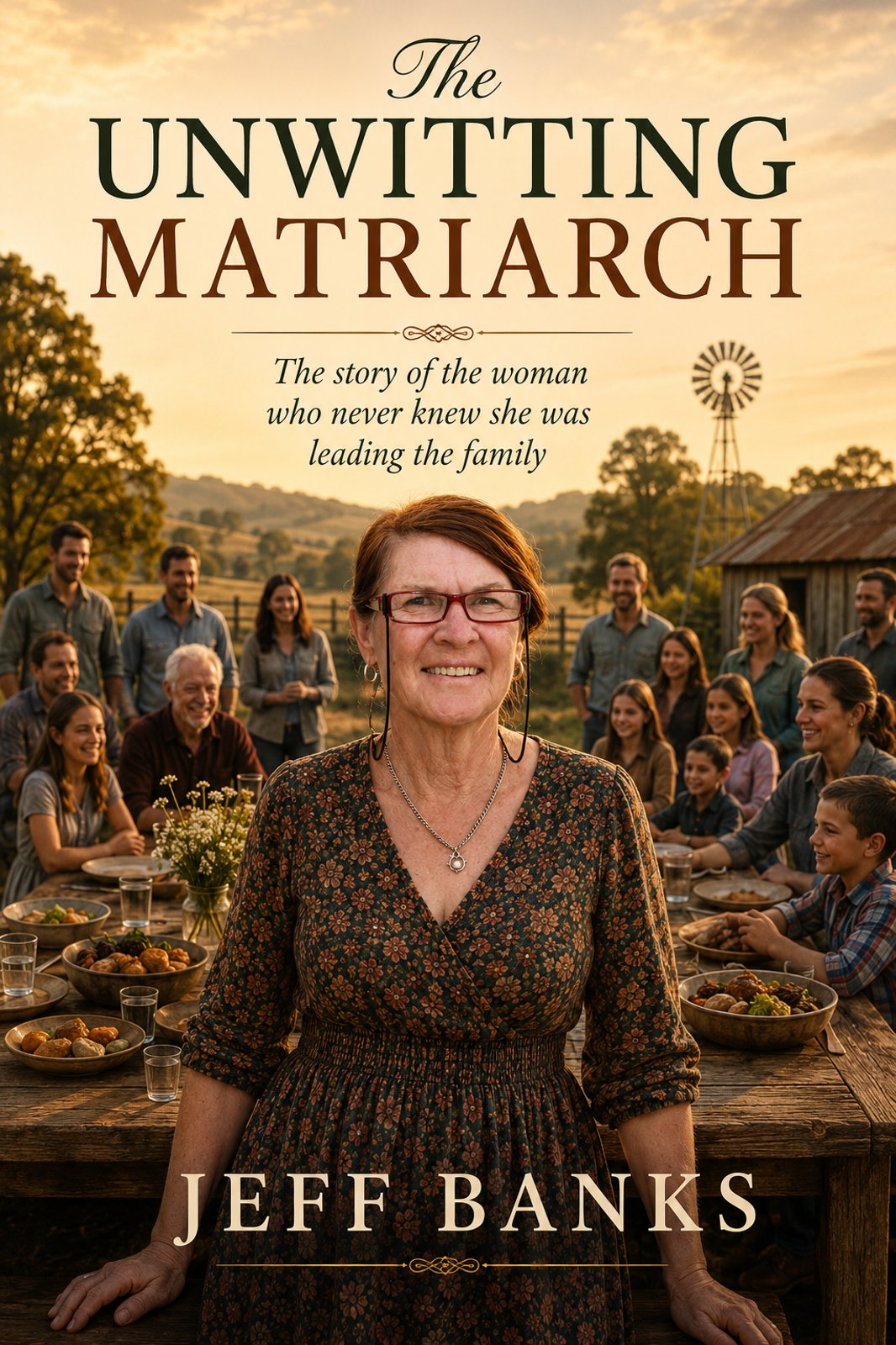
The Unwitting Matriarch Chapter 12 - Raising Mitch

The Unwitting Matriarch Chapter 12 - Raising Mitch | Travelling Around Australia with Jeff Banks

Perhaps that is the real story of raising sons. You begin with a little boy who believes the world exists for adventure and possibility. You spend years trying to keep him alive long enough to gain some wisdom, all the while worrying about the decisions he is making and the direction he is heading. Then one day you find yourself standing back and looking at the life he has built, wondering when exactly the change occurred.

THE UNWITTING MATRIARCH

She never asked to lead. She simply never stopped showing up. 

Chapter 12 — Raising Mitch

People often talk about raising children as though there is a moment when the job is finished. They speak about adulthood as if it arrives on a particular birthday, accompanied by some invisible certificate declaring that the child has now become a responsible human being. The stories I heard from Kerre always suggested something very different.

Children did not become adults overnight in Kerre’s world. They became adults in stages, often moving forward and backward several times before finally finding their feet. Sometimes they appeared determined to test every ounce of patience available to their parents before eventually emerging as decent people despite their best efforts to avoid the process.

Mitch was perhaps the best example of that reality. By the time he arrived, Kerre had already survived enough challenges to understand that children came with no instruction manual and no guarantees. Every child possessed a different personality, a different set of strengths and weaknesses, and a completely different view of how the world ought to operate.

Like many boys growing up in rural Australia, Mitch possessed an abundance of confidence, a shortage of caution and a great deal of obstinance. That combination created opportunities for learning, although not always the sort of learning schools intended to provide. Looking back, it is difficult to decide whether some of those experiences were educational or merely entertaining, but they certainly became part of the family folklore.

Whenever conversation drifted toward Mitch’s school years, Kerre would often roll her eyes before laughing. That reaction alone usually indicated that whatever story followed would involve equal measures of frustration and amusement. School and Mitch never appeared to enjoy a particularly harmonious relationship.

That was not because he lacked intelligence. In fact, many of the stories suggested exactly the opposite, as he seemed capable of understanding practical concepts long before he saw any value in formal lessons. Like his mother, he possessed a mind that preferred solving real problems rather than memorising information simply because somebody else had declared it important.

Unfortunately, schools often reward compliance as much as intelligence. Teachers generally appreciate students who sit quietly, complete assigned tasks and avoid questioning authority. Mitch frequently demonstrated an impressive ability to achieve precisely the opposite outcome.

Reports from school reflected that tension. Some teachers saw potential and recognised that he possessed an independent mind capable of original thought. Others saw trouble because independent minds often create additional work for people who prefer order and predictability.

Kerre viewed many of these reports with a degree of scepticism born from her own experiences. Having spent much of her life assessing people by their actions rather than their titles, she never automatically assumed that a teacher was correct simply because they occupied a position of authority. If Mitch deserved criticism, she was perfectly capable of delivering it herself, but if she believed a teacher was being unreasonable she was equally prepared to defend him.

That approach occasionally surprised school administrators. They often expected parents to automatically support whatever position the school adopted, particularly during that era. Instead they encountered Kerre, and those conversations rarely unfolded in quite the way administrators expected.

As Mitch moved into his teenage years, school gradually became only one part of a much larger world. Friends became increasingly important, independence became increasingly attractive and the opinions of parents became increasingly negotiable. This appeared entirely normal to everyone except the parents experiencing it.

Teenage boys possess a remarkable ability to believe they know everything while simultaneously demonstrating evidence to the contrary. Mitch embraced that tradition enthusiastically and with considerable confidence. Looking back, many of the stories from those years sound remarkably similar to stories told by parents throughout rural Australia.

The party years inevitably arrived. Like countless country teenagers before him, he discovered a social universe that existed beyond classrooms, sporting fields and family routines. Gatherings became larger, curfews became more flexible and explanations became increasingly creative.

Parents everywhere understand this phase because the pattern rarely changes. Children who once announced every detail of their day suddenly become experts in selective disclosure and strategic vagueness. Questions receive incomplete answers, locations become approximate and timetables become theoretical concepts rather than fixed commitments.

Kerre often found herself navigating the challenge of balancing trust with concern. She understood that young people needed freedom if they were ever going to become capable adults. At the same time, she understood how quickly youthful confidence could collide with poor decision-making and produce consequences nobody had anticipated.

One of the recurring names that surfaced throughout these stories was Casey. Every family accumulates certain names that become permanently attached to a particular chapter of life, and Casey became one of those names. Mention the name years later and an entire collection of memories immediately returns to those who were present.

Whether the stories involved friendships, adventures, parties or the general chaos that accompanies young adulthood, Casey often appeared somewhere in the narrative. The details varied depending upon who was telling the story and how much time had passed since the events occurred. The underlying theme, however, remained remarkably consistent.

These were the years when friendships began shaping identity in increasingly powerful ways. Parents influence children enormously during their early years, but friends often assume that role during adolescence. The people a young person chooses to spend time with can profoundly influence the direction their life ultimately takes.

Some friendships encourage growth and maturity. Others encourage mistakes and mischief. Most achieve a combination of both, which is why they become such important parts of growing up.

Kerre watched this process unfold with the same mixture of pride and anxiety experienced by parents everywhere. She knew she could not choose Mitch’s friends or live his life for him. She could only hope that the values learned at home would remain present when important decisions eventually arrived.

The stories surrounding Merringarra perhaps reveal the most significant part of Mitch’s development. Places matter in ways people often underestimate, particularly in rural families where land becomes intertwined with memory and identity. Certain locations become repositories of family history, carrying the weight of experiences accumulated over generations.

Merringarra occupied that role. The stories connected to the property were never simply about buildings, paddocks or physical improvements. They were stories about responsibility, belonging and learning that freedom and obligation often arrive together.

As a child, Mitch experienced Merringarra as a playground filled with possibilities. As a teenager, he experienced it as a base of operations from which adventures could be launched. As a young man, however, he gradually began seeing it through different eyes.

That change occurred so slowly that nobody noticed it happening at the time. Most important transformations work that way because maturity rarely arrives in dramatic fashion. Instead it develops through countless small experiences that slowly reshape perspective and priorities.

Responsibilities appeared where none had existed before. Expectations increased as people began relying upon him in different ways. Consequences became more real and less theoretical, which has always been one of adulthood’s most effective teachers.

The romantic freedom of youth eventually collided with the practical realities of adulthood. Work needed doing, things needed maintaining and problems needed solving regardless of whether they were convenient. The collision was not always comfortable, but few worthwhile lessons ever are. Casey was as much an influence on that change as anyone.

Kerre often spoke about watching children become people. That distinction always fascinated me because it captured something many parents recognise but struggle to describe. Children arrive with personalities already forming, and much of who they are exists beneath the surface long before adulthood arrives.

Parents influence them, guide them and occasionally attempt to redirect them. They provide opportunities, warnings and examples, while hoping those efforts eventually take root. Much of parenting, however, is less about what is said and more about what is demonstrated. Children watch far more closely than parents realise. They notice whether promises are kept, whether people are treated fairly, whether hard work is embraced or avoided, and whether responsibility is accepted when things go wrong. Long before they understand the words, they observe the behaviour.

Kerre and Lionel rarely sat their children down for grand lectures about life. Their lessons were usually delivered through example. The children saw Lionel leave for work regardless of weather, tiredness or inconvenience because providing for the family was simply what fathers did. They saw Kerre helping family members through crises, feeding extra mouths around the table, driving long distances to support relatives and stepping forward whenever somebody needed assistance because that was simply what family did. Neither of them would have described these actions as teaching, yet they became some of the most important lessons their children ever received.

The challenge with leading by example is that it requires consistency. Children quickly identify hypocrisy and possess an almost supernatural ability to notice the occasions when actions fail to match words. It is easy to tell a child to be honest. It is much harder to demonstrate honesty when the truth is inconvenient or costly. It is easy to talk about kindness. It is far more powerful to show kindness when no reward is expected and nobody is watching.

The real challenge is watching the person hidden inside the child gradually emerge over time. Parents spend years wondering whether the lessons have been absorbed, whether the values have taken root and whether the examples have actually mattered. Then one day they witness their son helping somebody without being asked, accepting responsibility without excuses or standing up for what he believes is right, and they suddenly recognise something familiar. In that moment they realise the child was watching all along, and that the examples quietly provided over countless ordinary days have become part of the adult standing before them.

Sometimes the result surprises everybody. Sometimes it confirms exactly what was visible from the beginning. In Mitch’s case, maturity appeared less like a sudden transformation and more like a slow settling of pieces into their proper places.

The rough edges softened without disappearing entirely. Impulsiveness gradually gave way to judgement and confidence became steadier and less dependent upon proving something. The same qualities that occasionally caused headaches during adolescence eventually became strengths.

Independent thinking became self-reliance. Stubbornness became determination. Questioning authority became critical thinking applied in more constructive ways.

The traits themselves remained largely unchanged. What changed was how they were applied and where they were directed. The boy who once challenged boundaries eventually became a man capable of navigating them.

Looking back, Kerre often seemed quietly proud of that journey. Not because it had been easy and certainly not because mistakes had been avoided. She was proud because growth had occurred, which is ultimately what every parent hopes for.

Children will make mistakes and create worries that seem enormous at the time. They will ignore advice they desperately need and occasionally follow advice they do not fully understand until years later. The goal is not perfection but progress.

Mitch’s story reflected that reality beautifully. The school troubles eventually became anecdotes, the parties became memories and the youthful dramas faded into stories retold around family tables. What remained was the person who emerged from those experiences.

What makes the story particularly satisfying is that few people would have confidently predicted the outcome during those turbulent teenage years. Looking back through the stories, it would have been easy to imagine a future of casual jobs, seasonal work and a life spent drifting from one opportunity to the next. Like many young men, Mitch seemed far more interested in freedom than structure and far more interested in experiences than long-term planning. The idea of sitting behind a desk, running a business or managing staff would have sounded almost laughable to those who knew him then.

Yet life has a habit of producing outcomes that nobody sees coming.

Somewhere between the school reports, the parties, the adventures with Casey and the lessons learned at Merringarra, something important was taking shape. The independence that frustrated teachers became self-reliance. The willingness to challenge authority became confidence in his own judgement. The refusal to simply follow the crowd became an ability to carve his own path when opportunities appeared.

Today, Mitch and Casey have built something that would have seemed almost unimaginable during those earlier years. Together they have created a successful business that continues to grow, employing people, creating opportunities and generating an income that exceeds anything Lionel and Kerre could ever have imagined earning in a single year. That observation is not intended as a criticism of his parents. Rather, it stands as a testament to the sacrifices they made and the foundation they quietly built.

Lionel and Kerre came from a generation where security often meant steady employment, careful spending and making do with whatever resources were available. Their dreams revolved around owning a home, raising a family and creating stability. Mitch belongs to a different era, one where entrepreneurship offers possibilities that scarcely existed for previous generations. Yet despite those differences, the values underpinning the success remain remarkably familiar.

The work ethic came from Lionel. The loyalty came from Kerre. The determination came from both of them.

That is often the hidden truth about success. The business may belong to Mitch and Casey. The achievements may carry their names. The risks, decisions and rewards may be theirs alone. Yet woven through every success are lessons absorbed around kitchen tables, in paddocks, on worksites and during countless ordinary days spent watching parents navigate life.

Perhaps that is the real story of raising sons. You begin with a little boy who believes the world exists for adventure and possibility. You spend years trying to keep him alive long enough to gain some wisdom, all the while worrying about the decisions he is making and the direction he is heading. Then one day you find yourself standing back and looking at the life he has built, wondering when exactly the change occurred.

The remarkable part is not how suddenly the change occurs. The remarkable part is how slowly it happens while you are busy looking the other way. By the time you finally notice, the child has already become the person they were always going to be.

And sometimes, if you are fortunate, they become far more than you ever imagined possible.

Author

Menu