

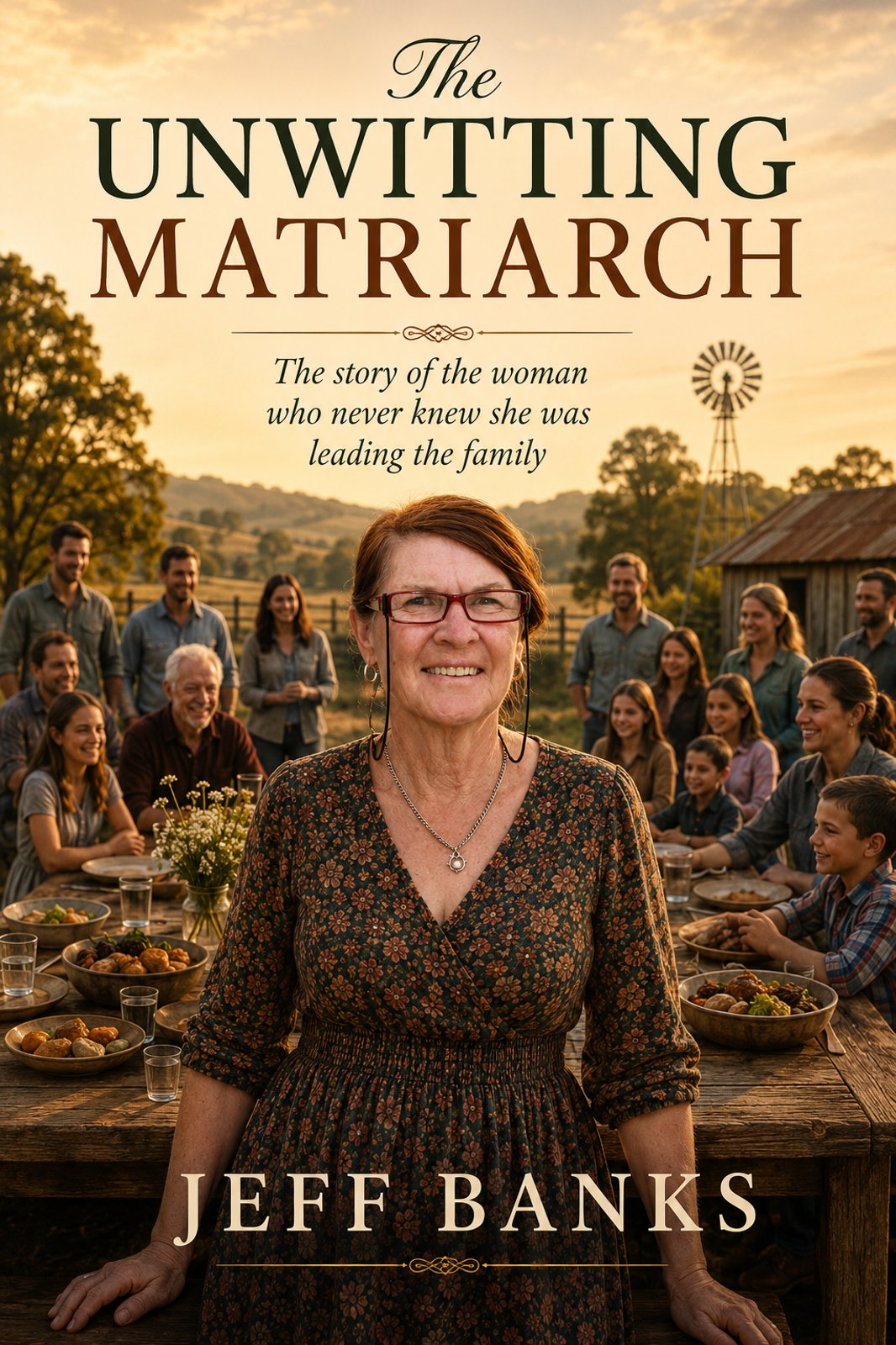
The Unwitting Matriarch Chapter 11 - Raising Tammy

The Unwitting Matriarch Chapter 11 - Raising Tammy | Travelling Around Australia with Jeff Banks

Of course, the story did not stop there. One of the quiet truths of family life is that every generation eventually becomes the foundation for the next. Children grow up, build lives of their own and, before anyone quite notices how it happened, they become parents themselves.

THE UNWITTING MATRIARCH

She never asked to lead. She simply never stopped showing up. 

Chapter 11 — Raising Tammy

There is a strange contradiction built into parenthood that nobody ever seems to explain properly. Parents spend years teaching their children to become independent, capable adults, then spend the rest of their lives wondering where the little child disappeared to. The goal is success, yet success inevitably creates distance. The child who once needed help with every decision eventually develops opinions, ambitions and identities entirely separate from the people who raised them.

When I listen to Kerre talk about Tammy, that contradiction seems to sit quietly beneath almost every story. It appears in the way she describes school years, family milestones and career achievements. It appears in the pride she carries when speaking about Tammy as an adult. Most of all, it appears in the gradual realisation that raising children is really an exercise in watching someone become themselves.

By the time Tammy arrived, life at Little Prairie was becoming something more stable than it had been during those early years. The house existed. The routines existed. Lionel and Kerre had survived the uncertainty that accompanies young families trying to establish themselves in rural Australia. What had once felt temporary was beginning to look permanent.

That did not mean life suddenly became easy. In many ways, the arrival of a child simply introduced a completely different set of challenges. The worries changed shape rather than disappearing. Instead of wondering whether they could build a life, they found themselves wondering how to guide a new one.

Looking back through modern eyes, some of those challenges have names and descriptions that were rarely discussed at the time. One of those was post-natal depression. Today there are support services, awareness campaigns and specialists devoted to understanding it. Decades ago there was often little more than confusion and misunderstanding.

Women were expected to cope with whatever life presented. They were expected to be grateful for motherhood and to continue carrying out their responsibilities regardless of how they felt. The idea that motherhood could arrive alongside sadness, anxiety or emotional exhaustion was rarely discussed openly. If it was discussed at all, it was often treated as a personal failing rather than a medical condition.

Kerre spoke of periods where life felt heavier than it should have. She described feeling overwhelmed despite having every reason to be happy. There were days when exhaustion seemed to seep into every corner of life, making even simple tasks feel larger than they really were. The demands of motherhood, combined with the realities of rural living, sometimes felt relentless.

What makes those recollections particularly powerful is the absence of self-pity. Kerre never presented herself as a victim of circumstance. She simply described those periods as difficult stretches of life that had to be navigated. In many ways, she spoke about them the same way farmers speak about droughts, floods or failed seasons. They were unpleasant, but they were part of life and therefore something that had to be endured.

That attitude reflected the generation to which she belonged. People often survived difficulties first and found language to describe them much later. There was little opportunity to sit and analyse emotions when livestock still needed feeding, meals still needed preparing and households still needed running. Reflection was often a luxury that practical responsibilities pushed aside.

The reality was that raising children on a rural property rarely allowed much time for emotional recovery. Every day arrived with a fresh list of jobs. Animals needed attention, washing needed doing, food needed preparing and countless small responsibilities demanded immediate action. Whatever emotional struggles existed had to compete with the practical realities of daily life.

Perhaps that was both a blessing and a curse. The work provided distraction and purpose, but it also left little room to stop and breathe. Problems were often carried rather than processed. Feelings were often managed through action rather than discussion. It was simply the way many families operated.

As Tammy grew, however, the focus gradually shifted away from survival and toward something far more interesting. The tiny child who had occupied every waking thought began revealing her own personality. That process fascinated Kerre because it confirmed something she had always suspected about children.

Parents often talk about children as blank slates waiting to be written upon. Kerre never seemed to believe that. From her perspective, children arrived with personalities already installed. Parents simply spent the next twenty years discovering who those children already were. The role of the parent was less about creating a person and more about helping that person emerge.

Tammy was not the loudest child in the room. She was not the child demanding attention or racing to become the centre of every conversation. In fact, one of the qualities most frequently mentioned whenever Kerre spoke about her was shyness. It was a characteristic that remained noticeable throughout much of her childhood.

Shyness is often misunderstood. People frequently assume it reflects insecurity or weakness, yet those qualities are not necessarily connected. Many shy children possess rich inner worlds. They spend more time observing than performing. They listen carefully, think deeply and often understand far more than adults realise. Their silence can conceal remarkable awareness.

By all accounts, Tammy fitted that description remarkably well. She was thoughtful, observant and perceptive. Conversations that appeared to pass unnoticed were often remembered in surprising detail. Situations that adults assumed she had ignored frequently resurfaced later through comments that revealed she had been paying close attention all along.

Kerre often described moments where Tammy appeared quiet and withdrawn during a conversation, only to later demonstrate she had absorbed every detail. Those experiences taught her not to mistake silence for absence. Tammy was present. She was simply processing the world in her own way.

That trait would become increasingly important as she moved through school. School itself produced mixed emotions within the family. Like many parents, Kerre viewed education through a practical lens shaped by her own experiences. She respected learning but remained sceptical of institutions. Those two positions sat comfortably together in her mind.

Her own schooling had convinced her that education and intelligence were not always the same thing. She had encountered plenty of intelligent people with little formal education and plenty of educated people who lacked common sense. As a result, she encouraged effort rather than achievement and curiosity rather than blind compliance.

The expectation was never that Tammy had to become the smartest person in the room. The expectation was that she learned how to think for herself. Marks mattered, but character mattered more. Knowledge was important, but judgement was equally valuable. Those priorities shaped much of the guidance Tammy received growing up.

Children absorb lessons that parents never consciously teach. They watch behaviour more closely than they listen to instructions. They observe reactions, attitudes and values. Long before parents realise it, children are constructing an understanding of the world based on the examples they witness every day.

Tammy grew up watching a mother who challenged assumptions. She watched someone who refused to be intimidated by titles, qualifications or social status. She watched a woman who believed that competence mattered more than prestige and that integrity mattered more than appearances. Those observations quietly shaped her understanding of the world.

As Tammy moved through her school years, the shy little girl gradually developed confidence. It was not the loud confidence that seeks attention. Instead, it was the quieter confidence that develops when someone begins to understand who they are. It emerged steadily rather than dramatically.

One of the things that always makes me smile when listening to Kerre tell stories about Tammy is the affectionate way she describes her as “Miss Goodie Two Shoes.” There is a warmth in the phrase, but there is also a hint of disbelief. From Kerre’s perspective, Tammy seemed to approach school and authority figures in almost exactly the opposite manner to the way she had approached them herself.

Kerre’s own school memories are filled with stories of questioning teachers, challenging rules and occasionally deciding that if something seemed unfair, she would simply stop participating altogether. The cane incident and her decision to walk away from school became part of family folklore. Compliance was never one of her defining personality traits. If anything, she possessed an almost instinctive resistance to being told what to do simply because somebody held a position of authority.

Tammy, on the other hand, appeared determined to follow the rules. She completed her work, respected her teachers and generally avoided the sort of adventures that had frequently found their way into her mother’s childhood stories. Where Kerre had often tested boundaries, Tammy seemed more interested in understanding them. Where Kerre occasionally viewed school as an obstacle to be endured, Tammy treated it as an opportunity to be embraced.

The contrast amused Kerre endlessly. She would laugh while recounting stories of Tammy’s diligence, shaking her head as though she still could not quite understand how a daughter raised by her had turned out to be so conscientious. Yet beneath the humour there was obvious pride. Tammy was not trying to rebel against her mother’s example. Rather, she had absorbed the values underneath that example while expressing them in her own way.

What both women shared was a strong sense of right and wrong. The difference was in how they chose to navigate the world. Kerre challenged systems she believed were flawed. Tammy worked within them. Kerre questioned authority. Tammy earned its respect. Different paths perhaps, but both ultimately guided by the same internal compass.

As the years passed, that quiet reliability became one of Tammy’s defining characteristics. Teachers trusted her. Friends relied upon her. Family members knew she would do what she said she would do. The shy child who rarely sought attention was slowly becoming a young woman whose character spoke far louder than any words she could have used to describe herself.

The transformation happened so gradually that it probably went unnoticed from day to day. Parents rarely observe growth while it is occurring. Instead, they notice it through sudden moments that seem to arrive without warning. A conversation sounds older than expected. A decision reflects unexpected maturity. An opinion emerges that clearly belongs to the child rather than the parent.

Kerre often spoke about those moments with a mixture of pride and surprise. No matter how much time parents spend raising children, there remains a part of them that still sees the toddler hiding behind their legs at family gatherings. Watching that toddler evolve into an adult never feels entirely natural, even when it is exactly what parents have worked toward.

The most remarkable chapter of Tammy’s journey emerged through her eventual involvement in Aboriginal education. Of all the career paths available to her, this one seemed particularly aligned with the values she had absorbed growing up. It combined education, community service and genuine human connection.

Education, at its best, is not simply the transfer of information. It is the transfer of opportunity. Good educators do more than teach facts and figures. They help people recognise possibilities that may otherwise remain hidden. They create confidence where uncertainty once existed and provide pathways where barriers once stood.

For Aboriginal communities, education carries additional significance because it intersects with history, identity, disadvantage and opportunity in ways many Australians still struggle to fully appreciate. Working in that environment requires more than technical knowledge. It requires patience, empathy and an ability to listen before speaking.

Those qualities suited Tammy perfectly. The shy child who had spent years observing others developed into an adult capable of understanding perspectives that many people overlook. The very characteristics that may once have seemed like disadvantages became strengths. Her ability to listen became one of her greatest assets.

As her involvement in Aboriginal education deepened, so too did her interest in Aboriginal history, culture and identity. What began as professional engagement evolved into something far more personal. Tammy became increasingly passionate about understanding heritage, ancestry and the experiences of Aboriginal communities. She invested enormous amounts of time and emotional energy into those pursuits because she genuinely believed they mattered.

In many respects, that passion reflected the very values she had learned growing up. Kerre had always encouraged curiosity, independence and the courage to stand behind one’s convictions. Tammy was doing exactly that. She had found something she believed in and committed herself wholeheartedly to it.

Yet family relationships are rarely as simple as right and wrong.

Listening to Kerre speak about that period, I was struck by the subtle sadness that occasionally surfaced beneath the pride. She admired Tammy’s commitment and respected the work she was doing, but there were times when she felt as though the search for heritage had become so consuming that family itself was being pushed into the background.

From Kerre’s perspective, there seemed to be an irony in the situation. Tammy was dedicating herself to helping people understand where they came from, while at the same time becoming increasingly distant from some of the people who had been beside her from the beginning. Heritage was important, undoubtedly so, but family was important too. To Kerre, the two were never meant to compete with one another.

Like many mothers, she struggled to articulate those feelings without sounding critical. The last thing she wanted was to discourage her daughter from pursuing meaningful work. She understood the significance of Aboriginal identity and the importance of preserving culture. What hurt was not the work itself. What hurt was the occasional feeling that the people who had loved, supported and sacrificed for Tammy throughout her life sometimes seemed less important than the broader cause she had embraced.

That tension created moments of misunderstanding between them. Neither was entirely wrong. Tammy was pursuing something she believed mattered deeply. Kerre was grieving, in her own quiet way, the sense that the daughter she had spent a lifetime nurturing seemed increasingly focused on distant histories while becoming less connected to the family stories unfolding around her.

Perhaps that conflict is more common than most families admit. Children eventually leave home physically, but they also leave emotionally as they discover causes, careers, communities and identities that exist beyond the boundaries of family. Parents are often proud of that growth while simultaneously feeling its cost. The two emotions can coexist quite comfortably, even if they occasionally pull in opposite directions.

When Kerre described Tammy’s career, there was obvious pride in her voice. However, it was not pride based solely on professional achievement. It was pride rooted in purpose. She recognised that Tammy had found meaningful work that reflected her values and allowed her to contribute to the lives of others.

At the same time, there was a mother’s hope quietly sitting beside that pride. It was the hope that while Tammy continued exploring heritage, culture and identity, she would never lose sight of the family that had helped shape the person undertaking that journey. After all, heritage is the story of where we come from. Family is the people who walk beside us while we are discovering it.

The little girl who once struggled with shyness had grown into a woman capable of helping others find confidence in themselves. That transformation represented something larger than career success. It represented the emergence of character, compassion and purpose.

Perhaps that is ultimately what parents hope for most. Careers rise and fall. Financial circumstances change. Public recognition comes and goes. The qualities that endure are usually less glamorous but infinitely more important. Kindness, integrity, empathy and purpose tend to outlast every professional accomplishment.

Listening to Kerre’s stories, it becomes clear these were the characteristics she valued above all else. She admired achievement, but she admired decency more. She appreciated success, but she appreciated character most. The things that mattered to her were the things that remained when titles and achievements were stripped away.

One of the themes running quietly through the history of Little Prairie is that the property itself was never really the point. The house mattered. The land mattered. The paddocks, sheds and livestock all mattered. Yet each of those things ultimately served a larger purpose.

The real story was always the people who lived there. It was the children who grew up there, the lessons they carried away and the adults they eventually became. The property provided the setting, but the family provided the meaning.

Watching children become people is one of the strangest experiences life offers. It happens so slowly that it is almost invisible, yet when viewed across decades it appears extraordinary. One day they are learning to walk and the next they are building lives of their own. One day they are asking questions and the next they are answering them for others.

Kerre’s stories about Tammy reveal all of that. They reveal the fears of early motherhood, the uncertainty of raising children, the challenges of school years and the pride of watching a shy little girl discover her place in the world. They reveal the quiet miracle that occurs when a child gradually becomes an adult.

More importantly, they reveal something about Kerre herself. For all her strength, stubbornness and determination, perhaps her greatest achievement was never the house at Little Prairie or the battles she fought to build a life from limited resources. Those accomplishments were significant, but they were not the whole story.

Perhaps her greatest achievement was far simpler and far more profound. She raised children who became good people. In the end, that may be the most important legacy any parent leaves behind.

Of course, the story did not stop there. One of the quiet truths of family life is that every generation eventually becomes the foundation for the next. Children grow up, build lives of their own and, before anyone quite notices how it happened, they become parents themselves.

Tammy’s greatest gift to Kerre may well have arrived in the form of two grandchildren, Maddie and Riley. Like all grandchildren, they seemed to appear one day as tiny children demanding attention, cuddles and endless patience, only to somehow become adults while everybody else was busy living their lives. The years that felt so long while raising children somehow move at remarkable speed when viewed through the eyes of a grandparent.

Listening to Kerre talk about them reveals something familiar. The pride is there, certainly, but it is accompanied by the same sense of wonder that accompanied her stories about Tammy. She has watched another generation discover who they are, develop their own personalities and begin carving their own paths through life. The process remains just as fascinating the second time around as it was the first.

The amusing part is that, despite being grown up now, despite becoming adults with responsibilities, ambitions and lives of their own, Kerre still speaks about them as her grandies. Age has never altered that description. It does not matter how tall they become, how independent they become or how far they travel from the family home. In her mind there remains a permanent connection to the little children she first held in her arms.

Perhaps that is another lesson hidden within parenthood and grandparenthood. Children become adults. Grandchildren become adults. Entire generations move forward. Yet the love that connects families seems remarkably resistant to the passage of time. It adapts to changing circumstances without ever really changing itself.

When Kerre looks at Tammy, she sees the shy little girl who grew into a woman dedicated to helping others. When she looks at Maddie and Riley, she sees not only the adults they have become but also the children they once were. Those images exist side by side, layered across decades of memories that remain vivid regardless of how much time has passed.

That, perhaps, is the true reward for all the sacrifices, worries and sleepless nights that accompany raising children. The houses eventually age. The paddocks change hands. Careers come and go. Even the stories become polished through years of retelling.

What remains are the people. What remains are the relationships. What remains is the quiet satisfaction of sitting back and realising that the family continues, not exactly as you planned it, but perhaps exactly as it was always meant to be.

Author

Menu