

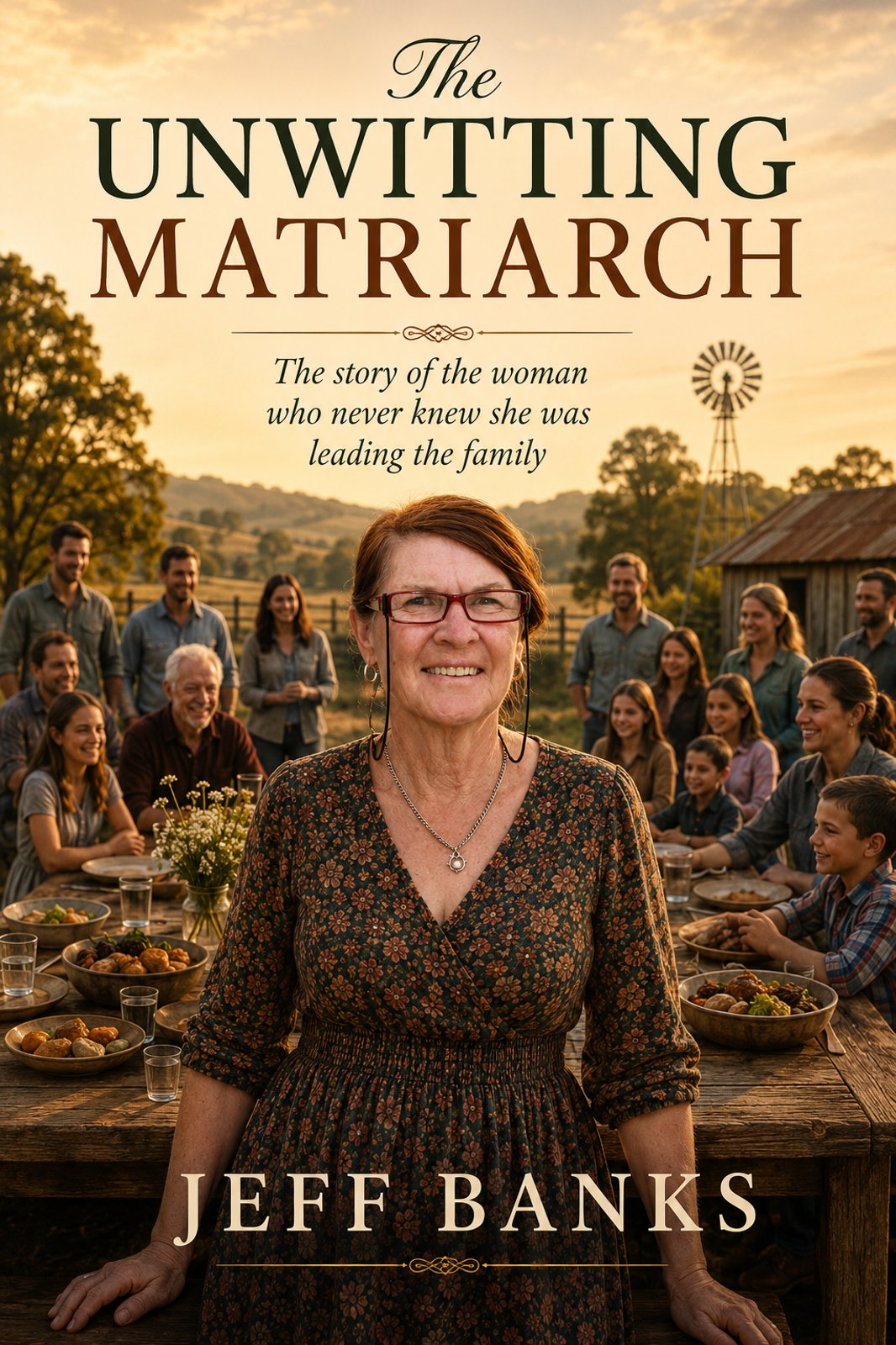
The Unwitting Matriarch Chapter 10 - Secret Money

The Unwitting Matriarch Chapter 10 - Secret Money | Travelling Around Australia with Jeff Banks

Looking back now, I suspect the secret money and the community work were really expressions of the same underlying belief. Both were about creating options. Both were about ensuring that problems could be managed when they arose rather than becoming overwhelming burdens. The hidden envelopes gave her confidence that financial setbacks could be handled. The friendships, volunteer work and community involvement gave her confidence that life's other challenges could also be managed. Together they created a level of security that no bank balance alone could ever provide.

THE UNWITTING MATRIARCH

She never asked to lead. She simply never stopped showing up. 

Chapter 10 — Secret Money

If there is one thing I inherited from my mother, it is probably the habit of looking at a bank balance and immediately wondering what might go wrong next. That sounds more pessimistic than it actually is. For people who grow up with very little, money is never simply money.

It becomes security. It becomes a choice. It becomes the difference between handling a problem and being overwhelmed by it. While some people spend their lives chasing wealth, Kerre spent most of hers chasing something quite different.

She was chasing certainty. The irony, of course, is that certainty does not really exist. Life has a habit of breaking carefully laid plans no matter how sensible those plans might appear at the time.

Cars break down. Children get sick. Jobs disappear. Roofs leak and washing machines seem to choose the worst possible moment to stop working. People who have experienced enough of life understand that trouble is not a possibility but an inevitability.

Kerre understood that lesson early. Growing up in a family where every penny mattered left permanent marks on her thinking. The habits formed during those years never completely disappeared, even when circumstances improved.

She remained one of those people who could not bear waste, disliked unnecessary debt and always seemed to have a contingency plan operating quietly in the background. Some people collect ornaments, others collect recipes. Kerre collected safeguards.

Sometimes those safeguards were hidden quite literally. Over the years, family members discovered money tucked away in all sorts of locations. There were envelopes hidden in cupboards, folded notes slipped inside books and containers whose contents appeared entirely innocent until somebody lifted the lid and discovered cash that had been quietly accumulating for months.

The funny thing was that these discoveries often surprised everyone except Kerre. To her, the existence of emergency money was simply common sense. She had grown up watching women survive difficult times by keeping small reserves tucked away from daily spending.

It was not a strategy learned from accountants, bankers or financial planners. It was a strategy learned from mothers, grandmothers, sisters and neighbours. Country women had been operating emergency funds long before anybody invented internet banking.

The amounts themselves were rarely impressive. Nobody was uncovering vast fortunes hidden beneath floorboards or discovering thousands of dollars buried in old biscuit tins. Most of the time the amounts were modest, but modest amounts can seem enormous when circumstances suddenly become difficult.

That was the entire point. The money was not there to make anybody rich. It was there to stop small problems becoming large ones and large problems becoming disasters.

A broken appliance could be replaced. An unexpected bill could be paid. A child could receive something they needed without the household budget immediately descending into crisis.

What Kerre valued was not the money itself. She valued the absence of panic. She valued the ability to look at a problem and think about solutions instead of worrying about consequences.

That distinction sits at the heart of her entire philosophy about finances. Many people spend their lives pursuing financial independence. They dream about the day they no longer need to work, no longer need assistance and no longer need to worry about money.

Kerre’s goal was much simpler and, in many ways, much more practical. She wanted to know that when life punched her in the mouth, she could punch back. She wanted enough reserves, enough preparation and enough options to ensure that one setback would never define the future.

That practical mindset appeared throughout her working life. Like many women of her generation, she accepted jobs that needed doing rather than jobs that sounded impressive. There was no grand career plan and no carefully mapped pathway toward professional advancement.

There were simply responsibilities to meet and a family to support. One of those responsibilities involved cleaning. It was not glamorous work, but then most essential work rarely is.

Nobody writes inspirational books about cleaning toilets. Nobody stands before a crowd and declares that their journey to success began with scrubbing somebody else’s bathroom floor. Yet thousands of families have survived because somebody was willing to perform exactly those sorts of jobs when the need arose.

Kerre was one of those people. She cleaned motels, buildings and whatever else required cleaning. The work was hard, repetitive and rarely appreciated by the people benefiting from it.

Like most invisible work, it was usually only noticed when it was not done properly. That never particularly bothered her because work was work. The task itself mattered less than the result it produced.

The wages earned from those jobs might not have been spectacular, but they were reliable. Reliable money possesses a value that many people fail to appreciate until they experience the alternative. Consistent income, even in modest amounts, creates stability.

Stability was always the objective. Part of the reason those years stand out in family stories is because they coincided with the period when Kerre and Lionel were trying to build something bigger than themselves. They were raising children, paying bills and slowly constructing a future one week at a time.

Every dollar had a purpose. One portion paid for groceries, another paid for fuel and another covered school expenses. Somewhere within that careful balancing act, Kerre usually managed to siphon off a little into one of her emergency reserves.

Not because she expected disaster around every corner. Rather, because she expected life to behave exactly as life always behaves. She understood that something unexpected would eventually happen, even if nobody could predict precisely what it might be.

One of the names that frequently appears in stories from those years is Anne Coffey. Like many important people in family histories, Anne was not important because of one dramatic event. She was important because she was consistently present.

Families often survive not because of heroes arriving at crucial moments but because of ordinary people who simply keep showing up. Anne was one of those people. Her value was measured through reliability rather than spectacle.

The friendship between Anne and Kerre reflected something deeper than social connection. It reflected trust and mutual respect. It reflected the sort of relationship where assistance could be offered without embarrassment and accepted without shame.

That sort of trust has a value that cannot be measured in dollars. Listening to Kerre speak about Anne always reminded me that financial security is only one form of security. Money helps solve problems, but so do relationships.

Sometimes the knowledge that somebody will answer the phone when things go wrong provides greater comfort than the contents of any savings account. Kerre seemed to understand that instinctively. The people she trusted became part of her emergency fund, although not in a financial sense.

They became part of it in a life sense. They represented another layer of protection against uncertainty. Just as hidden cash could help solve a financial problem, trusted friends could help solve a human one.

The older I become, the more I appreciate the wisdom contained within that approach. Banks can provide loans, governments can provide assistance and investments can provide income. Yet none of those things can replace a trusted friend who appears when times become difficult.

Anne represented that sort of friendship. Looking back now, I suspect the hidden money and the hidden strength of those relationships were really two versions of the same idea. Both represented preparation and both represented security.

Both allowed Kerre to face uncertainty with a degree of confidence. That confidence became one of her defining characteristics. It was not loud or boastful confidence, but something much quieter and far more durable.

People often assume confidence comes from wealth, status or education. Sometimes it does. More often, confidence comes from knowing you have survived difficult situations before and prepared yourself for the next one.

Kerre possessed that kind of confidence. She knew how to work, save and improvise. She knew how to stretch resources further than most people thought possible and how to make do without feeling deprived.

Most importantly, she knew that if things became difficult, she would find a way through. That belief did not emerge from motivational speeches, podcasts or self-help books. It emerged from experience accumulated over decades.

The hidden envelopes, the cleaning jobs and the friendships built over a lifetime all pointed toward the same lesson. Financial security was never really about accumulating wealth. It was about creating enough stability that fear no longer controlled your decisions.

That was the real secret money. It was not the cash hidden away in cupboards or tucked inside drawers. It was the confidence earned through years of preparation, discipline and persistence.

The notes hidden around the house were simply visible reminders of something much larger that existed inside Kerre herself. They represented resilience. They represented self-reliance. They represented the determination to ensure that her family would always have options when life became difficult.

By the time I understood that, I realised the money had never been the story. The story was about a woman who quietly created security for everyone around her and somehow managed to do it without ever thinking of herself as remarkable. Like so many things in her life, she simply regarded it as common sense while the rest of us slowly came to understand it was much more than that.

What made it even more remarkable was that the same philosophy continued long after the years of genuine financial struggle had passed. Like many Australians of her generation, Kerre eventually found herself navigating the strange balancing act that comes with retirement. There were pensions to consider, superannuation balances to manage and government rules that seemed to change almost as frequently as governments themselves.

Many people respond to those restrictions by simply accepting them. They see the boundaries and adjust their lives accordingly. Kerre’s approach was slightly different because she never viewed rules as barriers so much as conditions that required understanding and adaptation.

That did not mean she spent her life searching for loopholes or trying to beat the system. In fact, the opposite was often true. What fascinated me was her ability to see opportunities where others only saw limitations.

If pension rules reduced income, she found other ways to contribute. If superannuation balances could not be accessed in a particular way, she looked for practical alternatives. If something needed doing, she simply found a way to do it.

The motivation was never really money. That is perhaps the part many people misunderstand when they hear stories about secret cash reserves, cleaning jobs or little projects undertaken during retirement. There was never a sense that Kerre was chasing wealth for the sake of wealth itself.

She was not trying to accumulate more than she needed, nor was she attempting to build some grand financial empire in her later years. By that stage of life, she had already worked out what enough looked like. What interested her was something altogether different.

What she was pursuing was usefulness. There seemed to be an almost unspoken belief that every person should contribute where they could and when they could. If there was a need, and she was capable of helping, then helping simply became the natural response.

If somebody needed assistance organising an event, she helped. If a neighbour needed support, she turned up. If a community group was short of volunteers, there was a reasonable chance her hand would eventually go up.

The financial benefit, if one existed at all, was usually secondary. Most of the time it barely entered the equation. The satisfaction came from solving a problem, assisting another person or seeing something worthwhile continue because people were prepared to contribute.

That attitude probably explains why she never truly retired in the way many people imagine retirement. She may have stopped formal employment, but she never stopped being involved. She never stopped helping and she never stopped looking for ways to make herself useful within the communities she belonged to.

Part of that came from growing up in an era when community was not considered optional. People relied on one another because they often had no alternative. The local football club, the school committee, the church group, the fundraising drive and the neighbour down the road were all interconnected parts of the same support network.

You did not participate because there was necessarily something in it for you. You participated because that was how communities survived. You participated because one day you might be the person needing help yourself.

That lesson seemed to remain with Kerre throughout her entire life. Even when financial pressures eased and retirement arrived, the underlying habit remained unchanged. She continued looking outward rather than inward and continued asking what needed doing rather than what she might personally gain.

In many ways, that mindset became another form of security. The hidden cash reserves had always provided protection against financial uncertainty. Community involvement created protection against something equally dangerous, which was isolation.

People who spend their lives helping others often build networks without even realising it. They accumulate friendships, goodwill and trust in much the same way other people accumulate investment portfolios. The returns are not measured in dollars, but they can be every bit as valuable when life becomes difficult.

Kerre seemed to understand that instinctively. Where some people saw retirement as withdrawal, she saw it as freedom. Where some people saw pension rules as limitations, she saw them as circumstances requiring adjustment.

Where some people worried endlessly about having enough, she focused on doing enough. That subtle difference shaped much of her later life and explains why she remained so active long after many others had stepped away from community involvement.

Looking back now, I suspect the secret money and the community work were really expressions of the same underlying belief. Both were about creating options. Both were about ensuring that problems could be managed when they arose rather than becoming overwhelming burdens.

The hidden envelopes gave her confidence that financial setbacks could be handled. The friendships, volunteer work and community involvement gave her confidence that life’s other challenges could also be managed. Together they created a level of security that no bank balance alone could ever provide.

Perhaps that is the real lesson hidden inside all those stories. Financial security is important. Superannuation matters, pension payments matter and savings matter because they provide choices when circumstances become difficult.

Yet beyond a certain point, the thing that truly sustains people is purpose. Human beings were never designed to simply stop contributing. Most people need to feel useful, needed and connected to something larger than themselves.

Kerre seemed to understand that long before the experts started writing books about active retirement and healthy ageing. She never appeared particularly interested in having more than she needed. What interested her was making sure there was enough and then using whatever time, energy and resources remained to help the people around her.

In the end, that may have been the greatest investment she ever made. The dividends were not paid into a bank account, reflected on a superannuation statement or measured by government pension assessments. They were paid into the lives of family members, friends, neighbours and communities that were all made stronger because she quietly chose to contribute whenever she saw a need that could be filled.

Author

Menu