

Both men are tied to this country in ways that are neither abstract nor accidental.
Centre to the Dish – Chapter 14 The Arrival Isnt an End
- Centre to the Dish
Both men are tied to this country in ways that are neither abstract nor accidental.
FROM THE CENTRE TO THE DISH
Foreword
This book begins, as many good journeys do, not with a plan, but with two mates who don’t see enough of each other.
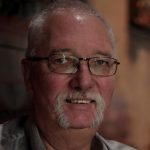
Jeff is a retired accountant, though that title hardly captures him. He has a fisherman’s patience and, infuriatingly, a fisherman’s luck, of the kind that only Robbie could dream of, much to the hysterical delight of Robbie’s young son, who has already learned that life can be unfair in very specific, fish-shaped ways. Robbie, meanwhile, is a photographer and videographer with far more than an eye for adventure. He has an instinct for movement, for angles, for knowing when to press on and when to stop.
Both men are tied to this country in ways that are neither abstract nor accidental.
This is Wiradjuri land. Jeff’s mother hails from Condobolin and is of Aboriginal descent. Her lineage is not just remembered privately but marked publicly, her grandfather, William Ferguson, stands in bronze in the centre of Dubbo, a quiet but unmissable reminder that history does not live only in books. Robbie’s connection is different, but no less rooted. His mother retired to the Condobolin region and died not far from it. For both men, this landscape is personal before it is picturesque.
Red dirt runs in the blood out here. When it’s not raining, and more often than not, it isn’t, the country is dry, dusty, and relentless. When the rain does come, the same red dirt turns to black, sticky mud that clings to boots, tyres, and patience in equal measure. The land offers no middle ground.
There are vast tracts of flatness that seem to stretch on forever. Horizons blur. Time loosens. And when boredom creeps in, as it inevitably does, the accelerator pedal gets nudged just a little harder, as if speed might break the spell of sameness.
Too often, in the lust for adventure, the journey to the destination becomes something to be endured rather than experienced. The real Australia flashes past the windows, reduced to background noise between better-known waypoints.
This book pushes back against that habit.
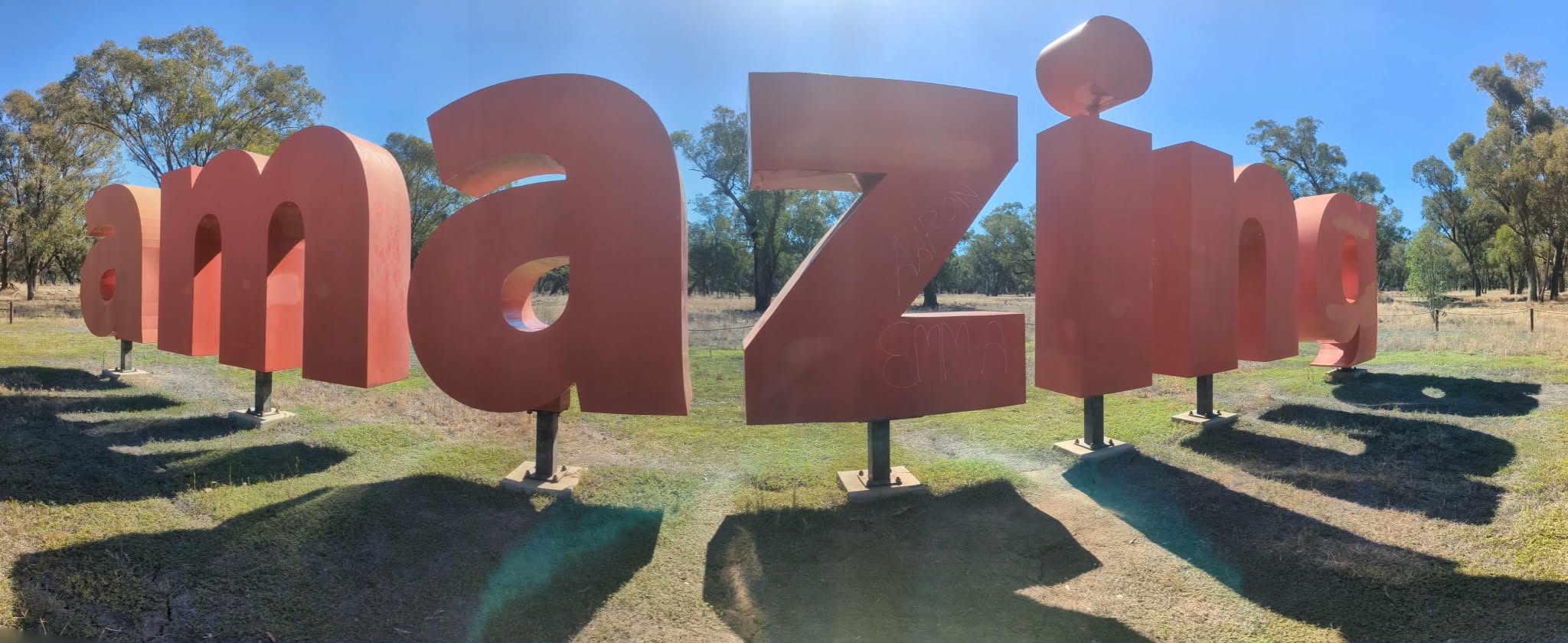
Here, Jeff and Robb take what should be a simple drive, roughly an hour from Condobolin to Parkes, and treat it with the respect usually reserved for far longer pilgrimages. They seek out the things that are easily missed: sculptures that speak softly, bends in the road that tell older stories, signs of work, endurance, humour, and loss. This is a road frequently travelled, but seldom truly trekked.
What follows is not a guidebook, nor a catalogue of attractions. It is an argument, quietly made, that the roads themselves are the adventure, if you are prepared to slow down enough to let them be.
This is a drive between mates. Between past and present. Between centre and sky.
And like all good journeys, it reveals more than it promises when you first turn the key.
About the Authors
Jeff Banks
Jeff Banks is a storyteller shaped by distance.
Raised with horizons rather than boundaries, his writing carries the cadence of the country, measured, observational, and unafraid of silence. His work sits at the intersection of place and reflection, drawing equally on lived experience and the quiet authority of the land itself.
Jeff’s writing does not seek to explain Australia to itself. Instead, it listens. It notices. It records the small, often overlooked truths that emerge only when you slow down enough to see them. Roads matter. Towns matter. Names matter, especially the ones that existed long before maps tried to replace them.
This project is less about a drive than about permission: permission to look properly, to feel uneasily at times, and to accept that understanding comes not from certainty, but from attention.
Robb Cox
Robb Cox is an award-winning photographer whose work is defined not by spectacle, but by restraint.
Robb’s images do not instruct the viewer where to look, they invite them to arrive on their own. His photography understands that light is not decoration, but information. That absence can speak louder than presence. That the land, when given respect, will reveal itself honestly.
In this collaboration, Robb’s lens does what the best photography always does: it pauses time without interrupting it. His images are not illustrations of the text. They are parallel narratives, equally grounded, equally patient, and occasionally confronting in their quietness.
Together, the writing and photography form a conversation with the road rather than a commentary on it.
Author