

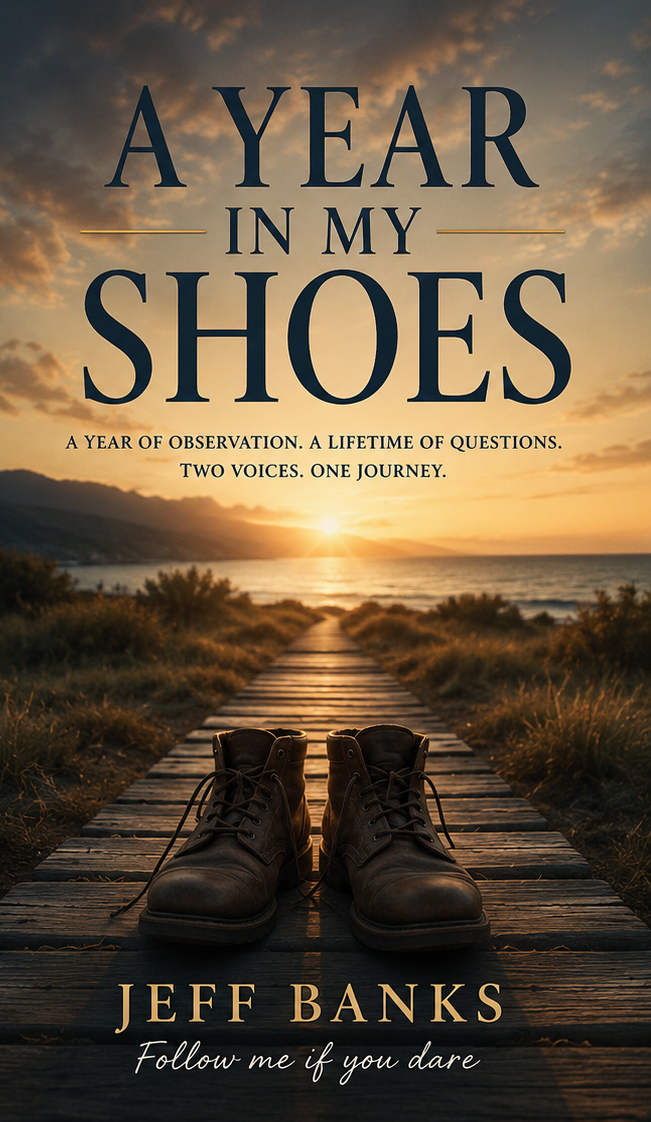
A Year in My Shoes - Foreword

A Year in My Shoes - Foreword | Travelling Around Australia with Jeff Banks

This is not a heroic narrative. Life rarely is. It is the record of a year spent negotiating meaning with honesty, humor, and stubbornness, measured not by the absence of struggle but by the willingness to stay in conversation with it, often when the conversation feels repetitive, inconvenient, or absurd.

A YEAR IN MY SHOES

Foreword

Meet the Two Jeffs, and Welcome to A Year in Review 

There is a dangerous myth that life moves in neat chapters, as though human existence follows a universal script where youth is for dreaming, middle age for building, and later life for resting. Retirement, in this tidy fiction, arrives like a long-promised resort package: the weather is agreeable, responsibility is checked at reception, and the daily question becomes “golf, gardening, or coffee with equally contented peers.” It’s a seductive picture, marketable and comfortable, but it bears little relation to how life actually unfolds.

In my experience, life behaves more like an improvised road trip: the maps are out of date, the weather forecast is unreliable, passengers disagree on direction, and the car sometimes coughs at the least convenient moment. That unpredictability isn’t a defect; it’s where real stories live. Yet it can also undercut the fantasy that later life will be serene and straightforward, a quiet reward for earlier exertion.

This book began as a diary, yes, but not to craft a self-help roadmap or a glossy retirement manual. It began because writing imposes a kind of order on chaos. A day that feels unruly becomes legible when translated into words. Frustration becomes an anecdote; exhaustion becomes observation; irritation becomes humor. A stray thought from a song, a film, a dinner conversation, or a moment of institutional silliness suddenly seems part of a larger pattern. And as patterns emerged, so did a voice that felt both intimate and expansive.

What you hold here is more than a record of events. It is a year-long inquiry into what those events stirred inside, questions of usefulness, obligation, ageing, purpose, relevance, responsibility, identity, and restlessness. And just nearby, quietly persistent, lived the Black Dog: not the melodramatic form we often see onscreen, but something subtler, more everyday. Depression in my experience isn’t a dramatic finale; it can arrive wearing competence, productivity, humor, and routine. It can answer emails, help clients, volunteer, and still feel profoundly heavy.

That subtlety matters because it shapes how this book should be read. This is not a self-help manual, not a medical treatise, not a sensational retirement chronicle. It is a year of observation, of events, of reactions, and of the inner weather those happenings provoke. A storm becomes more than weather when it intersects with mood, memory, inconvenience, or metaphor. A tax conversation becomes more than compliance when it reflects values. A road trip becomes more than distance when memory rides in the passenger seat. A song becomes more than nostalgia when it unlocks rooms long closed.

If you expect polished certainty from these pages, you may be disappointed. I offer no perfect wisdom, no conquering retirement, no neat, cinematic arc. What I offer instead is recognition: the sense that you’re not alone in negotiating a complicated year, that usefulness and identity can coexist with doubt, and that honesty, facing what’s true rather than what’s easy, matters more than tidy conclusions.

This book is built around a simple frame: two voices, two modes of thinking, one year. The Two Jeffs, Jeff One, the Analyst, and Jeff Two, the Humanist, tell the story in tandem. Their dialogue keeps tension between precision and empathy, between patterns and people, between structure and spirit. They aren’t characters from a distant era; they are ways of thinking you can try on in your own life as you read.

What you are invited to do is participate. If you have ever managed to be capable while privately carrying weight, you may recognise something here. If retirement has sounded more appealing in theory than in practice, you may recognise something here. If you have ever tied your worth to usefulness, competence, or being needed, you may recognise something here. And if none of those things apply, there are still observations about weather, films, memory, bureaucracy, and the absurdity of human behavior that might amuse you.

This is not a heroic narrative. Life rarely is. It is the record of a year spent negotiating meaning with honesty, humor, and stubbornness, measured not by the absence of struggle but by the willingness to stay in conversation with it, often when the conversation feels repetitive, inconvenient, or absurd.

Welcome to mine. May the Two Jeffs accompany you as you read, question, and decide what you will carry forward into your own year. 

About the Author

Jeff Banks is, depending on the day, a semi-retired accountant, reluctant philosopher, serial entrepreneur, occasional gardener, overcommitted volunteer, devoted husband, observer of human absurdity, and a man with an enduring tendency to see a need and immediately feel compelled to fill it.

With more than four decades spent in business advisory, taxation, and helping people avoid expensive mistakes of both the financial and emotional variety, Jeff has long resisted the traditional stereotype of the accountant as little more than a calculator with reading glasses. His professional life has been built not merely around compliance, but around conversation, strategy, interpretation, and the often-underappreciated art of translating complexity into plain English for people already carrying enough confusion of their own.

Yet professional labels only tell part of the story, because this book was never fundamentally about accounting. It is about the complicated, untidy business of being human while navigating ageing, purpose, depression, responsibility, identity, and the quietly confronting myth of retirement. Jeff writes not as an expert dispensing polished answers, but as a participant still very much engaged in the negotiation.

A lifelong storyteller by instinct, Jeff has discovered that writing offers something both practical and revealing. It imposes order on emotional weather, turns frustration into anecdote, and allows the ordinary clutter of daily life to reveal its deeper meanings. Songs, films, road trips, gardens, conversations, tax debates, golf politics, family life, and the thousand small absurdities of modern existence all become part of the landscape through which he makes sense of the world.

His long-running battle with what he refers to as the Black Dog has given his reflections a candour that will resonate with readers who understand that depression does not always look like collapse. Sometimes it looks like competence. Sometimes it looks like productivity. Sometimes it looks like humour, overcommitment, or the inability to sit still for long enough to hear the quieter questions.

Jeff lives in Australia with his wife my wife, whose patience, partnership, and quiet steadiness have provided ballast through far more than either of them probably expected when the journey began. Between writing, business interests, community involvement, golf, gardening, and continually renegotiating what “retirement” is actually supposed to mean, Jeff remains gloriously unconvinced that standing still is all it is cracked up to be.

A Year in My Shoes is not his attempt to present himself as having solved life. It is simply his invitation to walk alongside a year honestly observed, imperfectly negotiated, and stubbornly lived.

Author

Menu