

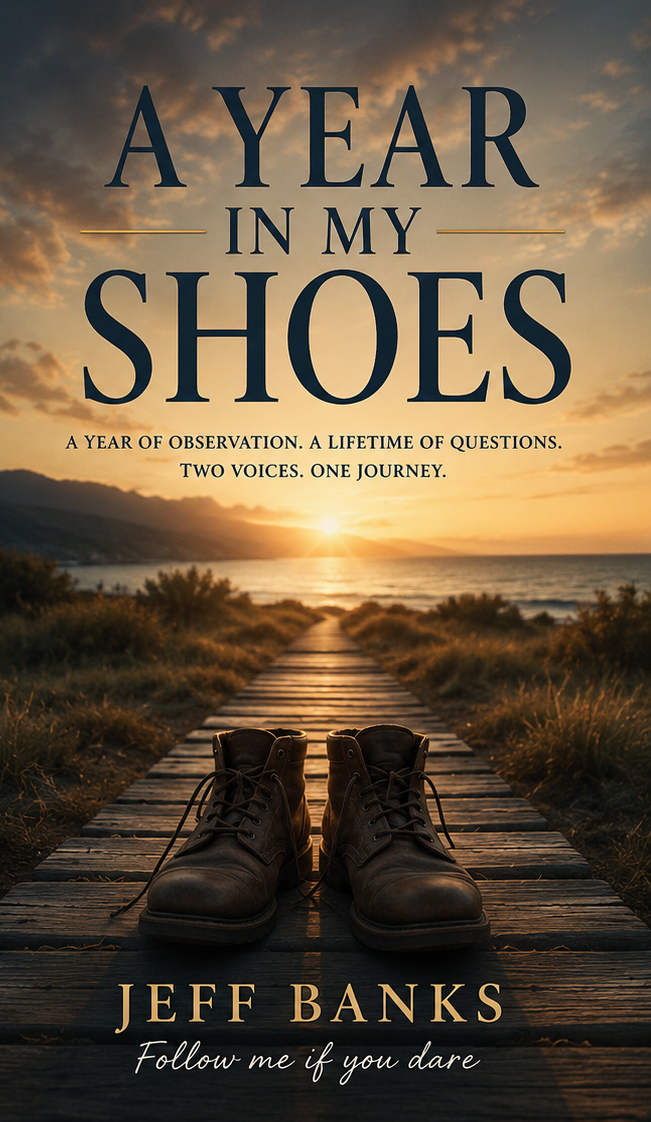
A Year in My Shoes Chapter 5 - When the Noise Changes

A Year in My Shoes Chapter 5 - When the Noise Changes | Travelling Around Australia with Jeff Banks

So it leaves us with a moment of interpretation rather than a finished scene. We stand at the kitchen door, the evening light soft along my wife’s hair, a kettle whistling somewhere in the background, and the room filled with the ordinary, stubborn tasks that keep a life from dissolving: a table that must be waxed, a few plants that must be rotated to catch the sun, two or three calls to make for tomorrow’s schedule, a memory of a film scene that suddenly returns with a raw, familiar ache and a note of hope. There’s a sense that synthesis is not a single revelation but a constellation, a small but steady pattern of light that grows brighter the more you allow it to overlap with the other patterns of living: family, friends, work, community, craft, and the quiet, stubborn belief that a life can still be useful if you’re willing to do the next thing well, even when the next thing is only to listen, to slow down, to be present, to tell the truth about what hurts, and to keep showing up for the people who matter.

A YEAR IN MY SHOES

Chapter 5 – When the Noise Changes


The two of us sit at the table, the room thick with the aftertaste of coffee and the faint skin of a smoke-tinged afternoon that has somehow become a year-end lullaby. There’s the steady Jeff, the one who can map a problem onto a whiteboard of routines and fix it with a calm, methodical breath; and there’s the other Jeff, the quieter, staying-present Jeff, who notices the way the light falls across my wife’s shoulder, the crackle of a fire in the memory of a movie line, the way a song can drag a memory forward like a tug on a stubborn boat. The Black Dog doesn’t roar here, exactly, he’s more of a discreet hum at the edge of the room, the familiar low-battery buzz that makes you check your tools before you start the new project. Retirement, I’ve learned, is less a ceremony than a renegotiation, a slow turning of the mind toward a different geometry of usefulness.

The calendar is a decoy. It wants to pretend that the year ends at the wedding, at the next board meeting, at the last trophy presented and the last word spoken into a microphone that doesn’t remember who you are when you step away from the podium. But the calendar is a memory-maker too, and November has been less a line on a page than a network of stories braided together by memory triggers, movies, songs, conversations in kitchens, the click of a drill, the rasp of a saw, the moment a plan shifts under the weight of new realities. If the old chapter asked, with a certain swagger, “What are you for today?” this one answers with a quieter, stubborn clarity: the answer is never simple, and the path isn’t straight, but there is still work to be done, and there are things that matter when a life has to be rebalanced.

We talk in a measured rhythm, letting memory scatter its embers across the table. There’s my daughter and her husband’s wedding, of course, the night when the smoke ceremony hovered over the water like a delicate weather system, the ceremony under the gum tree where a memory could be planted and watered with vows. The ceremony wasn’t merely a ritual; it was a map of belonging, with my wife on one side and me on the other, stepping into the space between generations, between old habits and new horizons, between the habit of solving problems and the endurance required to let new stories unfold without us insisting on the punch line. The memory of that day is not a polished centerpiece; it’s a rough-cut plank that you place on a wall and keep checking to see if it’s still true, if the room around it still holds the same air of belonging.

In the Sandbar life, the small rituals keep faith with the larger purpose. The interclub, the weekly match-play, the draw for ambrose teams, the way a club’s heart beats most honestly in the quiet hours of planning and the occasional ceremonial roar of a prize-giving night. The two Jeffs live in that little ecosystem as much as they live in the house, in the shed, in the workroom where the my daughter and Graeme tables wait for finish, where the sugar-cane mulch settles around the Octagon and makes a soft carpet of the earth you’ve cultivated with your own hands. It’s a life that measures usefulness not only in the number of problems you solve but in the number of hands you shake, the number of people you trust to show up when the weather turns and the road is a little slick with rain and memory.

There are plenty of other pressures. The moral economy of retirement is messy and rich with contradiction. There’s the sense that you should be thinning the herd of obligations, stepping back, letting younger shoulders carry some of the weight. Yet there is a stubborn echo of who you have become in the practice of helping people solve puzzles, the joy in guiding clients toward a form of structure that makes life less combative and more comprehensible. I’ve spent decades teaching people to see the consequences of their choices, to call forward the long view and the short one at the same time, to accept that sometimes the best action is a patient, stubborn pause. Retirement doesn’t erase that habit; it reframes it. It asks: if usefulness is a habit, what does a more generous stretch of time do to it? And what is left of identity when the measure of value shifts from billable hours to shared, slower moments, conversations over breakfast, the quiet arithmetic of a long relationship, the feeling that you are still useful even when the phone stops ringing with urgent problems?

The two interior voices keep circling. The steady one, the problem-solver, still notices a ghostly arithmetic in the world, how a decision at a client’s site, how a miscategorised GST credit in a BAS, how a misread email can cost weeks of late nights and questionable sleep. The quieter, present-focused Jeff senses the same problems, but the emphasis shifts. The present Jeff looks at my wife and sees a life lived in a sequence of acts that don’t always resemble the “work” we used to define. He notices the rituals, the making of prawns for a luncheon, the slicing of potatoes for a dish that will vanish in a moment, the careful varnish on another table in the Man Cave, the way a mulch of sugar cane settles into the soil like a soft conversation you’ve waited years to have. He hears the way memory triggers music, the careful scaffolding of a film to explain a moment instead of the moment itself. He nods at Night Moves in his head, not because it’s a favorite line of cinema or because the song has become a monthly weather report, but because the memory of its rhythm is a diagnosis of the age: the impulse to move, the fear that movement might be mistaken for flight, the sense that you’re still moving even when your body complains about the pace.

Music becomes a map of who I am on any given afternoon. A line from a Bob Seger song, the night’s still moving, the memory’s still finding a way to talk to me, circles my mind as I consider my wife’s day, the way she is drawn into the life of the Bowlo and the Sandbar the way you lean into a table and talk about the world in a way that makes sense, even when it doesn’t. A film’s moral riddle becomes a quiet commentary on the people I’ve watched grow older with me. Lawrence of Arabia (1962 – Colombia Pictures) sits on the bench of memory not as a hero’s arc but as a meditation on belonging,the way an outsider can feel at home when a place quietly asks you to stay, to contribute the part only you can offer, to carve a space for a life that is not about “being in the story” but about shaping the story as you go.

The month’s weight, the number on the scale, the number of meetings, the number of ballots and prizes, has been a reminder that the world still measures value by output even as we try to measure something more essential: continuity. The Black Dog returns in little ways, the way a memory of a long‑passed film turns into a sense of unease about purpose, the way a certain appointment or the loss of a routine can tilt the axis of a week. Yet those moments don’t swallow the chapter. They punctuate it with a necessary tension. If the chapter can be described in one breath, it’s this: you do not retire from life; you renegotiate its grammar. You learn to listen to the room as much as you speak in it; you discover that memory, like a golf ball that refuses to stay in the bag, will pop back up when you least expect it, and that the best response to memory isn’t denial but a careful, honest acknowledgment of its pull.

The wedding’s afterglow returns as a constructive memory rather than a lingering ache. The smoking ceremony’s smoke still hovers in the mind’s eye, not as a ritual that ended but as a memory you carry into every other act you perform. Our daughter and her husband’s vows sit with me as a reminder that love, even when complicated, is a living variable you must calculate with humility. I remember the speech, a rambling, affectionate mathematics of family, a field guide to the next generation, yet what lingers is not the humor but the responsibility. The family’s warmth, the way my wife stands with me at the edge of the dance floor, the way my daughter’s eyes light when her brothers appear with their partners, remains the heartbeat of the house, the gravity that keeps us from drifting too far into the cynicism that accompanies long years in the service of others.

Sandbar’s social economy continues to be a laboratory for human behavior. The club’s governance is a microcosm of the world outside: the volunteers, the commentators, the dreamers, the ones who show up when there’s a task, and the others who offer opinions from the bleachers. There’s romance in the ordinary: the way a committee meeting dissolves a tension with a single clear sentence, the way a plan for a social event can crumble into a map of who will show up and who will bring what. The club teaches you what the Black Dog knows well: momentum matters. Momentum is not a sprint; it’s a rhythm that repeats, and when it’s healthy, it keeps a village alive. When it’s not, it feeds the cynicism that makes retirement feel like a withdrawal rather than a turn toward a longer table.

Work-life balance, you’ll forgive the cliché, is a negotiation with grace. I find myself thinking about a life where the line between professional obligation and family obligation isn’t a fence but a shared porch, where I can step out to the shed, pick up a plane of wood, and not feel that every move is a misstep toward some dreaded end. But the line isn’t gone; it’s simply moved. The Bank’s endless forms, the Confidia token launch, the overnight emails that arrive with a promise to “fix this now”, these things still demand a response, and they demand it with an honesty that retirement does not make unnecessary. The exercise of letting go is not a magic trick; it’s a practice, a daily ritual of deciding what you keep and what you leave for others to carry.

There’s a particular ache tied to ageing that presents itself as practical irritations and almost comical inevitabilities. Joints squeak, the bike tires remind you that your legs aren’t as young as your ambition would like to pretend, and sometimes the body protests when the mind wants to push a little further, a little faster. The CPAP drama, the search for a replacement, the travel to a different town to fetch a machine, the insurance mazes, these episodes are not just about comfort but about the vulnerability that comes with reaching for a future you thought would have fewer moving parts by now. The healing is not in escaping pain but in learning to manage a life where pain is always a companion and humour is the safest way to live with it. I tell myself this with the dry mouth of a man who has learned to ration his jokes the way he rationed his spare hours in the early years: sparingly, but with precision, so that they land where they’re needed most.

The marriage of memory and responsibility is most evident in the scenes with my wife and the kids. There’s a recurring pattern: I bring a plan, a schedule, a series of boxes to check; my wife improvises with a quiet, almost surgical, grace that makes the plan seem quaint by comparison. She can bend a wardrobe crisis into a moment of beauty, a small act of stubborn generosity into a shared ritual. In the quiet kitchens, the long dinners, and the late-night conversations in the Man Cave, we discover that the best plans aren’t plans at all but evolving agreements that allow the living room to hold the stories we tell ourselves about who we are becoming. The two Jeffs don’t argue about what matters; we share it. We share it in the laughter that interrupts a moment of heaviness, in the memory of a film that reappears to tell us how to see ourselves honestly, in the music that acts as a kind of emotional weather report to tell us when to hold steady and when to turn the page.

There are moments when the two-internal voices clash with the outside world in a way that feels almost cinematic. A staff meeting that collapses into a debate about the ethics of a salary draw, a board call about a new token that sounds thrilling until the regulator’s hand tilts the whole table, a charity dinner where you watch your friends’ children grow into the adults you hope your own kids will become. In those moments the Black Dog doesn’t leave the room; he shifts from merely present to active, a reminder that depression isn’t a plot twist only in dramatic novels but a slow, persistent climate in a life that won’t be hurried into a neat conclusion. The antidote isn’t a single moment of clarity but a sequence of small acts: a call to a sister in pain, a decision to lend the money to help someone else avoid weeks of suffering, a careful sentence in a letter that clarifies a misunderstanding, a spare hour carved out to walk the dog or just to stand at the window and listen to the wind in the pines.

Music calls to memory the way a kitchen clock calls out the hour. A few notes from Night Moves drift through the mind not as a soundtrack but as a memory, constructed lens, a reminder that the rhythm of youth, which used to be the tempo of a gym or a city bar, remains a living instrument you carry into the quieter rooms of age. A film becomes a mirror: Lawrence of Arabia’s desert, the way a life sometimes feels like a caravan across shifting sands, the way a single act can alter the map of a decade. The Big Chill’s comfort and awkwardness remind us that friendship, even when it hasn’t aged gracefully, remains a compass for the present. The Joker in those memories is not cynicism but possibility: the sense that you can still reconcile the past with the present without pretending the past was free of danger or pain. You can still stand up for what matters and admit to what you fear might matter less than you’d hoped.

The practical craft of living well under pressure remains a constant theme. The workshop life, the making of tables, the sanding of burl, the careful choice of leg fittings, the moment of varnish catching the light in the Man Cave, these material acts anchor the mind when the emotional weather grows uncertain. If it’s possible to feel a sense of control in retirement, it’s in these tactile rituals: shaping wood, relieving a brace of joints, priming a coat of paint. In those moments, the two Jeffs become one again, the steady solver and the present-focused retiree, each doing a little more than his share of the work to keep the house upright and the life moving.

There’s something stubbornly hopeful about this chapter’s end, a sense that synthesis isn’t a dramatic revelation but a quiet re‑alignment of the self with the world’s stubborn, pragmatic realities. The wedding is behind us, the governance questions still echoing, the business remains a machine we keep feeding with attention and honest critique. Yet the year’s breath has shifted. The future is not a tidy, signposted valley; it’s a ridge where you can see patches of the past fading into the present and a horizon that invites a new kind of patience. The two Jeffs, still arguing quietly in the corners of the room, are no longer opposites so much as a single, more complete figure: the one who knows how to keep the engines running and the one who knows how to listen to the engine’s whisper and the room’s small, ordinary needs.

In the end, the moment of synthesis comes not with fireworks but with everyday proof: the truth that memory, when treated with honesty, becomes a tool for hope rather than a weapon for regret. The life you’ve lived, its bargains, its compromises, its stubborn refusals to give up, has made you who you are, and who you are now is someone who can carry both the risk and the relief with a steadier gait than you ever imagined. The wedding’s memory is a memory of belonging; the Sandbar’s rhythm is a memory of community; the two interior selves live together in a house that still smells faintly of varnish and old coffee, of memory and possibility.

We lean back, not full of grand conclusions but full of the quiet confidence that comes from having walked a long road with a curious, stubborn partner at your elbow. The Black Dog remains a companion, not a conqueror; the retirement renegotiation remains ongoing, not complete. The future will demand new adjustments, the governance conversations we’ll have in Thailand; the insect-neat discipline of keeping the books honest when the world wants to bend the rules to fit a story; the next Sandbar event where the humour will be as critical as discipline. And there will be more memory triggers, films and songs, the smell of a damp workshop, the taste of a perfectly roasted potato, that will pull the story toward another chapter, another turn of the year’s wheel.

As the light softens and the room goes quiet again, a memory lands with a precise, gentle weight: a photo from the wedding day, a beam of sun on a gum tree, my wife’s face half lit by the lanterns, my daughter’s smile for the camera, her husband’s quiet, certain presence. The memory is not an ornament but a spine to the narrative we’re still writing together. It’s a reminder that the recipe for living well under pressure is not a guaranteed fix but a practice, an art of showing up, of choosing the next right action when the last one hasn’t solved everything, of knowing that even in retirement you still have to decide what kind of day you want to live.

So we begin again, with the room’s ordinary rhythm and the weight of the year pressing toward its next crescendo. We answer the call of the day not with bravado but with an honest, almost clinical gratitude for the small things that hold us together: the words spoken at lunch, the chair warmed by a spent afternoon, the wood being cut to measure, the soil being laid with a patient care that says we belong to a place and a people who notice when a life is out of balance and then reach for the correct tool rather than pretend there isn’t a problem. The two Jeffs, the table’s careful clatter, the dog’s persistent, comforting presence in the back yard, my wife’s quiet leadership at the Bowlo, the friends who arrive with their laughter and their questions, all of it, stitched together, becomes the year’s own argument for continuing, not with impossible certainty, but with the stubborn faith that meaning remains possible if you keep showing up.

And in that faith, there’s the sense of a future that’s not about finishing last tasks but about finishing the long, slow conversation with yourself that retirement requires. It’s not a finish line so much as a turning of the page toward a chapter that can still grow richer, kinder, tighter, even in the way that memory itself grows sharper when you listen to it with honesty. The night settles, the room grows quiet, and the two Jeffs, in their own stubborn way, lean into the next morning’s quiet work, the next meal that needs making, the next broken thing that needs mending, the next step toward a year still unfolding with possibility.

If you ask how the path forward looks, I’ll tell you this: it’s a path of careful listening, of choosing to let a memory have its say before you respond, of letting a film be a metaphor rather than a script, of letting a song be a weather report rather than a chorus. It’s a path that accepts that the Black Dog will pace the perimeter but does not own the room, that the Sandbar’s energy will keep calling you to participate even as your own energy asks for a slower pace, that family remains a constant despite its inevitable friction, and that the craft of living well is inseparable from the daily act of proof, proof that you can still build something sturdy, useful, and beautiful from the tools at hand.

And so the chapter closes not with a revelation but with a promise: the year’s work will continue to yield its own, deeper synthesis, and the next mile will arrive with the same stubborn, patient, generous pace you’ve learned to trust. The two Jeffs will walk together, the Dog’s hum quiet now but not entirely faded, a reminder that even in retirement there is motion, there is care, there is a life of meaning to tend and to share. The final image is simple and grounding: a table, two chairs, the sound of my wife’s steps in the hall, and a memory of a night when love and work and memory and friendship aligned in a way that felt, for a moment, like coming home to the sound of one’s own true voice. That is the synthesis, earned not by triumph but by persistence, by showing up, by choosing to stay, by remembering what matters when the noise changes indeed, and then choosing to listen anyway.

The day after the last of the November nights, the room still holds the quiet afterglow of a wedding that wasn’t quite over but had already become a memory you lean toward like a new piece of timber you’re not sure you want to cut again yet. The two Jeffs, the steady solver and the slower, present‑minded retiree, sit a little closer to each other now, as if the table itself has become a hinge in the house, a place where one version casts a longer shadow than the other. The Black Dog has learned the trick of staying in the corner with his own cup of tea, not making a fuss, not insisting on a grand entrance, just reminding us that even the quiet is a kind of weather, unpredictable, persistent, and capable of turning a day from ordinary to recognisable in the moment you least expect it.

What follows November’s bright, chaotic weave is not a clean conclusion but a shift of gears, a quiet transition that feels almost like breathing in a room that has once again changed its temperature. There’s a sense of horizon, not a line on a calendar, but a slope you can feel moving beneath your feet, an incline toward the year’s synthesis, toward the long look at what retirement means when the clock keeps turning and the work ethic has learned new ways to be useful. The house remains full of little artifacts that tell stories, the sawdust in the tool rack, the varnish still drying on my daughter’s table, the soft hum of the fridge where a few remain of the week’s groceries, and the memory of my wife’s laughter at a joke that wasn’t really a joke but felt like a shared secret that kept us all from dissolving into the heavier matters outside the door.

The week that follows the wedding is not merely a recovery period; it’s a recalibration. The two Jeffs walk through the day with a new kind of caution and curiosity, the kind that comes from realising that the world does not stop to celebrate a family milestone, even when the milestone is dramatic enough to redraw the map of your kin. There is work to do, of course, the Sandbar Golf Club must finish its annual cycle, governance conversations need voice and authority to be shared with the new energy of retirement life, and the little workshop in the shed must be kept alive with the same stubborn care that kept the table from wobbling on the first day we put legs into it. But the work itself has learned to wear different clothes; it wears my wife’s steady hands and my daughter’s unshakable focus, it borrows my business partner’s energy when a deadline presses, and it is tempered by the memory of how a plan can go brittle if you insist on forcing it through a doorway it wasn’t meant to fit.

In the mornings I wake to the sound of the house still choosing which room to fill with light. The coffee has a familiar bitterness that doesn’t pretend to be sweet, and the quiet is not silence so much as a deliberate pause, a moment to listen to the sounds you might normally ignore, the soft sigh of the old floorboards, the clock’s patient tick that marks time’s return even when you feel you’ve already learned to live with less of it. The two inner selves pursue their own tasks. The steady Jeff measures the day with a practical map, what needs to be done for the club, what must be answered for clients, what must be scheduled for the Thailand trip that’s been planned like a careful, long obstacle course. The present Jeff measures the day through the texture of the light on my wife’s hair, through the scent of morning bread, through the way the dog lays his head on the rug and looks at you with eyes that seem to say, stay, there’s room here for more of what matters.

There’s a certain irony that the more the days become about synthesis, the more the world insists on testing your boundaries. A venture in Confidia, which once looked like a bright, clean whiteboard on the verge of a breakthrough, suddenly reveals the old tension between the glamour of the idea and the stubborn, slow reality of governance. A conversation with Paul, our counterpart on the board who can be both a spark and a friction point, reveals that the world beyond our island of Smiths Lake does not share our pace, our jokes, or our appetite for patient risk. The new token, the talk of AFSL licences, the regulatory knots that are not entertainment but inevitability, all demand a language that is precise and careful but not punitive. It’s a teaching moment more than an action: the transition from “we can” to “we must” if a venture is serious about existing beyond a single sunset. The two Jeffs listen to the exchange as if a new instrument has been added to the band, an instrument that makes the room sound more complicated, but also more alive, if played with care.

Meanwhile, the golf course, Sandbar’s green and its vieille ties to community, goes on, not as a proving ground but as a social laboratory. We run the now-familiar ritual of setting up a competition that will make a few voices cheer and a few others mutter about rules and fairness. There’s humour threaded through it, Ben’s quip about the “drama of the sausage” that somehow becomes a guiding light for the day, or Harro’s ability to turn a briefing into a play, all the while the course’s early morning mist lifts like a curtain and reveals the human theatre underneath. The golfers arrive as if they’ve come to a village fair rather than a contest; they want their moment, their prize, their bragging rights, but what they’re really hungry for is the sense that someone has spent the hours before them making the ground ready, making it fair, making it possible for a good game to happen without a hint of suspicion.

There’s a recurring tension between the old and the new, the way the club’s governance is run by the same hands that built its social life, and the way those hands must now learn to invite others to share the task, to trust the newer members to carry some of the weight. The old hands have the cadence; the new generation has the appetite for change, the readiness to experiment with formats that keep the event fresh while still honouring its core values. The two Jeffs watch and listen, the doctor in him of experience nodding toward the idea that a good system needs both tradition and reform, a conviction he has preached in every boardroom where the balance has to be found. And the Black Dog, that stingy companion, sits with his chin in his paws but, truthfully, has learned how to live with the rhythm, not to fight it, but to ride it, to see that even the fear of losing control can be an invitation to learn how to control a little less and trust a little more.

Songs and films, those memory anchors that can pull a moment out of the air and pin it to your chest, remain a living signal in this next stretch. The old film lines, the old music, come not as quotation marks, but as emotional pressure points: a chorus of Night Moves when my wife must decide between the old life and the present one; a scene in which a character’s stubborn hope becomes a kind of practical faith that the future, however uncertain, can still be shaped by the right habits; a music cue that makes you inspect your own priorities the way a film’s closing shot makes a viewer reconsider what they’ve just seen. The effect is not to nostalgia-trip but to anchor the mind in a pattern that allows you to move forward without pretending the past was all triumph. The two Jeffs learn to carry these triggers into the present, letting them illuminate not the past but the place where memory’s glow becomes the light that guides a decision.

Health and ageing, too, keep returning as themes, because retirement’s effectiveness as a life design depends on how you manage the body’s stubborn assertions and the mind’s inevitable wanderings. The CPAP saga returns in miniature as the household contends with the practicalities of health care in a country town: the search for a machine, the misalignment of insurance, the feel of being at the mercy of systems that exist to support life but often complicate it in the moment you most need straightforward help. These episodes are not mere plot devices; they are reminders that the year’s synthesis must accommodate the friction of real body and real liability. The two Jeffs talk about the price of care, about the value of preventive focus, about the necessity of keeping a network of specialists and a long view of health that doesn’t vanish the moment a deadline passes. The memory of the wedding’s happiness, the laughter, the dancing, the sense that family and friends stood in a circle around a moment of shared joy, coexists with the memory of nights when the body rebels or when the mind drifts into heaviness. The contrast is not a contradiction; it’s the very texture of a life that wants to be both grateful for what it has and honest about what it still must carry.

Domestic routines continue to anchor the day’s tempo. The workshop in the Man Cave remains a sanctuary where the act of finishing a table or easing the resin from a stool is not simply about furniture but about maintenance of a self who can still shape something tangible amid the intangible pressures of a life in transition. The garden, new soil, new mulch, new lettuce leaves, new potatoes sprouting in some habit of resilience, teaches a quiet lesson in patience: you plant, you water, you wait, you cut away what’s dead, you let what’s alive flourish. It’s a reminder that the body’s own cycles, the weight’s rise and fall, the sleep’s deepening monotony, the appetite’s shifting thresholds, are not obstacles to overcome but rather fields to tend. The two Jeffs talk about how the same patience that makes a garden grow can sustain a business, a relationship, a mission to give back to the community. The Sandbar’s vitality, the Bowlo’s rituals, and the Golf Club’s ceremonies all insist that life is both service and play, and the balance between them is the quiet art we practise with all the innocence and stubbornness we have left.

Memory triggers are not just decorative motifs but practical anchors for a life that would easily drift if not for the constant gravity of remembered things. The Melbourne Cup day grill, the dogs and ducks at Frothy Coffee, the old friends who appear at the Bowlo to share a laugh or a story, these moments become a kind of mental weather system, reminding us that happiness can be both ordinary and profound if you keep your eyes open for the texture of it. The year’s end looms not as a calendar marker but as a chance to reframe what you’ve learned about yourself during a year of change. The two Jeffs find themselves negotiating not a single decision but a series of cumulative ones: when to push, when to step back, when to pull someone else forward, when to let go, and when to say yes to something that requires more risk but promises more meaning.

The book’s central prop, the memory of memory itself, keeps returning. It’s not about a single event but about the way memory acts as a lens, sometimes magnifying pain and sometimes sharpening joy, sometimes neutralising the sting of failure and sometimes making the success feel almost unreal in its relief. A memory of a sports day in the old country shows up in a way that reframes the current Sunday’s golf as not just a game but an act of communal belonging. A memory of a late-night telephone call becomes a reminder that honesty, when spoken in the face of fear, can be the quiet miracle that keeps a family intact, even when the world seems to be pulling in opposite directions. The two Jeffs learn to listen to these memory anchors not as nostalgia’s trap but as navigational beacons, guiding decisions toward a synthesis that respects the past while inviting a future still undefined.

There’s also a harder truth to address, the contagion of entitlement, the ease with which communities can become complacent in a world that rewards improvisation more than discipline. The Caravan Park’s managers who lean toward profit, the club that must hold a line against the impulse to cut corners, the investors who want the next quick win rather than the longer, more durable success, these are the antagonists as much as the human characters who make mistakes in good faith. The narrative doesn’t pretend that maturity means perfection; it recognises that maturity means choosing the harder path when the easy one is seductive. It means acknowledging when you’ve contributed too much, when your own needs have slipped behind the needs of others, and when the best course is to stand up and say no, even if it’s unpopular. It’s a test of character as much as a plan for a day’s work, and the two Jeffs meet it with a measured, stubborn, hopeful grace.

And then there’s the ultimate question, the year’s synthesis, not in the form of a revelation but as a type of quiet, durable alignment. The two voices grow closer, though not identical, as they learn to listen to one another’s confusions and to translate them into decisions that respect both prudence and possibility. The retirement renegotiation shifts from a worry about loss to a question of what the life will be able to sustain in the long arc: the family, the community, the craft, the political and social obligations that make a small place matter in a world that prizes scale. There is no grand thunderclap, no single scene of triumph, only the slow, persistent turning of a person who has spent a lifetime turning other things into meaning and now must decide how to turn meaning toward a future that will demand different forms of contribution.

As the days drift toward the year’s deepest evening, I find myself thinking about the conversations that will define the months to come: the Thai trip’s logistics with Confidia, the Masters Retreat’s schedule, the way my business partner’s plans for growth will be balanced by a governance structure that no longer tolerates opportunistic improvisation, the way a quiet husband and father can still be a force in a community that still needs his hands. The two Jeffs look at one another and nod, not in agreement as such, but in the sense that they have learned to share the room’s air, to let the other finish a thought, to interrupt with a wry smile only when the moment needs levity rather than correction. The Black Dog’s presence is a given, but it’s a companion whose temper has softened with distance, whose conversations with us are more of a nudge than a thunderstorm. His presence is not a defeat but a reminder that the work of retirement is the work of staying present, of not letting old habits erode into apathy, of choosing to stay in the game even when the score is uncertain and the crowd is thinning.

And then the last pages arrive with the same quiet inevitability that marks all long lives, the revelation that the best endings are not endings at all but openings: doors you can walk through with a sense of purpose, even if you don’t know precisely where the corridor will lead. The chapter closes not with an epiphany but with a promise: the synthesis will continue to mature, the two voices will keep trading notes, the house will stay a workshop of memory and duty, and the life will keep offering its daily tests, the ones that ask you to show up, to listen, to give something away, to rebuild what time has worn down, to carry forward the people you love with a care that is as practical as it is tender.

So we lean into the next morning, a day that might begin with a light rain or a doorway of sun, and we walk into it with a steady pace and a patient sense that the most important work is the work we do at the small table, the work we do with the people who keep showing up, the work we do by letting memory guide us toward a future we cannot yet fully name but can feel calling from the horizon. The two Jeffs rise together, one not ignoring the other but allowing the other to lead when the moment requires it, and the room feels like a ship again, the deck squeaking a little with age but with sails full of a wind that refuses to be cynical, a wind that suggests the voyage is not about arriving but about becoming, about memory turning into direction, about love becoming a lasting discipline rather than a fleeting feeling.

And if the final surrender is not a single sentence but a sustained breath, then this breath is the chapter’s true gift: a life that has learned to tolerate ambiguity, to welcome help when it is offered, to resist shortcuts when they glimmer with possible profit, to keep laughter steady even when the night is heavy with the weight of questions. The room is still, except for the clock, and the clock is no tyrant here but a reminder that time, in a life like this, is less about deadlines and more about care, care for the people who stand with you, care for the craft you still love, care for the memory you’re already trying not to lose by letting it go too quickly.

The final image is not a grand tableau but a simple, human moment: my wife’s hand finding mine in a moment of shared silence, a small smile on the lips of a man who knows he’s still learning the same essential truth he learned when he first learned to be useful: that to be present is to be faithful, that to be faithful is to keep showing up, and that the best kind of synthesis is the one you live, not the one you declare. We sit, we listen, we remember, and we move forward, not with certainty but with an honest recognition that the path will demand more of us than we can predict, and that’s precisely the point. Because in a life measured by the quiet ritual of showing up, by the stubborn craft of keeping a home, a club, a family, and a dream upright, synthesis is not a final moment but a direction, toward which we walk together, with humour, with memory, with love, and with the resilient, everyday hope that the next year will prove us right about what we already know in our bones: that living well under pressure isn’t about pretending the pressure isn’t there; it’s about learning to carry it with grace, and to transform it into something larger than fear.

If you listen closely, you’ll hear the room exhale. It’s not relief so much as relief’s cousin: a calm confidence that we’ve learned, in the quiet, how to live with what remains and how to make what remains the impetus for a future that’s both prudent and hopeful. The table’s edge, the chairs, the lamp that glows just enough to see the colour of my wife’s eyes when she teases me about the next project, all of it says the same thing: the final pages of this chapter are not an ending but a door, and we’re stepping through with a pace that is neither hurried nor slow but simply ours, the two Jeffs, the Black Dog, the Sandbar community, and a life that refuses to give up on finding a place where a man can still be useful, still be loved, and still tell the truth to the people who matter most. That is the synthesis, and it is enough for this moment, enough to carry us toward the rest of the year with a stubborn, hopeful heart.

The room breathes differently after the wedding, and not just because the chandeliers have finally stopped dangling with a party’s energy. The two Jeffs sit closer, not in argument but in collaboration, as if the air between them has cooled enough to listen. The steady Jeff, with hands that know where to anchor a plan, sits beside the quieter Jeff, who measures the room by light falling on my wife’s shoulder, by the sigh a chair makes when someone settles into it after a long day of keeping everything from falling apart. The Black Dog lingers as a quiet hum now, not a shout, a reminder that tired minds can still do the kind of work that keeps a life coherent, but only if you acknowledge the hum rather than pretend it isn’t there.

November’s weave has loosened its bright threads and left behind the quiet, textured fibers of transition. Retirement isn’t a poster on the wall here; it’s the board you carry in your head, a board that keeps bending under the weight of what you still want to do and what you’ve promised yourself you would stop counting as “work.” The house has absorbed the guests, the wedding party that paid its respects in a smoking ceremony and then drifted away into the next ordinary evening, leaving in its wake a memory that feels almost ceremonial in its calm. The memory isn’t a trophy, not a grand triumph, but a hinge, a moment when two ways of living could share a room without knocking each other off balance.

Two strands run through the days that follow: governance and gardens. On the governance side, Confidia’s new energy, the token launch, the AFSL questions, the humility demanded by regulators, begins to demand a vocabulary that doesn’t sound like a pitch but like a map. The talk about a license isn’t glamorous; it’s the quiet recognition that a great idea isn’t enough to survive if the back-end isn’t rigorous enough to survive scrutiny. The two Jeffs listen to Paul and my fellow director with a mixture of admiration and caution, hearing in the room a version of the old argument, the tension between “let’s do this” and “let’s do this right.” The steady Jeff notes the blood pressure rising only when someone misreads a rule and then treats it like a weapon. The present Jeff notes the calm, the way a single, simple sentence can restore balance: a plan to break the task into manageable steps, to establish a governance cadence that doesn’t punish curiosity but channels it into accountability. They both sense the danger of glamour without discipline and the risk that a great idea will be the story you tell after you’ve forgotten to build the staircase.

Meanwhile the garden keeps teaching lessons in patience, the soil that remembers more than we think. The Octagon, with its mulch layering and careful watering, isn’t decoration; it’s a living laboratory for the same philosophy that governs a business, a club, a family: you prepare what you can, you tend what you own, and you accept that some growth happens in slow, almost stubborn increments. The soil’s quiet uptake of moisture, the way the grafted potatoes finally show their eyes, the potting soil that becomes a little cradle for a seedling that might become a memory if you’re lucky, these are not bright moments. They are the steady, practical ones that remind you that the world doesn’t belong to spectacle, it belongs to the repetitive, faithful craft of showing up and doing the next small thing well.

Memory, as ever, is the glue and the fuse. A film’s emblematic line or a song’s chorus becomes the weather by which the days measure themselves. Night Moves hums in the background as my wife steps into a new role with the Bowlo, and the same tune returns when I think of a time when risk felt like a necessary companion rather than a dangerous indulgence. The filmic echoes aren’t mere nostalgia; they’re a language that helps translate the unstable present into something navigable. If Lawrence of Arabia is the atlas of crossing deserts, then The Big Chill (1983 – Colombia) is the map of staying with people you’ve walked beside for decades, even when you’re not sure which road you’re meant to take next. The two Jeffs speak with the soft gravity of someone who has learned that memory doesn’t trap you; it offers you options, the option to turn toward warmth rather than urgency, the option to let a memory sharpen a future rather than a past.

In the days that come, the Sandbar Golf Club becomes a living classroom for the two-in-one life we’re attempting to steward. There’s Chris, who leans into his duties with a blend of quiet pride and a refusal to pretend the work is glamorous. There’s Harro, who can deliver a long handover monologue about sponsorships and sausage platters with a smile that makes it feel like a theatre piece rather than a meeting. There’s my business partner, who’s got the energy of a man who believes every problem owes him a sunrise, and there’s me, the old habit of looking for a reasonable path even when the room demands a bold one. The challenge isn’t simply to run a club; it’s to keep a community alive in a world that would gladly outsource loyalty to a shiny app. The staff catch-ups that used to feel like chores now feel like rituals that remind me of the value of showing up, of not letting the work drift into the background as if it were a mere nuisance. Our staff member’s misstep with a brochure becomes a moment for the whole team to re‑commit to a standard that isn’t about perfection but about care, the care to foresee a mistake, to own it, to fix it, and to move on with a clearer sense of purpose.

The personal world presses on as well. My wife’s breath is a constant presence, the calm eye in a storm of schedules and family obligations. Her leadership doesn’t announce itself; it arrives in conversations that begin with a practical question and end with a plan that keeps the rest of us from tripping over our own ambitions. The children’s futures fill the house with a different kind of energy, the energy of watching the next generation make their own decisions, and the terrifying, wonderful sense that our questions about life are now being answered by them, sometimes in surprising ways and sometimes with all the reassurance of a well-known error.

Depression, the Black Dog, continues to be a patient, unwelcome guest. Not the roaring, dramatic version of a few years ago, but a slow, stubborn fog that slides through the room like a draft you can’t quite pin down. It sits at the table and watches, sometimes with a sly, almost affectionate grin when you think you’ve found a foothold, other times with a heavier weight when plans fail to unfold as you’d hoped. Retirement doesn’t erase this companion; it reframes him as a tutor who makes you notice where your own boundaries lie. The trick is not to banish him but to learn his language well enough to translate his warnings into practical boundaries that keep you moving without pretending you’re never tired, never uncertain, never afraid. There are days when the memory of a friend, or the memory of a film, acts as a salve; there are days when a stubborn project, the Thai governance work, the master plan for the year’s end, offers a counterweight. The balance isn’t elegant; it’s lived.

Conversations with family keep the year’s arc tethered to something larger than the next event. My wife and I still joke about the “wedding of the century” in the same tone we use for the weather report, pointing out that the day’s drama wasn’t the ceremony alone but the way all the hours before and after it stitched themselves into memory. Our daughter’s wedding day lives on not as a milestone to be counted but as a beacon that glows whenever we need to remind ourselves why a family keeps gathering, even when the world tries to push us apart with new obligations or old resentments. The kids’ lives unfold with the same stubborn pace: their talents, their loves, their missteps, their successes, the memory of how far they’ve come becomes the measure of how far we’ve grown as a unit that knows how to bend without breaking.

And so the chapter threads forward, not toward a single crescendo but toward an interval, a sustained, honest listening to the room’s own heartbeat. The internal debate about what retirement means continues, but the two Jeffs have learned a more generous form of patience. The steadier part of me accepts that there will be days when progress looks like nothing more than a single line drawn on a page, a small, almost invisible improvement, and days when progress feels like a quiet revolution in taste and choice, the decision to shape a life that is less a timetable and more a set of practiced responses to the day’s demands. The quieter Jeff leans into that, reminding the other that meaning is not a trophy but a rhythm you can inhabit, a voice you can hear in the mundane, a sense that you are still useful even when usefulness has to wear different clothing.

So it leaves us with a moment of interpretation rather than a finished scene. We stand at the kitchen door, the evening light soft along my wife’s hair, a kettle whistling somewhere in the background, and the room filled with the ordinary, stubborn tasks that keep a life from dissolving: a table that must be waxed, a few plants that must be rotated to catch the sun, two or three calls to make for tomorrow’s schedule, a memory of a film scene that suddenly returns with a raw, familiar ache and a note of hope. There’s a sense that synthesis is not a single revelation but a constellation, a small but steady pattern of light that grows brighter the more you allow it to overlap with the other patterns of living: family, friends, work, community, craft, and the quiet, stubborn belief that a life can still be useful if you’re willing to do the next thing well, even when the next thing is only to listen, to slow down, to be present, to tell the truth about what hurts, and to keep showing up for the people who matter.

If the year is a river, the ending with the river is like a turning a bend, drawing the banks closer together, not erasing the current but guiding it toward a wider, kinder estuary. The two Jeffs step into the next day with the same resolve to hold both halves of the self in balance: the steady, capable mind that can frame a plan and the present, intimate life that makes the plan matter. The Black Dog crouches a little nearer the fire, but the fire isn’t meant to erase him; it’s meant to illuminate the room so that you can see what you’re carrying and decide what to do with it. The Sandbar, the golf, the governance, the home, the people, the weave remains and continues to be re-woven, thread by thread, nail by nail, memory by memory. And in that weaving, there is also laughter, not as denial of heaviness but as a quiet insistence that the work of living well can coexist with joy, and that joy, in turn, can sustain the hardest days.

So, if you’re asking what happens next, the answer isn’t a secret code or a sudden revelation. It’s a promise spoken softly into the evening, a promise that the year’s late chapters will keep teaching the same, stubborn lesson: you don’t escape the pressure; you learn to carry it with a grace that comes from practice, not from denial. You don’t merely endure; you create. You don’t simply survive; you build, with hands that know how to fix, and a heart that knows when to let go and when to stay. And you do it together, with my wife, with the kids, with the Sandbar, with the old friends and the new, with the memory of what you were and the stubborn, hopeful sense of what you might become. This is not an ending but a doorway, and the hinge on which the chapter will turn again as the year leans toward its summer’s end, with the room ready for whatever the next light may reveal.

Author

Menu