

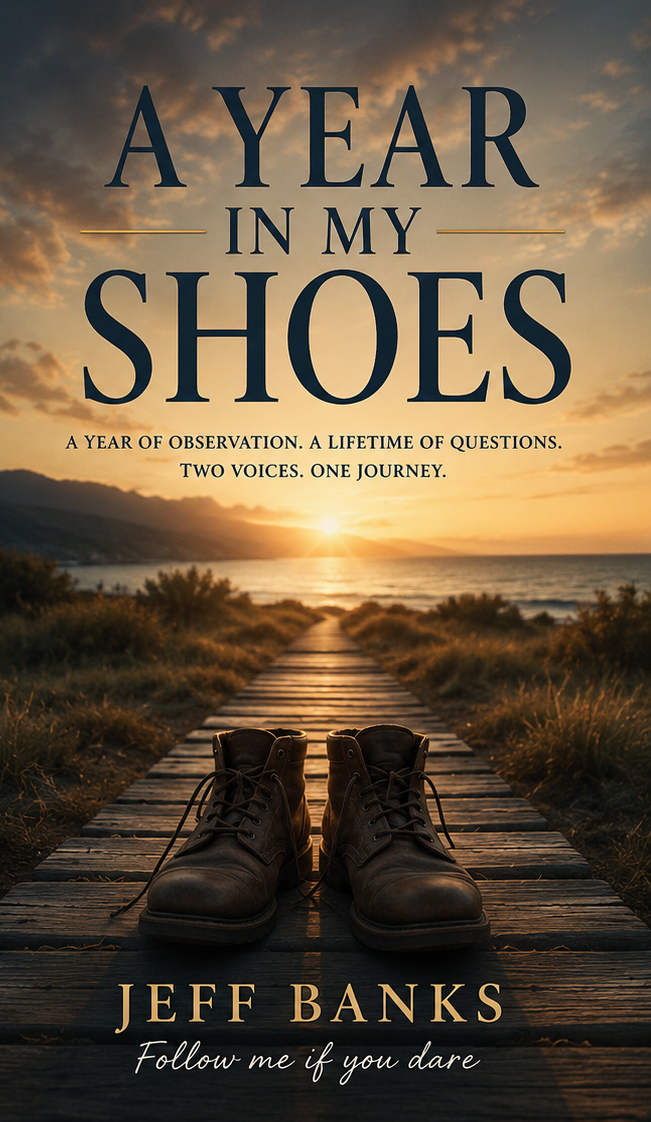
A Year in My Shoes Chapter 2 - The Weight of Holding Things Together

A Year in My Shoes Chapter 2 - The Weight of Holding Things Together | Travelling Around Australia with Jeff Banks

The emotional arc is not a dramatic crescendo but a careful compounding of small recognitions. The two Jeffs acknowledge the need to protect the resting, reflective half of the self as well as the active, problem-solving half. They admit that the life they’ve built, the table, the workshop, the club’s rituals, the family dinners, the late-night calls with a client, the careful crafting of a plan for an uneasy year, will require a different balance as months slide into a season of more unpredictable weather, more complex negotiations, and more opportunities to either stand still or move forward with humility. The chapter doesn’t pretend retirement will be easy or that the Black Dog will always stay quiet; it suggests that the real craft is how you carry both forward in a way that makes you useful, but not indispensable to yourself or to those you love.

A YEAR IN MY SHOES

Chapter 2 – The Weight of Holding Things Together


Two Jeffs share this head like a pair of old tools shuffled back into the drawer: the steady, stubborn gears that keep the machine ticking, and the quieter traveler who watchfully surveys the room as if the world will keep moving even if you pause to listen. The Black Dog skulks in the margins, not as an invasion but as a weather system you learn to read, a low pressure that doesn’t always announce itself with thunder but always leaves you a little lighter when it passes. August, in this room, isn’t a calendar page so much as a weight test: can you keep things together when the floor shifts under your feet and the people you love keep asking for more of your attention than you thought you had to give?

We begin the month with the room’s hum and the way memory ambushes the ordinary. The day sounds like a playlist you’ve heard a thousand times but never tired of hearing anew. A chorus of small awakenings, my wife’s calm in the morning, the dogs prodding for warmth, the clock’s stubborn insistence that time marches forward even when you wish it would stand still. I wake with the aftertaste of a long night of being useful, of plotting and plotting again, and I notice the two voices at once: one that calculates risk, pins down the numbers, and fixes what’s broken; the other that watches the scene like a visitor, noticing the scent of coffee, the way the sunlight lands on the old timber in our kitchen, the way laughter travels better than any spreadsheet.

At this time the landscape is not just the physical world but the interior topography, the way memory leaks into the present and drapes itself across the day’s tasks. The month’s rhythm is not a linear march of events but a braid of events, each strand tugging at a memory that flickers to life whenever a particular song drifts through the mind or a film’s image lands in the eye like a stone dropping into a quiet pool. The music first: August begins with a reminder of youth’s tyranny and companionable rebellion. A child’s pony club, a boy’s first ribbons, the sense of place that comes from saddle leather and the weight of a horse’s trust. The horse, Gazer, still echoes through the bones, that partnership I mistook for a simple story of transport and competition but which memory insists on naming as allegiance, an apprenticeship in how to move with another creature’s rhythm rather than coercing your own.

Riding returns as a memory’s hinge, not a calendar entry. It opens a window onto a past where usefulness had a clearer hierarchy and a clearer audience. In August that’s both terrifying and oddly comforting: retirement isn’t about freeing yourself from obligation so much as learning to shoulder a different kind of responsibility, one that doesn’t demand you always be in the arena with a reinsman’s grip. The present refuses to pretend the horse-and-rider bond can simply vanish when the work phone stops ringing. It morphs into a different sort of bond, one with time, with family, with the people who keep the business honest even as you step back from the daily show.

The Business Blueprint gatherings carry their own emotional weather. They’re a sanctuary where the weight of ownership feels normal, where the private weather system of cash flow, staffing, risk, and client expectations becomes something familiar enough to share without apology. There’s a generosity in those rooms that makes you feel less alone with all the burdens. And yet they are mirrors: you glimpse who you’ve become, who you’ve not become, and who you still miss being when you look at the room’s younger faces and recognise the same flame you once wore so brightly that you could mistake its heat for certainty. Kylie’s tears, when she finally yields to the month’s pressure, land with particular gravity. They’re not just about a farewell; they’re about the emotional cost of ambition, the way entrepreneurship can demand the expensive, exhausting neglect of personal wellbeing in pursuit of a future that may or may not arrive with the promised glitter.

Luke’s approach to parenting, the uninterrupted time that becomes a kind of ritual discipline, gnaws at me. It’s not nostalgia for a stricter childhood so much as a critique of what time would allow if you gave it your full permission to move gently yet unrelentingly. Old versions of myself exist in those reflections, the boy who believed in momentum and in a future where speed and certainty were enough to carry you through every storm. But August makes it clear that momentum without meaning is a long-sober walk to nowhere; meaning, if it’s to endure, must be shared, embedded in the people one loves, and anchored to the craft one cannot abandon, even when the market’s noise makes it seem strategically prudent to drift.

In the middle of August, the Black Dog grows quiet and then nudges again, not with a roar but with a pressure that makes you reshuffle your interior furniture. Depression in this book’s pages is not a meltdown; it’s a weather system that changes the light in rooms you’ve learned to live in. It’s fatigue wearing a friendly mask, irritation disguised as professional seriousness, and a somber humour that arrives just in time to keep you from spiralling into melodrama. The trick is to keep moving, to keep showing up to the same tasks with a different posture, the same words that say, “We’ll navigate this,” but with a new cadence that recognises the price of continuing to carry burdens others may think you should have relinquished long ago.

The domestic theatre of August is broad and intimate at once: the kitchen’s quiet ritual of turning leftovers into inventive meals, the slow cooker’s soft clock in the afternoon, the ritual of coffee and peppering in the garden. The rhythm is not simply about nourishment but about a practical, embodied refusal to let the months become a vacuum into which you disappear. There is something sacramental in the mundane: a jar of lemon myrtle gin tucked into a cooler, a bowl of prawn-topped salads shared with relatives, the ritual of delivering heavy tables to grateful family members, the quiet pride in turning timber into furniture and chairs into stories. The craftsmanship, sawing, planing, filling, sanding, sealing, feels like a physical counterpoint to the emotional craft of keeping a family and a business coherent under pressure. The workshop becomes a sanctuary in which the two Jeffs can argue in a soft, lamp-lit corner and still agree that the work will outlast their moods, if not their momentum.

Time, as the diary notes insist, does not heal cash flow or settle difficult relationships with lenders and business partners. It simply prolongs the ache and demands a different kind of stamina. In August I watch a client, the client whose empire of houses, shells, trusts, offsets, and shifting debt has become a live map of the month’s anxiety, learn to breathe differently. The spatial model I sketch for him becomes a shared metaphor: a way to see the forest rather than chase the next single tree’s shade. A client’s fear is not simply the risk of a bad investment but the fear of losing the one thing that has defined him for years, the sense that his choices are his own to make, not the bank’s to grant or deny. The model’s aim is not to fix his problems with a clever pivot but to restore him to a sense of genuine control, or at least a shared illusion of control that respects the fragility of the moment.

My business partner’s pushiness, his relentless insistence on the next deal, the next call, the next expansion, continues to be a thread that pulls at the fabric. The gap between him and the client’s real needs becomes the story’s tension: a reminder that empathy is not a marketing tool but a way of listening, a discipline that requires you to resist the impulse to push a sale when the client is not ready. In the late-night phone calls after a long day on the road, I feel the old ache of wanting to fix everything with a single, decisive move. The memory of a partner’s voice on the other end, calm or urgent, depending on the hour, flashes through the mind, and I catch myself asking whether real leadership is about making difficult choices that others call cowardice or about giving space for decisions to form at their own speed. The line between empowering a client and pressuring a client blurs when you forget that the customer isn’t a clock to be wound tighter but a person with a life that’s moving at a different pace.

Memory is a warp that keeps tugging at the present. In August the landscape, the country lanes, the towns from Yass to Gundagai, the Melbourne outskirts, the Condobolin dawns, becomes a map of my evolving sense of place. The road between one family and the other is not merely miles but a thread that ties the two halves of the man together. The Aussie ritual of accepting hospitality, scones at the Beadle’s, a bowl of Minestrone from my friend’s wife, a late-night tuna pie shared with my wife, reminds me that care has a texture and a taste, and that the body knows what the mind forgets: that warmth and quiet company are not luxuries but necessities when the Black Dog shadows lengthen. And when the calendar’s page closes on August’s last hours, the synthesis sits in the room as a quiet glow rather than a thunderbolt.

There are scenes of sport and ritual to anchor the season’s mood. The Sandbar Masters’ golf rounds, tales of wayward drives, luck-laden holes, and the rare moment of mercy granted by a ball finding a hole against all probability, are not just entertainment. They are memory’s weather, a counterweight to the month’s heavy talk. The golf course becomes a theatre for an old man who still loves the fight for a fair score and the ritual of sharing a drink after the round, a space where the talk slides from business to life’s small compensations with a deftness that makes the day’s politics feel both distant and unimportant compared to the human warmth that surrounds the table. The nine-ball ritual with Craig, the mock-heroics and the easy banter, the way the game’s pace slows the mind enough to let old hurts drift away for a few moments, that’s not escapism; it’s the body’s way of insisting that there must be room for joy beside the ache.

On the road the country’s memory keeps a ledger of the things that mattered and the things you forgot to write down when you were younger. Places like Condobolin’s dawns, the old farm’s smell of timber and soil, the story of the stolen generation’s memory carried in the land’s own lines, these anchor August’s emotional ballast. My Aunt Kerre, the matriarch by default, feeds people as if feeding time itself could repair the world, and her kitchen’s warmth becomes a quiet benchmark for what we owe to one another. The family’s stories, the long arc of siblings and cousins, the debt we carry toward those who got us here, are not merely a sentimental spine but a practical map for navigating a future in which retirement isn’t a place you arrive at but a rhythm you discover: the ability to say no with care, to say yes with discernment, to know when to step in and when to step back, and to remember that the craft of living well under pressure remains the most complex work any of us will ever undertake.

As August folds into its late days, the questions sharpen. If usefulness has become habit, what remains when the habit stops paying the rent? If the world still rings your office phone and asks you to save the day, what happens when the demand slows or vanishes? The two Jeffs listen to these questions and answer in tandem, sometimes with the same sentence spoken in two tones. The present Jeff, the one who wants to walk, to fix things with his hands, to build a life that feels solid even when the numbers misbehave, finds himself asking whether he can allow stillness to take its rightful place. The retired-adjacent Jeff, the one who has learned to listen for the Black Dog’s weather shifts and to measure time not by deadlines but by the depth of a breath, answers with a slower smile, a remark about the day’s craft, and a conviction that the work can proceed even if the pace changes.

Music keeps threading through the texture, not as decorative quotes but as mood-markers. The opening refrain of Mamma Mia becomes a capstone for memory’s ironies: a song of exuberant energy that once rode the belly of youth and now dissolves into a joke the body can still understand. Forrest Gump (1994 – Paramount) and its running sequence, so simple, so unplanned, so revealing about how followers seek certainty in someone who is just running because he feels the need to move, becomes a metaphor for faith, for the dangers of simple certainties in a world of nuance. The Band Played Waltzing Matilda’s quiet indictment lingers in the distance, a reminder that the real costs of grand choices are rarely borne by those who make them. And the way August’s weather changes, sunlight on timber, rain on the workshop roof, hail on a Melbourne back street, turns the everyday into a cinematic score, where the camera never stops rolling and the sound track keeps shaping what any given moment can mean.

The final turn of the month arrives not with a shot of triumph but with a quiet, almost unremarkable honesty. The space between the two Jeffs has grown more nuanced, less binary. The problem-solver remains essential, but his empire-now-and-tuture is tempered by a growing respect for the quieter art of withdrawal, of letting the wind change direction before you set a course again. The retiree in the heart, who once feared the void of less purpose, discovers that there is a different kind of purpose possible, one that doesn’t demand the fastest pace or the loudest claim but the gentlest consistency: showing up for the people you care about, keeping your hands busy with the craft you love, and letting memory’s anchors hold you in place long enough to notice the new shape of your life forming around them.

The synthesis comes on a night of small theatres and shared warmth, the kind of end-of-chapter moment that doesn’t pretend to solve the world but quietly holds it in a better balance. I’m in the workshop, a resin table gleaming with the patience of its many layers, the room smelling of timber dust and citrus solvent, the lamp throwing a warm halo over a life you keep trying to coax forward without pretending there is no weight to carry. My wife sits nearby, speaking softly about tomorrow’s plans, about my daughter’s next presentations, about the wedding invitations that keep arriving with the ordinary pressure of life’s invitations. The two Jeffs sit in the same chair, the present-day, pragmatic voice tallying the day’s missteps and small win’s, the older, quieter voice listening, measuring, and choosing to trust that a year’s arc can bend toward synthesis without breaking its spine.

And then there’s the moment. A simple, almost mundane moment that feels like a turning, a hinge that makes the surrounding walls seem a little more permanent. I set the last coat of resin on the plaque a few moments before dinner, and the room’s heat seems to lean in with approval. The plaque’s face catches the light and glimmers with a steady, patient glow, just enough to suggest it’s ready for its place in the hall of memory without shouting its own existence. It is, in short, a small miracle of patience, the physical echo of a state of mind: to do the work, to endure the wait, to trust that the material will settle and reveal what it is meant to reveal, just as life’s own pieces begin to settle into a sensible pattern if you give them time and a careful hand.

The dinner table becomes the site of the month’s last and most delicate conversation. My wife’s voice contours the room with a soft insistence that life’s next steps are both practical and tender: a wedding to plan, a retirement to inhabit with grace and honesty, a business to steer with integrity, and a family to love without smothering. The two Jeffs listen as one man sits, the other leans into the chair’s leather, and memory’s music slips from the speakers in a corner, a quiet reminder that the past isn’t something to be banished but a tide you ride, with a paddle you craft from your own hands, a board you shape in your own workshop with the care you’ve learned to bring to every other part of the life you call your own.

The narrative does not arrive with a single, definitive revelation. It arrives with a synthesis that feels earned, a sense that the year’s trajectory is not a line but a circle returning you to the same center with a different angle, a different level of acceptance. You cannot erase the Black Dog by wishing hard enough; you can learn to live with him, recognise his weather signs, name the wind, choose the shelter you’ll build around him. You cannot erase retirement by wishing for more hours in the day; you can honour the work you’ve done and still build a life that lets you be present to the people who matter most. The two interior selves do not vanish; they reconcile into a single, more capacious self that can hold both the urge to fix and the longing to listen, the impulse to lead and the need to be led by things larger than your own urgent concerns.

There will be more months like August, and they will bring their own storms and their own quiet, their own songs and their own films that become metaphors for the heart’s weather. But if there is a single truth this month returns with, it’s that the art of living well under pressure is not a heroic sprint but a patient, stubborn weaving of purpose into daily life. It’s the table you sit at with your partner, the chat that travels across a room and settles into a shared laugh, the careful work that becomes a legacy of timber and resin and honesty. It’s the memory trick that keeps you from thinking you are merely surviving time; it is the practice of turning time into a form of craft, a table, a plaque, a plan, a family gathering, a round of golf that ends with a handshake and a smile that means more than any score.

And so the month ends not with a thunderclap of clarity but with a soft, abiding sense that the arc of the year will bend toward synthesis not by big, dramatic acts but by the quiet courage to show up, to tell the truth when it’s easier to bend it, to let humour ride in to ease the heaviness, to keep the hands busy with work, and to listen to the life that speaks through the people you love and the work you’ve chosen to do. If Part 1 of the year was memory, ageing, and the quiet discomfort of time’s speeding edge, August has been the long, careful handshake with the future, a reminder that the work of becoming, as a father, a partner, a craftsman, a businessman, a friend, never truly ends. It only changes shape, and the shape it takes is a promise: that the two Jeffs can still tell a story together at the dinner table, and that, in telling it, they will help each other become the person who will be ready for whatever the rest of the year asks for, with honesty, a little stubborn humour, and a steady hand.

Two voices, still, like stubborn gears in an old windmill: the one that measures and fixes and keeps a ledger of every risk and every possible failure, and the other, quieter and steadier, who believes that the point of the day is not the fix but the being present for those who ask it of you. The Black Dog lingers at the edge, not as a showman but as a weather system you learn to predict, to ride out with a calm you pretend you don’t own but somehow do when the work demands it. August left more questions than answers, and September, if it’s honest, will ask different ones. The year, after all, doesn’t loosen its grip so much as reallocate it, toward a new set of rooms to walk through, new doors to open, and a new sense that the work of keeping life coherent is a craft, not a sprint.

The morning begins with a smell, the beverage’s bitter edge, the timber’s resin, a whiff of cold air that slips in through the open door and fogs the kitchen windows for a heartbeat. My wife moves like a quiet ship through a harbour, the way she arranges cups and plates with that calm competence that makes the room seem wider than it is. The two Jeffs sit at the table, a little stiff, a little open, the weight of the past month pressing on their collective shoulders in that almost particular way only a long, intense stretch of time can. It’s a moment that feels almost cinematic, the camera lingers on a mug steam, a dog’s head resting on the tiled floor, the hands of a clock that’s not sure whether it should hurry or slow.

The day’s first act is a walk and a memory, not a schedule. The walk is short but a ritual, the body’s stubborn reminder that movement is a form of negotiation with time. There’s a new plan tucked into the back pocket of the mind: get the spatial model across to a client, not as a fix for his problems but as a way for him to see the shape of the road ahead, to reframe the fear of debt and deadlines into something legible and, if not comforting, at least manageable. The two Jeffs talk in hushed, careful tones about liquidity and settlements, but the talk keeps drifting toward something more intimate: what it means to hold a life together when the life you’re making, your family, your partner, your crew at Sandbar, depends on your not giving up even when you want to.

The Coffee Table of Memory is still in the workshop, a moth-eaten plan half done and half dreaming, and I take a moment to run a finger along the smooth veneer, thinking of the cups that will rest on it, of the conversations around it, of the people who will lean on it with the same quiet faith we lean on the craft we do. The workshop is a sanctuary in the middle of a week that promises to demand endurance. The resin cures as if time itself is listening. The two Jeffs move in and out of the space easily, the older one ever mindful of the need to slow down, the younger one still restless with the hunger to produce something that will outlast the day’s anxieties.

The day’s work pushes its way into the calendar anyway. There’s a call with a client, and the spatial model becomes a map not just of his properties but of his nerves, a diagram to show him how the pieces are supposed to fit when the pieces have a habit of not fitting at first. I’m careful to let him see the logic without forcing the conclusion. The model is a sculpture of relationships, not a blueprint for a quick sale. A client’s voice comes through the speaker, tired, practical, grateful for the honesty even when it stings. He wants to know what the next six months look like if he steadies his course, if he keeps a hand on both the bank’s line and his own pace. I tell him that a patient plan, one step drawn out, not a leap, might be the best investment he can make in the face of changing lending rules. He is listening, which is not nothing; listening is how you begin to own your decisions again when you’ve spent years letting others dictate the tempo.

Meanwhile, the Sandbar table at the club has its own rhythm. The talk drifts from the day’s round to the week’s fixtures, from the committee’s tasks to the fundraiser’s latest update. Even the politics of the local scene finds its way into the dusk-lit room at the Bowlo: the sense that the club is not just a place to play but a way to belong, a place where the old stories keep the doors from closing and the fresh voices don’t feel like invaders. The game is social anesthesia and social glue at once: you swing a club, you miss the ball, you win a little, you lose a little, and you’re reminded that in a circle of men who have learned to rely on each other, the real prize is the shared ritual and a table’s worth of ribs and beer and legitimate talk about life’s messy middle. The two Jeffs watch, learn, and sometimes bite their tongues, choosing to let the conversation drift toward the future rather than the past, though every now and then a memory slips in, like a fish hooking itself on a line and pulling you back to the old waters you thought you’d left behind.

The afternoon brings the first trip west again, a reminder that the road is never really distant from the self you carry. The plan is to pick up Hogget from Aunt Kerre’s freezer, to see Mitch and Casey again, to watch the timber’s future take shape in the form of bowls and tables that will hold the family’s memories. The drive to Condobolin is long enough to reveal your own fatigue but short enough to keep hope from becoming an inflated balloon. The road’s curves and the land’s flat stretches are a theatre for memory: the red dirt’s texture on the glove, the way the horizon folds into itself as fields give way to scrub and then a hill, the sound of a radio that can’t quite decide whether it’s a country station or a pop channel.

Kerre’s kitchen is a climate of its own, a hearth that keeps the family from freezing in the evening’s chill, a table that holds cups of tea and talk that swirls like steam. The hogget waits, and the talk, always under the surface, touches on the kind of debts that aren’t monetary but moral and emotional: the obligations to siblings and cousins, the unspoken promises that bound us to one another even when the world’s atmosphere turned to competition and indifference. The practical tasks, checking the timber’s quality, selecting pieces for a future batch of tables, are not merely chores; they’re a form of memory-keeping, the physical record of a family’s craft and a man’s attempt to leave something behind that will outlast his fear of irrelevance.

In Condobolin, I watch Mitch work with a saw, careful and precise, the way a craftsman handles a living thing without letting it become a statue. The timber’s grain has stories to tell if you listen, and I listen with the ear that has learned to listen to people’s stories first and their profits second. The work is tough, the day’s rain threatening, but the moment is buoyant in its quiet, the sense that you’re building not just a table but a kind of scaffolding for the family’s future: a space where the grandchildren might sit and trace their fingers along the wood’s soft edges, where the table’s weight will demand a certain humility and gratitude that time often forgets to demand.

Even the awkward days, the phone calls that come with the wrong kind of urgency, the client who wants to push a new scheme when the old ships are still taking on water, feel less threatening when you’re surrounded by people who understand what it means to be responsible for something that outgrows you. The business of the day is not primarily about the sale; it’s about alignment, alignment of values and of the people who share them. The AI agents conversation with Naomi and Brendan, a dinner-table idea of the future, not a road map but a possible compass, lands like a soft suggestion rather than a hard directive. Naomi’s practical, human approach to AI, to using the new tools to support real, messy operations rather than replace human judgment, is a reminder that the future’s tools are only as useful as the people who wield them. The day ends with a sense that the right kind of technology will fit the human scale, not overwhelm it.

Back in the city, there’s a late-night Homecoming moment: a phone call with my daughter as she sails through a schedule that could star in its own soap opera, the graduation ceremony weeks ago, the Centrepoint lunch with the family, the looming wedding preparations, and now the steady trickle of speaking engagements and school visits that keep her energy high while the rest of us hover around the edges of exhaustion. She speaks not as a student but as a professional and as a daughter who understands the weight of expectation, and I feel that familiar tug: pride and fear, delight and worry, all braided together in the same breath. I listen as she talks about new projects, the way she’s turning her doctorate into something that could change how the world sees women in science. The two Jeffs, older, a touch more cautious, deeply invested in the idea that the future must be earned, watch and listen, and there’s a quiet prayer that the next wave will come and lift them all without washing away what’s already built.

The days drift into one another with the gentle persistence of a river that refuses to be diverted by a single stone. There are dinners in the homes of my wife’s kin, the kind of nights when the talk shifts from business to family, from numbers to memory, from the day’s disappointments to the day’s small mercies. There are the dogs that still beg for attention, the goats that wander the yard, the wood that needs sanding or planing, the resin that stubbornly refuses to dry in the exact way you want, the tools you don’t quite master yet but which promise a future craft that will be better than the last. The weight, if anything, feels more like a shared load now than a private burden. The two Jeffs carry it together, teaching each other how to lean in when the other wants to retreat, how to say yes to help without surrendering the autonomy that makes the life worth living.

Music and film keep weaving through the days as memory anchors, but not as shortcuts to nailing down truth. The films I’ve loved, Forrest Gump and Forrest’s hunt for meaning in a world that sometimes asks you to move on without a clear map, return as parables for a life that must keep moving because moving is how you stay connected to people you love. Forrest’s running is a metaphor not for blind faith but for practical perseverance, the stubborn belief that you can keep your feet moving even when your heart would prefer to stay in place. The month’s remembered songs, Mamma Mia’s exuberance, the Band Played Waltzing Matilda’s elegy, the quiet brutality of some of the more haunting ballads, become a chorus that rounds the corners of memory and present moment, a reminder that the interior weather never stops, it only changes weather patterns to suit the scene.

There are small, almost ceremonial rituals that keep the interior life from becoming overwhelmed by the outer one. A monthly BAS reconciled, a website draft improved, a timber slab planed and shaped into something that can be gifted or sold, a round of golf that doesn’t quite go as planned but offers a provocation for laughter and quiet reflection, a family meal that turns into a council of love and gentle argument about who gets to have the last word on a story that’s too long to fit in a single dinner. The practical side of living, finance, risk, scheduling, taxes, remains the frame; the art lies in the way we fill that frame with people, with silence between words, with a few well-chosen jokes that can loosen the jaw enough to let honest feelings escape without fear of breaking something delicate.

I think of the next leg of the year’s journey, the remaining months that will demand even more of the two Jeffs, and perhaps a more intimate reconciliation between the two interior selves. The retirement question will sharpen again, not as a fear of losing identity but as a question of what an identity becomes when the work that previously defined it is no longer the centre of gravity. The Black Dog will keep showing up, as it always does, not to swallow but to counsel: you are not alone, you are not unworthy of help, and you are not required to pretend everything is simply easy when it is not. The strength of this life is that you can walk with it, shoulder to shoulder with the people you love, and still tell the truth about the heaviness.

The day’s last light leaks away, and the workshop glows with a patient, amber burn. The resin table has finally set in the perfect moment, the grain catching the lamp’s glow in a way that makes it look almost alive, like a memory taking shape in wood. My wife sits on a stool nearby, watching the family’s pace change as the evening settles and the night takes its first quiet breath. Our daughter calls in from a talk she’s given at a school, the sound bright and buoyant, a reminder that the future’s voice, hers, will carry forward and keep the family’s story alive in new, hopeful ways. The news from the bank and the accountants’ desk recedes into the background for a moment as the heart concentrates on the tactile, the visible, the now: the table, the room, the people in it. The two Jeffs exchange a look that says: we’ve done a lot; we’ve endured a lot; and the next thing will be built not on triumph but on the precision of care.

There’s a late-night orbit around the family again, this time in the form of a small gathering at the Bowlo, the same room, the same familiar faces, the same quiet hunger for something to remind us that life still has substance, still has meaning beyond the next deal or the next deadline. The night’s simple wins, Craig’s good-natured pool victory, the pot of prawns, the shared laughter, the gentle ribbing about who’s a better table-builder, become a soft punctuation mark at the end of this stretch. In the end, no thunder, no final verdict, just a quiet, deserving relief that the day has found its way to a place where the two Jeffs can rest a little, the Black Dog can pause to catch its breath, and the world can carry on with the promise that September’s weather will be another teacher, another challenge, and another chance to polish the craft of living well.

If there’s a single insight August and its sibling days taught, it’s this: being useful isn’t a permanent title you earn and keep like a badge. It’s a practice you renew every morning, a dance between the momentum that keeps you in motion and the restraint that keeps you honest about when to slow down. The two selves don’t erase each other; they refuse to. They negotiate in the same room where the timber’s grain still remembers the horse’s stride and the golf ball’s path and the price of a night’s sleep. The memory of Gazer sits in the space between the spine and the heart, a reminder that belonging is not a simple inheritance but a practice of returning to places you once called home and recognizing that you carry them forward with you, in your hands and in your head.

And so it closes not with a verdict but with a place to stand, a moment when the two Jeffs, the aging body and the sustaining craft, the Sandbar life and the family orbit, the memory’s ache and the day’s small grace, meet at a single table and decide to eat together again tomorrow. The room grows quiet, the night encroaches, and the diary, if one calls it a diary, keeps its own faithful tempo: the hum of a life that would rather be honest than spectacular, practical than grand, and stubbornly hopeful in the face of a year that still has much to offer and much to ask. And in that quiet, with the scent of timber in the air and the sound of family voices fading into the walls, you hear a kind of answer, the kind you get not from a single revelation but from the slow, stubborn work of living well with the weight you’ve chosen to bear.

The hinge of a day stays quiet until you lean into it, and it ends picking up where perhaps the mid point left off, not with a calendar date but with the breath you take when you realise the weight you’ve been carrying has shifted just enough to feel different. The two Jeffs sit in the same room, but the room itself seems to have learned a new rhythm, a softer cadence that comes when the tasks aren’t shouting for attention and the heart rate finally finds a more human tempo. The Black Dog remains somewhere at the edge, not clawing but hovering, a reliable weather system whose forecast you learn to read not with fear but with a careful kind of respect. If August insisted on testing the bones, September is here to test the spine, can you carry what you’ve gathered without letting the load fracture under you?

The morning unfurls with a familiar scent, the sharp edge of coffee, the resin’s faint perfume clinging to the air, and the chill that slips in through an open door as my wife moves through the kitchen like a ship’s captain charting a familiar sea. My wife’s calm remains a constant anchor, but even she carries a new kind of quietness, as if distance from the day’s old fires has shifted the heat in her own interior furnace. The two Jeffs share a look that is almost a nod: we’ve weathered a long stretch, and though the ledger isn’t closed, something other than fear has started to fill the margins. It’s not bravado; it’s a careful acceptance that some days the world’s pace will drag you along whether you feel ready to go or not, and today we choose to walk beside it rather than sprint ahead of it.

The day’s plan, such as it is, begins not with a meeting but with a memory. The spatial model for a client remains the sort of tool that can’t fix emotions but can sometimes loosen the knots of anxiety a person carries about debt, timing, and the banks’ patience. I hear a client’s voice over the speaker and picture him in a shed full of blueprints and unanswered questions, a man who has learned to tolerate risk as if it were a familiar weather pattern, something you keep an eye on, something you plan around, something you don’t pretend will vanish if you ignore it long enough. He asks for a path forward that doesn’t pretend certainty exists on every corner. I tell him about the one-step plan: not a grand leap but a measured staircase, one square at a time, with a couple of landings he can actually stand on without feeling the floor drop away. It’s not “the sale,” it’s a way to breathe while the mortgage broker’s clock ticks and the accountant’s notes accumulate. He listens, and listening, in that moment, feels like the first real act of hope he’s allowed himself in a long season of push.

The workshop’s air is thick with the scent of fresh sawdust and varnish, a physical reminder that a life built with one’s hands can still surprise with how it can hold memory. The Coffee Table of Memory, half-dream, half-scheded plan, sits there, its edges soft with oil, a tangible heirloom in the making. I run a finger along its grain and imagine the cups that will rest upon it during the long conversations that no doubt will unfold around it in years to come. The resin table, our stubborn, stubborn child, has become a patient friend too, teaching the two Jeffs about time’s tempo: slow, steady, attentive, forgiving when the resin has a micro-bubble moment and then settles into a quiet, almost grateful shine. The workshop becomes a sanctuary where the body can remember how to hold a tool in one hand and a memory in the other, where the two selves can share the same bench without fighting for space or time.

The day’s second act slips in on the tail of the morning’s conversation like a sudden drop in wind. A call comes from a client who wants a plan for the next six months, not a miracle today but a map that makes room for the inevitable delays and the occasional, life-affirming breakthrough. The spatial model, in this telling, doesn’t promise a finish line; it promises a field where waiting becomes meaningful, where risk can be stewarded, where the mind can walk in parallel with the heart rather than ahead of it. I talk through scenarios and contingencies with the client’s voice in my ear and my wife’s steady rhythm in the background, and it becomes clear that the work we’re doing, this hybrid craft of numbers and empathy, has become less about producing a result and more about training the nerves to endure uncertainty with grace. It’s a paradox that still ticks: the more you know, the more you realise you don’t know, and the more you understand that the value of counsel isn’t in certainty but in the clarity to choose anyway.

Sandbar life continues to braid itself into the week’s fabric. The Bowlo’s table talk moves from the weather and the golf swing to the slow-work of planning a fundraiser that will keep the lights on for a local service club and keep the social fabric from tearing. The club’s governance, always a blend of ritual and negotiation, remains the most visible theatre where I watch the two Jeffs’ different energies collide and then converge. There’s a moment when Craig’s sharp humor lands just right, the kind that makes you forget the bank’s delays and the debt’s gravity for a breath or two. We laugh, we rib, and we turn the conversation toward something larger: the community needs us to stay balanced, not to disappear into admin or a torrent of ideas that never see the light of day. The laugh is a small rebellion against the fear that we’re spinning out of control; it’s also a reminder that the bonds we’ve built, between players, between committees, between a man and his craft, aren’t just hobbies, they are the scaffolding of resilience.

A thread of the day winds toward Condobolin again, but not the old town’s stoic memory; this time it’s the cousins and the timber Mitch is turning into work that will outlast the season’s storms. The timber’s grain speaks softly of the land’s long patience, and Mitch’s careful hands coax it into shapes that will demand attention long after we’ve stopped relying on their power to generate income. The day’s work isn’t only about making something beautiful; it’s about making something reliable that carries forward the family’s story, an artifact that will outlive the current mood and remind the grandchildren of how their forebears chose to endure, to persevere, to invest in a future they couldn’t fully see but believed in anyway. The workshop is where memory becomes material, and material becomes memory, and the two Jeffs walk that hinge with a quiet joy that isn’t loud but is unignorable.

Evenings, as always, carry the heavy sweetness of kin. The Greek currents still move through the kitchen, and the laughter at the table isn’t always about the subject at hand; it’s about the shared history that allows us to survive the current one. My wife’s kin bring their own rhythm, stories of everyday resilience, the dog’s quirks, the garden’s bounty, and the sense that life’s ordinary rituals, done with care, are what hold the family together when outside forces threaten to pull it apart. The memory triggers keep arriving: a film’s scene that reappears with a surprising force, a song’s line that lands with a new weight because it intersects with a fresh memory, a place you’ve passed so many times you think you know it, only to discover you know yourself a little better when you walk through it again. The two Jeffs let those triggers do their work, letting a memory of Gazer soften the edge of a day’s edge and letting a memory of a long, patient struggle with retirement ease into a sense of possibility rather than a fear of loss.

The health thread remains a stubborn patient in the back room of August’s memory, and it resurfaces again with a quiet insistence. There are moments, small, almost banal moments, when a twinge in the back or a stubborn morning stiffness draws a line between the life you’ve lived at full tilt and the one you’re trying to negotiate in a steadier cadence. The aging body is a map you learn to read with more tenderness than you ever imagined, not as a surrender but as a guide to pacing: where to push, where to pause, where to lean into a habit that keeps you functional and, more importantly, alive to the people who matter. The Black Dog appears not as a siren but as a patient tutor, reminding you that the real measure of strength isn’t the speed with which you confront the storm but the grace with which you walk through the rain and keep your coat dry enough to breathe.

Pop culture needles continue to thread through the chapter’s emotional fabric, but they do so with restraint. Forrest Gump’s running returns as a parable about perseverance, not as a sermon about certainty. The Band Played Waltzing Matilda surfaces as a haunting counterpoint to a country’s restless appetite for risk and power, a reminder that the true costs of choices are measured in human futures rather than in patriotic pageantry. And in quieter moments a line from a song, something like the hush after a storm or the soft trigger of a memory, lands with a tenderness that makes you pause and tell yourself the truth you’ve needed to hear for a long time: that self-worth isn’t earned by pushing harder every day but by choosing who you want to be when the day’s demands finally quiet.

The emotional arc is not a dramatic crescendo but a careful compounding of small recognitions. The two Jeffs acknowledge the need to protect the resting, reflective half of the self as well as the active, problem-solving half. They admit that the life they’ve built, the table, the workshop, the club’s rituals, the family dinners, the late-night calls with a client, the careful crafting of a plan for an uneasy year, will require a different balance as months slide into a season of more unpredictable weather, more complex negotiations, and more opportunities to either stand still or move forward with humility. The chapter doesn’t pretend retirement will be easy or that the Black Dog will always stay quiet; it suggests that the real craft is how you carry both forward in a way that makes you useful, but not indispensable to yourself or to those you love.

The end lands on a quiet, almost shy insight. The two Jeffs share a new awareness: usefulness, understood as a practice rather than a badge, can coexist with the desire to slow down, to listen more, to let memory have room to speak without the immediate pressure to act. It’s not that the drive to create, to lead, to help, or to guide disappears; it’s that it’s tempered by a growing belief that the work of living well under pressure also requires a generous allowance for rest, for the small rituals that sustain the soul, for the honest conversation with one’s own fears, and for the patient trust in those who stand with you in the trenches of daily life. The chapter closes with a moment of shared stillness, the resin table catching the lamp’s glow, my wife’s soft voice planning a future gathering, my daughter’s phone call lighting up the room with news of new talks and new opportunities, and the sense that you’re not merely arranging pieces of timber or accounts but arranging a life that can bear the weather, tell the truth, and still laugh when the moment asks for it.

If middle ended with a turning of the heart toward synthesis, the ending deepens that turning into a practiced stance: the two Jeffs will keep walking, keep listening, keep building, and keep telling the same story with a slightly clearer understanding of what it means to be useful when the world keeps changing its tune. The road ahead will test patience, and the test will be personal as much as professional, but it will also prove that the craftsman’s art, whether on a workbench or at a kitchen table, can make a life more capable of withstanding the storms, and perhaps more ready to welcome whatever gentler weather follows. The synthesis, for now, remains a promise rather than a verdict: that to be useful is to be present, to be honest, to be connected, and to accept that sometimes the best thing you can offer is your steady, imperfect self, standing with the people you love, while the world keeps asking for more.

Author

Menu