
A Year in My Shoes Chapter 13 - The Trouble With Standing Still

A Year in My Shoes Chapter 13 - The Trouble With Standing Still | Travelling Around Australia with Jeff Banks

If the year’s throughline has a spine, it’s this: motion continues. Not as a heroic sprint, but as a patient, stubborn persistence that learns to move with, not against, the body’s limits; with, not against, the heart’s tremors; with, not against, the year’s demands. The two Jeffs have learned to translate all that into practice: how to structure a day so that the workshop’s careful demands do not erode the evening’s capacity to listen to a partner’s quiet fear; how to address a client’s urgent need without letting urgency erase the weekend’s slow grammar; how to treat a family moment as a kind of project that requires careful planning, not domination.
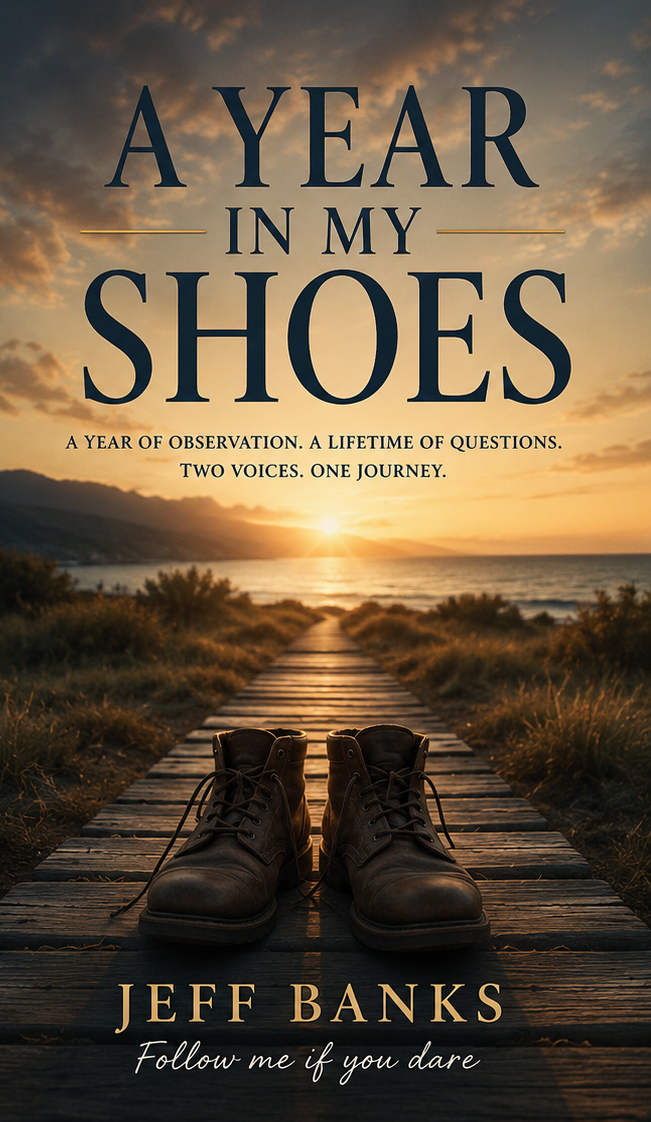
A YEAR IN MY SHOES

Chapter 13 – The Trouble With Standing Still

From the outset, two Jeffs sit at the same table, though only one of them feels the table’s edge moment-by-moment with the stubbornness of a built-in fault line. The other Jeff, the one who used to punch clocks and count margins and chase the next invoice, has learned to listen when the air shifts and the room grows a shade too quiet. The Black Dog has made a habit of arranging its own chairs in such rooms, so you know where to expect it, even if you pretend not to.

I’m writing this year as if we’re all still seated, glasses balanced just so, the Sandbar’s lamps throwing yellow halos over the green felt and the slow, patient clink of ice in a glass that knows how to pretend nothing’s wrong while telling the truth in a whisper. The truth is often less cinematic than the hope, and the moment of truth never arrives with a drumroll, not when you’re the kind of man who measures value in practicalities and in the texture of a day that doesn’t quit when you want it to.

The year has had weather in it, weather, and a certain stubborn momentum that refuses to behave in any neat arc, the way a well-designed spreadsheet pretends to when you’re trying to read the numbers without reading the life behind them. The two interior Jeffs have learned to speak in a shared shorthand that isn’t fully spoken aloud. One speaks in small and precise observations, the workshop’s sawdust coating the air like a winter fog, the way my wife folds towels with surgical calm, the way a client’s voicemail erodes the day’s edge with its urgent insistence. The other speaks in a slower tempo, in memory and in the kind of joke you tell at a golf club that sounds like a confession even when it’s merely misdirection.

The Black Dog has been a patient tutor this year, patient enough to sit on a chair in the corner and thump the floor with its tail when it wants a sign you’re listening. It’s a dog that learns a language by listening to the pattern of a life more than to words; it’s the dog you don’t name in public and only name in the quiet. Its presence isn’t melodramatic. It doesn’t crash through doors. It sits, quietly, and waits for you to notice what hasn’t been said as you move from task to task, from memory to memory, from the project you’re building to the one you’re trying not to abandon.

Retirement, or the sense of retirement, remains a conversation with a question that refuses to die: what remains when you quiet the external demands that have defined you for decades? The brochure version promises a horizon of calm, but this year has shown that horizons don’t actually erase the landscape that built you. They bend, they show you new ridges, and sometimes they reveal that the landscape you loved was itself a form of motion disguised as stillness. That’s the truth we’re not supposed to tell at dinner parties, the truth that sits beneath the sourdough bread and the careful pairing of wine with the memory of a time when you believed you could fix anything if you were fast enough, clever enough, relentless enough.

The year begins in the same way a long film begins: with a room’s murmur, with my wife’s quiet competence as the hinge on which the household rotates, with my daughter’s steady timing and warmth that keep the family’s orbit in a surprisingly reliable resonance. There are conversations that cross rooms as if the walls themselves are listening, and there are moments when the house feels almost shaped to shelter the two Jeffs who inhabit the same body and mind at different speeds. The Sandbar Golf Club is a living map of that speed. It is a place where the old men debate the physics of a ball’s arc as if the world’s order depends on a particular angle of flight, where rather than arguing about existential questions they argue about wind directions and which brand of beer tastes best with the memory of a trip taken years ago.

In the workshop, the day begins with the tools like a small, well-behaved army and ends with a quiet victory that doesn’t need to be announced. It’s not so much about the vanity of a clean project as it is about the predictable, stubborn joy of making something tangible out of the world’s ambiguity. The woodsick smell, the way sawdust climbs into a shirt collar, the precise feel of a plane’s bite as it takes a long cut through a length of pine, these are sensory anchors, the kind of anchors you realise you needed only when you’ve forgotten you needed them at all. The two Jeffs work in shifts of attention: one notices the grain and the tension in the wood, the other notices the room’s temperature, the rhythm of my wife’s footsteps in the hall, the way age turns a joint’s ease into a small, polite fight.

Memory arrives as a patient thief, tapping on the window with the wind through the pines and a reminder that yesterday’s decisions aren’t gone, only receded into the walls of a house that has learned to record time as a sequence of tasks and gestures rather than a clock’s tick. A song will drift in from the car radio and pull a thread from the year’s fabric and reweave it into a scene that makes you laugh and ache at the same moment. A film’s line, delivered by a character in a moment of quiet defiance, lands like a stone in a still pond and suddenly the pond’s surface is a mirror that shows you as you might have been, and a warning about what you’re becoming.

The Sandbar’s governance, its volunteer culture, and the way it has become a social organism with a governance problem, these aren’t merely anecdotes about a sports club; they are symptoms of a larger truth about aging men who have defined themselves by the act of fixing, building, and leading. The impulse to intervene remains both noble and dangerous. The “See a need, fill a need” line is as admirable as it is lethal when adopted as a permanent operating system rather than a temporary mode. The two Jeffs watch this play out as if it’s a microcosm of the year’s larger drama: a constant push to restructure, to improve, to keep the engine turning, even if the road is no longer straight and the destination doesn’t look like the one you were told to expect.

My wife has become, quite calmly and without spectacle, the year’s counterweight to the restlessness that slips out of the workshop’s sawdust and into the room’s quiet corners. She is the steady hand you don’t notice until you realise the minute you need a hand you’re not in charge of giving, she is the mirror that reflects back a clarity you hadn’t allowed yourself to admit you needed. The two Jeffs both see her as ballast and as the calm in which the two of them can breathe and be honest about what their lives require now. They have learned that honesty is not a speech you give to the other person; it is a practice you enact daily, in how you choose to stay on the table’s edge and not slip into the kitchen’s old rhythms of blame and defensiveness.

There are days when the two Jeffs walk the long, soft corridors of Sandbar’s corridors and sentence themselves to the same joke you tell at a dinner party to keep fear from becoming a scorecard you cannot bear to read aloud. You know the joke, every man who has ever built a thing has told it in some form: that the world’s complexity can be reduced to a handful of decisions, and that the decisions themselves aren’t as important as the act of choosing, again and again, in the face of uncertainty. It’s funny precisely because it’s a coping mechanism dressed as philosophy, and it’s also deeply true because in the end you can only live by the next choice you make, the next task you take on, the next conversation you dare to have with someone you love.

The two Jeffs also observe that the body’s aging is not a linear decline but an orchestra in which some sections pause, others quiet, and a few insist on playing louder out of stubborn habit. The body’s obstacles, sleep that misbehaves, energy that one day shows up like a guest who forgot to knock, joints that remind you they’re not as youthful as the mind pretends them to be, these aren’t defeats; they’re parts of the year’s fabric you learn to sew back together with patient, practical threads. You learn to measure relief not by the absence of pain but by the presence of a moment when you are able to breathe deep enough to feel something other than the topmost edge of tension.

Songs and films appear in this year as emotional weather systems, not decorative elements. The memory sequence that lands like a well-timed punchline might be triggered by a lyric you once loved without knowing why it mattered so much. A film’s scene, someone choosing to walk away from a fight, or to listen instead of speaking, or to allow a moment of vulnerability to pass into the room’s quiet breath, becomes a metaphor for a choice you know you should make even if you’re not sure you have the nerve to make it, even if you fear that to act with restraint might mean you’re giving up your power to help. It’s a strange economy: the more you realise you can’t fix everything, the more you learn what is truly yours to fix, and what is not your burden to mend but your chance to stand beside someone while they mend it themselves.

The year’s business stress, its relentless emails, its deadlines that keep moving, its suppliers’ delays, its councils’ why-do-we-do-it questions, remains the year’s living anatomy. It’s not a ledger; it’s a weather map. The two Jeffs carry the map in their heads, trading looks that say: we’ll find a way through the fog, not by pretending the fog isn’t there but by learning how to navigate it with the tools we’ve learned to trust most. The workshop becomes a kind of ship’s galley, where meals are shared, plans are hashed, and a kind of domestic democracy forms: the older, steadier voice making sure the day’s work doesn’t swallow the night’s peace; the quieter voice insisting that the night, too, deserves its share of daylight.

Memory triggers come not as thunderclaps but as patient taps, an old film’s line, a song’s chorus on the car radio that seems almost to rewrite a year’s emotional geography, a memory of a camping trip that folds back into a current scene like a seam in a coat that must be mended to fit the body it’s worn for now. The song that played in the car during a winter drive when the family laughed at a joke that wasn’t really that funny, the memory lands with a dull ache and a smile that knows better than to pretend that ache isn’t real. The film that suggested that love is not a grand finale but a sequence of small, stubborn decisions to stay, to listen, to forgive a little and carry on. These anchors help the two Jeffs tether their sense of meaning to the day’s work and the night’s quiet, which is the only kind of rhythm that makes sense when you’re living inside a year that refuses to arrive at a single verdict.

The Sandbar’s politics, its governance, its committees, its endless talking about the right sequence of steps, becomes a meditation on leadership at a moment when leadership is less about pedestals and more about staying in the room with people who don’t agree on everything but still crave a shared table. The two Jeffs watch and listen: the projectors flicker, the meetings begin with good faith and often end with gentle frustration, and the result is a club that feels at once essential and imperfect, like a life that cannot be reduced to a single principle even as it tries to hold a few principles steady enough to keep the day from crumbling. In the end, the club’s imperfections are the year’s mirror: a reminder that glory belongs to the compatible, imperfect practice of belonging rather than the flawless performance of a theory.

The health and aging thread, its friction and its stubbornly quiet resilience, sits with equal weight in the year’s table chatter. Recovery becomes a negotiation, energy a fluctuating guest, sleep a companion who sometimes cancels or delays with a shrug and a sigh. The two Jeffs learn to listen for signals that previously would have been dismissed as ordinary fatigue and now carry the freight of anxiety and worry. The Black Dog’s most dangerous trick this year is not dramatic crisis but the slow, stealthy erosion of certainty. It arrives in the form of a flat afternoon when the room’s light seems less forgiving, when a planned project’s momentum evaporates not because the project isn’t worth doing but because the will to begin has vanished into a fog that has lowered its own visibility, and you find yourself staring at the next action and realising you’re not sure you can name it, let alone do it.

That’s when the two Jeffs’ dynamic shows its most revealing face. The problem-solver Jeff, the old, reliable, practical one, faces an obstacle that is less about a missing toolkit and more about a missing energy field, about a sense of value that doesn’t come from the next thing you fix but from the interior stance you bring to the moment itself. The retiree Jeff, the one who has learned the mercy of small pleasures, the slow bread-baking, the longer evening with a film that doesn’t need to be understood to be felt, reminds the other that stillness, rightly understood, is not a vacancy; it’s a warehouse of opportunity: time to reflect, to listen, to decide what matters without the external pressure to prove something to someone. The two voices are not at war so much as they are co-authors, trading paragraphs, offering counterpoints, sometimes agreeing with a shared line of respect, sometimes letting a difference stand in the light long enough to show its cost and its courage.

Retirement’s emotional promise, freedom from deadlines, arrives at a practical cost: structure. Without external prompts, structure must be chosen, and choosing is itself a kind of obligation. The year’s subtler drama is not whether you will work but how you will decide what counts as enough work to claim meaning. This becomes a test of the quieter virtue: the capacity to select, to refuse, to reorder. It’s messy. It’s not glamourous. It’s honest in a way that early life’s sharp clarity often isn’t, because honesty in this space is not about thrilling content but about a steady, ongoing decision to stay in the conversation with one’s own longing and one’s partner’s needs. My wife’s presence makes this easier, not by solving anything but by making it possible to name what’s true when the room’s air grows heavy.

Music, again, does not merely accompany; it informs. A track you once hummed in your twenties when you believed “more” would always redeem “enough” now hums with a different gravity. It’s not the same track, nor is it a replacement; it’s a map that shows where you’ve traveled and how you’ve changed the terrain of memory. A film’s quiet insistence on loyalty, or its brutal honesty about compromise, acts as a parable you can carry into a council meeting or a family conversation, telling you that courage is often the courage to say no to something equally vital, simply because you’re choosing a larger yes, an honest yes, to a life that cannot be measured by the number of tasks completed but by the depth of the anchor you hold when the evening comes.

my daughter and the kids appear in the year as a gentle, ever-present gravity. They are the anchors that make the two Jeffs hungry for a future that does not require them to prove themselves to the next client or to the next crisis. The phone call that works, the call that doesn’t, these become micro-crises of their own within the larger, slower narrative of aging and transition. The kids’ laughter arrives through the house’s hallways and lands in the workshop like sunlight after rain: a reminder that life’s tempo is not merely about staying in motion but about sharing the motion with others who carry your best and your worst with equal tenderness. The family’s rituals, the Sunday bread that yields to butter and jam, the shared dish that never quite matches its imagined perfection, the bedtime stories that are read with a volunteer’s patience and a grandparent’s memory, these rituals are the architecture of the year’s sense of home. They remind the two Jeffs that a life is not a ledger of tasks but a rhythm that includes the people who are, in the end, the life’s purpose.

There are days when a tee shot at Sandbar seems to embody the year’s mood, when the ball climbs into the air and then, rather than following a glorious arc, lingers at the apex and drops, not with a crash but with a soft, almost apologetic thump into the rough. In those moments, the two Jeffs share a look that says: this is not a failure; this is a reminder that the game’s language, of risk, of control, of hope, has not changed, only the stakes and the body’s willingness to carry them. The golf course remains the course of their year’s negotiation: protocols, rituals, politics, and the quiet drama of people who want to be seen doing something meaningful enough to justify being present at all. The old gods of productivity and the new gods of presence have to learn to share the same altar. They do, slowly, through a dozen micro-decisions: to accept a slower pace; to accept help when it arrives; to celebrate small wins; to acknowledge a mistake and let someone else repair it.

Humor remains the year’s essential vitamin. It arrives in the mouth of a joke that starts as a cliché and ends with a twist that lands only because you’ve spent the afternoon listening with a kind of care you didn’t know you possessed. It interrupts heaviness with the clean, dry line that says, yes, we are afloat in the current of life, and yes, we’ll survive the next storm by telling the next joke. The humor never discounts the seriousness beneath it; it lubricates the joints of life so you can move toward what you know you must do, not because you’re forced by obligation but because you’re pulled by a sense that you don’t want to let the day go unaddressed.

There are days when the body, and therefore the mind, feels as if it’s aging at double speed. The body protests: a night’s sleep is a currency you spend unwisely, a morning walk drains you before lunch, a simple chore becomes a small war with the clock. The mind protests: a memory that slips, a rumor you fear, a plan that requires a level of precision you no longer trust your hands to produce. The emotional response is not always dramatic; more often it’s a slow, stubborn dragging of feet, a moment of internal bargaining with the self that says, not today, not yet, but perhaps later. It’s in these moments that the two Jeffs speak most candidly to one another, a private dialog that would shock no one who knows the year’s rhythms but would likely surprise the younger self who believed mastery looked like a calendar of successes.

Memory’s power this year is unglamorous, stubborn, and intimate. A room’s acoustics become a theatre in which a scene from twenty years ago replays with a precision that feels too intimate to share aloud. A film’s scene about forgiveness becomes a blueprint for a conversation you stage later with a partner you’ve spent your life trying not to disappoint. A song’s memory, the kind that travels back to a road trip where you were sure of the path and certain of the day’s brightness, arrives with a weight that makes you laugh because the voice singing the lyric in your memory belonged to a younger, more confident you, and yet you feel more alive for having carried that memory into this moment. The memory is not nostalgia’s sweetness alone; it’s the architecture of resilience: you navigate by what has been, and you survive by what you choose to do with what you carry forward.

The year’s synthesis is not a single revelation but a mosaic of small, honest recognitions. The Black Dog has not vanished, nor has it become a bright chorus of hope; it remains a constant presence that asks you to name it, to acknowledge it, to negotiate with it rather than pretend its absence. The negotiation is not a cure but a discipline. It’s a practice of naming what’s heavy, of acknowledging what hurts, of choosing to keep moving even when the path is uncertain and the horizon looks suspiciously like fog. The discipline is also a gift: the ability to observe one’s own reactions with a certain amount of compassion, the capacity to let go of the illusion that mastery means doing everything, the understanding that usefulness is a powerful force but not the sole measure of a life’s worth.

If the year’s throughline has a spine, it’s this: motion continues. Not as a heroic sprint, but as a patient, stubborn persistence that learns to move with, not against, the body’s limits; with, not against, the heart’s tremors; with, not against, the year’s demands. The two Jeffs have learned to translate all that into practice: how to structure a day so that the workshop’s careful demands do not erode the evening’s capacity to listen to a partner’s quiet fear; how to address a client’s urgent need without letting urgency erase the weekend’s slow grammar; how to treat a family moment as a kind of project that requires careful planning, not domination.

And there are moments, unexpected, unscripted, that feel like small suns. A child’s simple question that reframes a long-standing worry. A wife’s quiet observation about a habit you didn’t realise you’d formed, and a humored acknowledgment that yes, it’s a habit you can gently alter without surrendering a part of your identity. A walk with my wife along the river where the autumn light makes the water look as if it’s one breath away from turning to gold. A late-night kitchen chat where a dish of leftover soup becomes a metaphor for the year’s stubborn comfort: nourishment that isn’t flashy, but that keeps the body and soul in balance, the way a good joke keeps the room from tipping into silence.

The final stretch of the year is not a crescendo but a careful, anticipatory hush. It feels different from the earlier months’ urgency, less dramatic and more tuned to a rhythm of careful attention. The questions that haunted the year, Who am I when I am no longer required? What is enough when the engine of obligation cools down and you’re left with a room full of people who still need you in ways you cannot always name?, these questions aren’t resolved by an external victory but by a quiet, ongoing negotiation of self and role, a recalibration that asks, not for a surrender of the life you’ve built, but for a more honest description of what part of that life remains true when the clock’s pressure isn’t pressing down on you every hour.

In the end, the year’s synthesis comes down to a choice I make with no drama, but with a stubborn, almost childlike insistence on truth: I choose to stay at the table, to listen, to contribute when it matters, to decline what would steal from the space for real listening. The two Jeffs, in their parallel, imperfect collaboration, decide that retirement is not an exit sign but a door you pivot on. It’s not about ceasing action; it’s about choosing a different tune for the same orchestra, a tune that still has a cadenced pulse, still makes room for a joke, still holds a space for a memory that’s earned its place in the present. It’s about learning that the Black Dog’s patient, quiet company can be a tutor in how to be gentler with yourself and with others, how to let the body be imperfect and still show up, how to let the mind rest in the present long enough to notice that happiness can arrive not with fireworks but with a familiar, steady warmth that says: you are still here. You are still needed. You are still possible.

The reconciliation is not a grand reconciliation with the self that existed in youth or a new self that has emerged fully formed. It’s a reconciliation with a self that has learned to exist in multiple modes, a self that walked into the room with a ledger and is learning to leave the room with a laugh that doesn’t pretend it’s not written in ink. The Sandbar’s flag doesn’t fly as high as it once did, nor does it need to. What matters is that it continues to exist as a common ground where a man can still offer help and still be helped, where the language of service remains a language of shared vulnerability rather than a badge of unassailable competence. The house, too, continues, a place where my wife’s quiet rituals keep the clock’s hands from becoming daggers, where the garden’s winter sleep holds a promise of spring in its soil, where a workshop’s hum persists as a daily sermon about craft and care.

In these pages, I have learned to listen to the two voices with deeper patience. The steady problem-solver can be trusted to keep the household from sinkholes and to steer projects toward completion. The quieter, present-focused retiree can be trusted to remind the table that food and conversation matter as much as the project’s plan, that a life is not a checklist but a sequence of living moments that require room for emotion to breathe and for memory to mingle with the day’s sun. The two voices, in their stubborn dialogue, are not contradictory so much as complementary, a pair of hands on the same heart that say: we will keep moving, but we will also learn to pause, to savor, to name what’s hard, to laugh about what’s absurd, to forgive what’s beyond repair in a day but not beyond repair in our own life’s core.

And so, as the year bends toward its closing light, there is a quiet, stubborn hope that does not pretend to erase fear or uncertainty but asserts that fear and uncertainty can share the table, can find a human warmth that keeps the conversation open. If this year has taught me anything worth keeping, it’s that life isn’t measured by the absence of struggle but by the willingness to stay in conversation with it. The Black Dog is not mastered; it’s befriended, tempered by the small acts of care that fill a day with meaning without pretending that meaning is simple or that happiness is guaranteed. The body is aging, the mind is recalibrating, and the heart remains, imperfect, ambitious, stubborn, and fiercely capable of choosing, again and again, to stand beside the people who matter most and to keep moving, not toward a final triumph but toward a future where motion, in all its imperfect gentleness, remains the central truth.

The night in the year’s last act is not a dramatic close but a measured turning of a page. A car’s radio releases a note that feels like home visiting you one more time: not a call to action, but a whisper that says, you have done enough to keep moving. The dinner-table warmth is not in a moment’s bright triumph but in the cumulative effect of being present: my wife’s confident nod as I return from the workshop with a piece of wood that serves no obvious purpose but holds a story; my daughter’s unexpected question that makes me pause and choose a different answer; the kids’ voices that drift through the room, as bright and messy as the larder’s light after a roast.

In this moment, the synthesis isn’t loud, and it doesn’t pretend to be a chorus. It’s simply the practical truth that life’s momentum keeps moving, even when the body’s engines are weathered enough to make the old ways of measuring success seem quaint. It’s the recognition that the year’s end is not a final curtain but a doorway that opens onto the next corridor, where the two Jeffs will continue their dialogue, where the Sandbar’s governance will keep needing the same stubborn care, where the family’s love will keep being the quiet ballast that makes even a misfired shot feel like part of a larger, more honest game.

And if I’m allowed a last reflection, it’s this: the future remains unwritten, yes, but it’s not unwritten because there’s nothing to write. It’s unwritten because there is everything to write, and the act of writing it requires choosing to begin again after every breath, to trust that the page will hold, to trust that the next story can be told without pretending the earlier ones never happened. The two Jeffs know this now with a tired, almost amused fondness. They know that the year’s end is less a finale and more a re-entry into the life you continue to live through your choices, your commitments, and your stubborn, hopeful ability to keep moving, one small, honest step at a time.

The night closes with my wife’s presence in the doorway, an unspoken invitation to share the quiet that follows a day’s long labor. The lights of Sandbar flicker in the distance, a constellation of ordinary ritual that, in the end, is more celestial than any grand allegory could aspire to be. The dog’s soft breathing comes from the hall, late in the hour, as if to remind us that companionship is the year’s most reliable ballast. The two Jeffs, listening to the night’s slow rhythm, hear again the argument they’ve had all year, the argument they don’t mind continuing: not whether to fix the next thing or to rest, but how to fix without erasing the other, how to rest without dissolving the drive that keeps a life worth living.

And so the month ends where this year’s book seems to have started, at a table, in ordinary light, with ordinary voices choosing to stay, to listen, to act when it matters, and to allow the rest to be enough, to be enough for today, to be enough to carry us toward tomorrow, where the conversation can resume with the same two selves, the same old comforts, the same stubborn hope that motion is, after all, the measure of life. It is not heroism, not a triumph over the year’s shadows; it is the quiet assertion that a life can be both useful and tender, that a table can be a sanctuary, that memory can be a map and not a trap, and that even when the Black Dog returns to check the door, there is room for it, and for us, to stay, to laugh, to reset, and to move forward again, together.

Coda, then, a simple, honest line: tomorrow remains unwritten, not as a threat but as invitation, and this year’s answer is to keep moving with care, with humility, with a kind of stubborn grace that approves of imperfect progress and calls it enough. The two Jeffs nod to each other across the room, a shared acknowledgment that there is no last page to this story, only a long, patient, ongoing month that you read aloud to the people you love, until the words themselves feel like breath, and the breath itself becomes home.

Author

Menu