

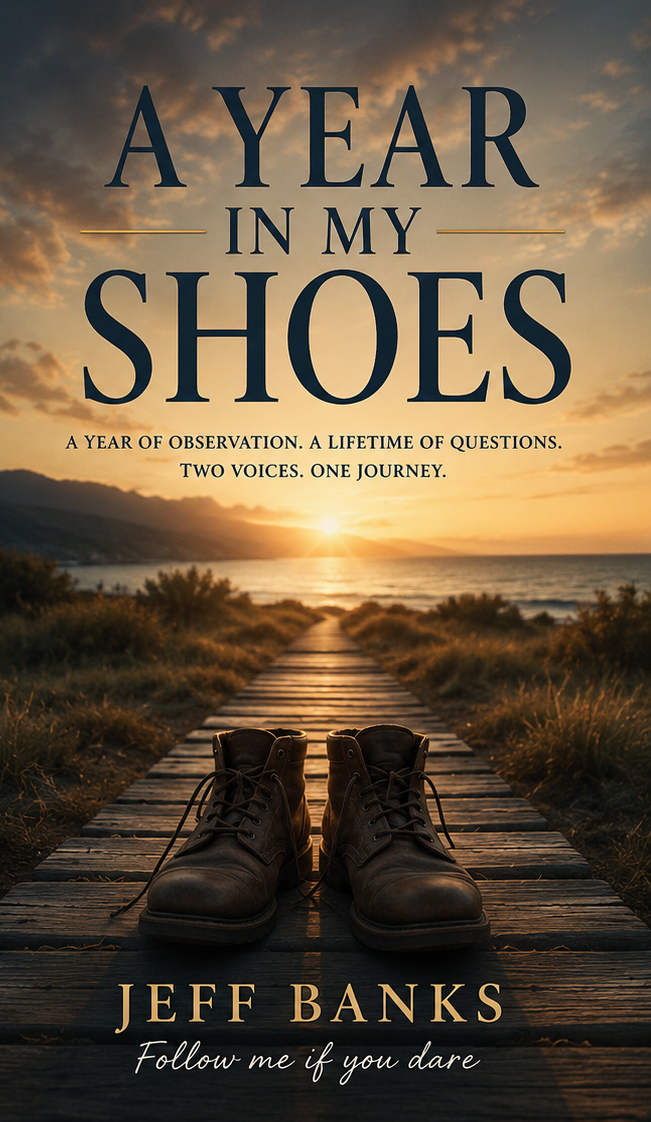
A Year in My Shoes Chapter 12 - The Weight of Useful Things

A Year in My Shoes Chapter 12 - The Weight of Useful Things | Travelling Around Australia with Jeff Banks

There is a tight-lidded feeling in the air, the sense that the year’s middle is a hinge, that the months ahead may demand more from us than we expect, and that we’ll meet them as we’ve learned to meet all things: with a blend of craft and care, a stubborn grin, and a memory that won’t quit, even when the world seems to be leaning in a different direction. The two Jeffs nod to each other, and the Black Dog, still there, still patient, presses its nose to the door but finds the door ajar only a crack, just enough for a sigh to escape and for us to move forward with a little more ease.

A YEAR IN MY SHOES

Chapter 12 – The Weight of Useful Things

The room holds its breath a little, the quiet after the day’s loudness, and I listen for the two versions of me to speak in turn. One is the steady Jeff, the one who tames the day with a calendar and a plan, who still believes that you can fix a world by tightening a joint or aligning a hinge, by ordering the week and the trip to the shed as if the universe might settle if you just get the screws to bite. The other Jeff sits closer to the table, the quieter, present-focused retiree who notices the glow of a lamp on the grain of timber, who hums along with the memory of a crowd and a game, who measures value not in figures but in the warmth of a room after a hard day, and who also nurses the Black Dog, that old, patient roommate who doesn’t always roar, but always lingers.

We’re mid-season of a year that refuses to pretend retirement is a clean cut. It isn’t. It’s a shifting shoreline, a borderland between the old map and the new coast, where the Sandbar’s rope of governance and the kitchen’s quiet rituals keep tugging at the ankles of time. The table in front of me is a small altar of continuity: a chair repaired with more glue than dignity, a cheese board still half-sanded, and a new plank in the works, a plane’s path traced across a Cypress warping back toward a memory of flat, true surfaces. The two Jeffs watch the clock through different lenses: one with a ledger, the other with a grain of wood and a memory of a wedding, of a boy who learned later that craft can be a form of truth-telling when words fail.

Sometimes the day begins with a song that isn’t just a tune but a trigger, a memory key that unlocks doors you thought you’d closed. This morning it is a refrain that drifts from the past into the present, not to mock, but to remind: the ritual matters. The ritual is a fortress and a thread. A man can fix a chair and still hear the floor whispering about all the things not yet done. The Black Dog doesn’t arrive with fanfare; it slinks in at the periphery, wearing the ordinary as camouflage: the unmade bed, the unsent email, the next invoice you’ll pretend isn’t a leverage on your last nerve. It growls in the ribs, a low-frequency hum that resembles patience more than rage, as if the mood itself were weight more than sorrow.

My wife wakes in Sydney with my wife’s care in mind and I wake in the same house with a different clock in my chest. The day will begin with a walk through the memory of last night’s fire, the glow of the stove, the scent of lamb, the quiet arithmetic of a shared meal that was good enough and fed more than the body. In a life where perfection is the enemy of progress, good enough is a stubborn friend. The dinner table becomes a kind of refuge where stories tuck themselves into the corners of plates, where the world’s noise seems to soften for a moment, and where you can admit you don’t have to own the whole map to keep moving.

The morning’s ritual stretches longer than the weather forecast, which is consistent only in its inconsistency. There’s a small, almost ceremonial act: to take a walk to the shed with the bacon-leftover-courage of a man who’s spent a lifetime treating problems like puzzles to be solved with a blade of reason and a twist of glue. The shed is a cathedral of wood and patience, a place where the two Jeffs can agree on one thing: the line between “nearly there” and “there” is never merely a line; it’s a trace of effort, a whisper of pride, a hinge that might yet swing true.

Our daughter’s photograph project keeps circling the room like a planet, a constellation of memory that orbits the family’s life and anchors it to a table, to a chair, to a craftsman’s bench. The Wiradjuri table for my daughter becomes not just a display of timber and resin but a living documentary of belonging. It’s the hinge between a girl who grew into a woman who learned to tell science’s story with warmth and clarity, and the father who learned that the best gifts are not always the loudest or the brightest but the stubbornly durable ones: a board that sits without rocking, pictures that hold a moment without needing a perfect frame, a hand that steadies and a heart that forgives the imperfections you can’t fix with lacquer. The three photos that will line the board, her wedding dress, the handing-over, her life with her husband, aren’t mere decoration. They are the year’s ledger in three elegant lines, a permission slip to acknowledge that letting go is a form of love as much as holding on.

The day’s work pulls me toward the Men’s Shed again, where a different world breathes, where timing is measured in the sound of a plane blade cutting a curve and in the rhythm of a hand plane sighing over a warped Cypress plank. The first session’s successes, flat faces, a table top that sits true when set on its legs, feel like a lighthouse in a foggy harbor. The old hands, the new beginner’s awe, the laughter and the careful instructions, the way one man can turn a stubborn knot into a story about patience, these moments anchor me when the news outside feels like the world’s gears grinding in a different language. In this space, the Black Dog is not a roaring beast but a whispering advisor: patience, not panic; method, not improvisation; a belief that when the wood yields to a patient hand, the world might yield to it too.

Sam the Park Manager arrives, driven by a sense of unfinished business and a half-formed dream, and we talk about the Sandbar’s face for the year to come. The conversation’s dance is familiar: I speak of change in measured terms, of scaled projects and careful governance, of the need to balance ambition with due process. He speaks in the cadence of a caretaker, a person who understands that to push too hard is to risk what the place already is: a living, breathing community hub where volunteers give what they can and ask for nothing but a fair chance to be seen. We retreat to the edge of the fairway and look out over the grass that’s already slick with damp, imagining how to coax a more robust resilience from a patch that has borne the weight of a thousand little compromises, the irrigation lines, the sign’s update, the slow, stubborn regrowth after a season of rain.

The real tension of the morning isn’t the physical work or even the political theatre of management; it’s the quiet erosion of purpose that runs through the day’s small tasks. The moment when you realise that you’re not chasing a single end but sustaining a mode of being: you show up, you fix what you can, you contribute what you know, you tell the truth as you see it, you let the questions remain in the room and move on with the hand you’ve got. It’s not glamour; it’s a rhythm, and rhythm is what keeps the Black Dog from announcing itself with a roar every afternoon.

That rhythm also carries a strange warmth: the ritual of feeding neighbours, of handing off jars of fresh chilies from the garden, of the everyday act of generosity that feels almost revolutionary in a world that treats shopping centers as local sanctuaries and signs personal connections as optional. The market is a theatre with its own gravity, a place where the world’s small, honest acts collide with a larger, often hollow, promise: the idea that consumerism can satiate hunger, that a jar of chutney can replace community. I watch the jam maker’s labels, the wool spinner’s honesty, and I hear the friction between marketing language and the lived truth of a small producer’s life. It’s not cynical to notice the difference; it’s necessary to protect the spaces where truth can breathe.

As the day tilts toward late afternoon, the family’s orbit calls again. My wife reads the room with a quiet, almost surgical exactness, tending to her eyes and to the calendar’s demands with the same careful attention she’s given to every project we’ve touched together. There are moments of tenderness: a text from my daughter about a door left slightly ajar on a shared memory, a phone call that maps out an upcoming family milestone with a tenderness that makes the ordinary feel sacred. The house’s bones,, its walls and its chairs and its little rituals, hold the day together. They are the spine of a life that’s learned to carry more, not by stacking more weight but by choosing where to place it.

Music and film drift in and out, not as a soundtrack but as a memory triggers, as soft anchors that tether the present to the old, a way to measure how far I’ve come without losing sight of who I was. The Captain America (1990 – Colombia TriStar) vigil and the Star Wars marathons appear as moments of learning rather than distraction; Captain America’s Sam Wilson is a mirror for the self I’d like to be, not flawless, not a savior, but stubbornly reliable in the shelter of the ordinary. The Force Awakens (2015 – Walt Disney Pictures) era shows a girl who’s more light than dark, and Rey’s balance becomes a living metaphor for the life I’m trying to craft: a balance between the inherited duty of family and the independent grace of a man who’s learned he’s not a hero by grand gesture but by the steady kindness of showing up.

By nightfall, my wife and I talk quietly about the future’s simple architecture: not big leaps, but a few nailed-together steps that keep the house from sinking under the weight of itself. The kitchen ritual returns: a butter chicken experiment that isn’t about culinary ambition so much as resolve, to feed the body and, in doing so, feed the mind back into its better places. The dish isn’t perfect; it isn’t meant to be. It’s another expression of making do, another evidence that a life built around improvisation can still produce something warm, satisfying, and true.

Weight and weather keep their stubborn arithmetic: the scale, the back, the sleep, the ache that travels through the hip and the shoulder and returns as a dull, familiar drumbeat. The Black Dog has a way of arriving in the gaps between action, a reminder that even in the middle of a day’s small triumphs, the body knows what it’s been through, the miles of road, the nights of uncertain health, the long lists that never end. And yet there is something quietly liberating about naming the struggle, about speaking the word you’ve learned to fear in a tone that doesn’t give it power to dictate your mood. If the weight on the scale is real, so is the weight of meaning when I choose to keep moving, when I choose to repair rather than replace, when I choose to build a table with three legs and a memory, not a showroom-staged sculpture.

The month’s end, though not a formal end, for we don’t end like a month concludes, feels like a turning toward synthesis. The two Jeffs have shifted into a more comfortable dialogue, the steady problem-solver and the quiet retiree who still believes in the power of a good day’s work, in a chair that doesn’t rock, in a table that does. The two lives have a language now that isn’t simply a compromise but a shared map: we move through a world where responsibility remains heavy and opportunity persists in the smallest acts,  an invitation to come to the shed, an invitation to share a meal, a hand extended to a neighbour with a bag of fish, a photo framed with a future in mind.

In the scramble of the Confidia ledger, the crypto maze, and a mortgage market that jitters at every wind, I still hear the old truth: you cannot outrun consequence by busying yourself with more tasks. Consequence will show up in the quiet places, the body’s ache after a long day’s labour; the bank’s demand for a clean audit trail; the memory’s insistence that a life be remembered with a certain accuracy even when accuracy itself is a stubborn companion. So I learn to live with the tension: the sense that the world’s complexity doesn’t shrink because I’m tired, but that the management of it, through craft, through care, through the small theatre of a shared life, does bend the edge inward, slow the storm, and give us a moment where we can breathe and say, yes, this is enough for now.

And then there are the moments that arrive like small, bright coins tossed into a fountain: the chair that’s truly sturdy; the two old friends who walk into a shed and walk out with a new project, their voices lifting with laughter and the shared pride of a day’s honest labour; the memory of Richard’s girls on their birthdays and the memory of a man who would have liked to see his kin building new futures on old soil; the quiet pride of my daughter’s success and the knowledge that what we’ve built can support her, support my daughter’s husband, support their life’s unfoldings. The world’s noise remains, but it no longer drowns out the soft engine of purpose that keeps turning when the lights go down.

If the month has a hinge, it’s a moment when the two Jeffs align and the Black Dog’s leash, though not dropped, grows a little shorter. It’s the moment in which the shed’s lamp lights the grain of a Cypress plank not as a product but as a promise: that even warped wood can be planed true; that even a life cracked by time can be flattened enough to host a family table; that even a retirement that feels like a drift can become a map for those who learn to navigate it with patience and stubborn heart. The world’s storms will keep tossing the ship; we’ll keep bailing, repairing, and remembering that the ship is ours not because we own the weather but because we own the act of showing up.

The last full measure comes not with a thunderclap but with a soft rain at the edge of evening, the kind that makes a man want to stand on the deck, look across a lake that glints under a late sun, and feel the quiet gravity of home. The kitchen light glows, the chair sits steady, the table’s lines have become a little friend you can lean on. The year has not sprinted to a finish line; it has transformed into a scaffolding you climb with care, the sort of structure you’ll remove only when you’ve built something you can carry forward. The room holds the smell of a slow-cooked supper and the glow of a man who has learned to measure success not by the number of tasks completed but by the number of people touched by what’s been done, the warmth that remains when the shouting has subsided.

There’s a sense that the year’s synthesis lies not in a single revelation but in a quiet thesis: that life, in its most valuable moments, comes down to what you choose to hold close and what you choose to pass along. The sentimental is a dangerous fuel, but memory, when tempered by craft and care, becomes a living instrument. The timber you plane, the chair you fix, the table you design for a daughter’s memory not as a possession but as a story you want to tell her children, the act of creation becomes faith in the future even as the present’s questions gnaw at the edges.

So we keep the rhythm of ordinary miracles: a birthday text that lands with a sigh of relief; a neighbour’s laugh at a lunch table; the scent of rosemary in the breeze as a door opens to a world of small, shared kindness; the quiet relief that comes from a successful repair and a day that didn’t require heroic courage so much as stubborn decency. The Black Dog, still there, does not vanish; it shifts its mood with the weather, with the night’s sleep, with the ache in the back that signals a body that has earned its years and its scars. Yet it cannot undo what the day’s work has begun: a family that endures, a business that learns to walk with grace rather than sprint toward a horizon that can’t hold its breath for long, a mind that keeps asking questions even when the answer it finds is that there are no perfect endings, only ongoing acts of care.

In the end, the synthesis feels earned, not granted. The open box of potential in the shed’s corner has grown clearer: three new tables, a set of memory-keepers in resin and timber, a number of projects that will outlive a season and become the furniture of a family’s life. The instruments, the router and the thicknesser, the laser printer and the old hand planes, remain instruments, not idols; they are the means by which a life is shaped rather than the life itself. There is a last, small gesture: a kiss on my wife’s forehead after she tucks the last cup away, a nod to the memory of a wedding, a quiet pledge to be present for whatever comes next. The dinner conversation dissolves into comfortable silence, and in that silence, I realise the greatest thing I’ve learned this year: to keep faith with the ordinary, to accept that the extraordinary will come to you when you’ve learned to show up for the day itself, again and again, day after day, even when the days feel like the same day wearing a dozen different masks.

And so the month ends with a breath, slow and steady, and a sigh that is not surrender but a promise: I will keep building a life that matters, I will keep tending the shared soil that feeds us, I will keep listening to the dog at the door and finding ways to invite him to stay, not to rule the night but to help me find the dawn. The year’s arc, in its quiet, stubborn way, threads forward: retirement not as a bow but as a bridge, craft not as a hobby but as a way to anchor identity, memory as the instrument that keeps the tune honest, and love as the one permanent structure that doesn’t need a blueprint to prove its worth. If the last pages of June have taught me anything, it’s this: the synthesis isn’t a finale; it’s a commencement, a doorway into a year’s second half in which the two Jeffs walk side by side, the Black Dog kept closer by care but never allowed to steal the entire day, and a table that stays upright not because the wood is perfect but because it’s loved, trusted, and fed with the light we’ve learned to carry home.

The morning after the confession of the long day’s work, the chair finally stubbornly true, the table gluing itself to a future, I wake to the soft ache of a body that has earned its keep in a way the calendar won’t applaud. The two Jeffs are there, as they always are, not arguing but reframing, one with a ledger’s gravity, the other with a grain’s patient memory. The Black Dog is a footnote today, not the headline. It taps at the edge of consciousness and then slides away when I let the sun come through the blinds and touch the edge of a timber’s grain.

July begins not with a fanfare of breakthrough but with an ordinary morning that feels like a turning in a narrow hallway. The house is awake but not loud, my wife in the kitchen with the quiet choreography of someone who knows exactly where the cups go and why the kettle should be boiled with intention and not as if it’s a ritual to rid the day of its own dampness. The memory of last night’s supper, lamb shanks again, not because we’re sentimental but because the bone and the marrow remember how to pull the room toward warmth, lingers, a warm scent that can anchor a mood even before the first lines of speech are spoken.

The two interior voices do not bicker; they converse. The steady Jeff lines up the day like a golf shot, measuring wind, the lie, the target hole. He sketches a quiet plan: the Confidia ledger still isn’t finished, the currency shadows still cross the page, but there is a rhythm now, a pattern that begins to feel less like chaos and more like a map. The quieter Jeff, the present-focused retiree, tugs at the sleeve of memory, reminding me that this isn’t retirement as a pause so much as retirement as a different charge: a mandate to nurture the things that endure when the adrenaline of invention subsides, the things that hold a family’s gravity, habits, rituals, small acts of repair, the capacity to make useful what others might discard.

We move through the morning as if we’re shadowboxing time: not with fists but with hands, with the careful application of oil to timber, with the ritual of a cup of something hot that doesn’t burn but steadies. The shed’s light creeps across the workbench where the Cypress plank finally lies free of its warp, a single plane stroke away from becoming what it was meant to be, part of my daughter’s memory board, part of a wall-hanging that will one day catch echoes of a life lived in sound and silence, a memory that isn’t trapped in a frame but breathes through the room’s quiet, room after room.

As the morning wears, the world outside coughs with weather, a seam splitting in the sky, a reminder that the climate never signs a calendar. The markets, the politics, the Sandbar’s governance, the social science of a community that lives by volunteers’ choices, these do not vanish when you decide to make. If anything they sharpen. The two Jeffs know this well: you don’t retire from the world; you retool your contribution. You move from the boardroom to the workshop, from the kitchen to the creek, from the online invoice to the one that comes in your hand at the end of a day’s honest labour.

The day’s work is a sequence of small choices, each carrying a half-smirk of humour that guards the serious, a mechanic’s humility. The first is a phone call to my daughter and her husband, not to chase a price but to check the shape of the next move. The Melbourne unit’s negotiation lingers in the background like a slowly turning gear. They’re not rushing; they’re thinking. That is enough to remind me that negotiation is not only arithmetic but theatre and psychology, a rehearsal for the moment when a life is at stake, when the future’s map must be drawn with care, not with impulse.

Our daughter is in property mode again, the way a player is on the greens when the wind shifts and the sand glides under the feet. Her partner speaks softly, their voices carried by the highway’s hum, a cadence born of years of learning to read the terrain without trampling the vines. The line between emotion and calculation remains delicate; the line between desire and due diligence is the landscape we’re always crossing. I offer perspective rather than instruction, a habit I’ve grown into: a slow, patient commentary that helps them keep their pulse steadier than their fear.

The phone call segues into a memory: Richard’s twins turning thirty and the conversation with his wife, a quiet rebellion against a corporate machine that knows the price of a breakthrough but not the cost of a quiet life. It’s a memory that travels with me as I drive to the shed again, the memory of a friend who could read a room as deftly as he could read a bus timetable in a foreign language. Grief does arithmetic with time: it stretches the moments that matter and compresses others, and the trick is to let the ones that matter stay in the daylight, not relegated to the melancholy basement where the Black Dog tends to lurk.

In the workshop, the day’s problem, how to fix the wobble of my daughter’s Wiradjuri table, becomes a metaphor for the year’s larger problem: how to keep faith with what matters when the world keeps asking for more, faster, and louder. The legs must be true, not just by measurement but by trust. The old hands here speak in a language of squared feet and straight lines, a conversation that doesn’t pretend to fix the world but fixes a table that will hold a memory. The moment of truth arrives when the table’s weight is tested by a hand that isn’t asking for attention but demanding it, when the leg’s joint settles and the table sits with new dignity. The room yields a soft, surprised breath, as if to say, “Yes, this is what it means to make something right again.”

The crafting is not only a return to form; it’s a return to a way of thinking, a line to the past that does not pretend the past is a perfect map but respects its roughness. The warp’s remedy becomes a quiet sermon: not about getting it perfect but about making it honest. The workshop is a kind of school where experience is the teacher and humility the coursework. The other men, Tony, the elder with the calm eyes who treats a blade’s edge as a living thing, and the others who bring their own stories and their own struggles, are not spectators but co-authors of this day’s narrative. We talk in the polyphony of chatter that rings with the sound of a router and a sander’s pulse, a chorus of small, patient crimes against entropy.

Lunch at the shed is a ritual all its own: the barbecued sausages, the fat of the day’s work, the laughter that arrives with a joke about the stubborn screw and the loyal, stubborn man who refuses to accept defeat. The banter is a therapy in its own right, an antidote to the quiet seriousness that threads through the morning’s work. The talk drifts to the club’s finances, to the promise of a new signage project, to the memory of Richard’s absence and the way community spaces keep the memory of him alive not through monuments but through the living rituals of a game, a meal, a shared fence, a common laugh.

The afternoon offers a moment of grace in small, easily overlooked forms. A memory triggers a film’s line, a song’s chorus, a moment when a man learned that constraint can be a kind of freedom. There is a scene in which a character insists on building something not because it’s needed but because it’s a demonstration of care, a demonstration of the belief that life’s sum is greater than its parts. The day’s work flows like water around a rock: you push, you pull, you adjust, you learn to live with the resistance of the days and still find a channel for movement. And when the sun sinks a little, when the last clamp releases and the table is laid in the sun’s last gold, I step back and see not a finished object but a living object: something that holds memory and potential side by side.

The Sandbar life returns in a different light. The governance discussions come with new information about the cooperative’s future: the new membership drive, the charity raffles, the quiet, almost sacramental pace of a volunteer culture that refuses to be hurried even when the clock is loud. The club’s atmosphere, the iron reflex of keeping the ball rolling, the sense that someone is always listening, feels like a mirror of the home we’ve built here. It’s where I learned to value not the trophy but the honest, stubborn practice of showing up, of taking a position on the field and holding it with grace even when the crowd’s attention drifts elsewhere.

Even as I stand in the shed’s doorway, a glass of something in my hand, listening to the muffled thump of the last nails being hammered, I hear a distant trumpet of a future that isn’t certain but isn’t fearsome either. The year’s questions don’t vanish with a single turn of the calendar. They migrate; they settle into the corners of the room and demand a different form of attention. I realise that the two Jeffs’ dialogue is not about dodging reality but about refusing the temptation to pretend reality can be avoided. It’s about learning to interpret what the world throws at you with the same calm you bring to a chair that won’t sit still, to a real estate negotiation that won’t slow down, to a family’s needs that never stop asking to be seen.

Even the conversations with my daughter and her husband return in a gentler key this month, a conversation about money and meaning that doesn’t end with a winner or a loser but with a plan that can be adapted as life’s weather changes. They’re careful with each other, the way adults who’ve learned to speak honestly with tenderness are careful: not to crush hope under a ledger’s weight, not to turn caution into fear, but to balance both into something that resembles wisdom. I offer a perspective shaped by years of watching people do the right thing badly and then do it better: a reminder that value isn’t merely what you can quantify on a spreadsheet but what you can pass along as a kind of moral capital, how you treat a vendor, how you respond to a delayed shipment, how you handle the truth when it’s not convenient to tell it. In the rooms where the two Jeffs share air, that becomes a moral compass as much as a business plan.

The health notes continue to march through the month like a slow drumbeat. Sleep remains a negotiator with the body’s stubborn needs; the Black Dog remains a constant, a partner in the room who sometimes draws breath with you and sometimes lingers behind the door, waiting for a moment to remind you that you’re mortal, that you carry more than your numbers and your plans. Retirement remains a proposition rather than a promise; it’s not a day when you hang up a badge but a life that asks you to adjust the strap again and again, to learn to hold the line with fewer resources, to learn that care is not a sign of weakness but the condition that allows you to keep giving.

There’s a moment, mid-month, when the house’s routine seems to pause and listen: the soft, almost musical whirr of the shed’s planer, the kitchen’s soft clink of cutlery, the distant hum of a car on the highway. The two Jeffs look at each other and nod, a quiet treaty: the work will continue but at a pace that respects the body and the heart; the memory boards will grow, not in size but in depth; the Sandbar’s governance will be more thoughtful, not less ambitious; the family’s needs will not be postponed or ignored in the chase for the “big” thing.

The fishing charter that looms in the background, an event that would feel like a small pilgrimage in another life, becomes a thread for the month’s end. The group’s weathered patience meets the sea’s indifferent appetite, and the day’s catches become a ledger of memory: the big snapper that my wife lifts with pride, the day’s quiet heroics that come from not letting a single wave wreck a morning, the way Speedie makes sense of the tides the way a good broker makes sense of risk. It’s not about trophy hunting; it’s about ritual, about the promise that a line cast and a fish landed carry more weight than a word spoken in a room full of numbers.

And in the quiet after the day, as the wind drifts in and the room grows cooler with the sun’s retreat, I catch the sentence the month has needed all along: this is how we become who we are, not by conquering the world but by stewarding the small spaces where life actually happens. The two Jeffs return to the same question, whether retirement is a cessation or a transformation, and I hear again the answer the heart gives when the mind’s ledger has run its course: not a goodbye but a redefinition. It’s a shift from the need to prove to the world that you can fix everything to the obligation to keep a life that can be lived with dignity, with care, with humor when it’s needed and silence when it’s wiser.

The month’s end comes not with a crescendo but with a quiet, a sense of synthesis that doesn’t pretend there’s nothing left to do but that there is a way to do it differently. The workshop lights dim, the shed’s last tool is laid down with respect, and the house settles into a comfortable stillness that holds both memory and hope in its quiet corridors. The Black Dog sits in the corner, not defeated, not loud, merely present enough to remind me that the work is ongoing, that the day’s task is not to finish life but to keep faith with the living. The two Jeffs share a glance that says we’re tired, yes, but we’re not done. Not yet.

And so, as the night closes in around the glass of wine and the soft thrum of cricket outside, I lean into the chair that has become the year’s quiet theatre. The room’s temperature and tone make a small stage for the mind’s rehearsal: the past’s weight, the present’s call, the future’s tentative, shimmering possibility. The memory of Richard glances by, a finger of absence that doesn’t sting so much as guide the way, reminding me of a man who understood that friendship isn’t a ledger’s asset but a living practice, the kind you practice by showing up, by listening, by naming what hurts and choosing to keep going anyway.

If there’s a single breath, it’s the one that comes after you set the last tool down and feel the glue dry, the last joint settle, the last memory board’s edge catch a ray of light. It’s the feeling of balance: not perfect, not complete, but honest enough to let you lean on it. The two Jeffs, those twins in one body, know there will be another day’s work, another meal to cook, another negotiation to navigate, another story to tell that will be better because you told it with your own truth intact. And as the house grows quieter, the night grows deeper, and the sea keeps its patient counsel beyond the window, I realise that synthesis isn’t a final act. It’s a practice. A way of moving through the next month’s weather, the next season’s storms, the next set of demands with the same stubborn calm that has kept us afloat this year.

Tomorrow will come with its own questions, its own memory triggers, its own songs to anchor us, its own films to hold up against the day’s soft, heavy light. The Black Dog will rise again, maybe with a different tune, maybe with less bravado, maybe with a kinder, more persuasive voice that asks for a moment of rest before the next round of labour. And we will answer not with bravado but with the quiet, stubborn yes that says: we will try again, we will fix what can be fixed, we will let go when letting go serves the larger good, we will show up for the people who need us, and we will continue to build a life that matters, even if it never makes the headlines.

The final note is simple, a memory and a promise wrapped into one line: the work is not simply about the chair or the table or the board. It’s about being here, with my wife, with my daughter and her husband’s growing life, with the Sandbar’s weekly rituals that anchor a village of people who know the price of care. It’s about memory’s power to keep us honest, about humour’s mercy, about the craft of living well under pressure. It’s about recognising that the day’s worth is not measured by what you accumulate but by what you pass along, stories told, hands repaired, a meal shared, a memory kept safe for the dawn.

And with that, I lean back and listen to the room’s quiet, to the house’s soft breathing, to the slow, invisible turning of the year toward synthesis. The two Jeffs rise and settle, a balance learned, a balance kept, a balance earned by showing up again and again. The Black Dog sighs, perhaps a touch closer to sleep, and I, for the moment, finally believe that this is enough: the day’s work, a life’s work, a story that’s not finished but is never done. In this room, at this table, we find our measure not in the perfect nail but in the patient trail of wood shavings and memory that will outlive the year’s next storms. And that is the truth that keeps us going, one quiet, stubborn day at a time.

The morning unfurls with that careful, almost choreographed quiet you get when a day isn’t sure whether it wants to be productive or healing. The two Jeffs drift through the kitchen like old colleagues who know the joke but pretend not to tell it too loudly in front of the guests. The steady one, the one who still trusts a plan and a handbrake on the world’s momentum, leans into the day with a coffee cup filled with something dark and honest. The quieter one, the present-focused retiree who notices the grain in the timber’s skin as if it were a map, nudges the day toward smaller, slower verbs: mend, align, measure, coax. And between them, though not always in loud dialog, lives the Black Dog, quieter today, a moth in a jar, fluttering but contained, waiting for a gust to loosen its hold or for a moment of mercy to loosen the jar.

We drift through a morning that smells of coffee, timber dust, and lemon zest from my daughter’s husband’s preserved chillies. The shed light steals across the bench, catching on the edge of the Cyprès plank, which now lies true enough to be coaxed into becoming my daughter’s memory board piece rather than a stubborn warp that refused to bow to our patience last week. The glue has dried in a pale film, the screws have found their mates again, and there’s a bruise on the table’s side where a clamp pressed a little too hard, a reminder that even craft is a negotiation with the world’s quirks.

I begin by cataloguing the small wins, not to boast but to anchor belief. The two Jeffs keep a joint ledger in their minds: the big wins, the currency hedges, the contracts, the long-term plans for Confidia, paired with the tiny, tactile triumphs, the chair that finally holds, the table that doesn’t rock, the memory board’s traces that will hold my daughter’s life together in a home she and her husband will create. It’s not a confession, it’s a seam. You stitch the visible with the invisible; you stitch memory to practice, because memory will outlive a moment’s spark if you don’t give it a room to breathe.

The day’s work begins with my daughter and her husband again, not in the literal boardroom sense of a real estate negotiation but in the life-as-ongoing-boardroom sense: decisions that will ripple outward for years, even when the market’s mood changes with the weather. My daughter’s husband’s cautious optimism walks hand in hand with my daughter’s rising certainty, and I’m a stray committee member who happens to know something about numbers and something more about people: the way to ease a pulse is not to give an answer but to hold space for a honest pause. We talk of Melbourne units, the vendor’s price, and the uncertain chorus of “another interested party” that keeps popping up like a chorus in a song you’ve heard too many times but never quite learned the words to. I remind them, softly, that price is a narrative, not a verdict; it’s the opening bid in a long conversation rather than a truth etched in stone. The trick is to keep the pulse from racing too fast, to keep one eye on the mortgage and the other on the life they want to build in Melbourne, which is not merely a roof but a geography for belonging.

Money and memory twist together in my mind as I watch them talk, and the memory goes off like a flare: the twins’ birthday, the old friend’s passing, Richard’s absence and the way it sits in a quiet corner of the mind like a well-marked seat in a theatre that no longer has a show but still has a memory of laughter. Grief isn’t something you measure in hours; it’s something you measure in how long you carry a certain weight without letting it define every movement. And today, I realise that the weight has a rhythm: it rises, it settles, it invites you to shift your stance, to change the leverage you’ve been using on life’s heavy things. That rhythm becomes the day’s drum, a subtle percussion that keeps me honest.

The second thread of the day veers to Sandbar life: its governance, its half-glass-full, half-glass-empty dynamic, and the volunteers who keep the place alive even when the world’s news becomes louder than the daily green. We talk about the elder statesmen who show up with the same jokes, the same concerns, the same quiet desperation to keep the place afloat, and I see again why the club has become a living study in community. It’s not about winning at golf or ponying up for the best deals; it’s about showing up when the car’s broken, when the weather is unkind, when your own body is whispering that it’s not sure it wants to go out again but you go anyway because it’s a place you belong. The Benches become a chorus of memory and habit, a microcosm of the life I’m trying to craft for myself: a way to contribute without breaking, a way to be useful without losing the sense of self.

There’s a moment during the lunch break when Speedie, who always arrives with a mixed bag of optimism and no-nonsense, sets up a mini whiteboard session in the shade. We draw a handful of options for the year’s next moves, and the room hums with a gentle, almost conspiratorial energy. This is not a room where illusions thrive; it’s a room where reality is examined with a respectful fear and a stubborn hope. Speedie’s eyes light up when we sketch a path that could bring some stability to his portfolio without threatening the entire enterprise, while I nudge the conversation toward keeping the plan agile: a strategy that can bend without snapping, a plan that respects the old guard and invites the new blood in.

The memory triggers keep coming in waves: Captain America’s shield, Rey’s weight, a line from a film that anchored a moment in Richard’s life, a joke about a chair that wouldn’t sit, a scene from a show in which the protagonist fights not to give up but to keep going even when the world seems set on proving him wrong. These anchors do not merely decorate the day; they map its emotional topography. They are the daylight map readers, the compass points that remind me where I’ve come from and where I’m trying to go. I start to weave them into the day’s work as if I’m stitching a map onto the memory board I’m building: a collage of songs and films and conversations that tell the truth of a life lived in moments, not a chain of calendar ticks.

In the workshop, the Wiradjuri table’s legs begin to tell their own tale: not merely a fix but a redefinition of what it means to carry a memory into a home. The leg joints, once a stubborn puzzle, yield to a patient approach: planed surfaces, measured glues, the quiet, almost ceremonial tightening of clamps. The old man’s pride, my pride, really, rises as the thing sits, square and level, a practical monument to the idea that you don’t have to be perfect to be sturdy. The memory board’s photography fuels the moment, too: my daughter’s wedding dress stands as a silhouette against the past, her husband’s smile in the wedding photo a reminder that love is a kind of architecture, a structure you build not alone but with a circle of support.

The day’s terrain is not flat; it’s undulating with the gravity of the year’s larger questions: How long can you remain useful before usefulness itself becomes a burden? How do you negotiate your own energy while staying present for the people you care about? The Black Dog’s presence is the quiet hinge: not a blast of despair but a slow pressure that sits at the edge of the day until you choose to ease your posture and breathe into the moment. Some days the Dog’s growl seems louder than your own; other days you notice that a mild, almost affectionate rumble can be coaxed into a lullaby by a familiar tune, a familiar gesture, a memory that tethers you to the good that remains.

The phone continues to chirp with the ordinary and the extraordinary: a call from a client about a complex trust arrangement that must be explained with patience and a hundred clarifying questions; a word from my daughter about a vendor’s counteroffer that demands a steadier tone than she’s used to wielding; a note from my wife about an eye drop regimen that has to be followed with a schedule as precise as a manufacturing line. I respond with a rare combination of clarity and gentleness, a tone I’ve learned is both efficient and kindly: say what you know, ask what you don’t, don’t pretend you know what you don’t, and do what you say you’ll do. It’s not a magic spell; it’s a habit, one that keeps people trusting you even when the ground is shifting.

Evenings bring a reprieve. We sit with a film that doesn’t demand spectacle but allows space for the mind to breathe. Not the blockbuster kind, but the quiet, human piece: a film about memory and reconciliation, about the stubborn grace of ordinary people who repair what’s broken and keep moving forward. The two Jeffs watch with a quiet humor that’s not frivolous but life-affirming: a reminder that art can hold conflict and tenderness in equal measure, that vulnerability can coexist with competence, that the honest telling of one’s fear can become a kind of courage.

As the day’s last light fades, I step back from the memory board to see the arcs of the month’s stories align like the faint lines of a coastline seen from a plane window: the Sandbar’s governance steadying, the family’s needs receiving attention, the old friendships kept alive by a text or a phone call or a shared meal, the garage’s clutter gradually converted into space for a new idea. And I think about the larger arc we’re walking toward, retirement as a transition, not a finale; the shift from “how much can I build today?” to “how can I sustain what matters for tomorrow?” The two Jeffs talk about it in a murmur that’s almost a lullaby: we’re not chasing a finish line; we’re refining the engine we already own, making sure it purrs long enough to carry us through the next stretch.

The night ends with my wife’s return and a quiet supper that tastes like weathered wood and memory. We talk softly, not about the heavy stuff but about the small things, the stain on the cheese board’s edge, the pattern the router might carve, which family member’s memory we’ll honor next with a piece of furniture or a photograph. The talk is a gentle coda to the day’s work, not a closing argument but a settled note, a shared understanding that this life’s rhythm isn’t about dramatic breakthroughs but about showing up, again and again, for the people who make the house a home.

There is a tight-lidded feeling in the air, the sense that the year’s middle is a hinge, that the months ahead may demand more from us than we expect, and that we’ll meet them as we’ve learned to meet all things: with a blend of craft and care, a stubborn grin, and a memory that won’t quit, even when the world seems to be leaning in a different direction. The two Jeffs nod to each other, and the Black Dog, still there, still patient, presses its nose to the door but finds the door ajar only a crack, just enough for a sigh to escape and for us to move forward with a little more ease.

In the dawn that follows, the day’s work will begin again not with the loudness of conquest but with the quiet invitation to contribute: to fix, to teach, to listen, to learn, to repair what can be repaired, to cherish what has endured, to plant what will outlive the current season. The month’s end will come in the same way it always does: not a fireworks display but a careful alignment of the pieces that have carried us thus far. The two Jeffs will wake and speak in their shared room of memory and possibility, and the world, Sandbar, family, work, the long, stubborn, beautiful practice of living well under pressure, will keep turning, insisting that you show up again tomorrow with the same stubborn grace you brought today.

So we breathe, and we move, and we listen for the Dog’s soft growl to remind us of the line we’ve drawn and the line we’ve kept. The room holds us, the timber holds us, the memory holds us, and the life we’re building holds us steady enough to keep going. The month that began with a chair’s stubborn fix and a memory board’s quiet frame now widens into a narrative that’s not about endings but about continuation: a year’s synthesis, a life rebalanced, the constant return to the workshop, to the kitchen, to the club, to the river of memory that flows beneath every ordinary day and makes them worth talking about at length, around a dinner table, with the sound of a radio humming in the background, and with the unglamorous, unflashy, utterly true work of showing up.

Author

Menu