

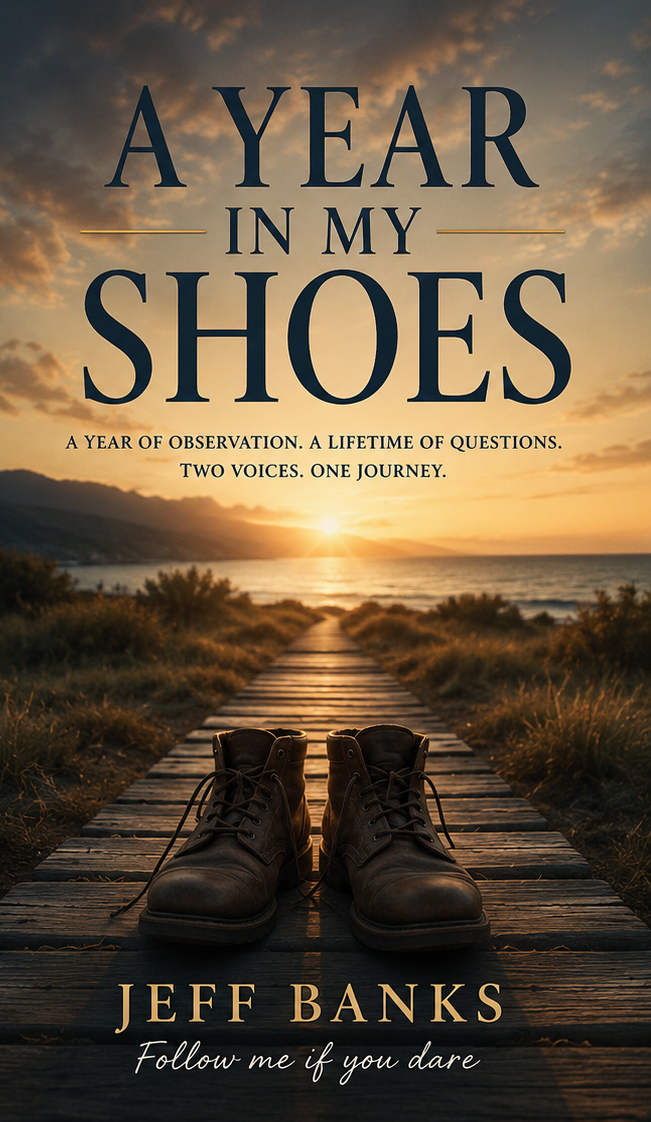
A Year in My Shoes Chapter 11 - Still Moving, Still Wondering

A Year in My Shoes Chapter 11 - Still Moving, Still Wondering | Travelling Around Australia with Jeff Banks

A week folds into another week, and the room keeps its quiet, even as the world outside keeps changing its weather and its rules. The two Jeffs sit closer now, not because they’ve finally agreed on a single path but because they’ve learned that the best conversations don’t demand a verdict; they demand a further tightening of the weave, a few more threads pulled to make a tighter fabric of days. The Black Dog is not banished, just invited to the table with a softer nightlight and a casual truth that sometimes the shadow is the room’s hinge, the point where you pivot rather than pretend you’re standing still.

A YEAR IN MY SHOES

Chapter 11 – Still Moving, Still Wondering

Two Jeffs remain at the same table, even when the room is loud with the hum of a golf club waking up a bit later than it used to. One Jeff, the steady, problem-solving, ledger-reading, problem-spotting guy, leans in with a pencil-thin patience for the stubborn bits of life that demand a method, a plan, a budget, a plan for the budget. The other Jeff, quiet, present-focused, somehow always listening to the room even when the room is too loud to hear him back, taps a finger on the edge of the chair and looks out the window as if the world there might tell him what to do next without the need for a memo. The Black Dog skulks somewhere between the two, a patient, uninvited guest who prefers not to shout but to linger in the kitchen between tasks, tapping the mind with a slow, insinuating weight.

The day begins with a sky that doesn’t rush. It’s a soft, damp light, a sound made of rain-clouds that haven’t decided whether to spit or to hold. Sandbar greens glisten, the fairways breathing with the after-rain scent, and the little rituals of the club, the tape measure, the stakes, the map drawn in the dirt where landscaping might yet appear, are arranged on the table of my mind like a work plan I can almost trust again. I’m in a phase where the ripples of life have grown into a quiet swell, and the swell, I learn, is precisely where the work of living well begins. The two Jeffs exchange a look I’ve learned to read with the same precision I used to read a client’s numbers: one in focus, one a touch hopeful, both aware that the year’s end is not a red line to sprint toward but a horizon to cross with care.

We’ve just had a week that fought with weather, with council papers and bank forms, with ideas that sounded elegant until you tried to bake them into real life. Our staff member’s thing, the notice, the not-quite-yet-finished handover, the awkward last-mile of a career with a curtain about to fall, lingers in the air like a golf flag that won’t drop, a reminder that even the most beloved routines carry loose ends you can’t pretend aren’t there. The two Jeffs talk softly about it, not arguing, but choosing strategeries that respect both the human story and the need for some practical breathing room. We’ve learned that you can’t retire a life with a single breath; you do it in small acts of letting go, little by little, so the air can come in and the room can be filled with something other than the echo of what used to be.

In the quiet, one of the ordinary rituals of Sandbar life returns with a familiar laugh: the working bee of one. I’m there with my wife,  gumboots, a tape measure, an earnest determination to shape something that doesn’t yet exist but could, with a little emotion and a few careful cuts. The fourth hole’s drainage, the palm fronds, the little mulched strips that might blur the harsh lines between water and grass, all those pieces are the stage on which the small dramas of community life play out. Terry is there, optimistic, the tractor’s soft clunk a counterpoint to the administrative anxiety that gnaws at me when I think about the balance sheet and the new structure my business partner is chasing like a cat after a sunbeam. The word “second bin” returns in a dozen conversations, not as a mere container but as a symbol: every simple improvement seems to pull a caravan of obligations behind it, forms, approvals, shelter, storage, fees, until you wonder if you’ve become an archaeologist of your own life, digging for purpose in the layers of paperwork you never meant to exhale.

I’m not pretending I’m outside it all. The life I’ve lived has taught me to ride a thousand currents at once, to stay on the wheel while the world shifts. The two Jeffs argue softly about the pace. The steady one wants to measure, to forecast, to forecast the forecast. The present-moment Jeff nods toward the lake, toward the sound of the water on the reed beds, toward the men who make a living with their hands and don’t pretend to have all the answers but do insist on finishing the task with a clean conscience and a good counter story for the bar afterwards. The Black Dog, meanwhile, sits under the table for a moment and then slides off to the corner where the old songs and the old ghosts keep him company: not loud or melodramatic, just present enough to remind you that you’re still moving, even when you’re tired of moving.

Memory is the quiet engine of the month. It runs in the background and sometimes roars at the surface, like a submarine surfacing to remind you where you came from. A tune drifts in with a memory of a road trip and a particular night at the club, Hotel California flickering on a screen of recollection, the singer’s voice a doorway to something older and wiser than the last meeting you attended where you swore you’d never again be the one who asked again, “What do we actually want this to become?” The line about the grapes of wrath, the Battle Hymn line gathered in the head of a business day, becomes a way of living a little theatrically, not as a performance, but as a reminder of what purpose looks like when you’re confronted with the plain logistics of life and aging. The two Jeffs know well that a song can anchor a mood and then detach itself, leaving you standing with more clarity than you started with.

There’s an afternoon not long after a morning of small, stubborn tasks and the usual Sandbar governance drama where the day’s tempo shifts from the practical to the poetic, as if the universe has decided to deliver a gentle reminder that you cannot outwork a life you’ve already lived. We’ve been trying to push a little more grey space into the year’s margins, spaces where the money flows don’t entirely define what matters, where a person’s worth isn’t measured by the speed of a decision or the density of a memo but by what you end up making of the space you’re given. The Black Dog’s quiet has become a kind of weather forecast: not a storm but a chance to notice the air thinning for a moment and then to breathe in again.

On a walk around the greens with my wife, we talk about memory and the accident of opportunity: the way a life can pivot when you realise you’re not the only one chasing the dream anymore, when your offspring start building their own versions of success, when your own work becomes less about proving you were right and more about making room for them to be right themselves. Our daughter’s path, her precise spreadsheet, the careful weighting of outdoor space and the intangible “vibe”, is beautiful in its own way because it’s honest to what the next generation wants: a home that is both shelter and possibility, something they can graduate to as they become more themselves than they were when they were still in school. My daughter’s husband’s voice is there too, steady in the background, the man who can do the work but wonders what the road forward looks like when the job may not be forever and the city’s demand for something new is loud as a siren.

The memories drift, and with them, the movies, an entire cinema of anchors. Sphere (1998 – Warner Bros) , Forbidden Planet (1956 – Metro Goldwyn Mayer), Klute (1971- Warner Bros), The January Man (1981 – Metro Goldwin Mayer). They are not here to fill space with quotes; they exist as mood magnifiers, a way to measure the present against how we’ve lived before. The films become parables for a life that’s learned to fear the wrong things and has learned to tolerate the right ones. Forbidden Planet teaches that intelligence untempered by wisdom becomes a danger; Sphere pushes the idea that power to create reality from thought is a test we’re not yet ready to pass; Klute suggests that the detective’s own pain is the lens through which truth becomes legible. We watch, we think, and we let the stories reframe the day. Sometimes you want to cry; other times you want to laugh at the absurdity of your own daydreams about what might have been or what could still be found in a salvage yard of second chances.

And then there’s the golf course, always there like a stubborn tree with rings you can’t quite count anymore. The second bin conversations, the trench warfare of drainage and aesthetics, the slow-motion of a planning committee where every improvement is a tether waiting to be reeled back in by the next “but what about” that lands on the table with the seriousness of a sermon. There’s my wife, moving through the world with the patient, practical grace of someone who cooks for the day’s needs, not the day’s philosophy. There’s Jane and Richard, the public-private dance of property and structure, the tension between enabling a generation and safeguarding one’s own long game. There’s Sam, the caravan park manager with a eye for what will work and what would be nice, and who knows enough to keep a straight face about the difference between a plan and a miracle.

There’s a thread of the moral economy of retirement running through all of this. Not a grand reveal or a catastrophe, but a constant negotiation with the idea of “not yet” and “not any more.” The two Jeffs discuss it in the kitchen, between the mulched strips by the drainage line and the plan to push the earth back toward a future where the place you put your feet is not a stage for the old life but a doorway into something more useful, to someone else’s life and to your own, smaller, steadier. Retirement is not a sign that you have nothing left to give. It’s a sign that you have time to choose what to give it to. The Black Dog doesn’t vanish, it learns to lie down more often, to nap in the sun on a rare day when the mind doesn’t need to chase a moving target or defend a dwindling margin. He’s still there, but the rhythms have changed: less shouting, more listening, more leaning into the present.

A crucial turning is not a single moment but a sequence of small, almost unremarkable choices, each one a step toward a synthesis that feels earned. We decide again to simplify our staff member’s transition, not because we’re tired of the drama but because we know it has become a barrier to the new geometry we’re building. The plan is not to deny the past but to draw a line under it that lets the future breathe. We’ll maintain the two-company ecosystem, but we’ll shift some energy to the things that matter more now: the Sandbar life that anchors us to community; the workshops in the shed where the old timber speaks and the new joiner learns to listen; the golf, not as a means of escape but as a shared language that binds the village with its rough edges and its rituals; the family, my daughter, her husband, and the others, who remind us that love, not profit, is what makes a life expansive.

Music remains a quiet thread. May shows me, again, that a song can hold a memory and also map a path forward. The day when I hear the old chorus, the kind that calls you to stand, even when you’d rather sit, becomes a reminder that leadership isn’t about volume but about sustaining momentum through quiet rooms, through the spaces you carve out with your own hands. The Luft of the club, the band, the people, the veterans who keep showing up, these are the places where you still learn how to belong, how to listen, how to contribute without needing to be the center of gravity. The Sandbar life is not a stage; it’s a large, living workshop where the work is done by the people who show up, who offer their time and their hands, who do not demand the spotlight but grow the room that makes it possible for others to stand in it.

The two Jeffs become more integrated as the days pass. The steady one’s ledger eyes keep scanning for risk, for the next pivot, for the line that must be drawn so that the boat doesn’t sink when a storm passes. The present-moment Jeff learns to ride the wind, not by ignoring the gusts but by tilting the sail toward them, letting them fill the room with possibility rather than fear. It’s a slow calibration, like learning to trim a hedge while your shoulders ache from last week’s work and your memory keeps returning to the way a film’s plot turns on one decision, one moment of clarity when you finally admit you cannot control everything, and that perhaps control was never the point anyway.

There are sundry scenes that become emotional anchors, Mother’s Day mornings with my wife, the quiet appreciation of a child’s independence, the moment you realise the bond you’ve built with a partner is not merely about presence but about a kind of quiet stewardship of each other’s hearts. A kitchen table conversation about a kitchen itself as a living space, a reminder that home is not a place but the agreement you make to stay, to show up, to pick up after each other, to keep choosing when the other options are easier to abandon. We speak with honesty about our aging bodies, about the daily battles with a body that won’t always obey, about the joy in a well-timed nap that doesn’t erase life’s obligations but makes them easier to bear. Health is a currency we learn to spend prudently, not to hoard but to invest in, so we can keep serving the ones we love.

The year’s synthesis does not pretend to resolve the global injustices or to fix all the council’s missteps, nor does it pretend to provide a financial cure-all that would satisfy every auditor or bank manager. It does something smaller and more honest: it anchors a way of living that respects the past but doesn’t surrender to it, that honors the two interior selves while acknowledging the need to let one triangle of life, the Sandbar world, the family, the workshop, carry more weight than the others for a while. It recognises that the Black Dog isn’t a sign of failure but a signal to rest when rest is possible and to push when momentum is needed. It argues that nostalgia can be a tutor if you listen to it with critical warmth, not a chain that binds you to a single year’s method.

We end with a moment that feels earned and true to the arc we’ve walked through the May months. It is not a cliffhanger or a hero’s triumph; it’s a quiet, clear hinge, a realisation that the year’s work is not a dramatic arc but a careful weaving of scenes that teaches you to live with pressure rather than pretend to suspend gravity. The two Jeffs sit again at the kitchen table, the window weathered by the day’s rain and the memory of a day at the club where a tune, Hotel California or the Battle Hymn of the Republic, slips in and makes a corridor between the present and the past. My wife’s chair is opposite, a living counterweight to the ledger. The two share a look and a breath, the same breath that used to be used to mark time, now used to measure the space between older life and the life that awaits. The Black Dog lurks only in a soft shadow, not a threat, but a reminder that the path ahead still holds unknowns, and that’s not a crime but a truth.

We walk through the next scene, which is not dramatic but instructive: a morning spent with the shed’s quiet discipline and the Men’s Shed’s code, twenty percent of time spent on Shed Matters, a reminder that the craft itself, the tactile contact with timber and tools, can be a form of therapy as well as a form of knowledge. I see the youngsters, Bastion, the other lads, their rough but earnest engagement with the work, and I feel something shift in me: a sense that perhaps the best retirement is not the ending of a career but the turning of a new page in a familiar format. You don’t stop being the fixer; you repurpose the fix into something that teaches others to solve their own puzzles. And if you’re lucky, you do it by inviting them to join you at the table rather than trying to drag them across the finish line.

In the end, the year’s May month does not pretend to resolve the overall dilemma, the tension between care and entrepreneurship, between the Sandbar’s volunteer ethos and the cold calculus of real estate and governance, between the longing for quiet and the burden of leadership. It does something more human: it shows a man’s evolving stance toward retirement, a stance that accepts diminishing capacity for control while expanding capacity for meaning. It shows a life that is not planning to vanish but planning to morph, to become a kind of living workshop where the old timber of memory is not tossed but repurposed into something that lasts.

The final image is not a triumph but a handshake with the future. The two Jeffs, one anchored in duty and the other loosened enough to listen to the room and feel the wind, raise a glass, not in celebration of a victory but in gratitude for the chance to share the road. The Black Dog, now a smaller figure, looks on with a patient curiosity rather than a constant barking, as if to say: I’m still here, but you’ve learned how to travel with me instead of through me. At the Sandbar, at the club, in the shed, we’ve learned that leadership is not about forcing a room to see your point but about inviting the room to see itself through your eyes for a moment, then letting it carry the moment forward.

And if there is a single line that may live beyond the last paragraph, it’s this: retirement is not a conclusion but a conversation, a living negotiation with time, with memory, with the people who remain and the ones who drift away, with the craft that keeps your hands honest, and with a future that still asks you to show up, today, tomorrow, and the next day, yet with the freedom to choose how you do it. The room has changed; so have we. The world remains what it always was: imperfect, stubborn, generous, and full of chances to be better than the day before.

So we sit a moment longer, listening to the quiet breathing of the room, the soft clink of the glass, the distant murmur of the Sandbar’s life continuing beyond the windows. The two Jeffs share the space, the memory, the hope, and the slow, stubborn joy of simply being present, and hopeful that the present is enough to carry us toward a year’s synthesis that will feel earned, and true, and ready for the rest of the road. That’s the gift of a May month written in the present tense, not as a ledger of losses but as a ledger of small, stubborn, human gains: a second chance to build something that lasts, a chance to teach the old dog a softer trick, a chance to pass the reins to the hands that will take the next step, and the quiet confidence that the table will always be there, ready for another dinner and another story.

The afternoon settles in with a kind of meticulous quiet that only a life lived in parallel currents can know. The two Jeffs are there still, not bickering at the edge of the table this time but leaning into the same story from different angles, like birds perched on the same branch, one watching the horizon, the other watching the grains of timber beneath their feet. The Black Dog rests in a corner, not asleep but listening, tail tucked, eyes half-closed, content to let the room fill with the sound of rain on the roof, the distant chorus of Sandbar’s members swapping stories and plans in that peculiar, generous way small communities manage to do when the world outside threatens to move too quickly.

There’s a sense that the May stretch is not so much a calendar of events as a strain of weather you carry inside. The money stuff remains stubborn, accounts, reconciliations, the quiet art of making a balance sheet look as if it belongs in a museum of good sense rather than a ledger you wedge into a drawer and pretend is archival. The Property Portfolio Solutions and Confidia threads haven’t vanished; they’ve braided themselves into the walls of the house in a way you notice only when you step back and see the shape of the whole. It’s not a crisis so much as a long game that demands you learn new habits of restraint, honesty, and timing. The two Jeffs nod at each other as if acknowledging a shared creed: the world won’t hand you a full map, so you learn to read the terrain and trust the next small signal that says, “Yes, you go this way.”

My wife is downstairs, moving with the same practical calm that has always steadied our days. She’s making tea for two and for the guests who drift in and out of our near-nightly Sandbar rituals, the wives and husbands who arrive with the lightness of volunteers and stay for the warmth of a conversation that doesn’t pretend to solve the world but promises to make it a shade more tolerable. It’s a strange rhythm, this, where the same people who willingly shoulder the heavy lifting of a community also shoulder the emotional load of a partner who’s aging into a quieter, steadier future. My wife never asks for applause; she asks for cooperation and a steady pace, the way you’d coax a stubborn plant to thrive in a corner where the sun only touches for a minute at a time.

The memory triggers keep arriving, not as sudden headlines but as soft, almost shy recollections: a particular voice across a smoky pub, a band in a club that somehow found the exact note to lift the room, a child’s giggle that comes back to you when you least expect it and anchors you to a moment you thought you’d forgotten. It’s a reminder that memory isn’t a shelf you dust; it’s a living path you walk, sometimes wandersome, sometimes straightforward, always shaping the way you notice today. The garden, of course, remains a theatre of small wars and quiet reconciliations, where Cardiman and Ornamental Ginger continue their stubborn negotiation with the weather and the gardener who insists that order isn’t control so much as a promise to future self that you won’t leave the yard a battlefield next time.

The first real test of the week arrives in the form of a whiteboard moment that isn’t a whiteboard at all but a kitchen table re-anchored with coffee mugs and the stubborn weight of a plan that won’t bend. Jane and Richard swing by, not to recite the gospel of property ladders but to test the anatomy of outcomes, the kind of conversations that used to roll out in a pub, where you could doodle an entire lifetime’s worth of strategies in the margins of a napkin. They’re blended in with the club’s tempo, a couple who see the same problem from different doors: Jane with her serene logic and the Harry Potter-esque willingness to conjure up a solution out of thin air, Richard with the builder’s eye and the ability to spot the weak seam in a plan and patch it with practical, understated advice. They’re not asking for more, they’re asking for clarity: what outcome matters here, what is the destination they’re actually aiming for, and what are we prepared to lose in the process of getting there?

The conversation slides toward the grand question of intergenerational giving and the way the system, banks, super funds, the ATO, the regulators, tends to forget that wealth is a living thing that needs breath, not a trophy on a shelf. Jane’s story, blended family, inherited assets, a burning desire to help the kids without turning herself into a lifeboat for every passing wave, lands with a quiet, almost devastating honesty: she’s asset-rich and borrowing-cheap in theory, but every red line in the ledger has a shadow of real-world friction. The two Jeffs listen, one track for risk and another for possibility, and the room’s air shifts as if a door had opened to let a new wind through, not a gale but a breeze that resets a few stagnating sails.

Meanwhile, the club’s own electric hum, the board’s debates about drainage, the four holes’ look, the future of the greens, the gates that open late and close early, spills into the conversation as a kind of live metaphor for governance itself. It’s not about who’s right or wrong in a given moment; it’s about the ongoing negotiation of a shared space where people invest time and money and hope. The Sandbar life, the volunteers and the waiters who are not paid to care but care enough to do it anyway, becomes a living case study in how to keep a community afloat when the storms are two tides away. There is humor in it too: the memory of Harro’s pre-birthday party, the way the band runs through Hotel California with the crowd lifting its voice in a way that makes the room feel bigger than the ceiling, the strange, almost tender moment when a guest teaches another how to play the spoons, turning a pub’s noise into something almost sacred.

The Black Dog, as quiet as a cat in sunlight, shifts its weight but doesn’t vanish. It’s not the old, loud fear, but a more refined, patient presence, an old friend who knows your pace and doesn’t interrupt unless you really need the interruption. He sits with us as we talk about the year’s rhythm: the way retirement isn’t a door you walk through so much as a corridor you keep moving along, with light at the far end that shifts as you approach. It’s not a resignation so much as a recalibration: the money questions continue to matter, yes, but the real currency now is time and trust and the ability to wake each day with a sense that you’re still contributing to something bigger than your own small world.

There are scenes of work, too, that are as tactile as the garden’s earth and as precise as a joiner’s blade. The shed’s discipline, twenty percent of time to “Shed Matters,” a rule that feels like a long, quiet hymn to responsibility, becomes a counterweight to the theatre of a boardroom where decisions feel like a game of chess played with people’s lives as pawns. The musk of timber, the rasp of a saw, the groan of the old machinery, the smell of oil and fresh shavings, all these textures ground the day in something real and stubborn: you can push for growth, you can chase the next milestone, you can even pretend the future will be easy, but when you go to your hands, you know what the work actually asks for. It asks for time to shape, for patience to smooth the grain, for a habit of showing up when you’d rather drift into the soft chairs of a quiet life.

In the night’s quiet, where the TV’s glow competes with the lamp’s dim halo and a pot of soup sits on the stove like a domestic lighthouse, the bigger questions drift in again. What is the point of all the long consultations if you can’t repair the core human connection that started you down this road? If you’re a parent, a partner, a friend, a community elder in a small territory, how do you keep your own heart healthy enough to show up for the next call, the next meal, the next decision that might determine someone else’s future? The answer isn’t a line in a budget and it isn’t a clever scheme for tax minimisation. It’s a quiet ritual of being there: a kitchen table’s safety net, a shed’s shelter against stormy weather, a club’s shared ritual that makes a life feel like a long, comfortable, public conversation rather than a solitary task.

The Meditations By the Fire, that old ritual of warmth and belonged-in conversation, reappears. We talk about health, aging bodies, the stubborn ache in the back after a long day of digging or lifting, the small illnesses that come with winter and the bigger ones that threaten to derail a life that’s learned to keep its pace. We talk about the two interior selves again, the steady one counting the cost and the other one listening to the room and deciding whether to speak, whether to push, whether to let the moment pass and trust the next moment to carry it forward. The Black Dog’s teeth show up only when the room’s light dims and fear starts to look like a plan that’s been told a thousand times but never quite worked as advertised. But even then, we’re not defeated.

There is a thread of travel in these days, roads, trains, and the weight of the next journey’s possible routes. The train’s steady rhythm becomes a meditation on pace and purpose: how sometimes the right answer is to slow down, to re-see the land you’ve crossed a dozen times as if you’re looking at it for the first time, to notice how the fences, the paddocks, the roads, and the people moving through them carry stories you haven’t heard yet. The travel becomes a metaphor for the internal journey: you don’t rush to a new month; you teach yourself how to live with the month you have while you write it into something you can hand to someone else.

This reflection closes with a memory-stitched moment at the table, a moment of honesty that feels like a hinge turning toward a bigger truth. The month’s end isn’t a triumph so much as a synthesis: a recognition that the two Jeffs, the dog, the Sandbar, the family, the work of healing and building, and the quiet craft of daily life have formed a single, braided cord. It’s not a rescue; it’s a renewal. The day ends with the sense that a year’s May may not be finished in a single note or a single confession, but it has given us a chorus: a reminder that to live well under pressure is not to pretend pressure isn’t real, but to learn how to carry it with grace, humor, and a stubborn, loyal sense of what matters most.

As the room quiets and the rain writes its soft line across the glass, I lean back and let the two Jeffs, one awake, one listening, inhale the moment and exhale a careful, almost grateful, breath. The Black Dog lifts his head, sees the glow of the lamp in the corner, decides this corner is a better bet for the night, and curls again into a position of watchful peace. We’re not free from fear. We’re learning to carry it in a way that doesn’t stop the heart from beating, doesn’t still the hands from work, doesn’t silence the stories we’re meant to tell to the people who need to hear them most.

And so the month’s reflection ends with an ordinary act that feels charged with possibility: the clink of a glass, a toast toward tomorrow, and a shared sentence spoken in the music of a life that refuses to be reduced to a ledger. We will wake to the same tasks, to the same challenges, to the same questions about what the year will demand of us next. But we’ll also wake to the knowledge that the month is not finished by numbers or schedules; it’s finished by the way we chose to listen, to share, to care. The room holds a little longer, and the night, in its patient, quiet way, says yes to more of this life, more of this slowing down toward something that might be called synthesis, a moment where two paths converge into a single road, one that isn’t a deadline but a direction, not a triumph but a trust: that the best month is the one that teaches you how to keep showing up, even when showing up is hard.

So we sit, two Jeffs at one table, with the Black Dog tucked away and the Sandbar hum filling the air, and we begin to speak not to fill time but to fill meaning. We tell the stories that connect the days and the nights, the fishing trips and the council rooms, the kitchen salads and the timber shavings, the laughter that cuts the edge of fear and the silence that invites a closer look at the truth we’ve carried all along. The future circles, the present holds, and the memory of what we’ve built, hole by hole, yard by yard, meeting by meeting, glows quietly, like the soft light that lingers after a day well spent, promising that, yes, there will be another dawn, another dinner, another month to be written with care, and that the heart keeps beating not because life is easy but because you choose to stay.

A week folds into another week, and the room keeps its quiet, even as the world outside keeps changing its weather and its rules. The two Jeffs sit closer now, not because they’ve finally agreed on a single path but because they’ve learned that the best conversations don’t demand a verdict; they demand a further tightening of the weave, a few more threads pulled to make a tighter fabric of days. The Black Dog is not banished, just invited to the table with a softer nightlight and a casual truth that sometimes the shadow is the room’s hinge, the point where you pivot rather than pretend you’re standing still.

May’s calendar, which once resembled a ledger of meetings and deadlines, has grown a new texture: renewal, rebalancing, and the slow, stubborn insistence that life is not a sprint toward a date but a way to keep showing up to the person you’re becoming. The garden’s small wars have quieted; the Sandbar’s governance still keeps its tempo, not a chorus, more a chorus-within-a-chorus. There are new neighbors, new voices in the shed when you poke your head inside, and the old voices, my wife’s patient pragmatism, Jane’s precise calm, Richard’s builder’s eye, still orbit the orbit with their own gravity, leaving trails you follow because they feel like home.

We start with a morning that’s all still air and careful light. The kitchen’s surface is clean enough to reflect a face you’ve learned to trust, one that has learned to look past the fault lines of a week’s worry and notice the small places where something might still become good. The two Jeffs share a mug of tea and a bite of toast, and the talk slides from the imminent to the remembered to the possible. The Black Dog stirs for a moment, as if to remind us that the pace matters as much as the plan, that you don’t outrun a life you’re living, you walk alongside it and let it teach you the steps.

The Property Portfolio Solutions/Confidia threads remain in play, but they are not the day’s center. They show up as fingerprints on a glass and a reminder whispered under a breath: you can’t pretend a system is tidy when the human heart is tugging at it from the inside. I find myself thinking of the May mornings when the old man I used to be would have bulldozed the day with a furious efficiency, when you could measure worth by the pace of a completion and the weight of a signed document. Now, the measure is different: it’s the way the day holds together, the way a plan survives a digression, the way a meal turns into a story that doesn’t end when the kitchen clock says it should.

My wife moves through the day with a calm that could be mistaken for absence, except that calm is a refusal to surrender to the small, deadly habit of letting pain define the moment. Her health, eyes, breath, the way a cough waits its turn, becomes soft, not dramatic, a reminder that even as we step into a future that looks less certain, the body still deserves the courtesy of good care and steady attention. There are quiet evenings when she sits in her chair and I see the line of fatigue that is not defeat, just a map of where we’ve been and how far we’ve walked since the last time we rested properly.

The shed’s clock is not loud, but it ticks with a faithful rhythm. The twenty-percent rule sits on a wall like a steady drumbeat: safety first, discipline second, craft as the quiet third that makes up for the times when the budget’s signs look too glossy to trust. The boys show up with their usual mix of banter and seriousness, Bastion’s big grin edged with grit, the others trading jokes that aren’t really jokes so much as agreements that we’re all in this life together, whether we’re talking about mulch or mortgages or the next community project. The work isn’t glamorous, but the smell of timber, the feel of a plan starting to take shape, the warmth of a handshake that isn’t a contract but a compact, all of it feels like a form of belonging you can measure with grain and glue.

A walk with my wife along the Sandbar’s lanes becomes a small map of the year’s shaping. The club’s future is a living thing: a question of how to hold onto what works while letting in the new who matter. We talk about the night Harro’s band fills the hall with something that isn’t just sound but memory, about how Hotel California becomes a sacramental moment when it lands in a room full of people who’ve weathered their own storms and know a simple truth, that sometimes a single note can hold you longer than a thousand words. The talk slides toward the ordinary magic of volunteers, how they show up not for praise but for purpose, and how the best leadership often looks like someone simply saying, “I’ll be here,” without insisting that you follow.

There are the family calls that arrive like well-timed waves. Our daughter’s search for a home, the spreadsheet and the gut-check, the way a life is planned in one column and felt in another. Her husband’s voice comes in as steady as ever, the man who can map a route but who wonders what the road’s for once you’ve built a life you love. The idea of a great house as a haven, with a garden you’ll never quite finish, becomes a shared dream that isn’t a pressure but a possibility, a doorway that invites not an exit but an entry to the next version of a life you still want to fashion with the same careful hands you’ve used to build a business, a club, a family. The need to decide, not hastily but with patience, becomes the month’s quiet core: a decision to let life reveal its own pace rather than forcing a timeline that doesn’t fit.

Music threads its way through again, not as loud as before but as necessary as air. A chorus from the past, the Village People’s playful defiance, a memory of a pub’s hush just before a solo, becomes a signal that memory is not nostalgia’s prison but its engine. The present gets a little more room to breathe when a memory can slip into a moment and reframe it with a soft, honest blink. In the kitchen, a plate of comfort food, decent, well-seasoned, the kind that makes noise fade for a moment, lets the body become the instrument. You cook, you listen, and the room’s tempo slows to something you can keep up with without pretending you’re sprinting toward a deadline you no longer believe in meeting with the same urgency.

There are still sharp edges, of course. The question of who gets to be the guardian of the family’s wealth, who carries the load when the numbers refuse to tell a simple truth, who can hold the line when the wind changes direction, all of that remains unsettled. The two Jeffs talk about it in the night, not as a debate but as a shared problem, a puzzle you solve by listening to the other’s logic and accepting that the solution may not be a single formula but a mosaic of compromises that both honour the past and leave space for the future. The Black Dog’s presence is a whisper now, not a warning, a reminder that fear can be re-routed through action rather than surrendered to as a master, as a controlling force. The solution is not to chase the fear away but to acknowledge it, to name it, to move with it rather than against it.

The month’s tensions are reflected in the everyday rituals, the bin that finally meets its daily appointment with the curb, the garden’s mulch that seems to multiply even as you drag it away, the “second bin” discussion that isn’t just about refuse but about what you’re willing to stack into your life and what you’re not. You’re learning to practice less urgency about the things that drain you and more patience for the things that restore you. There’s a sense of learning to be gentle with the self, of letting the body and mind recover when the heart protests, and of building a life where you don’t pretend you’re unbreakable, you simply refuse to let breaking be the story you tell.

And then there’s the political theatre that refuses to vanish, not because you crave conflict but because you need to keep reminding yourself of the lines between personal life and the wider world. The talk about councils and bailouts and housing, about planning rules and the strange, almost absurd dance of development that makes the citizen feel both seen and abandoned, returns as a reminder that you’re part of a landscape bigger than your block and your property, bigger than your club or your ledger. It’s not a sermon; it’s a map of your own boundaries: how far you will go to defend a friend’s dream or a family’s future, how much you will give to a system that sometimes forgets the people who keep the system honest. The writing keeps moving toward that synthesis: that you must protect the space where you can still build, the space where you can still feel your own heart beating in time with the land and the people you love.

And in the end, we close with a moment that is not a resolution but a soft, stubborn quiet: a long, slow dinner that ends with laughter and a quiet toast to the day’s stubbornness, to the days that didn’t end the way you planned but did end with something earned. The two Jeffs sit with my wife and the kids, with the club’s quiet energy still in the air, with the shed’s wood’s grain still speaking to you in ways you can’t quite name. There’s a sense that a new month has taken a small step toward becoming something more integrated, an integration of craft and care, of enterprise and tenderness, of the dream you chase and the life you’re currently living.

The night sees the house settle into its own version of a harbor. A glass clinks, a breath is drawn, a story that began with a map of tasks closes with the knowledge that the map’s edges will always blur and bend as you walk. The Black Dog rests a little longer in the corner and then slides into the shadow, not defeated but invited to stay for one more drink, one more quiet moment of acknowledgement that it’s not about banishing fear but about learning to walk beside it, to let it ride the seat beside you while you steer toward a horizon you can only guess at with a steady heart and an open ear.

The month ends not with a dramatic arrow pointing toward a finish line but with the soft acceptance that the year’s May continues to unfold as a conversation, not a confession. The months that will come will demand a different kind of courage: not the one that faces down a bank ledger, but the one that faces a family’s future with generosity, the one that greets a friend with a forgiving silence, the one that holds joy even when the day’s burdens are heavy. The two Jeffs will keep sitting at the table, listening to the rain, listening to memory’s soft insistence, listening to the room’s needs, and listening to the call of Sandbar’s work and the next project that might make life a little more human for everyone involved.

And as the night deepens and the house grows quiet again, the final line lingers like smoke from a well-kept fire: the year’s May doesn’t end with a vow, it ends with a hand on the oak, gritty, honest, and familiar, ready to resist easy cynicism, ready to choose a path that honors the past while offering room for what’s to come. If Part 2 was about the hinge, the reflection of the month is about the hinge’s hinge, the quiet, stubborn pivot that keeps turning, that makes the room feel safe enough to lean into the next thing, that promises the table will be there for the next dinner and the next story, and that, in the end, what matters most is that we keep showing up, together, in the ordinary and the extraordinary, with hands ready to build and hearts ready to forgive.

Author

Menu