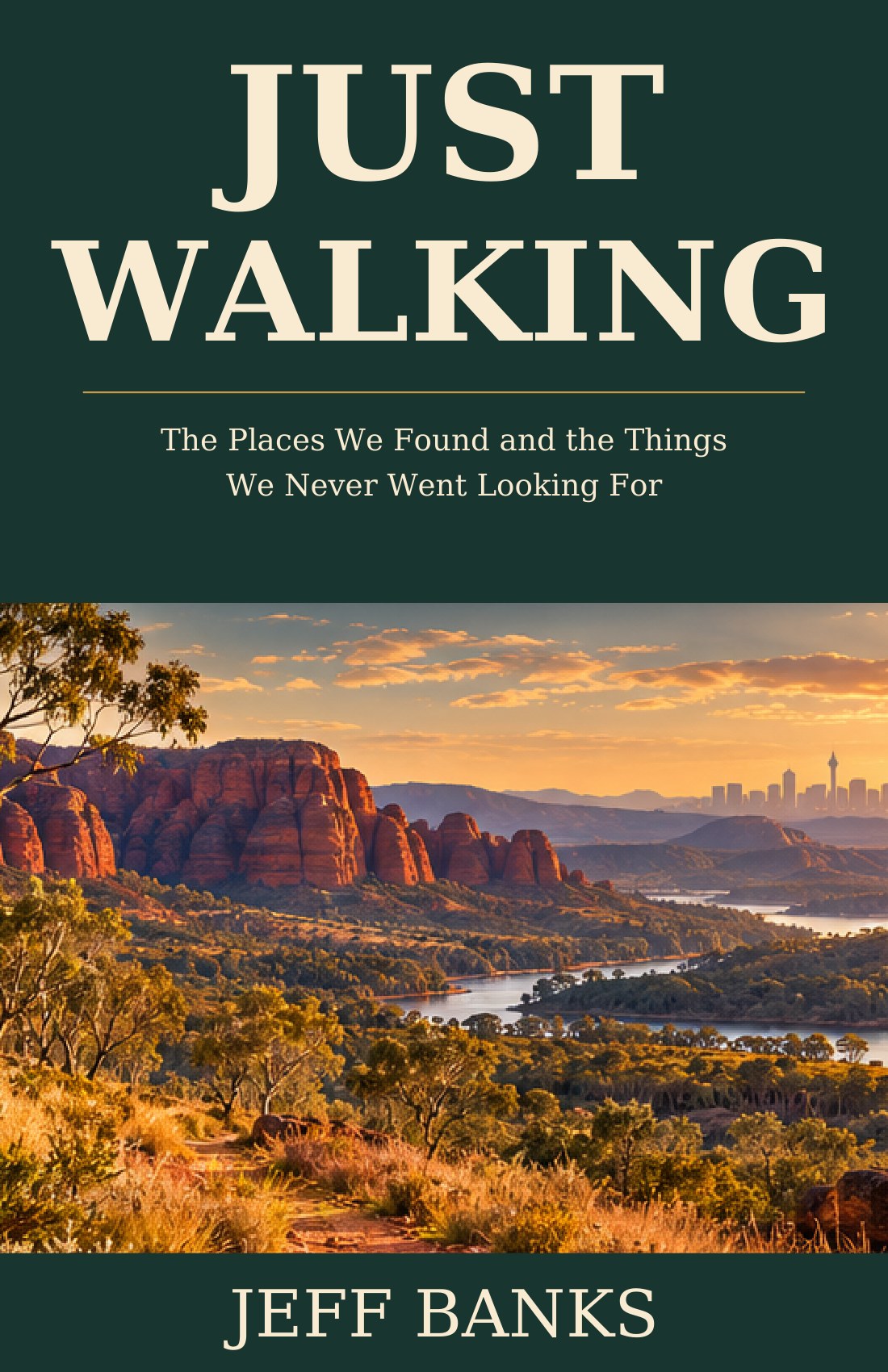
JUST WALKING - Foreword

JUST WALKING - Foreword | Travelling Around Australia with Jeff Banks

There are older stories within the country through which we have travelled, and people whose relationships with it extend far beyond our brief visits. Where those encounters prompted questions, I have allowed the questions room. I can share what I noticed, heard and thought without pretending that walking a marked track gave me possession of everything the place meant.

JUST WALKING

Foreword

The Places We Found and the Things We Never Went Looking For

Robyn and I just like to walk and take places in. We might have travelled a long way to get somewhere, or we might be filling a few hours before an appointment, but once we are there, we generally want to see what is outside. A street, a track or the prospect of finding somewhere for lunch can provide sufficient encouragement to get us moving.

My first thought was to call this book A Day In…. I had been considering the days we had spent wandering through places together, looking around without necessarily having much of a plan. A day in Melbourne, Singapore or Kununurra seemed a useful way to gather those experiences, although the more I looked through my accounts, the less willing the stories were to remain within the boundaries of a single day.

Some reached back into childhood. Others belonged to more than one visit, with the return giving us a different understanding of somewhere we thought we already knew. There were also occasions when the thing we remembered most had very little to do with what had persuaded us to set out. The destination could supply the reason for leaving, then find itself sharing the story with a bird beneath the awning or a tyre which had chosen an inconvenient time to require attention.

Just Walking seemed to leave a little more room for all of that. It also sounded comfortably modest, which is how quite a few of our undertakings appeared before we discovered what we had agreed to do. Going for a walk in Singapore, for example, was an innocent enough proposal when we left our room. By the time Robyn completed the return on her hands and knees, the expression had acquired considerably more substance.

There is a map of that walk on the wall in the Man Cave. Its highlighted line records our progress through the city with an ease which bears very little relationship to the heat, the humidity or the patch of shirt beneath my backpack. I can follow it now without raising a sweat, although doing so brings back much more than the route. Robyn and I had given the city a day, and the city had made fairly comprehensive use of us.

We do not always require that degree of exertion to enjoy ourselves. There is pleasure in drifting through warm water with a pool noodle doing much of the supporting, or sitting beside our caravan while a brolga finds our shade suitable for its own purposes. Being somewhere can involve a comfortable chair. I would be disappointed if the title discouraged anyone from bringing one.

Nor have I attempted to count the walking closely enough to exclude bicycles, boats, cars or trains. They have helped us reach places we could then take time to explore, and sometimes the journey aboard them has been the experience itself. Out on Lake Argyle, a boat carried us beyond headlands which had persuaded me I understood the size of the lake. I was delighted to discover how thoroughly I had underestimated it, particularly as correcting the mistake required nothing more demanding than remaining in my seat and looking.

That willingness to find out has served us rather better than arriving with a settled opinion. Other travellers almost persuaded us there was little reason to stop in Kununurra, while in Albany I could easily have declined the museum visit which eventually held me until closing time. Neither place needed to become something different to interest me. I needed to give it an opportunity.

Of course, I have not approached every outing with exemplary curiosity. I can become absorbed in getting somewhere, keeping to a timetable or finding a fish, and overlook things deserving considerably more attention. On occasion, one of those things has been a crocodile. The accounts I wrote at the time have been useful in preserving the qualifications which a more comfortable memory might prefer to leave out.

Those diaries and travel writings have supplied much of the material for this book. They contain the practical business around the views: work following us into the caravan, food to organise, equipment to mend and travelling companions with their own ideas about the day. I wanted those details to remain, because they belong to how we experienced the places. The washing did not disappear simply because the scenery was magnificent.

Our friends belong here for the same reason. Silver Leader, Rosalie and Forbsy brought their interests, enthusiasms and considerable capacity for commentary, ensuring that few questionable performances went entirely unremarked. Shaun showed us country we would scarcely have known to look for, then introduced us to people whose welcome gave our visit a quite different depth. A place can become memorable through the company in which you encounter it.

Sometimes that company lets you enjoy saying very little. Fishing with Julian offers stretches when neither of us needs to supply conversation, followed by an incident which gives us more than enough to discuss. The final result may remain open to interpretation, especially when one of us has caught more fish and the other begins reconsidering what the competition was supposed to measure. Either way, we have had time together which would be difficult to arrange by simply deciding to have a talk.

Walking can also bring company from much further back. Along Northbourne Avenue, I found myself reacquainted with a boy whose equestrian achievement still occupies a proud position in our house. The tray had kept the result available, but the walk allowed more of the life around it to return. I had gone out before a conference and discovered that an earlier version of myself still knew the way.

Some experiences reached further into our family than I could have expected. At Kata Tjuta I watched Kirsten begin exploring a connection to her Indigenous heritage which I could witness without fully understanding for her. Later, near Purnululu, Robyn and I were welcomed through friendships our daughter had already made with children asking questions about the stars. We had brought her into places as a child; now her connections were opening places to us.

There are older stories within the country through which we have travelled, and people whose relationships with it extend far beyond our brief visits. Where those encounters prompted questions, I have allowed the questions room. I can share what I noticed, heard and thought without pretending that walking a marked track gave me possession of everything the place meant.

Not every outing led us towards something profound. Chocolate, a good lunch, a foolish photograph or the opportunity to remind a friend about his vehicle could occupy us quite satisfactorily. I would not improve those days by giving them a seriousness they never required. Much of the pleasure was in being together and seeing what happened.

Your day in any of these places would almost certainly be different. You might find something we missed, leave earlier, stay longer or exercise better judgement about how far to walk before turning towards home. The same streets and tracks remain available for very different experiences. These are ours, with the limitations, laughter and tired legs which came with us.

And there is no requirement to go a long way to begin. Our own streets in Smiths Lake can provide ample opportunity to look around and think, even if the hill back to the house sometimes concentrates attention on more immediate matters. We have returned from distant places to find the ordinary walk still worth taking.

I hope these pages give you something of the enjoyment we found along the way. Come with us for a while, and see what catches your attention. We may stop for lunch, and there is every possibility that getting there will take longer than we intended.

JUST WALKING

About the Author

Jeff Banks lives with his wife, Robyn, in Smiths Lake on the New South Wales coast, where a pleasant walk generally finishes with an uphill reminder of why the view from home is so good. After a working life in taxation and business advice, he now spends more time writing, fishing, playing golf and discovering that retirement has done very little to reduce the number of things capable of occupying a day.

For many years, Jeff described himself as “Not Your Ordinary Accountant”. His interest extended beyond the figures to the people whose decisions, ambitions and difficulties produced them, and that curiosity has followed him into his writing. He enjoys the detail which complicates an easy explanation, particularly when it arrives through a conversation with someone who sees the world differently.

His books draw on family life, childhood, business, travel and the experiences which remain interesting long after the practical business of getting through them has passed. He writes with affection for the people involved and a willingness to include his own questionable judgement. There is usually room for humour, especially when an occasion has failed to provide quite the dignity its participants might have preferred.

In Just Walking, Jeff brings together experiences shared with Robyn, their children and the friends who have accompanied them along the way. Some began with a deliberate expedition, others with spare time, an errand or the need to find lunch. Looking back through his diaries and travel accounts, he found that the memorable parts were often those nobody could have put into the plan.

Family sits close to the centre of those recollections. Whether fishing with his son Julian, watching his daughter Kirsten explore questions of heritage and science, or wandering somewhere unfamiliar with Robyn, Jeff values the time in which people can simply be together. A successful outing need not produce a trophy fish, a perfect photograph or an answer to anything particularly substantial.

His involvement in community organisations, from Cub Scouts and school councils to business groups and his local golf club, has also supplied a continuing interest in how people contribute, cooperate and occasionally make straightforward matters considerably more complicated. Years of helping organise things have left him with an appreciation of the effort behind an enjoyable occasion—and a considerable affection for occasions which organise themselves.

Jeff remains inclined to take a camera, look around the next corner and wonder whether there might be fish in the water. Robyn has accompanied enough of these investigations to understand that “just a walk” is best regarded as an opening proposal.

Author

Menu