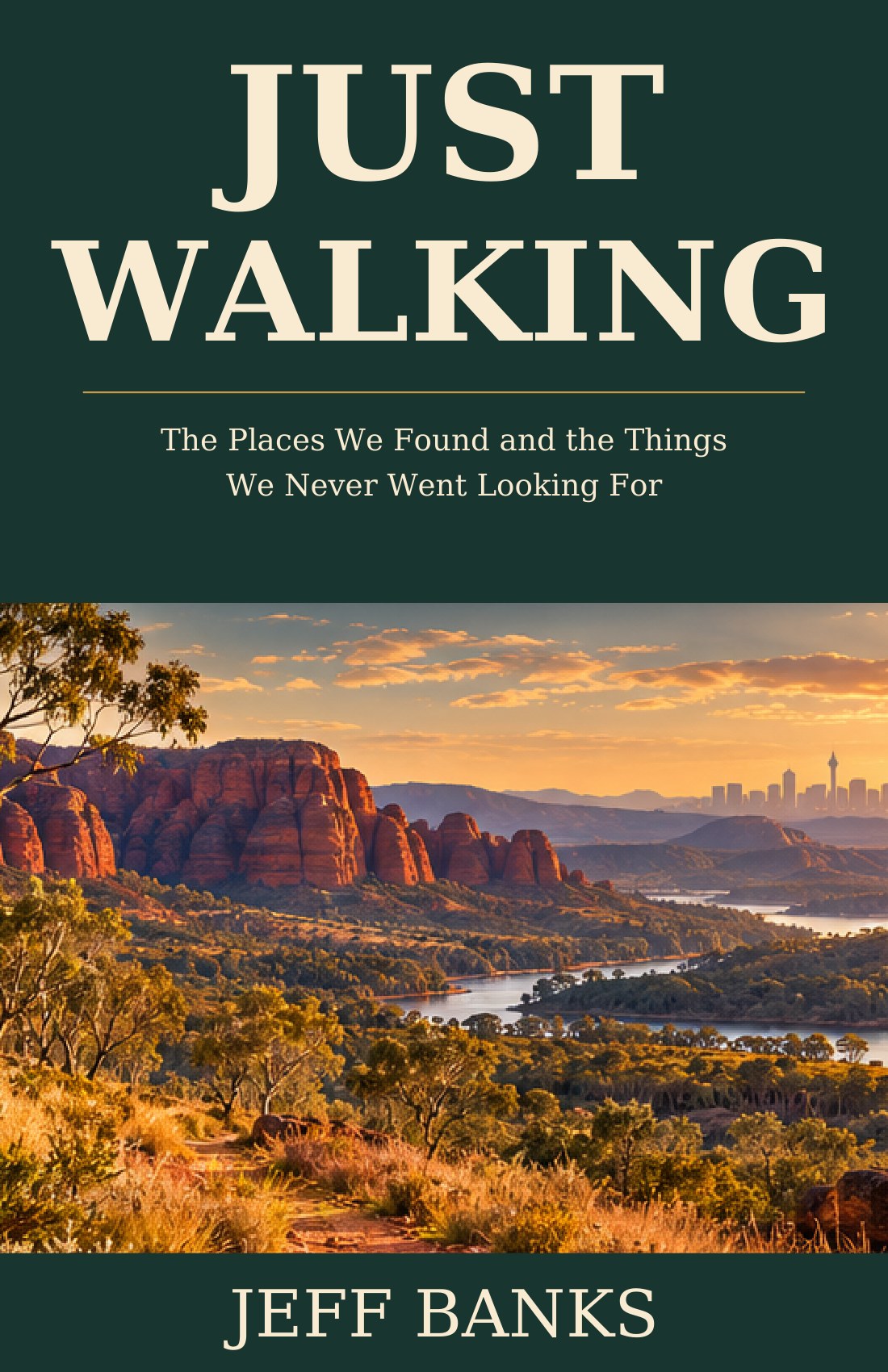
JUST WALKING - Chapter 8 - Winton — A Few Pieces of the Past

JUST WALKING - Chapter 8 - Winton — A Few Pieces of the Past | Travelling Around Australia with Jeff Banks

I had no great conclusion to offer about existence, and the day had been enjoyable without producing one. There was pleasure enough in having been able to wander through a small part of that country, see what someone else's patience had revealed and return with more to wonder about. Our own share of time included this evening together, which was sufficiently close at hand to appreciate.

JUST WALKING

The Places We Found and the Things We Never Went Looking For

Chapter 8 – Winton – A Few Pieces of the Past

There are several ways of measuring time in Winton. The people working on dinosaur bones have one, the pharmacist dealing with a summer cold has another, and the galahs in the caravan park appear to work to a timetable that has never been submitted for human approval. At about three in the morning, their particular interpretation of a suitable starting time became difficult to ignore.

They roosted in the trees around us and, for reasons known only to themselves, decided that the night required a considerable amount of discussion. It continued until after dawn, which was generous of them, as it removed any uncertainty about whether we might get back to sleep. We had planned a day in Winton, but none of us had requested quite that much of it.

Robyn and I had arrived on the Friday night, some two thousand kilometres into the trip. There was plenty here to justify stopping, and a day without towing the van had its own attraction. By morning, however, the sore throat I had been carrying for a couple of days had developed into a proper cold, giving me something less interesting than dinosaurs to think about.

A summer cold always seems an unreasonable arrangement. The morning was pleasant enough for board shorts and a T-shirt, with none of the crispness we had encountered earlier in the journey, yet my head had apparently decided on a different season. Before contemplating the distant past, I needed breakfast and something to make the present a little more comfortable.

There was a bakery just beyond the pub where we had eaten the night before. I had enjoyed a very good pie in Barcaldine, although a fair proportion of its pastry lid had finished up on me, and saw no reason to abandon a promising line of research. A pie and a hot chocolate seemed a sound basis on which to begin the day.

The bakery also provided an opportunity to examine an assumption I had brought through the door. I noticed the Asian staff and management, then found myself surprised by how good the pie was, as though pastry and filling were skills that depended upon ancestry. It was a small and fairly unnecessary piece of thinking on my part, particularly after an evening in a decidedly Australian pub where one of the barmaids had been American.

The pie was delectable, which settled the only question that actually needed answering. A sign offering payment by Bitcoin added another little adjustment to my picture of an outback bakery. Here I was, carrying old expectations into a shop that was quite prepared to deal in a form of money I had not expected to encounter while buying breakfast.

With that important business concluded, I went looking for a hose clip. We had an issue with the van’s water pump, and the hardware store had the small item I needed. There is something satisfying about an errand that can be reduced to one readily available fitting, especially when you are travelling with a collection of things capable of going wrong in places a long way from home.

The pharmacy was next door, making it easy to attend to the other maintenance problem. The pharmacist supplied enough medication to help with the symptoms, but the cold would still have to run its course. That was less satisfying than the hose clip, although it was hardly her fault that I had arrived with a problem for which the appropriate replacement part was unavailable.

My concern was that Robyn might get it. She had already had a cold that took far too long to leave her alone, and I had no wish to provide another round of entertainment inside the van. We could repair fittings and make plans, but there were limits to how much control either of us had over the day.

Forbsy was taking everyone out in his car, leaving ours with no greater responsibility than being filled with fuel ready for the following morning. Between the errands and the galahs’ overnight contribution, we were not especially quick getting under way. The dinosaurs, having already waited a considerable time, could presumably manage a little longer.

We saw brolgas on the way out and intended to photograph them on the return. There were also depressions in the ground that looked to me like sinkholes, another of those things you notice from a car and begin trying to explain without having much evidence to work with. Ahead lay an escarpment, and a sign at the turn-off told us we still had eleven kilometres to go.

That raised the question of exactly where our destination might be. Were we heading to the escarpment, over it, or somewhere beyond it? When the road turned to run along its length, I suggested to Forbsy that perhaps the eleven kilometres would take us to the end of the hill, which at least gave the navigation a theory to work with.

Eventually the road climbed. The view opened, and I started taking photographs as quickly as I could, already finding that a place we had approached for its dinosaurs had something substantial to offer before we reached the displays. From up there, the country spread out in a way that the road below had not allowed us to appreciate.

The day at the dinosaur museum involved three separate tours, some walking and some travelling in a vehicle that resembled a little road train. There was enough movement to take us through different parts of the experience without making it a test of endurance. It was hot, although not oppressively so, and we could take our time walking, conserve our energy and sip water as we needed it.

Walking between the different parts of the museum gave the information somewhere to go. There was time to carry a thought out of one explanation before collecting the next, and the country around us kept it from becoming an exercise confined to display cases. We were walking on ground that belonged to the same planet as the creatures we had come to see, although the interval between their lives and ours was almost impossible to picture.

What held my attention was the work behind the things we had come to see. A dinosaur in a display has already had an enormous amount done on its behalf by the time visitors arrive. We tend to encounter the result, complete enough to consider as a creature, without necessarily giving much thought to the fragments from which that understanding has been assembled.

Here we saw bones being cleaned with meticulous precision. That process gave the day a different pace, because there was no sensible way to look at such care and imagine that speed would improve it. The object was to uncover what remained, and an impatient hand would hardly be an advantage.

A fossil does not arrive conveniently separated from everything that has surrounded it. Watching the cleaning brought that simple fact into focus, along with the difference between finding something and being able to understand it. The discovery might supply the excitement, but there was a great deal of patient work between a find and the sort of exhibit I could wander past in a few minutes.

I found that part absorbing. These people were giving their attention to details that I would not have known how to recognise, let alone deal with, and the result depended on them doing it properly. Somewhere in the material before them was evidence of something that had once been alive, going about a day without the slightest possibility of knowing we would one day be interested in it.

It is easy enough to say that dinosaurs existed. We learn that early, see the pictures and accept the enormous animals as part of the world’s previous arrangements. Standing near the remains, watching the care being taken with them, made that familiar knowledge less comfortable and much more interesting. There had been an actual creature here, with a life of its own, rather than an illustration waiting to find its way into a book.

I could not supply its particular day, or pretend to know what had passed through its awareness. Yet it had occupied space, needed food and existed in surroundings that were as immediate to it as the heat and the need for another sip of water were to me. Whatever difficulties we have imagining such a world, the animal had not needed to imagine it. It had simply lived there.

There was also the business of putting the pieces back together. My original description of it was a jigsaw puzzle made from a bag of fossilised bones, and I still think that gets reasonably close to the difficulty for anyone whose relevant experience comes from a dining table. At least a domestic jigsaw generally offers a picture on the box and some assurance that all the pieces were supplied.

With these remains, the questions went much further than where one shape fitted beside another. The pieces had to contribute to an understanding of an animal from a world none of us could visit. I could follow enough of the explanation to appreciate the undertaking without pretending that one day in Winton had qualified me to assist.

What appealed to me was the distance between the size of the subject and the scale of the work. We were thinking about enormous creatures and a past that stretched well beyond the ordinary reach of imagination, yet the practical business required close attention to small areas and individual pieces. The whole became more convincing because someone was prepared to spend so much time on a part of it.

Earlier that morning, I had been pleased to find a hose clip because I knew what I needed and where it belonged. Here the work involved discovering what a piece could tell you before deciding how it belonged with anything else. My little repair suddenly seemed a rather accommodating proposition, although I was still grateful it had come with a straightforward solution.

Walking on from those explanations, I found the numbers less useful than the bones. An immense span of years can be stated quite accurately and still leave me with very little sense of its length. A piece of an animal makes a different demand, because it gives the thought something to hold on to. Someone was carefully uncovering evidence that a life had happened, however far beyond my reckoning its date might be.

Our own days are crowded with things that feel substantial because they belong to us. A troublesome pump, a cold, tomorrow’s fuel and the question of breakfast can occupy a perfectly respectable amount of attention. Seen beside those remains, they took on a different scale, although I could not see that it made them foolish. Being alive presumably involves attending to the life you actually have, and mine still required a working van.

What interested me was how readily the two scales could sit together. I could wonder about creatures separated from us by an almost inconceivable interval, then reach for my water because the present body was making a reasonable request. There was no need to choose which of those things mattered. Walking allowed the mind to range a great deal further than the feet while the feet kept us moving through the day.

The information across the tours kept drawing us further in. There are visits where you reach the point at which another explanation becomes one too many, but this did not feel like that. Seeing the preparation and hearing about the reconstruction gave substance to what might otherwise have remained a collection of impressive objects with difficult names.

The afternoon tour took us into a gorge arranged to suggest something of the Cretaceous world. After the close work on the bones, there was room here to think about the surroundings in which such animals had lived. We had moved from looking at surviving pieces to considering a larger setting, while remaining very much visitors travelling through the country of our own day.

That present-day country kept asking for attention. We stopped several times for photographs of the views, and I clambered onto rocks where I thought I might get a better angle. My enthusiasm had the usual limit imposed by vertigo, which tends to make its own assessment of a photographic opportunity regardless of how promising I consider it.

There is a point beyond which the better picture can remain untaken. I was quite capable of appreciating the escarpment without demonstrating complete confidence in its edges, and took what I could within my own arrangements with height. The country did not need me perched somewhere uncomfortable to prove its extent.

Even from the positions I was prepared to occupy, the camera could not give me what I was seeing. It recorded the view, but the depth seemed to disappear into the picture. The distance that was so apparent when I looked across the country became much harder to recover when I looked at the screen.

The vistas brought Namatjira’s watercolours to mind. In particular, the outlook from the reception area, with a ghost gum in the scene, had something of the arrangement and spaciousness I associated with his paintings. It was my own comparison, prompted by the view in front of me, and it made me look again at the relationship between the tree, the land and all that room beyond.

There was something in that view that made me reluctant to hurry to the next thing. We had come up a road, joined tours and followed explanations, but now there was simply country to look across. Walking a little way and stopping changed what occupied the foreground without making much impression on the extent beyond it. My own movement was quite real and, measured against all that space, exceedingly modest.

I wonder whether that is part of the pleasure in such places. For most of a day we occupy the middle of our own concerns, with everything else arranged according to whether it helps or inconveniences us. Out there, I could see country whose existence required nothing from me, and whose scale would be undiminished when I went back to the van. I found that a pleasant thought to spend some time with.

A painter can make distance part of the way you see a picture. My camera seemed determined to bring everything back to the same small surface, regardless of how much country I tried to put into it. I kept taking photographs anyway, presumably in the hope that the next attempt might persuade it to reconsider.

We were told that on a clear day the view from the escarpment could extend upwards of forty-two kilometres. Ours was one of those days, although knowing a distance did not make it any easier to absorb. There was a great deal of Australia out there, and from where we stood it appeared so still that it was easy to mistake the absence of obvious movement for an absence of life.

A bulldozer corrected that impression by disturbing a sleeping kangaroo as we returned from the afternoon tour. The animal had been there all along, getting on with the sensible business of remaining out of sight in the heat. We were the ones wandering about trying to see everything, which perhaps said more about nomads than it did about the country.

One of the displays offered a circulating panorama of the wildlife. There were lizards and geckos, marsupials and other mammals, as well as birds, including the brown falcon we had seen hovering and going after carrion. It supplied a fuller account of a landscape that could look empty simply because its occupants were not arranging themselves for our inspection.

The kangaroo also offered a useful correction to the way I had been looking. I had been considering an immense past and a distant view, while a living animal occupied the country close at hand. Its presence had not begun when the bulldozer caused it to move, any more than those ancient creatures had begun to matter when someone discovered their bones. There was more going on than my ability to notice could account for.

I could take that thought for a walk without finding an answer to everything it opened up. How much passes beside us without becoming part of our account, simply because we are looking elsewhere? The question seemed particularly appropriate after a day among people whose work depended on noticing what others might quite reasonably walk past. I was unlikely to develop their eye in an afternoon, but I could at least give the ground and the country another look.

I did notice an omission. There were no pictures of the galahs that had worked so hard to make their presence known during the night, an oversight I found difficult to reconcile with their contribution to the local experience. Perhaps the people choosing the images had been sleeping somewhere else.

Back in Winton, we went to the Matilda Centre. It paid tribute to Banjo Paterson and the song associated with the district, and on another day it might have occupied a different place in my account. Following the dinosaurs, however, I found it something of a letdown.

The dinosaur experience had caught my interest and kept it, particularly through the painstaking work that allowed the exhibits to exist at all. It had also left me with thoughts that continued beyond the explanations, following us out among the views and back towards town. The Matilda Centre had arrived while I was still occupied with all that. My response belonged to that particular visit, and there is little point improving it in the telling just to be fair to the itinerary.

A day does not have to deliver equal enthusiasm for everything on the list. Robyn and I had given Winton our time, and part of being there was finding out what held my attention rather than deciding in advance what ought to hold it. In this case, the bones and the people working on them had won comfortably.

The van brought us back to matters with more immediate deadlines. I wanted to make sure the barbecue was working correctly, and it obliged, allowing us to have chicken breast and chips for dinner. After a day spent considering how difficult it could be to establish what had happened in the distant past, I was happy with that small piece of present certainty.

We met a couple from Canberra travelling in the opposite direction. Those encounters belong naturally to caravan travel, with people briefly sharing a place before their journeys carry them apart again. Our own next day involved an early start and a considerable distance, so we were not planning to extend the evening too far.

We sat in the Forbsy beer garden and watched the moon rise. After the walking, the looking and the effort of trying to take in distances of several kinds, I was content to sit beside Robyn and let the evening be an evening. The people at the museum would continue their patient work, and the country beyond town would carry on holding far more than we had seen of it.

I had no great conclusion to offer about existence, and the day had been enjoyable without producing one. There was pleasure enough in having been able to wander through a small part of that country, see what someone else’s patience had revealed and return with more to wonder about. Our own share of time included this evening together, which was sufficiently close at hand to appreciate.

The galahs had other arrangements. As night came on, they were back, with one youngster in particular making its requirements impossible to overlook. I felt its parents might usefully attend to the feeding before the rest of us were required to take an interest.

At the museum, people had worked with extraordinary patience to uncover evidence of lives separated from ours by an immense span of time. In the trees, a youngster was supplying all the evidence anyone could need of its own existence, with no specialist interpretation required. We retired early, with a long road ahead of us and that small, insistent life still making its demands upon the night.

Author

Menu