

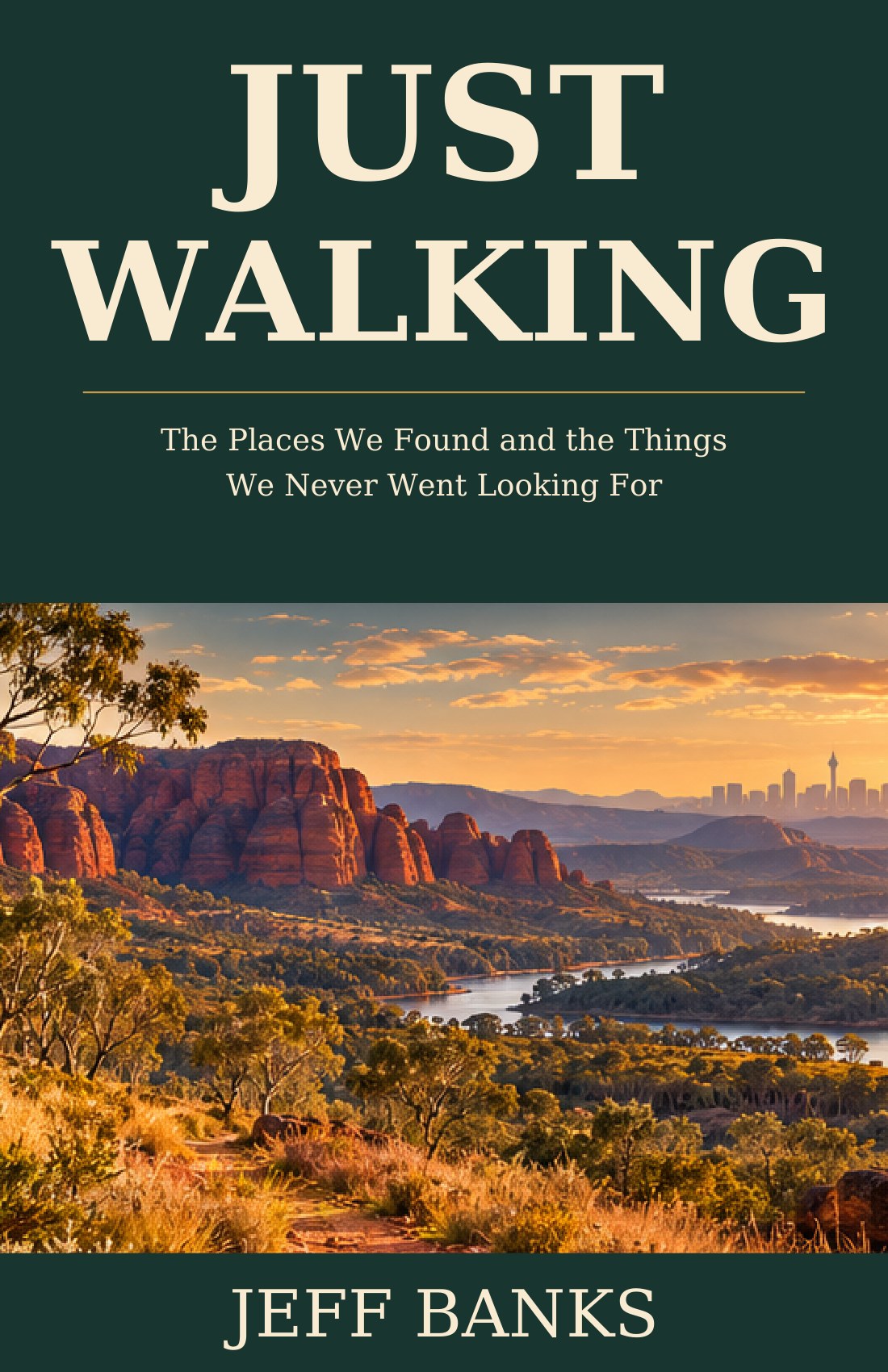
JUST WALKING - Chapter 6 - What You See Is Not What You Get

JUST WALKING - Chapter 6 - What You See Is Not What You Get | Travelling Around Australia with Jeff Banks

I have certainly walked like that. Familiarity gives the mind permission to get ahead, perhaps to the next hill or the things waiting at home, while the feet deal with the present stretch of road. We can cover a considerable distance without acquiring much more than confirmation that the route is still there.

JUST WALKING

The Places We Found and the Things We Never Went Looking For

Chapter 6 – What You See Is Not What You Get

Twenty kilometres is a considerable distance to swim, but when we first arrived at Lake Argyle, my immediate concern was where the organisers of the marathon swimming event intended to find it. Looking across the water from the dam end of the lake, I could only imagine competitors completing several laps around a series of buoys. There was certainly enough water to exceed my own swimming requirements, but fitting a marathon into the available space seemed to call for a fair amount of repetition.

The headlands appeared to establish the boundaries quite clearly. Water lay between them, the cliffs rose beyond it, and the whole arrangement presented itself as something I could take in from where I stood. I had no particular reason to doubt my eyes, although the conclusion I drew required considerably more information than they had supplied.

Robyn and I were being introduced to a place that seemed quite willing to let us underestimate it. There was no shortage of interest in the view itself, and nothing about those rocky slopes suggested we had been short-changed by coming to look. The difficulty was that I had accepted an attractive portion of the lake as a reasonable indication of the whole, then begun working out how a swimming event might be accommodated within it.

Even the outlook from the infinity pool at the adjacent caravan park did little to prepare us for what lay beyond the headlands. Its edge seemed to surrender the pool’s water to the lake below, carrying the eye out into the surrounding country without an obvious interruption. It was a clever piece of design, making a comparatively modest swimming pool appear to belong to something much larger, while the landscape beyond was performing an equally effective trick in the other direction.

The pool appeared to continue further than it did. The lake appeared to finish long before it actually ended. Between the two, there was ample opportunity for a man to get his dimensions wrong, and I was making reasonable use of it.

Those encroaching cliffs stood like battlements across the view, substantial enough to give the water an apparent enclosure. I could admire the rock, follow its meeting with the lake and feel that I had a fair understanding of the place. What I could not do was see through it, a limitation that should perhaps have featured more prominently in my assessment.

There is something persuasive about a view that appears complete. The eye moves across it, finds recognisable edges and returns to the things that first attracted attention, while the mind quietly closes the file. I had water, cliffs and a swimming event to consider, and apparently believed I had been supplied with all the relevant material.

Had we remained beside the caravan park, we would still have seen a lovely part of Lake Argyle. We could have taken photographs, enjoyed the outlook and described it later with complete sincerity. Nothing in that description would necessarily have been false, but a considerable amount of lake would have been absent from the telling.

Our evening cruise took us beyond the reach of that first impression. A boat gave us access to country we could look towards from the land without being able to look into, and the distinction became apparent as we approached the headlands. The rock that had seemed to mark the limit of the lake was about to give up that responsibility.

As we cleared those rocky battlements, the water opened out beyond them. What had appeared to be an enclosing shore became a piece of the foreground, with more lake continuing behind it than I had imagined could be concealed there. There was water stretching away in either direction as far as the eye could see, and even from the cruise boat we could not take in the whole impoundment.

It was an extraordinary expansion of the view. The further we went, the larger the place seemed to become, as though our progress was adding water to the lake rather than carrying us across what was already there. Instead of bringing the far side closer, moving beyond the headlands seemed to remove the far side from consideration altogether.

Of course, nothing had expanded. The cliffs had not shifted, the water had not risen to impress the passengers, and the country had undergone no alteration on our behalf. We had moved far enough to see what our original position had prevented us from seeing, and my understanding was struggling to catch up.

There are moments when being wrong is a pleasure. I had no investment in keeping Lake Argyle within the dimensions I had assigned to it, and there would have been very little satisfaction in a cruise that merely confirmed the view from the caravan park. Robyn and I had gone out to see the lake, and here it was, making my earlier estimate look increasingly economical. Every stretch of water opening beyond the headlands seemed to require another adjustment to an understanding that had been quite comfortable while we remained on shore.

I had seen the map, which makes my surprise a little harder to defend. The extent of the lake had been laid out there, its shoreline reaching into folds of country well beyond the small area visible from the caravan park. I had looked at that information without properly joining it to the landscape in front of me, as though the map described one place and my eyes were reporting on another. Faced with the two, I had given the apparent boundaries of the view more weight than the considerable body of water clearly marked on the page.

Out on the boat, the two versions finally began to belong to each other. Those reaches on the map acquired distance, and the headlands became interruptions in the view rather than the limits of the lake. What had been a shape I could glance across on paper was now water spreading away from us, continuing beyond the country that had concealed it. I could understand why it occupied so much of the map, because it was now occupying rather more of my field of vision than I knew what to do with.

Across the old Durack country, the water seemed to expand forever. Somewhere beneath that immense surface lay land that had once been understood through tracks, paddocks and the practical distances of pastoral life, its contours now determining where the lake widened and where the higher ground still broke through. The map could show me the present shoreline, but sitting on the water brought a different sense of what that outline represented. We were travelling across a landscape whose scale had survived its transformation, even though much of the land itself was hidden beneath us.

It was a curious reversal of my first impression. From the caravan park, visible land had persuaded me there could not be much more water; out here, the water made it difficult to imagine the extent of the land it covered. My eyes and the map had finally reached an agreement, although neither could quite prepare me for the pleasure of being there with Robyn as another stretch of lake opened ahead. The swimmers, I was now satisfied, had plenty of room, and my assistance with their arrangements was becoming less necessary by the minute.

The marathon swimmers could relax, at least as far as my concern about their course was involved. Twenty kilometres remained a substantial undertaking, but the organisers were clearly in no danger of exhausting the available water. My imaginary laps around buoys had been a solution to a problem that existed entirely in my head.

I find that part of the experience particularly amusing now. Faced with a discrepancy between the length of the swim and the size of the lake I could see, I had rearranged the swim. It had seemed easier to imagine people going around repeatedly than to wonder whether the headlands were hiding something significant.

The boat had done more than show us a bigger view. It had exposed the bit of reasoning that preceded it, that small and apparently harmless decision to treat the visible water as sufficient evidence. I had been looking directly at Lake Argyle all along, but the amount I could see had acquired an authority it had done nothing to earn.

Out beyond the headlands, the distances resisted that sort of easy judgement. There was too much water to divide neatly into the familiar measurements I carried around with me, and too little visible enclosure to make an estimate feel useful. For once, there was no particular advantage in trying to reduce what was in front of us to a size I could comfortably explain.

We were out in it, which made a difference that a description could not quite supply. Somebody could have told me beforehand that the lake was enormous, and I would probably have agreed without altering the picture already forming in my mind. Passing the headlands required that picture to change, because the evidence was now spread across the view in front of us.

Even then, the lake had not revealed everything. The water continuing into the distance was enough to overturn my first understanding, but it did not turn us into authorities on the whole place. We had exchanged a restricted view for a much broader one, and there was a certain pleasure in knowing that more still lay beyond it.

That is one of the difficulties with trying to bring a place home in a photograph. A frame puts edges around something that may have been memorable precisely because its edges were so difficult to find. Water, rock and sky can all be present in the picture, yet the sense of sitting out among them, with the country continuing beyond your ability to take it in, is much harder to carry back.

The photograph asks the person looking at it to supply the missing scale. They may have no more reason to suspect what lies beyond its boundaries than I had beside the caravan park. I could hardly blame anyone for underestimating a view I had already underestimated while standing in front of it.

Reflections make their own contribution to the business of looking at water. A rocky slope can appear to continue below the surface, lending the scene a depth and symmetry that the solid country does not possess. We understand the arrangement well enough to enjoy it without expecting to find another cliff beneath the boat.

Yet there is an odd difference in how we deal with that image and the shore above it. We recognise the reflection as an appearance produced by water and light, while readily accepting the visible outline of a headland as a reliable indication of where the lake must finish. One illusion is familiar enough to allow for; the other slips into our understanding almost unnoticed.

I would not want to turn every attractive view into an examination. There is ample pleasure in looking across water without demanding that it explain itself, and a holiday would become fairly tiresome if every pause required a review of the evidence. What interested me at Lake Argyle was how little doubt had accompanied my first conclusion, and how completely a short passage beyond the cliffs had overturned it. I had been quite prepared to believe the lake was smaller than the map suggested, simply because the country had concealed the rest.

Our guide supplied another proposition for the mind to wrestle with. He suggested that raising the dam wall by as little as ten metres would capture such an extraordinary volume of additional water that drought across Australia’s inland deserts could become a distant memory. I cannot reproduce his calculations, and I took it as a striking proposition rather than an engineering conclusion I was qualified to endorse. Nevertheless, sitting out there on water that already seemed to have no end, it was a thought with plenty of room to grow.

Ten metres sounded almost modest in that setting. Beside the scale of the surrounding country, it was easy to imagine it as a relatively small addition to an existing wall, something that might scarcely alter the appearance of the place from a distance. Yet the guide was asking us to consider what that extra height might mean when spread back through all the country capable of holding the water. The suggestion gave another dimension to the lake, requiring me to think beyond its visible surface to the shape of the land beneath and around it.

My imagination was quite happy to take the next step. There was water here in quantities I had only just begun to appreciate, while elsewhere in the same country people watched the sky and waited for rain that might not arrive. Put those two pictures beside each other and the temptation is to draw a line between them, much as you might connect two places on a road map. From the comfort of a seat on a tour boat, the country’s water problems could begin to look like a matter of getting a sufficiently large supply to the places that needed it.

Of course, a line on a map does not have to climb anything. Water being available in the Kimberley and water being available somewhere in the inland are two rather different propositions, with distance, terrain, cost and the consequences for the country along the way sitting between them. Nor does supplying water to a dry place necessarily change the conditions that make it dry. The guide’s comment opened an enormous possibility in the imagination, but the view from the boat could no more establish its practicality than the view from the caravan park had established the size of the lake.

That was perhaps the most interesting part of hearing it there. Only a little earlier, I had underestimated the water because I could not see enough of it; now, surrounded by its apparent abundance, I could just as readily imagine it solving problems far beyond the horizon. Both impressions came easily, and both relied on allowing what was immediately in front of me to explain considerably more than it could. The lake had corrected one assumption without making me immune to the attractions of another.

Still, I was pleased the guide had offered the thought. It gave us something substantial to ponder as we looked across that flooded country, a sense of how a seemingly small change in height might have implications difficult to picture from the wall itself. There was no need to settle the future of inland Australia before the cruise ended. It was enough to recognise that the lake raised questions considerably larger than where to put the swimming buoys.

The infinity pool belongs firmly in that recollection. Its apparent connection with the lake encouraged the eye to travel, but the headlands still brought that journey to an early halt. The view had offered beauty quite freely while giving away very little about the sheer extent of the place behind it. Out on the boat, even after the hidden water had revealed itself, there remained plenty I could look at without fully understanding.

I can understand why that initial outlook seemed sufficient. We had come to somewhere unfamiliar, found plenty worth looking at and begun making sense of it through the shapes available to us. By the time we were beyond the headlands, the map, the visible water and the guide’s proposition had given us three different ways of considering the same place. I was enjoying the lake rather more once I stopped expecting my first impression to contain it.

Walking produces smaller versions of the same discovery. A bend in a track can conceal a stretch of country, while a gap between buildings can reveal something that remained invisible from only a few paces away. The distance travelled may be modest, but the change in understanding can be substantial if we had already decided what was there.

There are also times when the obstruction is less obvious than a headland. We recognise a street, assume we know the view and continue along it with our attention elsewhere. The eyes remain open and do the necessary work of getting us past obstacles, while much of what gives the place its interest is allowed to pass without consideration.

I have certainly walked like that. Familiarity gives the mind permission to get ahead, perhaps to the next hill or the things waiting at home, while the feet deal with the present stretch of road. We can cover a considerable distance without acquiring much more than confirmation that the route is still there.

At Lake Argyle, my mistake had occurred in unfamiliar country, which makes it harder to excuse as habit alone. I had looked with interest and still seen less than I thought I had. The missing ingredient was the willingness to leave room for something beyond the part already explained.

That does not mean every headland conceals an inland sea, or that every track deserves to be followed indefinitely. Sometimes the next corner offers much the same view, and there are occasions when turning back is a perfectly satisfactory decision. But the boat trip gave me a reason to be more careful about confusing the point where my sight stopped with the point where a place ended.

When I think of our introduction to Lake Argyle, it is that opening beyond the cliffs that comes back most clearly. The pool and the first outlook belong to it because they establish how little I understood, while the cruise supplies the pleasure of discovering how much more there was. The two views remain part of the same experience, each made more interesting by the other.

I still have no ambition to swim twenty kilometres of it. Seeing how much room the competitors had did nothing to improve my qualifications, although I was pleased to discover they would not need my assistance with the layout. Out there with Robyn, beyond the headlands, there was quite enough to occupy me simply looking across the water and allowing the lake to be larger than I knew.

Author

Menu