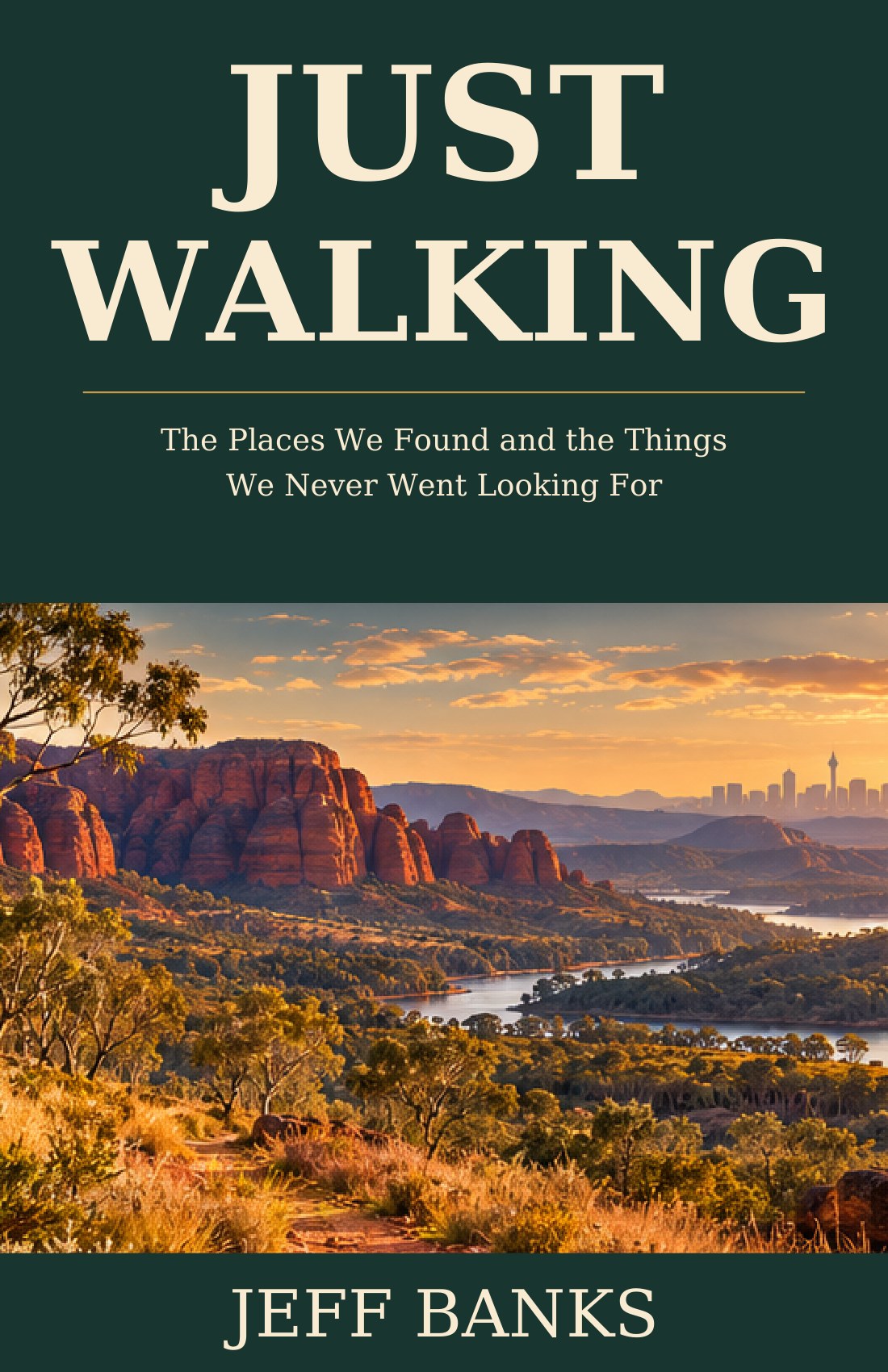
JUST WALKING - Chapter 5 - The Town We Nearly Missed

JUST WALKING - Chapter 5 - The Town We Nearly Missed | Travelling Around Australia with Jeff Banks

The people who advised us against stopping could not have known which parts of the place would become ours. They had their experience, and Robyn and I were fortunate to have stayed long enough to acquire something different. We came away with more than an assessment of whether the town was worth the detour.

JUST WALKING

The Places We Found and the Things We Never Went Looking For

Chapter 5 – The Town We Nearly Missed

Other people’s advice almost kept us out of Kununurra. There was apparently little there to justify stopping, and Robyn and I would be better off spending our time somewhere else. It was the sort of advice that could easily have become part of our plans, leaving us to drive past with the comfortable conviction that we had made an informed decision.

Had we done that, I would have missed almost stepping on a crocodile. I would also have missed a sunset that made a lookout seem like a seat in an enormous outdoor cinema, and a brolga would have had to find someone else’s caravan awning beneath which to rest. Those experiences alone gave us considerably more to remember than the recommendation suggested was available.

Travellers exchange opinions quite freely. We tell one another about roads, caravan parks, places to eat and towns worth an extra night, usually with the best of intentions. The difficulty is knowing how much of another person’s judgement belongs to the place and how much belongs to the day they happened to have there.

A town visited when you are tired, hungry or anxious to get somewhere else has a fair amount of work to do. Arrive with enough time to look around, and the same town may offer a very different experience. I cannot account for what Kununurra had been like for the people who discouraged us, but I am pleased we allowed it the opportunity to become something of our own.

On the map, it occupies a small amount of space in a very large part of Australia. A dot and a name hardly prepare you for the business of exploring the country around it, particularly when you begin to discover how the waterways, farmland, ranges and town fit together. There is a good deal concealed within what looks, from the comfort of a map, like a modest stop.

I should acknowledge early that our “walking” around Kununurra involved considerable assistance from the car. We got out and walked, but the distances between some of the places we explored would have made a strictly pedestrian approach a rather different undertaking. Driving gave us the chance to reach them, and walking gave us the chance to take them in.

That seems a reasonable division of labour to me. There is no particular merit in arriving somewhere too exhausted to enjoy it, especially when the purpose of the outing is to see what is there. Some of our best wandering begins after the engine has been switched off.

Kununurra itself needed room in the visit, beyond whatever practical jobs brought us into town. It is easy, when travelling, to reduce a place to the things you need from it: fuel, groceries, a replacement for something that has broken and somewhere to stay. Once those jobs are done, the road begins making its claim again.

Yet the streets and shops belong to a town where people are carrying on with lives that have nothing to do with our journey. We may be wondering what to see before leaving, while someone else is trying to fit the shopping into a working day. Spending time there gives that ordinary activity a chance to register, and the place begins to acquire an existence beyond its usefulness to us.

The water broadens that impression. Lily Creek Lagoon and Lake Kununurra give the town a setting that cannot be appreciated by looking only along its streets. Follow the water with your attention, and before long you are looking further out, towards the country through which it moves and the work it makes possible.

Around Kununurra, the irrigation country gives that connection a practical form. Cultivated fields sit beneath the surrounding ranges, their boundaries and ordered plantings bringing a different pattern to the landscape. Looking across them, there is interest in both what is growing and the considerable undertaking that allows it to grow there.

An accountant does not cease to be an accountant merely because he has gone away in a caravan. Productive land raises questions about costs and returns, even when nobody has asked me to consider either. Getting water to a crop is an achievement, but there remains the business of producing something that can be sold for more than it costs to grow.

I can admire a paddock without knowing its gross margin, although some old habits are difficult to discourage. Behind the view sit decisions about water, planting, labour and markets, along with all the things that can refuse to behave as the calculations suggest they should. There is enough going on to make a drive through the district interesting well beyond the appearance of the fields.

As those roads carry you between farmland and water, the town becomes easier to place. Kununurra is part of a working district, and the water that makes an attractive foreground elsewhere is also involved in somebody’s livelihood. The further we looked, the less adequate that small dot on the map became.

At Ivanhoe Crossing, the river itself took a greater share of our attention. Water flowing across a causeway is an arrangement worth stopping to consider, particularly when you are accustomed to roads being kept clear of rivers by bridges. Here, the road and the water occupy the same space, with the river showing little concern for the convenience of anyone wanting to get across.

For me, there was also fishing to consider. That occupation has a way of concentrating the mind on a particular patch of water and the possibility of something beneath it. Unfortunately, concentration is only an advantage when it has been directed towards everything that deserves it.

I almost stepped on a freshwater crocodile. In the course of attending to the fishing, I had failed to give sufficient attention to the ground around my feet. Whatever I might have been hoping to encounter in the river, the crocodile was a much more immediate consideration.

It was a warning for young players, although I could hardly call upon youth in my defence. I had reached an age at which looking where I was going ought to have been a reasonably established habit. Evidently, the prospect of a fish could still interfere with its application.

There is a temptation, in telling the story, to let the word “freshwater” take some of the weight out of it. It identifies the crocodile, but it does very little to improve the judgement of the man who almost stood on it. I cannot imagine any crocodile benefiting from that arrangement, and there was certainly no advantage in it for me.

The incident deserved more than a laugh, even if I had supplied a fair opportunity for one. Those of us arriving in the Top End bring habits acquired in other places, sometimes applying them without considering what else might need our attention. We recognise somewhere to cast a line and begin thinking about fishing, as though the familiar activity makes everything around it familiar too.

It does not take much to expose the gap in that assumption. In my case, there was a crocodile occupying ground I had come far too close to treating as available for my next step. I was fortunate to be left with a story about what almost happened.

After that, any claim I might make about being an observant traveller required a qualification. I could take an interest in the surrounding landscape and still overlook something of considerable importance beside my own feet. Kununurra had provided a practical addition to the business of looking around.

There were other places where the looking could be given more room. At Mirima, also known as Hidden Valley, the sandstone formations brought us into country that revealed itself through walking. Instead of remaining an outline beyond the road, the rock became something we could move among.

The path determined what came into view and what disappeared behind us. A formation seen from one angle took a different place in the landscape as we continued, while gaps and turns offered another part of the country to examine. There was pleasure in that gradual change, with enough ahead to encourage us onwards and enough around us to make hurrying seem unnecessary.

From a vehicle, a ridge can pass in a few moments. On foot, its shapes have time to become distinct, and the relationship between one piece of country and the next is easier to follow. Walking gives you a scale against which to consider what is around you, even when the rock makes your own contribution look rather modest.

Hidden Valley was an apt name in a town we had almost allowed other people to explain for us. It was there to be explored, close enough to form part of our time around Kununurra, but still required us to go and look. No recommendation, favourable or otherwise, could do that part on our behalf.

Kelly’s Knob opened the country out again. From its outlook, the township, waterways, farmland and surrounding ranges spread into a view broad enough to bring our separate explorations together. Places that had occupied individual portions of a day now stood in relation to one another.

There was satisfaction in recognising something below and following its position towards somewhere else we had been. The driving began to make geographical sense, along with the distances that had required it. From up there, the landscape offered its own explanation of why our walk around Kununurra had needed a car.

Towards sunset, the explanation became a performance. The outlook had the scale of a cinema of nature’s grandeur, with more taking place across it than the eye could comfortably follow. Light held one part of the country while another began to settle into shadow, and our attention moved between them.

The changes were gradual enough to invite watching, yet constant enough that a view did not remain quite as we had first seen it. A ridge became more distinct against what lay behind it, while another lost some of its detail. The spaces between the ranges deepened, making the distance across the country more apparent.

Water caught the eye, then a slope or a further line of hills drew it elsewhere. Looking in one direction meant allowing something to change in another without supervision. It was an unusually generous performance, although there was no prospect of persuading it to repeat a particular moment because we had happened to be looking the other way.

Below it all, the town remained part of the scene. Streets and buildings gave the view a human scale, placing ordinary lives within the country we had spent our time exploring. Somewhere down there, the business of evening was continuing while we stood above it watching the light withdraw.

A photograph could keep one arrangement of that light, but the pleasure lay in remaining for the next change. There was always the possibility that another few minutes would reveal something else, or alter something we thought we had already taken in. Leaving became a decision we had to make without any clear announcement that the performance had finished.

For a place we had almost been persuaded to miss, Kununurra was making a substantial claim on our time. The sunset did not need any further activity attached to it, and there was nothing to achieve by watching it particularly efficiently. Being there occupied us quite well.

The caravan park offered a different scale of entertainment. Our awning had been put up to provide shade for Robyn and me, but a brolga found it satisfactory and came to stay beneath it. There was no elaborate arrangement involved; the bird settled in, and caravan life continued around our guest.

We went in and out of the van without causing any apparent concern. Those small movements that make up time at a campsite were evidently no reason to abandon a comfortable position. The brolga remained at ease while we attended to whatever required our attention.

There was something rather companionable about it. We were using the shade to rest between outings, and the bird was using the same shade for much the same apparent purpose. Its requirements seemed comfortably compatible with ours, and no one needed to make a special effort to keep the arrangement working.

After driving out to look across farmland, walking among sandstone and finding a vantage point for sunset, here was an encounter taking place at our temporary front door. It asked for no journey and no preparation. We could step out of the van and find part of Kununurra quietly sharing the campsite.

Our visitor also brought a pleasing lack of urgency to the place. There was shade, there was room and there was no apparent need to go elsewhere simply because elsewhere existed. Robyn and I were taking a break, and the brolga gave every appearance of being settled into its own.

Only two of us were contributing to the caravan park fees, although it would have been difficult to make a convincing case for an additional charge. The bird required no power connection and had raised no concerns about the facilities. As caravan park neighbours go, it was easy company.

That time beneath the awning belongs in the account as firmly as the broader landscapes. A town becomes memorable through odd combinations of things: a view that holds you in place, a walk that reveals more than the road, an incident you would prefer not to repeat and a visitor that seems perfectly content with your arrangements. Kununurra had supplied all of those.

The people who advised us against stopping could not have known which parts of the place would become ours. They had their experience, and Robyn and I were fortunate to have stayed long enough to acquire something different. We came away with more than an assessment of whether the town was worth the detour.

There was the country spread beneath Kelly’s Knob as the light changed across it. There was also the freshwater crocodile that deserved considerably more room than I almost allowed it, an encounter best remembered without arranging a repeat. Neither experience would have appeared on a map, however carefully we had studied the dot beside Kununurra’s name.

And beneath our awning, there was a brolga untroubled by our comings and goings. We had almost accepted that there was little reason to stay, while the bird had found our patch of shade and made itself comfortable. With Robyn and me resting there too, the arrangements seemed perfectly satisfactory.

Author

Menu