

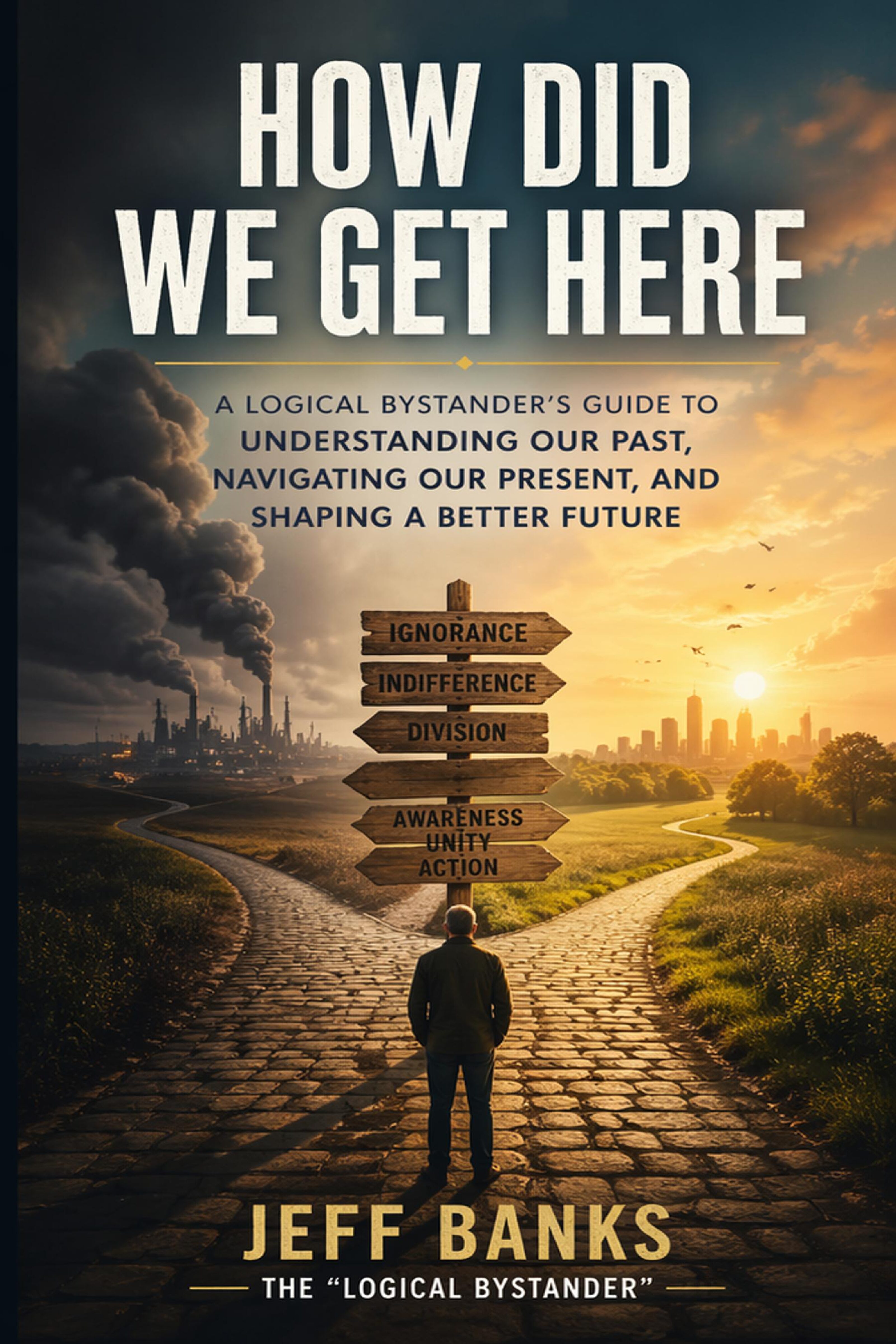
How Did We Get Here - Foreword

How Did We Get Here - Foreword | Travelling Around Australia with Jeff Banks

In the end, this is a book about awareness. About noticing what has been normalised, about questioning what has been accepted, and about recognising that the path from where we were to where we are is rarely accidental. It is built, step by step, often quietly, often without scrutiny. The invitation extended here is simple. Read with an open mind. Allow the observations to sit, even if they do not immediately align with your own. And in those moments where something feels uncomfortably accurate, resist the urge to move past it too quickly.

HOW DID WE GET HERE


Foreword


A foreword, when it works, does not explain the book so much as it prepares the reader for the experience of it. It adjusts the lens just enough so that what follows is not dismissed too quickly, not skimmed past in search of something more comfortable, more agreeable, more easily digested. This book does not offer that comfort. It was never meant to.


There is a particular kind of conversation that tends to happen in quiet moments, often unplanned, where something is said out loud that most people have thought at one time or another but have chosen not to pursue. Not because the thought lacks merit, but because following it to its logical conclusion becomes inconvenient. It raises questions that are harder to put down than they are to pick up. It asks not only what is happening, but why it is happening, and perhaps more uncomfortably, why it is being allowed to continue.


This book lives in that space.


It does not present itself as a set of answers delivered from a position of authority. It is, instead, an exploration from the perspective of someone who has spent a lifetime observing patterns, decisions, consequences, and the often curious gap between intention and outcome. There is an accountant’s discipline underpinning the narrative, a habit of tracing cause and effect, of looking beyond the surface transaction to understand what sits behind it. But this is not a book about numbers. It is about behaviour, about systems, about the collective habits that shape outcomes far more than any individual decision ever could.


What becomes apparent early is that many of the things that frustrate, confuse, or quietly concern us are not isolated incidents. They are repetitions. Patterns that have been allowed to embed themselves through a combination of convenience, inertia, and, at times, a reluctance to challenge what appears to be working on the surface. The book does not rush to dismantle these patterns. It sits with them, examines them, turns them over, and in doing so, invites the reader to do the same.


There is a tone to the writing that may feel familiar. It carries the rhythm of conversation rather than instruction, the sense that these observations could just as easily have been shared across a table as they are across these pages. That is deliberate. The intent is not to lecture, but to engage. To create a space where agreement is not required, but where consideration becomes difficult to avoid.


At times, there is humour. Not the kind that distracts, but the kind that softens the edge of what might otherwise feel too direct. There is also a willingness to call out what appears to be obvious once it has been said, even if it has been overlooked before that moment. That balance between lightness and weight is part of what makes the book accessible, even as it deals with ideas that are anything but simple.


What gives this work its strength is not the boldness of its claims, but the persistence of its questioning. It does not rely on a single argument carried through to a predetermined conclusion. Instead, it builds through accumulation, each observation adding to the last, creating a broader picture that feels less like a thesis and more like a gradual realisation. By the time that realisation takes hold, it does so not because it has been forced, but because it has been allowed to emerge.


There is, underlying it all, a quiet challenge. Not directed at any one group or institution, but at the reader as much as at the world being described. It asks whether the things that are seen and questioned in passing deserve more than a passing glance. Whether the acceptance of “that’s just how it is” is, in itself, part of the problem. And whether, by choosing to look more closely, to think a little longer, something different might begin to take shape.


The title poses a question that feels simple enough on the surface. How did we get here. The book does not pretend that there is a single answer. What it offers instead is a series of pathways, each one illuminating a different aspect of that journey. Some will resonate more than others. Some may challenge assumptions that have been held for a long time. That is not a flaw in the process. It is the point of it.


In the end, this is a book about awareness. About noticing what has been normalised, about questioning what has been accepted, and about recognising that the path from where we were to where we are is rarely accidental. It is built, step by step, often quietly, often without scrutiny.


The invitation extended here is simple. Read with an open mind. Allow the observations to sit, even if they do not immediately align with your own. And in those moments where something feels uncomfortably accurate, resist the urge to move past it too quickly.


Because it is often in those moments that the most important questions begin.


About the Author


An “About the Author” is often expected to read like a list of achievements, a tidy summary of a career that fits neatly into a few paragraphs and leaves the reader with a clear sense of authority. That version would be easy enough to construct. It would speak of decades in practice, of qualifications earned, businesses built, clients advised, and stages stood upon. It would present a linear progression, a narrative of steady accumulation that points, inevitably, to expertise.


That would also miss the point.


Jeff Banks has spent more than forty years working as an accountant, though the description has never quite captured the way the role has been approached. Numbers were always part of it, but never the end of it. The work sat as much in the conversations as it did in the calculations, in the space between what people said they wanted and what their decisions suggested they were actually doing. Over time, that gap became more interesting than the compliance itself, more revealing than the figures that were ultimately reported.


Operating through Banks Consultancy Pty Limited under the banner of “Not Your Ordinary Accountant,” Jeff built a practice that was less about recording history and more about influencing outcomes. The focus was never simply on meeting obligations, but on understanding the consequences that sat behind them. Taxation, structure, risk, and decision-making were not treated as isolated components, but as interconnected parts of a broader system that needed to be navigated with intent rather than reacted to by default.


That approach brought him into contact with a wide cross-section of business owners, investors, and individuals, each carrying their own assumptions about how things worked and how they should work. Patterns began to emerge. Decisions repeated themselves across industries, across generations, often leading to the same outcomes despite being framed as unique circumstances. It became increasingly difficult to ignore the consistency of those patterns, or the way in which they were often accepted without being properly examined.


Alongside his work in practice, Jeff became a regular speaker and mentor within business communities, most notably through his long-standing involvement with Business Blueprint. The stage provided a different vantage point, one where the same observations could be shared in real time, tested against the reactions of an audience, refined through dialogue rather than theory. The message remained consistent. What you saw on stage was what you encountered in the office. There was no performance separate from the practice, no distinction between what was said and what was done.


Writing, in many ways, became a natural extension of those conversations. Not as a departure from the work, but as a continuation of it in a different form. It offered the space to explore ideas more fully, to follow lines of thought without the constraints of time, to sit with the questions that arise when everyday observations are given more than a passing moment of attention.


This book is part of that process.


It reflects a perspective shaped not just by professional experience, but by a broader curiosity about how people think, how systems evolve, and how outcomes are often the result of decisions that made sense at the time they were made. It does not position the author as separate from the world being observed. If anything, it acknowledges that the same patterns being examined externally exist internally as well.


Jeff Banks writes as he speaks. Directly, conversationally, with a preference for clarity over complexity, and with an understanding that the most important ideas are often the ones that appear obvious once they have been said out loud. He lives and works in Australia, continuing to engage with clients, community, and the ongoing process of making sense of a world that rarely sits still long enough to be fully understood.


If there is a common thread through his work, it is not a claim to have all the answers. It is a willingness to keep asking the questions.

Author

Menu