

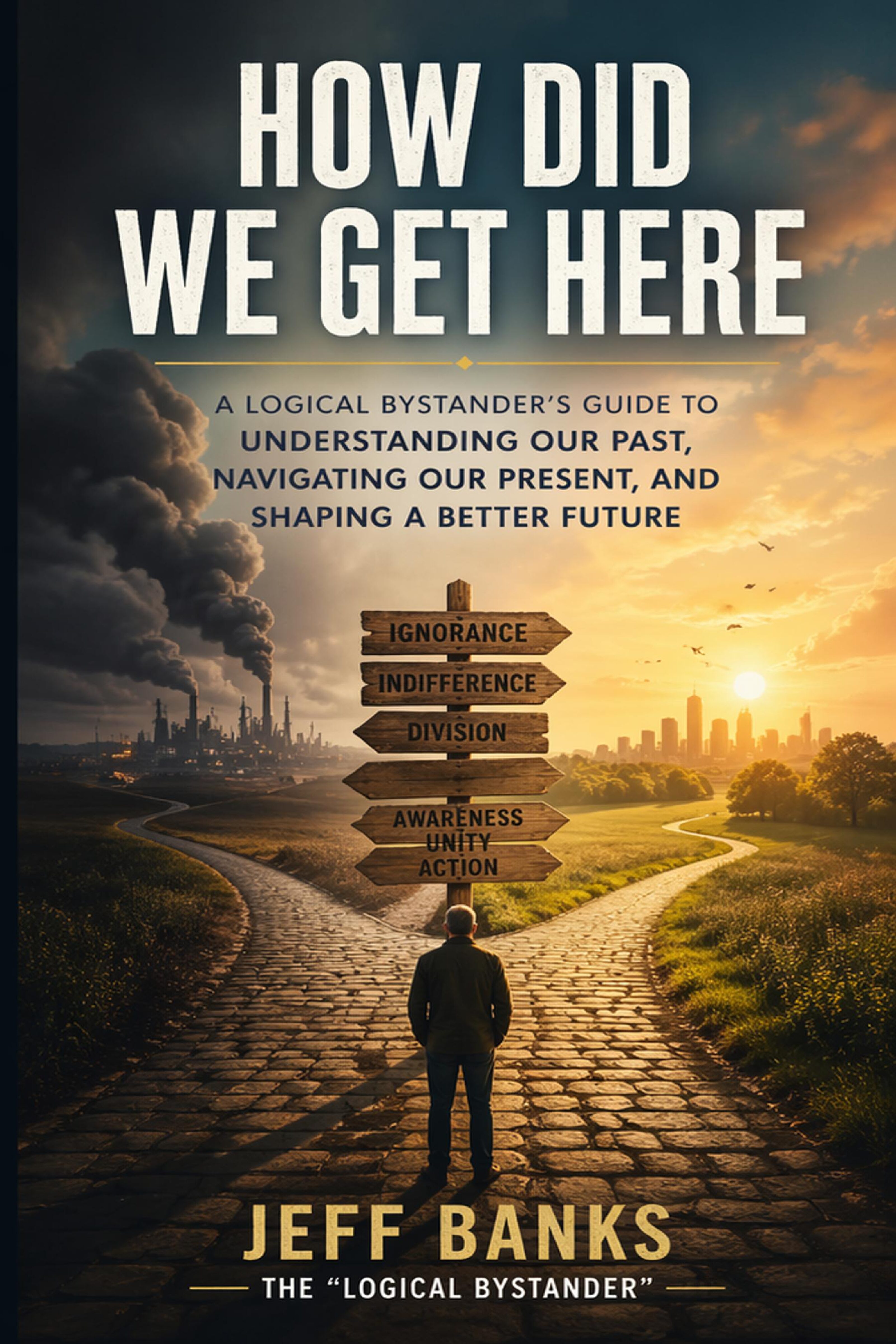
How Did We Get Here Chapter 3 - Faith Versus Religion

How Did We Get Here Chapter 3 - Faith Versus Religion | Travelling Around Australia with Jeff Banks

Looking back, it becomes possible to wonder whether elements of what is now held as sacred began in similar ways. Not as deliberate constructions, but as interpretations of events that could not be explained at the time. Over centuries, those interpretations are refined, codified, protected, until they become something far removed from their origin.

HOW DID WE GET HERE


Chapter 3 – Faith Versus Religion


This is one of those conversations that tends to unsettle a room before it has properly begun. The subject alone is enough to shift posture, to draw quiet lines in the sand, to prompt the kind of polite discomfort that usually signals something is about to be challenged. There is an awareness, even at the outset, that what follows will not sit neatly with everyone, that it will press against beliefs held not just with conviction, but with identity. That, in itself, is part of the point.


There is also a recognition, quietly sitting beneath it, that speaking about this at all will annoy some people. Not because of malice, nor because of any desire to provoke for the sake of it, but because of the lens through which it is being examined. This is not a discussion framed from within faith, nor one that seeks to affirm what is already held. It is a conversation shaped by how it appears when viewed from the outside, stripped back to its structure, its patterns, its outcomes. That perspective, by its very nature, will feel uncomfortable to those who sit inside the belief rather than observe it.


And yet, the conversation persists, because avoiding it does not make the questions disappear. When faith is set aside, even momentarily, and the world is viewed through a purely logical framework, the construct becomes difficult to reconcile. Not the presence of belief itself, that can be understood as part of the human condition, but the way it expands, divides, and, at times, appears to turn in on itself. The same foundational ideas, interpreted in different ways, giving rise to entirely separate systems, each holding firm to its own version of truth.


From that vantage point, the challenge is not to dismiss belief, but to understand how something that begins with a unifying intent can evolve into a landscape marked by division. How the act of interpretation, of rewriting, of reinforcing particular readings over others, can create outcomes that seem at odds with the original premise. It is in that apparent perversion, or at least the appearance of it, that the tension sits.


That tension is not easily resolved, nor is it expected to be. But it is difficult to ignore once it has been seen, and perhaps even more difficult to leave unspoken.


The starting place, however, feels disarmingly familiar. A small child sits on the floor, mid-conversation, nodding, pausing, listening, responding. There is laughter, negotiation, the occasional disagreement, all directed toward someone who cannot be seen. The adults in the room exchange knowing glances, the kind that carry both amusement and a quiet understanding that this is, in some way, part of development. The imaginary friend is indulged, even encouraged. It is a phase, they say. A harmless exercise in creativity. Something the child will grow out of once reality takes firmer hold.


Shift the setting, and the structure remains curiously intact. A room, often quiet, sometimes grand, filled with people seated in rows. Heads bow, words are spoken, sometimes whispered, sometimes projected with confidence, all directed toward something that cannot be seen. There is reverence in the tone, intention in the posture, a shared understanding that the conversation is real, that it carries meaning, consequence, presence. No knowing glances this time. No suggestion that this is a phase. Instead, it is reinforced, repeated, embedded as something to be sustained rather than outgrown.


The comparison does not arrive loudly. It sits there, almost uninvited, waiting to be acknowledged. The innocent bystander, bound by logic, wonders if there is a form of inequity in the two scenarios. 


Time passes, as it does, and the same child learns to differentiate between what is tangible and what is constructed. The imaginary friend fades, not through confrontation but through irrelevance. School, relationships, consequence, these things introduce a different framework, one that rewards what can be demonstrated and questions what cannot. The child becomes an adult, the conversation with unseen companions replaced by conversations with the world as it presents itself.


And yet, in another setting, perhaps a building designed with intent and reverence, a similar dynamic unfolds. Voices are raised, not in argument but in appeal. Words are spoken toward something that cannot be seen, cannot be measured, cannot be tested in any meaningful way that would satisfy the same criteria applied elsewhere. There is structure to it, ritual, history, layers of interpretation that stretch back beyond the reach of memory. This is not dismissed as a phase. It is not expected to be outgrown. It is reinforced, formalised, and protected.


The difference between the two scenarios is not immediately obvious when viewed from a distance. In both cases, there is belief in something unseen. In both cases, there is interaction with that belief as though it carries weight, influence, presence. The divergence lies in how each is treated by the surrounding environment. One is gently guided toward resolution. The other is embedded, expanded, given authority.


It is at this point that logic begins to slip, not dramatically, not in a way that announces itself, but in the quiet acceptance of a double standard that rarely invites examination. The imaginary friend is recognised as a construct of the mind, a useful tool perhaps, but ultimately separate from reality. The deity, depending on the context, is afforded a different status entirely, one that moves beyond personal comfort into collective truth.


This is where momentum takes hold. Not through force, but through repetition and agreement. The more a concept is shared, the less it is questioned. The more it is reinforced through community, through tradition, through the weight of history, the more it becomes insulated from the kind of scrutiny that would otherwise be applied. It transitions from belief to assumed reality, not because it has been proven, but because it has been accepted.


The mechanics of this are not unique to religion. They appear in business, in politics, in any environment where enough people agree on something long enough for it to feel immovable. The difference here is the scale and the duration. Religion has had centuries to entrench itself, to evolve, to fragment and reform, to adapt to the cultures it inhabits while maintaining a core that resists direct challenge.


Within that framework, the Christian tradition offers a particularly interesting study. At its centre sits a figure whose teachings, as recorded, lean heavily toward compassion, humility, and a questioning of authority. There is a simplicity to the message that, when stripped of interpretation, speaks to something fundamentally human. Care for others. Resist the urge to judge. Understand that power, when misused, distorts the very thing it claims to protect.


Somewhere along the line, that simplicity becomes layered. The writings of prophets, the interpretations of scholars, the agendas of institutions, all begin to shape what was once a relatively direct message. Each layer adds nuance, but it also introduces distortion. What begins as guidance evolves into doctrine, and doctrine, when left unchallenged, becomes something closer to law.


It is within these layers that fragmentation begins. Different interpretations emerge, each claiming alignment with the original intent, each supported by selective readings of the same foundational texts. Over time, these interpretations solidify into separate identities, each with its own structure, its own authority, its own version of truth.


The result is a landscape where belief, once a personal matter, becomes a point of division. Communities form around shared interpretations, and with that comes an implicit boundary. Those within the boundary are aligned. Those outside are not. The shift from belief to identity introduces a new dynamic, one where disagreement is no longer just a difference of opinion but a challenge to something more deeply held.


This is where the minefield reveals itself. Not in the existence of belief, but in the way it is held and defended. The original message, centred on compassion, becomes secondary to the preservation of the structure built around it. Disagreement is met not with curiosity but with resistance. The question is no longer “what is true?” but “what must be protected?”


History offers no shortage of examples where this dynamic has played out with consequences that extend far beyond the abstract. Conflict, both subtle and overt, emerges from the need to assert one version of truth over another. The language of faith, intended to unify, becomes a tool for division. The irony sits quietly beneath it all, rarely acknowledged in the moment, but impossible to ignore in hindsight.


And still, the process continues. New interpretations arise, old ones are challenged, institutions adapt or resist, and through it all, the underlying mechanism remains unchanged. Enough people agree on something, and it becomes real within that context. Questioning it becomes difficult, not because the question lacks merit, but because the act of questioning itself carries risk.


This is where the logical bystander begins to take shape, not as an outsider standing at a distance, but as someone moving within the same current, noticing the pattern as it unfolds in real time. The question is not whether belief has value. Clearly, it does. It offers comfort in uncertainty, structure in chaos, and a sense of connection to something that sits just beyond immediate reach. The question is how that belief is held, and what happens when it shifts from a personal framework into something collectively owned, collectively defended, and, at times, collectively weaponised.


Because the starting point, at least in theory, is not one of division. The foundations, particularly within the Christian tradition, speak of a common origin, a shared message, a central narrative that was never intended to fracture into competing versions of itself. The idea of a unified beginning carries with it an implicit assumption, that those who follow would, in some form, remain aligned. That the message, once delivered, would hold its shape.


Yet that is not what unfolds.


Over time, interpretation begins its quiet work. Words are examined, then re-examined. Context is applied, then adjusted. The writings of prophets, already shaped by perspective and circumstance, are revisited through new lenses, each one influenced by the era, the culture, and, perhaps most significantly, the agenda of those doing the reading. What begins as exploration gradually becomes assertion. The interpretation is no longer a possibility; it becomes the position.


From there, divergence accelerates. Not in large, dramatic breaks at first, but in subtle shifts. A word emphasised differently. A passage prioritised over another. A conclusion drawn where once there had only been suggestion. These shifts accumulate, layer upon layer, until what was once a single thread begins to branch. Each branch retains a connection to the origin, yet each claims a clarity that the others, by implication, lack.


The remarkable part is not that this happens. It is almost inevitable in any system that relies on interpretation. The remarkable part is what follows. Instead of recognising the divergence as a natural consequence of human engagement with complex ideas, each branch begins to assert itself as the truest reflection of the original intent. The shared starting point is acknowledged, but the paths taken from it are defended as though they were the only possible route.


This is where the tension begins to build. Not because people believe, but because they believe differently while holding the same conviction that their version is the correct one. The shared hymn sheet remains, but the readings from it vary, sometimes subtly, sometimes fundamentally. The expectation, however, is not one of variation, but of alignment.


And when that alignment does not occur, the response is rarely curiosity.


It is here that the world begins to show the strain of that contradiction. Communities that originate from the same text find themselves at odds, not over entirely separate ideas, but over interpretations of the same words. The language is familiar, the references shared, yet the conclusions drawn create distance. That distance, left unexamined, hardens into something more defined. Identity begins to attach itself not just to belief, but to the specific version of that belief.


Once identity is involved, the stakes shift.


Disagreement is no longer a discussion about interpretation. It becomes a challenge to belonging, to correctness, to the very framework through which meaning has been constructed. The response, then, is not to explore the difference, but to defend the position. The shared origin, which might have served as common ground, is overshadowed by the need to maintain distinction.


This is how a world, theoretically built on a common message, finds itself fractured into opposing positions, each convinced of its alignment with the source. The anger that emerges is not always loud, not always overt, but it is present in the quiet dismissals, the unwillingness to engage, the certainty that leaves no room for alternative readings.


And all the while, the foundation remains the same.


This is where the question begins to press a little more firmly. What would it look like to apply the same criteria used in other areas of life? To move beyond whether something feels true and ask whether it can withstand examination. Not as an act of dismantling belief, but as a way of understanding it more clearly. To separate the comfort that belief provides from the assertion that it must be universally accepted in its current form.


What would happen if uncertainty were allowed to exist without being immediately resolved? If the presence of multiple interpretations were seen not as a threat, but as an indication of the depth and complexity of the original message. If the response to difference was not defence, but inquiry.


The logical bystander does not demand answers. It simply notices the pattern. A shared beginning, followed by divergence, reinforced by certainty, leading to division. And somewhere within that sequence, a question that remains quietly unresolved.


How did we get here, when the starting point suggested something very different, and what would it take to read from the same hymn sheet without turning the page into a point of conflict?


These are not easy questions, and they are rarely welcomed in environments where the answers are assumed to be settled. Yet they offer a pathway that does not require the abandonment of belief, only a recalibration of how it is understood. A recognition that certainty, when left unchecked, can lead to the very outcomes it was intended to prevent.


The absurdity, when viewed from a slight distance, becomes difficult to ignore. Entire systems built on interpretations of interpretations, defended with a conviction that leaves little room for reflection. The child with the imaginary friend is gently guided toward reality, while the adult, engaged in a far more complex version of the same interaction, is often shielded from similar scrutiny.


It is not a matter of mocking belief, nor of elevating scepticism as a superior position. It is about recognising the pattern, the way ideas move from thought to acceptance without passing through the filter of critical examination. The way communities reinforce those ideas until they become self-sustaining, resistant to the very questions that might refine them.


And so the chapter finds its way to a place that feels less like a conclusion and more like a quiet confrontation. Not with others, but with the self. The recognition that certainty, in any form, carries a weight that must be managed carefully. That belief, while powerful, is not immune to distortion.


The words from When I Die linger in the background, not as an answer, but as an honest admission of the space that exists between certainty and doubt. There is a confidence in the statement, a declaration that there is no heaven, delivered with a clarity that suggests resolution. And yet, in the same breath, there is a plea, a hope that there is no hell.


It is in that contradiction that something real begins to take shape. Not certainty, not proof, but an acknowledgment of the limits of understanding. A space where belief and doubt coexist, not as enemies, but as reflections of a mind trying to make sense of something that resists simple definition.


From there, the mind drifts, not in search of answers so much as possibilities. The question of origins, of where belief first takes hold, has a way of inviting speculation that sits just outside the boundaries of what can be proven. Not in the sense of conspiracy or grand design, but in the quieter curiosity about how something so deeply embedded could have begun.


There is a version of that question that finds its way into science fiction, not because it offers answers, but because it removes the constraints of what must be accepted. The idea that first contact, the arrival of something beyond comprehension, could have been interpreted through the only lens available at the time. A visitor, advanced beyond understanding, demonstrating capabilities that defy explanation, arriving in a world not yet equipped to question the mechanics behind what it is witnessing.


Within that frame, the line between visitor and deity becomes blurred. Not through intention, but through perception. The technology that allows for travel, for healing, for communication, would appear indistinguishable from what might be described as divine. The response, then, is not one of analysis, but of reverence. Stories begin. Interpretations form. What was witnessed becomes what is told, and what is told becomes what is believed.


It is not difficult to see how that process, repeated over time, shaped by culture and retold through generations, could evolve into something far more structured. The visitor becomes the god. The event becomes the origin. The unexplained becomes the sacred.


And yet, place that same scenario in the present day, and the response shifts. An arrival, even one that defies current understanding, would be met not just with awe, but with analysis. Cameras would capture it. Scientists would dissect it. Governments would attempt to control the narrative. There would still be wonder, certainly, but it would be accompanied by scrutiny. The instinct to believe would be tempered by the instinct to understand.


This is where the contrast begins to settle in. If something similar occurred in what is now described as the post-Christ era, would it carry the same weight? Would a returning explorer, whether imagined as the Vulcans of Gene Roddenberry or something entirely different, be received with the same unquestioned reverence, or would it be filtered through a framework that demands evidence?


The answer is not as clear as it might first appear. Because while knowledge has expanded, the underlying human tendencies have not shifted as dramatically as the technology that surrounds them. There is still a desire to believe, to attach meaning, to find something larger than the immediate experience. The difference is that this desire now competes with a parallel instinct to verify, to challenge, to deconstruct.


This tension is captured, perhaps unintentionally, in Star Trek Into Darkness. The opening sequence, often viewed as a piece of cinematic spectacle, carries within it a quieter commentary. A primitive civilisation, witnessing the arrival of something far beyond its comprehension, responds not with curiosity but with worship. The figure that emerges, not as a god but as an explorer, is immediately elevated to something more. The act of observation becomes an act of belief.


There is an unsettling familiarity in that scene. Not because it mirrors a specific historical event, but because it reflects a pattern. The leap from unknown to divine, from unexplained to unquestioned, happens quickly when there is no framework to contain it. The presence of something extraordinary fills a gap that logic cannot yet reach, and in that space, belief takes root.


The alarming part is not the reaction itself, but the speed at which it solidifies. The absence of understanding does not slow the process. It accelerates it. The less that is known, the more confidently it is defined. The narrative forms around the experience, and once formed, it resists alteration.


Looking back, it becomes possible to wonder whether elements of what is now held as sacred began in similar ways. Not as deliberate constructions, but as interpretations of events that could not be explained at the time. Over centuries, those interpretations are refined, codified, protected, until they become something far removed from their origin.


And yet, even with all that has been learned, the underlying contradiction remains. The capacity to question exists alongside the desire to believe. The tools to analyse sit beside the impulse to accept. The modern world, for all its advancements, still carries the same fundamental tension that echoes through the words of that song.


A certainty expressed, followed immediately by a hope that contradicts it.


It is not a flaw. It is a reflection of something deeper. A recognition that, despite the frameworks built and the answers proposed, there remains a space that resists being filled completely. And perhaps that is where the question returns, not with accusation, but with quiet persistence. How did we get here, and if faced with the same moment again, would it unfold any differently at all? And perhaps that is where the question settles, not in the structures that have been built, nor in the doctrines that have been defended, but in the quieter space beneath it all.


How did we get here, and what would it take to not end up here again?

Author

Menu