
How Did We Get Here Chapter 1 - Introduction

How Did We Get Here Chapter 1 - Introduction | Travelling Around Australia with Jeff Banks

There is a long tradition of using the absurd to illuminate reality, and it is a tradition worth leaning into. Works such as The World According to Garp demonstrate how the farcical can carry weight in ways that straightforward seriousness often cannot. The ridiculous becomes a lens through which truth is made more accessible, allowing the reader to step back just far enough to see the shape of things without becoming overwhelmed by them. That same approach sits at the heart of what follows here, where humour is not used to diminish the situation, but to expose it more clearly.

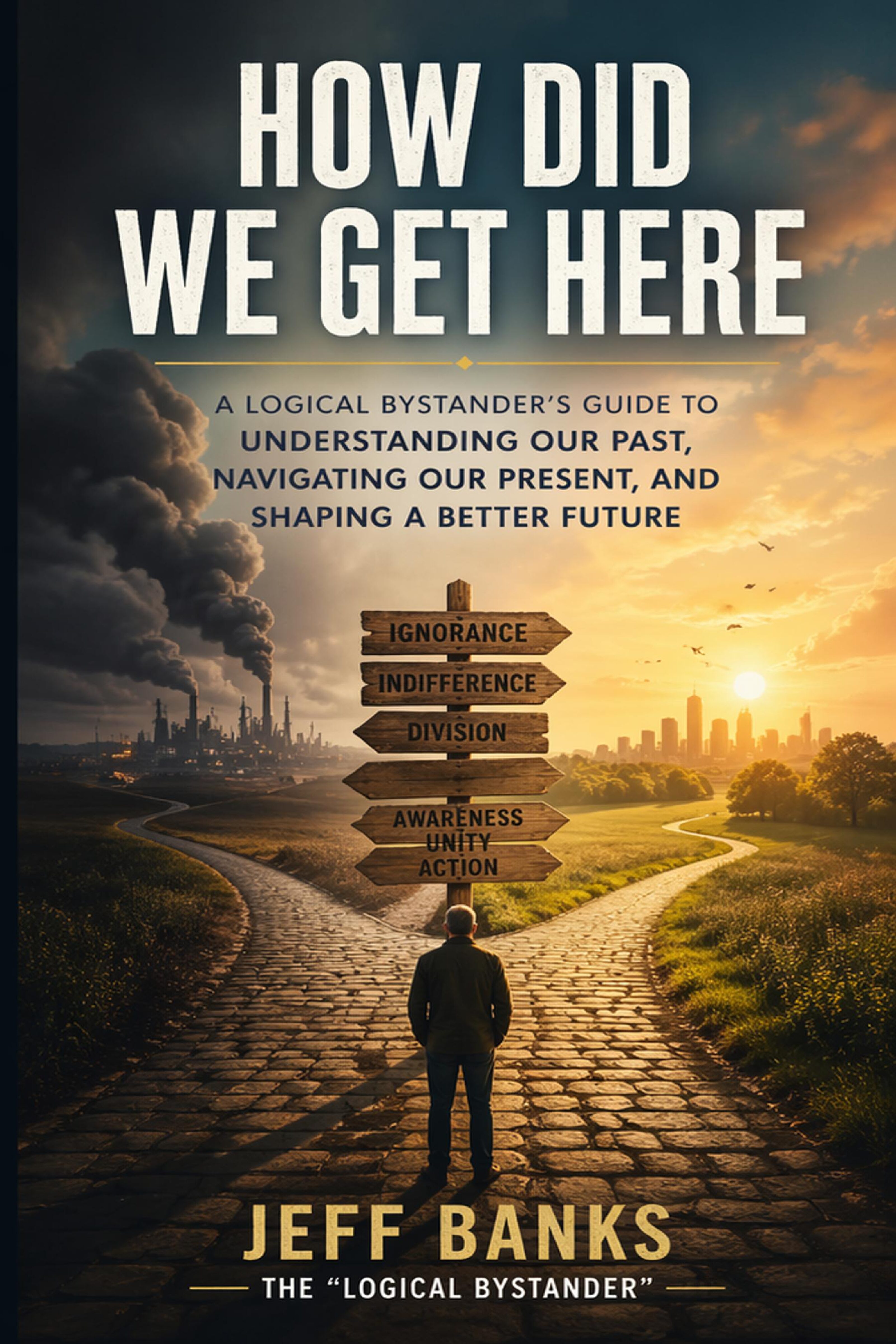
HOW DID WE GET HERE


Chapter 1 – Introduction


There is a moment that arrives more often than most would care to acknowledge, where something unfolds in front of you, and the only honest response is a quiet, internal question about how on earth things reached this point. It is not the grand, sweeping kind of reflection reserved for historians or economists trying to explain wars or recessions. It is something far more ordinary and, because of that, far more dangerous. It is the meeting that drifts off course while everyone politely allows it to happen. It is the decision that makes little sense but gathers momentum simply because it has already been spoken aloud. It is the idea that, once expressed, seems to take on a life of its own, shifting from a thought into something treated as fact without ever earning the right to be there.


This book lives in that space, the space between thought and acceptance, between logic and momentum. It is not a manual, although it will try to offer some sense where it can. It is not a rant, although there will be moments where restraint feels like a wasted opportunity. It is certainly not an academic dissection of human behaviour, even though there will be analysis that is grounded, practical, and occasionally uncomfortable in its honesty. What it is, at its core, is an observation. A running commentary from the cheap seats, where the view is often clearer precisely because there is no authority attached to it. It is a collection of moments where the world tilts just slightly off its axis and, rather than rushing in to fix it or pretending not to see it, someone stands there, watches, and later asks why.


There is something quietly liberating about that position, the role of the logical bystander who is not responsible for the decision yet cannot ignore it, who is not invested in the outcome yet understands its consequences. It is a role that becomes second nature over time, particularly in professions where observation and interpretation are constant companions. Years spent watching numbers tell stories that people themselves either cannot see or choose not to acknowledge begin to shape the way situations are viewed. Patterns emerge, repetition becomes familiar, and logic is often seen being overridden by emotion, ego, fear, or, at times, sheer inertia. It is in those moments that a particular truth begins to reveal itself, one that does not arrive with any fanfare.


Stupidity rarely announces itself in any obvious way. It does not walk into the room with a name badge or declare its intentions with any clarity. Instead, it arrives quietly, often dressed as consensus, occasionally disguised as urgency, and sometimes presented as innovation. It borrows credibility from those around it, builds momentum through silence, and before long it is no longer questioned. It simply exists, accepted not because it has been tested, but because it has not been challenged. The shift from “someone said it” to “it must be right” happens almost without notice, and once that shift occurs, reversing it becomes far more difficult than it ever should have been.


Mob mentality plays its part, though not in the dramatic, headline-grabbing way that tends to dominate public imagination. This is not about crowds in the street or chants that echo through history. This is the quieter version, the nods around a boardroom table, the unspoken agreement not to challenge something that feels slightly off, the gradual drift toward an outcome that, if examined individually, no one would have chosen. Yet collectively, it becomes inevitable. There is a comfort in alignment, even when that alignment is misplaced, and a reluctance to be the one who interrupts the flow. The consequence is that decisions are often carried forward not by conviction, but by momentum.


When those decisions eventually unravel, as they often do, the clarity that follows can feel almost insulting in its simplicity. The risks that were invisible suddenly become obvious, the questions that were never asked now seem essential, and the same people who moved with the current begin to speak as though they had always been standing apart from it. Hindsight provides a convenient vantage point, but it rarely offers any practical benefit to the moment that has already passed. This book is not interested in hindsight. It steps into the moment as it happens, capturing decisions in motion and examining the environment that allows them to take shape.


There is a long tradition of using the absurd to illuminate reality, and it is a tradition worth leaning into. Works such as The World According to Garp demonstrate how the farcical can carry weight in ways that straightforward seriousness often cannot. The ridiculous becomes a lens through which truth is made more accessible, allowing the reader to step back just far enough to see the shape of things without becoming overwhelmed by them. That same approach sits at the heart of what follows here, where humour is not used to diminish the situation, but to expose it more clearly.


This, however, is not Garp’s world. It is a world shaped by a lifetime of observation, where businesses rise and fall not purely because of market forces, but because of decisions made in rooms where logic quietly leaves without drawing attention to its departure. It is a world where clients navigate complexity with confidence, only to stumble over something simple that no one paused to question. It is a world where communities build something meaningful and then, over time, erode it through expectation, entitlement, or the quiet assumption that responsibility belongs to someone else. There is no shortage of material, only a question of whether it is worth putting it into words.


Writing these things down carries its own risk, as it challenges the comfort that silence provides and invites a level of scrutiny that is often easier to avoid. It removes the distance between observer and participant and forces an acknowledgement of something that sits uncomfortably beneath the surface. No one is entirely separate from the behaviours being observed. The same instincts that are easy to identify in others exist, in smaller and more subtle ways, within ourselves. The tendency to go along rather than push back, the desire to avoid unnecessary conflict, and the quiet hope that something will resolve itself without intervention all play their part in shaping outcomes.


This book does not attempt to sit above that reality. Instead, it sits within it, presenting each anecdote and observation not as a judgement, but as part of a shared experience. The moments that appear, at first glance, to be examples of sheer stupidity are unpacked with an intent to understand rather than simply criticise. The motivation behind decisions is explored, the logic, or absence of it, is laid bare, and then, where possible, an alternative way of thinking is offered. Not a perfect solution, and certainly not a guaranteed one, but a way to interrupt the pattern before it becomes entrenched.


If there is a purpose in all of this, it is not simply to point out what is wrong. It is to understand why these patterns repeat, why intelligent people find themselves part of decisions that, in hindsight, seem indefensible, and why silence so often replaces curiosity at the very moment it is needed most. There is an opportunity, small but meaningful, to shift that balance. It begins with awareness, with a willingness to question what is presented rather than accept it at face value, and with the recognition that just because something has been said does not make it true.


The hope is not for dramatic change, but for something more subtle and, in many ways, more powerful. It is the introduction of a pause, a moment where the flow is interrupted just long enough for a question to surface. It is the quiet voice in the room that is willing to ask whether the direction being taken actually makes sense. It is the recognition that the role of the logical bystander does not have to remain passive, that observation can, at times, evolve into gentle intervention.


And perhaps that is where this begins to matter, not as a collection of stories about what went wrong, but as a reminder that the next time one of these moments unfolds, there is a choice. It may not feel like a significant one, and it may not always change the outcome, but it exists nonetheless. It is the choice to ask, to challenge, and to resist the quiet slide from thought into assumed truth.

Author

Menu