

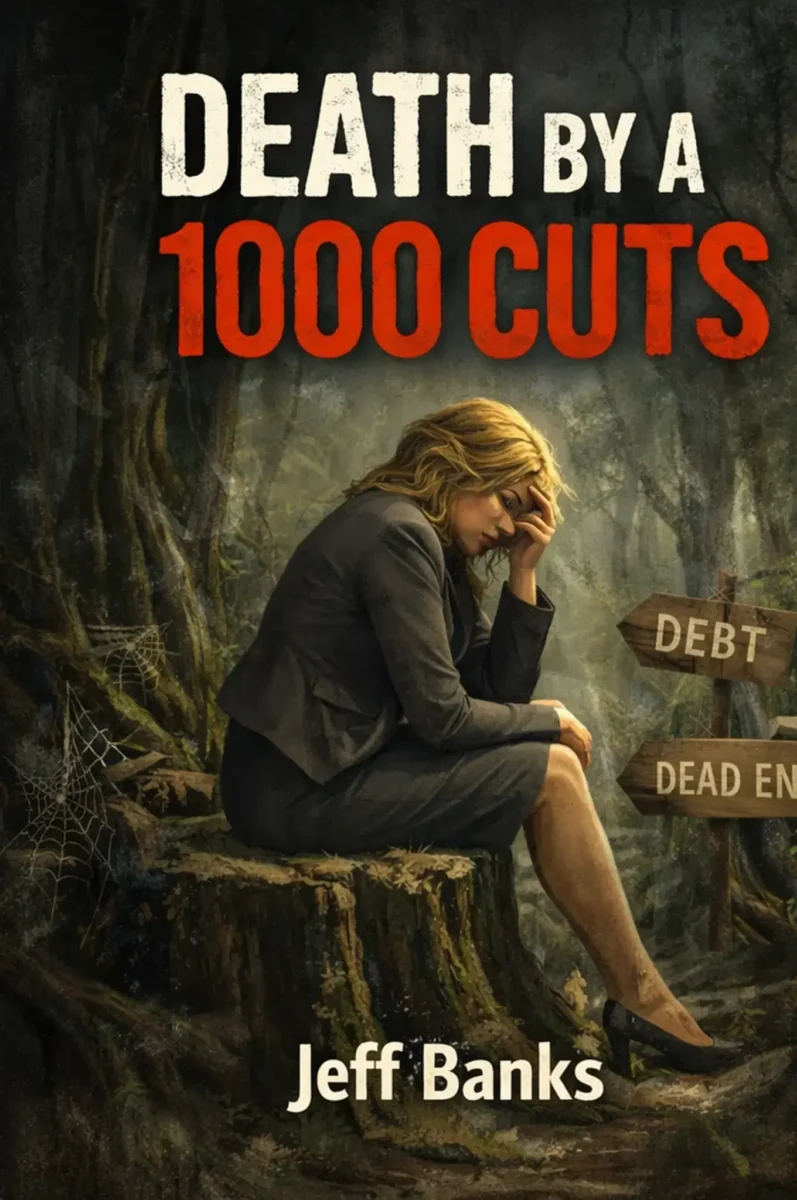
Death By a 1000 Cuts - Foreword and About the Author

death_by_1000_cuts_front_cover

This book is not about a single catastrophic failure. It is not the story of fraud, scandal, or reckless extravagance. It is something far more common, and therefore far more confronting. It is the story of accumulation.

DEATH BY A THOUSAND CUTS


Foreword 


Entrepreneurship is often romanticised in hindsight and sanitised in public. We celebrate the exits, the pivots, the triumphant relaunches. We package the journey into neat keynote slides and social media captions. We applaud resilience as if it were a personality trait rather than a daily act of quiet survival.


What we rarely document, honestly, clinically, compassionately, is the slow erosion.


This book is not about a single catastrophic failure. It is not the story of fraud, scandal, or reckless extravagance. It is something far more common, and therefore far more confronting. It is the story of accumulation. Small decisions. Small assumptions. Small moments of pride, hope, defensiveness, and fatigue that compound over time.


A thousand cuts.


Mandy did not begin with naivety. She began with conviction. She had experience. She had passion. She had a sense, deeply felt, that she could build something better than what she had endured. In the wake of divorce, in the quiet determination to redefine herself beyond the label of “failed marriage participant,” she stepped into business not simply to generate income, but to reclaim identity.


That is not weakness. That is human. But entrepreneurship is an unforgiving arena for unresolved emotion.


When business becomes both livelihood and therapy, objectivity blurs. Market validation can feel like personal validation. Revenue becomes proof of worth. A quiet week becomes a referendum on capability. And mentors, advisors, and friends, however well-intentioned, often reinforce optimism before they interrogate fundamentals.


This book traces those moments.


The soft opening that was meant to test systems but quietly became a plea for traction. The grand opening suggested by mentors as a turning point that could manufacture momentum. The practitioners who hovered politely at the edges, supportive but uncommitted. The financial projections that assumed best-case uptake in a market that had never been clinically measured. The sleepless nights that began as excitement and slowly morphed into vigilance.


There is no villain here. Not the mentors. Not the market. Not the divorce. Not even Mandy.


What there is, instead, is psychology.


The rose-coloured glasses effect, so common among founders, does not present as delusion. It presents as courage. As persistence. As belief when others hesitate. It is celebrated in business folklore. “Just back yourself.” “Stay the course.” “Push through the dip.”


And yet, there is a line, often invisible in real time, between resilience and resistance to reality.


One of the central tensions explored in these pages is the fight between what is right and what I think. The numbers whisper one story. Identity shouts another. Advisors offer frameworks. Pride filters the interpretation. Divorce stigma lingers in the background, turning every business challenge into something larger than commerce. To close the doors would not simply be a financial decision. It would feel like confirmation of a narrative she was determined to escape.


Entrepreneurial instinct is powerful. It is also partial.


We are wired to notice confirming evidence. We seek anecdotes that support the thesis. We interpret early interest as proof of inevitable traction. We discount silence. We rationalise poor weeks as seasonal fluctuations. We call additional capital injections “investment” rather than “avoidance of loss.”


Throwing good money after bad rarely feels like recklessness at the time. It feels like commitment.


This book does not mock that commitment. It examines it.


There is courage in starting. There is courage in persisting. But there is also courage in stepping outside oneself long enough to observe clinically. To ask uncomfortable questions before the bank balance demands them. To separate personal reinvention from commercial feasibility.


Mandy’s story is not unusual. That is precisely why it matters.


Across co-working spaces, boutique studios, wellness centres, digital agencies, and small retail fronts, similar patterns play out quietly. Founders stretch themselves thin between family and business. Overseas virtual assistants become line items rather than human beings navigating their own pressures. Systems are documented but not embedded. Leadership thins, not because intention fades, but because exhaustion erodes clarity.


“I’ve already explained this.” “It’s written in the procedures.” “Why can’t they just follow it?”


What often goes unspoken is simpler and harsher: the organisation moved on before it stabilised.


This is not a book written from inside the dream. It is written from the edge of it. From the vantage point of someone trained to read numbers, structures, and patterns, yet aware that numbers never tell the full story without understanding the human who generated them.


It asks questions that mentors sometimes avoid: Was the business model validated beyond personal experience? Was the demographic base sufficient within a realistic travel radius? Was capital allocated to growth before breakeven stability? Were advisors challenged, or simply trusted? Was entrepreneurship chosen as strategic expansion, or as emotional reclamation?


These are not accusations. They are inquiries.


The purpose of this foreword is not to warn against entrepreneurship. On the contrary, enterprise is the engine of community, innovation, and personal growth. But it demands more than passion. It demands a willingness to confront unknown unknowns, those blind spots that no spreadsheet highlights until liquidity evaporates.


The unknown unknowns are where most rose-coloured glasses thrive.


You cannot research what you do not know to question. And yet, disciplined curiosity is the entrepreneur’s most underrated tool. Not excitement. Not hustle. Not branding. Curiosity. What might I be missing? Who benefits if I am wrong? What does the data say when stripped of narrative? If this were someone else’s business, what advice would I give?


Mandy’s journey forces those questions into the open. And in doing so, it offers something more valuable than a redemption arc. It offers insight.


If you are an aspiring founder, this book will challenge your optimism, not to extinguish it, but to strengthen it with structure. If you are an established business owner, it may feel uncomfortably familiar. If you are an advisor, mentor, or accountant, it may prompt reflection on the responsibility carried when guiding someone whose identity is tied to their enterprise.


Entrepreneurship magnifies what already exists within us. Confidence becomes vision. Doubt becomes insomnia. Determination becomes stubbornness. Hope becomes denial.


Left unchecked, those magnifications create friction. Not one decisive blow, but a series of minor wounds.


A thousand cuts. And yet, there is dignity in examining them.


This book does not end with easy answers. It does not pretend that every enterprise can be saved with better forecasting or stricter governance. Some ventures are born too early. Some are undercapitalised. Some are responses to emotional earthquakes rather than market gaps.


But there is power in learning. To recognise the early signs of cognitive bias. To understand the interplay between personal reinvention and commercial reality. To value mentors without surrendering critical thought. To know when persistence is strength, and when it is self-preservation disguised as ambition.


Mandy’s story is specific. The lessons are universal. If, as you read, you find yourself nodding, uncomfortable, defensive, or reflective, that is the point. Because the true cost of entrepreneurship is rarely the headline failure. It is the incremental erosion that goes unexamined. And the true value of a story like this is not in dissecting what went wrong, but in illuminating how easily it can happen.


May these pages encourage clearer vision. May they sharpen instinct with inquiry. May they honour courage while demanding discipline. And may they remind us that while ambition builds businesses, awareness sustains them.


About the Author


Jeff Banks has spent more than forty years at the coalface of Australian small business.


An accountant by qualification, an advisor by instinct, and a mentor by lived experience, Jeff has worked alongside hundreds of founders, family enterprises, tradespeople, professionals, and aspiring entrepreneurs across regional and metropolitan Australia. His career has not been confined to compliance and lodgements. It has been forged in boardrooms, across kitchen tables, in workshops, in start-up hubs, and in moments of quiet crisis where numbers alone were never the full story.


Through his work as a registered tax agent and business advisor, Jeff has guided clients through the full spectrum of commercial life: launch and growth, partnership disputes, restructures, divorces, generational succession, asset protection strategies, vendor finance negotiations, capital raises, and dignified exits. He has helped design structures to mitigate risk, navigated the intricacies of Australian taxation law, and counselled business owners on the emotional weight that leadership carries long after the spreadsheets are closed.


But his experience extends beyond advisory roles. Jeff has been an entrepreneur himself, founding, leading, restructuring, and at times closing ventures. He understands from both sides of the desk that business is never purely financial. It is psychological. It is relational. It is identity-shaping.


Over the decades, he has mentored emerging business owners through structured programs, informal networks, and one-to-one advisory relationships. His guidance has often centred not only on profitability, but on sustainability, financially, emotionally, and structurally. He has seen firsthand how optimism can propel success, and how unexamined bias can quietly erode it.


Jeff writes with the clarity of a practitioner and the empathy of someone who has witnessed the human consequences of commercial decisions. His perspective is shaped by thousands of real conversations: late-night calls about payroll pressure, anxious discussions about loan covenants, hopeful projections for new ventures, and the hard truths that sometimes follow.


Death by 1000 Cuts reflects the accumulated insight of four decades spent observing entrepreneurial psychology up close. It is not written from theory alone, but from lived exposure to the patterns that repeat across industries and generations. Jeff’s work seeks to bridge the gap between passion and prudence, between the dream of building something meaningful and the discipline required to sustain it.


He continues to advise, mentor, and write, driven by a belief that business, when approached with clarity and integrity, can be one of the most powerful forces for personal growth and community contribution.

Author

Menu