

Will the business continue because it is evolving into something structurally sound? Or will it continue because stopping feels unbearable?
That distinction matters. One reflects adaptation. The other reflects attachment.
Will the business continue because it is evolving into something structurally sound? Or will it continue because stopping feels unbearable?
That distinction matters. One reflects adaptation. The other reflects attachment.
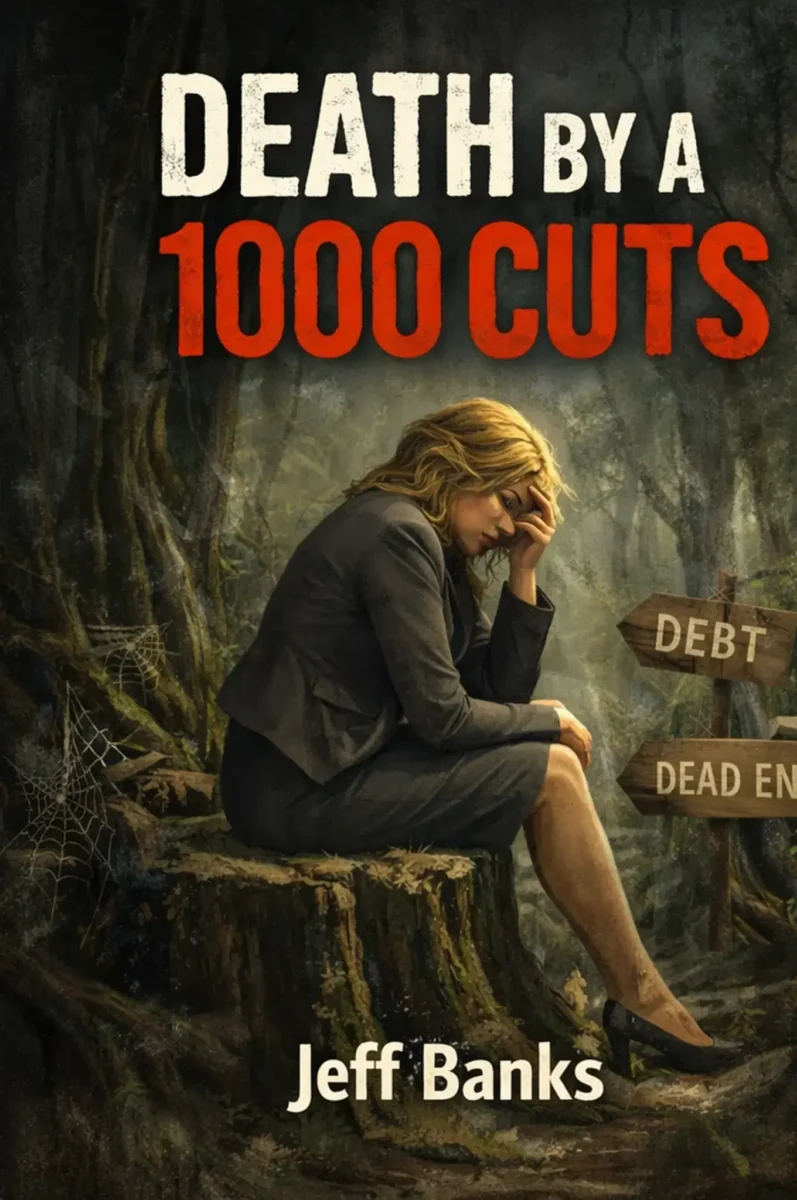
DEATH BY A 1000 CUTS
Chapter 8 – What Does the Future Hold
It is a deceptively simple question. The sort of question that sounds hopeful when asked across a café table or written into the back page of a business plan. “What does the future hold?” It implies possibility. Expansion. A turn in fortune just beyond the horizon.
For the rose-coloured-glasses entrepreneur, that question does not trigger caution; it triggers projection. The mind fills the horizon with growth curves, busy appointment books, practitioners fully booked weeks in advance, a community gradually realising what it has been missing. The future becomes an extension of belief rather than an interrogation of risk.
Yet the most dangerous element in that optimism is not miscalculation. It is the existence of things not yet imagined.
Every venture begins with known unknowns. These can be listed, modelled, and debated. Will demand be strong enough? Will marketing convert? Will costs stay within projection? These are uncomfortable but manageable uncertainties.
The greater threat lies in the unknown unknowns, the factors the founder does not even recognise as variables.
An entrepreneur infected with rose-coloured conviction does not deliberately ignore these. She simply cannot see them. They exist outside the frame of her current understanding. And because they are unseen, they are unresearched.
How do you research a cultural resistance that has never been explicitly voiced? How do you quantify the subtle inertia of a suburb that supports wellness in theory but defaults to convenience in practice? How do you survey for the emotional fatigue that might creep in after three underperforming months?
You cannot run a focus group on what you have not conceived as a risk.
The first area a mentor would probe is market validation. Most advisory platforms for entrepreneurs repeat the same uncomfortable principle: you are not your market. The fact that you once needed something does not automatically mean a sufficient number of others are prepared to pay for it consistently. The centre was built on conviction that there was a genuine community need. That belief was not naive. It was heartfelt. But conviction and demographic analysis are not the same thing.
And this is where rose tint subtly alters perception. When the founder believes deeply in the premise, research tends to seek confirmation rather than contradiction. A handful of encouraging conversations begin to feel like momentum. Expressions of interest are interpreted as pre-commitment. The absence of visible competitors is assumed to signal opportunity rather than prior failure.
A textbook approach would have demanded granular data. What is the population within a realistic travel radius? How many of those individuals fall into the likely age bracket for ongoing complementary health services? What proportion have the discretionary income to sustain repeat visits? How many similar services operate quietly within neighbouring suburbs? How many visits per week are required to reach break-even, and what percentage of the local population would need to convert to achieve that number?
Those questions appear clinical, almost cold. But they are not designed to extinguish vision; they are designed to test its structural integrity. They attempt to surface what might otherwise remain invisible until it is too late.
The difficulty is that even granular data cannot expose everything. It can reveal population size but not cultural priority. It can reveal income levels but not willingness to allocate that income to preventative care. It can identify competitors but not the reasons they struggled. It can calculate break-even but not the lag between curiosity and commitment.
There is a psychological dimension at work here. The entrepreneur wants the premise to be true. Not recklessly, but sincerely. She believes the service adds value. She sees transformation potential. She imagines gratitude from clients who have yet to walk through the door.
That belief becomes a lens through which ambiguity is interpreted optimistically. If bookings are light, it is because awareness is still building. If practitioners hesitate, it is because they need more proof. If early months underperform, it is because timing is off. Each data point is reframed as temporary rather than structural.
This is not dishonesty. It is hope protecting itself. But the inability to truly research the unknown does not eliminate its impact. It simply delays the moment of recognition. By the time the unknown unknown becomes visible, in the form of flat bookings, inconsistent practitioner commitment, or sustained cash pressure, the business has already stepped beyond the planning stage into full exposure.
At that point, the conversation shifts from theoretical modelling to lived consequence.
The future that once implied expansion begins to imply endurance. The question “What does the future hold?” no longer feels like projection; it feels like interrogation.
And perhaps that is the true challenge for the rose-coloured-glasses entrepreneur: not the courage to step out, but the willingness to examine whether the premise itself was tested deeply enough before the step was taken.
Because optimism can build a business, but only disciplined confrontation with the unknown can sustain one.
These questions are not romantic. They do not inspire. But they protect. When research is built more on felt need than hard data, the business begins its life with a subtle structural vulnerability. It is not doomed, but it is exposed.
The next point of discussion would likely revolve around timing and momentum. The soft opening was intended to be prudent, a gentle introduction to the market that allowed systems to settle and word-of-mouth to develop organically. Later, a grand opening event was positioned as a potential turning point, something that might catalyse the energy the centre needed.
Yet business mentors often caution that events amplify momentum rather than create it. If there is already traction, an event can accelerate growth. If there is not, the spike is often temporary. When numbers return to baseline after the excitement fades, the emotional impact can be disproportionate. The expectation of a breakthrough collides with the reality of steady, unremarkable trade.
Another structural feature worth examining is the practitioner model itself. Independent practitioners offer flexibility and reduce fixed salary exposure. On paper, this is attractive. In practice, it requires commitment. Without written agreements, minimum room rentals, or long-term contracts secured before significant overhead was locked in, the model leaned heavily on alignment and goodwill.
Encouragement from a distance is easy. Anchoring one’s income to a centre still finding its footing is harder. Practitioners may have viewed the centre as a potential pipeline of clients rather than a shared risk environment. This is not unethical; it is rational behaviour. But from a structural perspective, it left the centre carrying the fixed costs while others retained flexibility.
Cash flow, inevitably, becomes the central conversation. Entrepreneurial forums describe it bluntly: profit is theoretical, cash flow is survival. Fit-out costs rarely land exactly on projection. Compliance adjustments appear midstream. Marketing requires repetition and testing rather than a single campaign. Software subscriptions accumulate. Insurance premiums increase. Small timing blowouts compound.
When break-even shifts from one projected month to another, the runway shortens. The business may still be viable in theory, but viability over a twelve-month horizon looks different from viability over three. A mentor would ask not whether the business can work, but how long it can afford to discover whether it will.
Overlaying all of this is something no spreadsheet can measure: the personal narrative. Divorce sits quietly in the background of this enterprise. The centre is not merely a commercial experiment; it is, in part, a statement of capability and independence. Success becomes symbolic. Closing the doors feels less like a financial recalibration and more like conceding something deeply personal.
This is where decision-making becomes complicated. If identity is intertwined with enterprise, the option to close is not evaluated solely on economic grounds. It becomes emotionally charged. That does not make continuation wrong, but it does mean the analysis is never purely rational.
So the discussion turns to the fork in the road.
From a purely logical perspective, one option is immediate closure. Stop the ongoing financial bleed. Preserve remaining capital. Protect emotional reserves. Pivot sooner rather than later. In theory, this is clean.
In practice, it is anything but. Lease obligations remain. Personal guarantees may trigger. Equipment finance must be resolved. Suppliers must be settled. There are costs to stopping, both tangible and reputational. Closure is rarely the simple act of turning off the lights and walking away.
The alternative is to continue. To refine the offering, sharpen demographic targeting, secure firmer practitioner commitments, renegotiate terms, audit expenses, and adjust marketing strategy. Many entrepreneurial mentors would advocate this path, arguing that businesses often require longer than expected to reach stability.
However, continuation without structural change risks becoming slow depletion. Owner salary is typically the first casualty. Personal savings follow. Sleep becomes irregular. Stress creeps into other areas of life. By the time closure becomes unavoidable, there may be little left to rebuild from.
This is the delicate balance at the heart of the chapter. It is not a choice between courage and cowardice. It is a choice between structured recalibration and unexamined persistence.
A rational path forward might involve a defined review period. A ninety-day audit with explicit metrics: recalculated break-even, written practitioner commitments, measurable marketing returns, and transparent cash runway visibility. At the same time, an exit strategy prepared in parallel. Lease exposure quantified. Guarantee obligations understood. Emotional impact anticipated.
Paradoxically, clarity around exit can strengthen commitment to continue. When staying is a conscious choice rather than a refusal to contemplate stopping, the energy applied to the business shifts. It becomes strategic rather than defensive.
So what does the future hold?
The honest answer is that it holds uncertainty, whether the doors close tomorrow or remain open for another year. The deeper question may not be about the market at all. It may be about endurance.
Will the business continue because it is evolving into something structurally sound? Or will it continue because stopping feels unbearable?
That distinction matters. One reflects adaptation. The other reflects attachment.
If the pattern observed so far continues, the business will likely persist. Not recklessly, but stubbornly. It will adjust, attempt to refine, and push forward in the belief that momentum can still be built. It may yet stabilise. Many ventures do, often just beyond the point most people would have quit.
But there is also the possibility that it will continue until the reservoir of energy, capital, and emotional resilience is empty. That is not failure in a dramatic sense. It is attrition.
The future, then, is less a forecast than a measure. It will measure research against reality, structure against hope, endurance against depletion. And eventually, it will reveal whether persistence was strategic or simply brave.
That is where this project now sits, not at collapse, not at triumph, but in that uncomfortable middle space where clarity must replace optimism, and where the next decision will determine whether the story bends toward renewal or toward release.
Author