

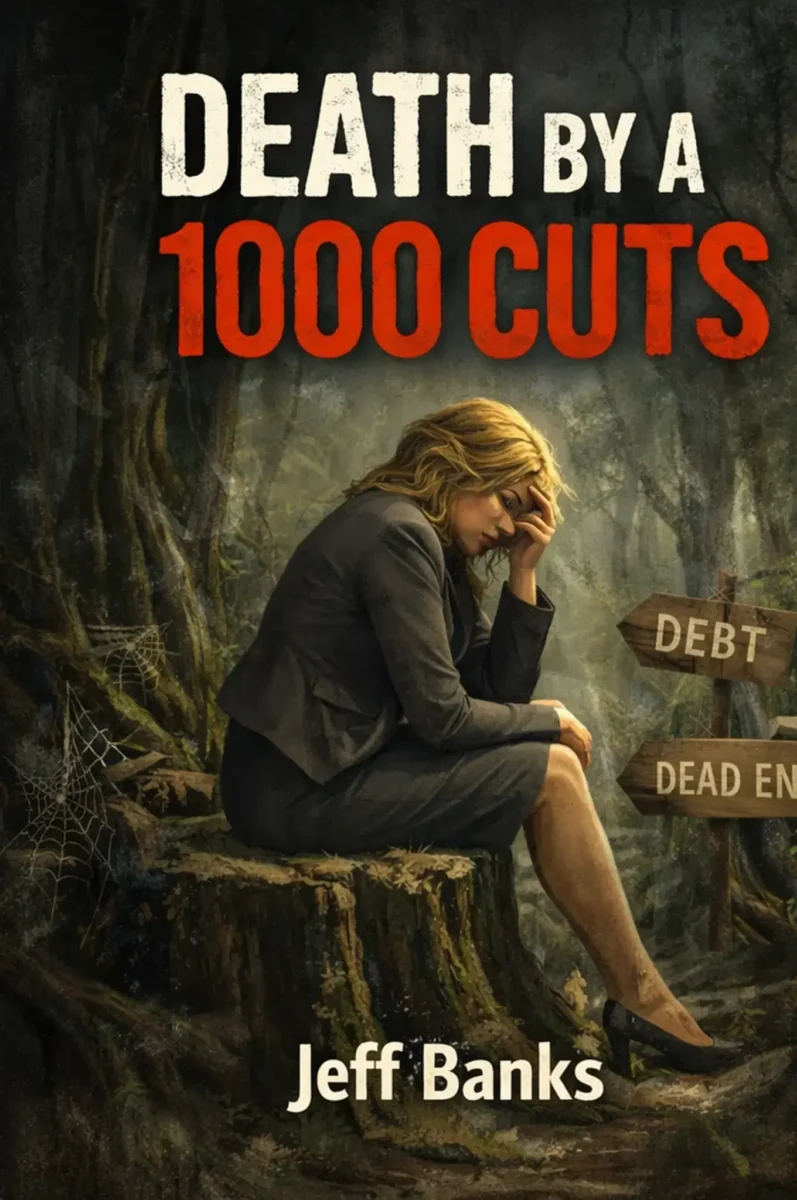
Death By a 1000 Cuts - Chapter 7 - The Rose Coloured Glasses Premise

death_by_1000_cuts_front_cover

She hasn’t retreated. She hasn’t scaled back the vision. If anything, she is pushing harder. More conversations. More ideas. More tweaks. She convinces herself that movement is the antidote to anxiety.

DEATH BY A 1000 CUTS


Chapter 7 – The Rose Coloured Glasses Premise


This chapter must sit in that uncomfortable space most entrepreneurs never talk about publicly. Not the launch. Not the collapse. But the long, expensive middle.


The part where the numbers are no longer surprising, but still not accepted. The stretch where belief becomes insulation. Where the dream is no longer fresh, but not yet surrendered.


There is a particular blindness that creeps in during this phase. It is not stupidity. It is not incompetence. It is proximity.


Entrepreneurs build from the inside out. They feel the walls go up. They remember the first coat of paint. They know the backstory of every decision, every sacrifice, every late night. That intimacy creates attachment. Attachment creates distortion.


Rose-coloured glasses are not naïve optimism. They are survival filters.


From inside the ideal, everything looks like progress. Every inquiry becomes a pipeline. Every enquiry that doesn’t convert becomes “brand awareness.” Every quiet week becomes “seasonal.” Every loss becomes “front-loaded investment.”


From the outside, the picture is clinical. Revenue versus expense. Margin versus burn rate. Liquidity versus obligation. It is arithmetic. From the inside, it is narrative.


Mandy was not ignoring the numbers. She was interpreting them. And interpretation, when your identity is involved, is rarely neutral.


She had built this centre not just as a commercial venture, but as a declaration. A statement that she was capable. Independent. Visionary. That she could stand on her own.


Divorce had not simply rearranged her domestic life; it had rearranged her social standing in her own mind. There is a quiet stigma that lingers, particularly in circles where success is measured in stability. The failed marriage becomes an unspoken footnote.


She was determined that this business would not become the second one. The centre was more than rent and treatment rooms. It was redemption. It was proof. It was the counter-narrative to any whispered judgement that she had “miscalculated” her life.


Failure, therefore, was not financial. It was personal. That is what rose-coloured glasses really protect.


When you are locked inside the ideal, you do not see the cliff; you see the summit just obscured by cloud. You tell yourself that perspective belongs to those who lack courage. That caution is the language of people who have never built anything.


Clinically stepping outside yourself requires detachment. Detachment requires emotional safety. And emotional safety is hard to find when you feel the need to succeed radiating from every direction.


Friends watching quietly. Family offering careful questions. Former partner moving on. Children observing more than they say.


This enterprise carried all of that weight.


So when the numbers failed to reach break-even, she did not see a structural issue. She saw timing. Marketing inefficiency. Under-education of the market. Temporary lag. Because to see structural fragility would mean entertaining the possibility that this, too, might not hold.


Entrepreneurs often speak about “vision.” But vision without distance can become tunnel sight. She was so close to the machinery that she could hear it working, feel its vibration, smell its potential. That sensory proximity drowns out the quieter truth of margin compression and negative cash flow.


From the outside, one could draw a simple line through the data and project the runway. The shortfall was not catastrophic; it was persistent. Persistent is more dangerous. It lulls. It allows time for rationalisation.


Inside the ideal, she reframed persistence as resilience. Every injection of capital was not a bailout. It was commitment. Every asset sold was not retreat; it was reallocation. Every dip in bookings was not rejection; it was an opportunity to refine.


Blindness in business rarely feels dark. It feels bright. Motivational quotes. Strategic pivots. New campaigns. Language of expansion layered over shrinking buffers. And hovering behind it all was the quiet refusal to let another chapter of her life be defined by the word “ended.”


Divorce had already carried its own narrative of loss. The centre was meant to carry a narrative of emergence. To shut it down would feel like conceding to a pattern she was desperate to break. That is the emotional overlay spreadsheets cannot capture. The stigma was not public humiliation. It was internalised expectation. A need to show, to herself most of all, that she could create something enduring. Something independent of anyone else’s support.


When she looked at the accounts, she did not see just red ink. She saw an argument still in progress. And arguments, when personal, are rarely conceded early.


The uncomfortable truth is that entrepreneurs often cannot clinically witness their own enterprise while standing inside it. The ideal becomes immersive. Confirmation bias becomes strategy. Selective data becomes hope. It takes either distance or disaster to pierce that filter.


This time lives before disaster. In that soft, stretched space where belief is still louder than evidence. Where the need to succeed, not for applause, but for restoration, keeps the glasses firmly tinted. And where the numbers continue their quiet, indifferent counting.


Break-even remained a horizon line. Always visible. Never reached. Yet in her mind there were indicators of success.


A day fully booked. A glowing client testimonial. An Instagram reel that “popped.” A practitioner saying, “This place has potential.”


Potential. That word can bankrupt you.


From the outside, those around her could see the arithmetic tightening. The margins were thin to begin with; they were now transparent. Every additional dollar of revenue seemed to require two dollars of spend. The engine was revving harder, but the wheels weren’t gripping.


Still, she leaned in. Because this wasn’t just a business anymore. It was identity. She had spoken about the centre so often, so publicly, that it had become inseparable from her personal narrative. To step back would not feel like adjusting strategy. It would feel like admitting she was wrong about herself.


And so she reached for liquidity. An investment property sold “to simplify the portfolio.” “Unwanted jewellery, liquidated “to redeploy capital more efficiently.” Savings redirected “to give it one proper run.”


Each decision had logic when isolated. Together they form a pattern to those of us standing on the outside looking in..


Throwing good money after bad rarely feels reckless in the moment. It feels courageous. It feels committed. It feels like the grit that separates winners from quitters.


That is the cruelty of it. There were days when buoyancy felt almost tangible. A Saturday workshop sold out. A new referral stream appeared. A practitioner tentatively committed to more hours. The EFTPOS terminal hummed for a few glorious days and she would message me numbers with exclamation marks.


“See? It’s turning.”


Hope is intoxicating when you are underwater. For a moment, the centre feels alive in the way she had always imagined. Conversations in hallways. Laughter in treatment rooms. Social media engagement ticking upward. The story in her head began to reassemble: the dip was temporary, the market just needed educating, the brand was still in its infancy.


Then Monday would come. Cancellations. Quiet phones. Bills due, especially the rent.


The drift returned.


Not always as far back as before, and that was the dangerous part. It was incremental. A slow leak rather than a blowout. Enough improvement to argue that momentum existed. Not enough to sustain the structure.


Sunk cost quietly took hold. She had already invested too much time, too much money, too much public credibility to stop now. If she pushed just a little further, surely it would tip. The mentors had said so. The frameworks implied so. The stories of “overnight success after three years of grind” hovered like mythology.


But mythology doesn’t pay rent. What made it more complex was that she wasn’t delusional. She could see the numbers. She would open the dashboard and stare at them. She would forecast. She would calculate what “one more strong month” would do to the runway.


She knew. Yet knowing and accepting are different disciplines.


Around her, concern began to surface in gentle ways. Questions about cash reserves. Suggestions about reducing overhead. Quiet comments about lifestyle strain. None of it confrontational. Just small signals from people who could see the cliff edge closer than she could.


But to her, those voices sounded like doubt. And doubt was the enemy.


So she moved faster. New campaign. New offering. New discount strategy. New collaboration. Speed can create the illusion of progress. Activity can masquerade as traction. When fear rises, movement feels safer than stillness.


But acceleration toward a structural flaw only magnifies the impact.


The irony was that the centre did have merit. The concept wasn’t absurd. The demand wasn’t imaginary. There were genuine clients who benefited. There were real moments of transformation in those rooms.


That is what made it hardest. If it had been obviously flawed, closure would have been cleaner. But it was close. Always close. Close enough to believe that the next tweak would be the one.


And so assets became fuel. Equity converted into runway. Security traded for optionality. Future stability sacrificed for present possibility.


From a distance, it looked like desperation. From inside, it felt like bravery.


Entrepreneurs are wired to believe the corner is just ahead. We tell ourselves that persistence is the virtue that history rewards. We consume stories of founders who mortgaged everything and won.


We rarely study the ones who mortgaged everything and didn’t. What nobody tells you is that hope can extend the runway just long enough to make the eventual fall steeper.


Yet even here, it isn’t linear decline. There were weeks when the centre felt steady. Not profitable, but stable. The losses narrowed. The energy lifted. Conversations shifted from survival to expansion again.


Those weeks were oxygen. They reset the narrative in her mind. They justified the previous sacrifices. They made the sale of assets feel strategic rather than reactive. They softened the anxiety in quiet moments.


False hope is rarely loud. It is subtle. It does not promise triumph. It merely suggests survival. And survival feels like enough.


But arithmetic does not negotiate with emotion. The gap between revenue and subsistence income remained stubborn. Break-even was still theoretical. Owner drawings were symbolic rather than real. The business consumed her time while refusing to feed her financially.


The hole widened slowly. Each injection of capital did not close the gap; it postponed the reckoning. And postponement, when wrapped in optimism, can feel like momentum.


To those around her, the inevitable seemed closer with every cycle. Not because she lacked effort. Quite the opposite. Because effort was no longer the missing ingredient.


Structure was. This chapter must resist caricature. Mandy was not reckless. She was committed. She was not blind. She was hopeful. She was not ignorant of risk. She simply believed she could outwork it.


And that belief, that refusal to fail, is both the making and unmaking of many founders.


The tragedy is not that she chased the dream. It is that the dream began to demand more than it could ever return.


Yet even as the numbers leaned toward gravity, she could still feel buoyancy on certain mornings. The sunlight through the windows. The smell of the rooms prepared. The quiet before clients arrived. In those moments, success did not look like a P&L statement. It looked like purpose. And purpose is harder to abandon than profit.


So she carried on.


A little lighter in savings. A little tighter in margin. A little more determined to prove that persistence would bend the outcome.


The drift continues, forward, back, forward again, never quite enough to end it, never quite enough to fix it.


Hope, in small doses, can keep a business alive. In excess, it can slowly finance its decline. And somewhere in that space between buoyancy and gravity, between optimism and arithmetic, this chapter finds her, still moving, still believing, and inching closer to a future that, to others, seems already written.


The cracks are there now. She knows they are there. But this is not defeat. Not yet. If anything, it sharpens her.


A holiday was meant to soften everything. Sun, salt air, children running ahead on the sand, no roster to check, no front desk to open. She had promised herself she would switch off. That she would prove, to herself more than anyone, that she still controlled this thing. That the business did not own her.


But even on the second morning, coffee in hand, watching the tide push in and retreat again, her mind was calculating. Not obsessively. Not frantically. Just… constantly.


If next month tracks slightly higher than this one, and if the new package converts at even 30%, then we’re not far off. We’re close. We’re always close.


That word again. She doesn’t see this as losing. She sees it as being in the trench. And trenches are endured, not abandoned.


At night, when the children are asleep and the house is quiet, she lies awake staring at the ceiling. It isn’t panic. It isn’t even fear in the dramatic sense. It’s argument.


Two versions of her talking across the dark. One says, This is the grind. This is what every founder goes through. You knew it wouldn’t be easy. If it were easy, everyone would do it. Stay steady. Stay strong. Push through.


The other, quieter voice asks questions she doesn’t want to entertain. Why does it feel heavier than it should? Why didn’t the holiday reset you? Why are you rehearsing numbers instead of resting?


She resents that second voice. It sounds too much like doubt. Too much like the tone she heard when the marriage ended, the careful, sympathetic language of people who think they are being kind while quietly adjusting their expectations of you.


She will not be adjusted again. The business has become more than a commercial exercise. It is proof that she can build something stable on her own terms. Proof that she is not defined by what ended. Proof that she can carry responsibility without leaning on anyone.


So when she feels the strain, the tightening chest when she opens the banking app, the small spike of adrenaline when a practitioner texts “Can we talk about hours?”, she reframes it.


This is pressure. Pressure creates diamonds. She tells herself she thrives under pressure. But her body is not so easily convinced.


She notices she is more talkative lately, almost overly animated when discussing the centre with friends. The optimism has an edge to it now. She explains strategies in detail. Talks about marketing funnels. Conversion rates. “Momentum building.” She wants them to see what she sees.


Because the noise outside is getting louder.


It isn’t cruel noise. It is gentle. Careful. Concern dressed as curiosity. “How’s it all tracking now?” “Are you getting close to break-even?” “Are you sure you don’t need to slow down a bit?”


Slow down. That phrase feels like insult. Slowing down is what people suggest when they think you’re failing. She is not failing. She is early. There’s a difference. But even as she defends the vision aloud, she feels the arithmetic pressing in. The numbers are not catastrophic. That would almost be easier. Catastrophe forces action. What she has instead is erosion. A few thousand short here. A week softer than forecast there. A marketing campaign that performs at 60% of what it needs to.


Close enough to justify staying. Not close enough to relax.


The cracks widen not in revenue but in energy. She is shorter with the children than she wants to be. Not unkind, just distracted. Present in body, elsewhere in mind. She catches herself checking bookings while sitting at the dinner table. Just quickly. Just to stay on top of things. Because if she stays on top of things, nothing can surprise her.


Control has become her silent obsession. She doesn’t want to have the hidden battles. She doesn’t want to admit that sometimes she fantasises, briefly, guiltily, about what it would feel like to not carry this weight. To close the doors. To simplify.


The thought arrives like treason and is dismissed just as quickly.


No. That would mean they were right. That it was too much. That she misjudged. The rose-coloured glasses are still firmly in place. They have to be. Without them, the landscape looks harsher. The light less flattering.


But now she can feel the pressure of them against her temples. The outside world keeps offering data she doesn’t want. A competitor quietly shutting down. A friend mentioning cash reserves as if it’s obvious wisdom. A former colleague casually talking about predictable salary and weekends off.


The contrast stings.


She reminds herself that predictability is not the same as freedom. That she chose this. That entrepreneurship is volatility by design. And she is still fighting. That’s the important part.


She hasn’t retreated. She hasn’t scaled back the vision. If anything, she is pushing harder. More conversations. More ideas. More tweaks. She convinces herself that movement is the antidote to anxiety.


But movement also drowns out stillness. And in stillness, the questions get louder.


The cracks are not yet fractures. The business is still standing. There are still good days. There are still mornings when the centre feels alive, sunlight through the windows, rooms prepared, the hum of possibility in the air.


On those mornings she feels almost vindicated. See? It’s working. It’s building. You just have to hold the line. Then a quiet afternoon arrives. Or a late payment. Or an unexpected expense. And the internal argument resumes.


This time is not about collapse. It is about endurance. About what it costs to keep believing when belief requires effort. About the emotional tax of holding a narrative together while external noise grows louder.


She is still in the fight. But the fight is no longer just against the market. It is against fatigue. Against doubt. Against the creeping suggestion that strength might sometimes look like letting go.


For now, she tightens her grip instead. The glasses remain. The cracks widen. And the noise outside keeps rising, just enough to hear, not yet enough to obey.

Author

Menu