
Cashflow becomes her Black Dog. Not a dramatic, snarling beast… but a low, persistent shadow.
It walks just behind her. She can’t escape it, because part of her doesn’t want to.
Cashflow becomes her Black Dog. Not a dramatic, snarling beast… but a low, persistent shadow.
It walks just behind her. She can’t escape it, because part of her doesn’t want to.
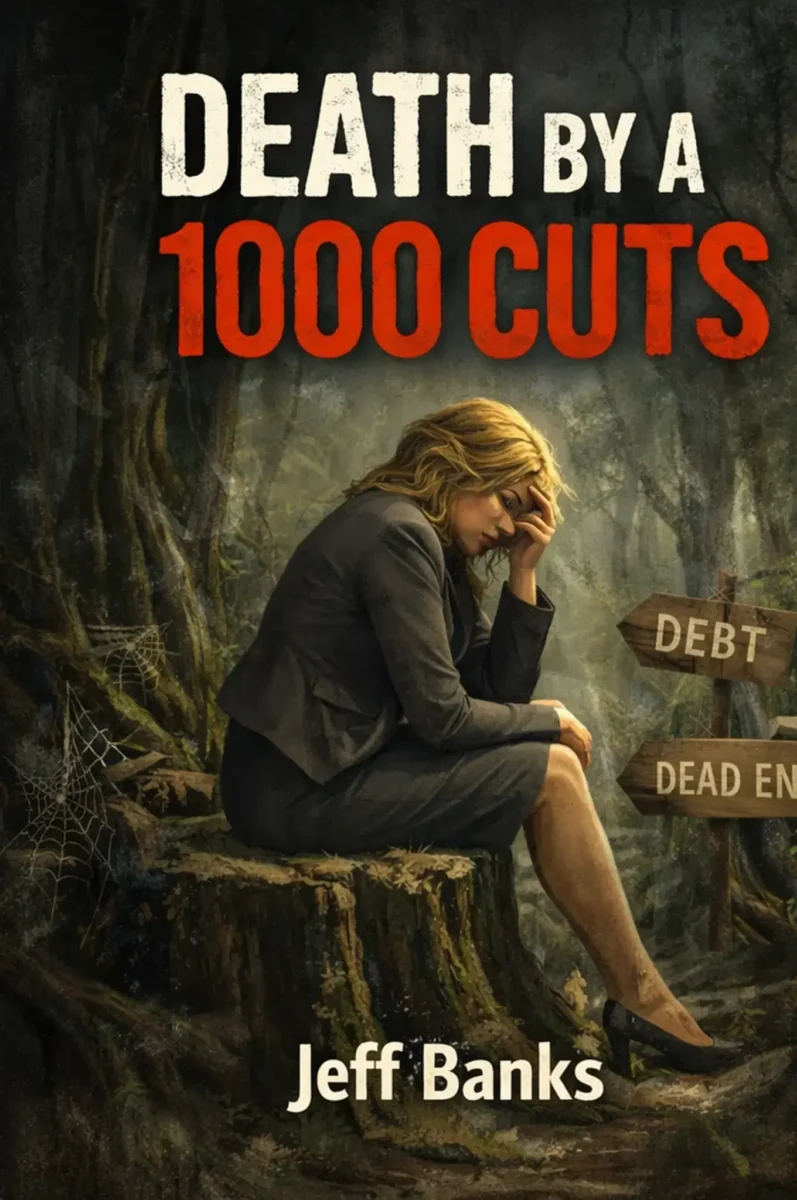
DEATH BY A 1000 CUTS
Chapter 4 – How Do I Fund It
In the mythology of small business, money is always spoken about as if it were a hurdle. Something to be jumped. Something to “figure out.” Something that, if you just push hard enough or want it badly enough, will eventually yield.
But the truth is far less poetic.
Money isn’t a hurdle. It’s the terrain.
It’s the landscape every entrepreneur has to crawl across before anything resembling success can even be glimpsed on the horizon. And for people like Mandy, people who don’t come from dynasties or trust funds or names that open doors simply by being printed on a business card, that terrain is jagged, narrow, and designed to favour those who already have a head start.
The banks say they “assess risk,” but what they really assess is lineage. Track record. Assets that look like something they could auction off on a Wednesday morning if things go south. Mandy had a block of land, sure, a patch of earth that meant something to her and nothing to a lender. It didn’t earn money, so in their eyes it wasn’t really an asset at all. More like a hobby. A decorative item. Nice to look at, useless for underwriting.
And then there’s the experience test, the unspoken one. The “Idiot Test.” The line item on some bank clerk’s checklist that no one ever sees in print but every small business owner feels like a slap.
On paper, banks pretend the process is clinical. Mathematical. Objective. Loan-to-Valuation Ratios. Debt Service Ratios. A series of neat percentages that supposedly calculate “risk” in a way that feels scientific.
But for first-time entrepreneurs, those numbers might as well be written in invisible ink.
A Loan-to-Valuation Ratio (LVR) only works when the security is something the bank understands, bricks and mortar, a suburban house, a commercial warehouse, an asset that could be photographed, valued, and flogged off at auction when the world collapses. Mandy’s block of land, sitting there quietly on the outskirts, meant something to her. To the bank, it failed the second test: it wasn’t income-producing, although horses were agisted in a barter system arranged to keep repairs up to scratch. It didn’t generate a cent. Therefore, its value in the bank’s eyes dropped through the floor. What looked like equity to Mandy was treated like a liability wearing makeup.
If you think about this area of lending in detail, you would suggest that business banking actually does not exist, especially for the small businessperson who has to throw personal assets as security for any lending a bank might provide.
Debt Service Ratios (DSRs) were no better. To a banker, the DSR equation is simple: If your business hasn’t existed long enough to pay the loan, then the business can’t be expected to pay the loan.
Which is circular logic at its finest. You can’t get the loan because you don’t have the income, but you can’t get the income because you don’t have the loan. It’s a loop that should come with its own Greek myth.
But even if you pass those mathematical contortions, the final gateway is always human.
That last box on the form. The “gut feel.” The unwritten rule that can override every spreadsheet, every valuation, every projected cashflow.
The Idiot Test.
It isn’t called that, of course, not officially, not anywhere you can point to. But you’ll see it in the hesitation of a loans officer flipping back through your application for the third time. You’ll feel it when they ask, “Have you done this before?” with the tone of someone fishing for a reason to decline. You’ll sense it in the polite smile that means: You’re too new. Too green. Too ambitious for your own good.
If you’ve never run this kind of business before, you’re too risky. If you’ve run it for years, you don’t need them. It’s a paradox only banks could create and proudly defend.
For Mandy, it didn’t matter how carefully she explained her vision, how meticulously she mapped the numbers, how airtight the logic was. It all came down to whether a clerk who had never owned a business, never risked their home, never mortgaged their future for an idea, believed she knew what she was doing.
Pass the Idiot Test, and the door opens a crack. Fail it, and the whole application drops silently into the void, joining thousands of others that just didn’t “feel right.” And that’s the brutal truth nobody tells you when you decide to start a business: It’s not the plan that gets judged. It’s you.
Divorce adds another layer, the financial amputation that comes with disentangling a life. A settlement can offer breathing space, maybe even a small burst of momentum, but it’s never enough to build the dream as it existed in the imagination. It’s just enough to stop the bottom from falling out completely. A tourniquet, not a cure.
And the thing about the Idiot Test, the part nobody says out loud, is that it isn’t really about intelligence at all. It’s about bias. Quiet bias. Baked-in bias. The bias that suggests we have the money and we make the decision about who gets it. The kind that lives in the pause before the banker answers, in the way they glance at one page of the application more than the others, in the tone they use when they say, “We just need to be sure.”
Because it’s one thing to walk in as a first-time entrepreneur. It’s another layer entirely to walk in as a woman. And another layer still, a new divorcee.
Banks don’t record that as a risk factor, but you can feel it. The subtle recalibration. The unspoken questions swirling behind the clerk’s eyes: Is this a rebound venture? Is she chasing a dream or running from something? Does she even understand the pressure she’s walking into? Where’s the husband?
They don’t ask these things, but the hesitations tell the story.
They never say, “We don’t trust women the same way we trust men.” That would be against the law. But the Idiot Test leans harder on them. The scrutiny is sharper. The margin for error is thinner.
A man in the same position, fresh out of a marriage, trying something new, would be framed as “reinventing himself,” “starting the next chapter,” “taking the initiative.” For a woman, the same facts look like instability.
A man is bold. A woman is emotional.
A man is calculated. A woman is impulsive.
A man is ambitious. A woman is “uncertain.”
And then there’s the divorce itself, sitting quietly in the background like a watermark across every page of the application. Divorce produces cash, but not the right kind. Not the kind the bank respects. It’s capital from a loss, not capital from success. In banking logic, it’s not momentum. It’s residue.
They see the settlement figure and immediately downgrade it in their minds. They see the surname and wonder if it will change again. They see the separation and ask themselves, silently: “Is there someone else behind the scenes? Someone who will derail the business? Someone who will challenge the loan?”
These aren’t policy considerations. They’re human ones. Which makes them harder to counter because you can’t argue with what isn’t openly acknowledged. And so the Idiot Test becomes something bigger, heavier, more complex than most people realise. It’s not simply: Do you know what you’re doing? It becomes: Do you look like the kind of person we trust? Do you fit “our” picture of a safe borrower? Do you tick the boxes we aren’t allowed to write down?
Loan-to-Value Ratios and Debt Service Ratios might shape the mathematics, but the Idiot Test shapes the decision.
And Mandy walked straight into that furnace, carrying a block of land the banks didn’t like, a dream they didn’t understand, a gender they subconsciously undervalued, and a divorce settlement that, in their minds, was more red flag than runway.
To her, the dream made perfect sense. To them, it looked like risk with a heartbeat.
And this is where the entrepreneurial story really begins, not when the business opens its doors, but when the world tells you, in a dozen polite ways, that you shouldn’t even try.
Investors? That’s a different universe altogether.
If your surname is Packer, you begin with a large fortune and spend the rest of your life trying not to turn it into a small one. Access is assumed. Doors open. Meetings are taken. Failures are framed as “bold plays.”
But if you’re Mandy, alone, unknown, unproven, looking for investors is less like raising capital and more like asking strangers to believe in a future they can’t yet see. A future you can barely articulate yourself because the dream burns faster than the words can catch it.
And yet, this is the point every small business reaches. The fulcrum. The moment when the idea burns so hot, so impossibly bright, that the lack of money feels almost irrelevant. There must be a way. There has to be an answer. You look at the spreadsheet and the shortfall is real, but the need is louder than the maths. Survival first. Growth second. Dignity somewhere behind that.
This is the part of the entrepreneurial story that nobody glamourises. The part where grit matters more than brilliance. Where certainty dissolves into improvisation. Where the dream doesn’t just inspire, it demands.
And for Mandy, this was only the beginning.
The bank. We went there, we did that, we got the expected outcome. The one I expected, the accountant who has seen this play out too many times to count, but still a body-blow to the budding entrepreneur who believed, just for a moment, that logic and vision might overcome policy and procedure.
But Mandy has something the bank never factors in: cashflow thinking. The ability to build a plan, model a spreadsheet, reverse-engineer a goal from the bottom up, and turn costings into strategy. She knows how to negotiate with suppliers. She knows how to price. She knows how to move the pieces around until they start to resemble a workable future.
The only problem is simple and brutal: She doesn’t have enough. Enough of anything to satisfy the bank that we are quadruply covered should anything go wrong.
So down the investor route we travel.
Fortunately, and this is where life mimics the Packers more than the spreadsheets do, sometimes it isn’t just what you know. It’s who you know, and whether they see just enough of themselves in your dream to lean in.
The complementary medical world is full of true believers. People who don’t just buy products, they buy purpose. People who will follow a spark if they believe the flame behind it is real. So desperate can some of these people be, especially in the area of cancer etc., who will buy snake oil if someone has a good enough spiel to suggest it might work for them.
And so when Mandy is introduced to a potential client, a woman with her own history of alternative therapies, wellness retreats, and a lingering wish to be part of something meaningful, the conversation shifts. Not into charity, but into opportunity.
She loves the concept. She sees the treatment models and modalities. She believes in the dream enough to consider a stake in its birth. And she is willing to throw money at one specific piece of equipment: the oxygen pod.
A gleaming, futuristic device that looks like it belongs in a NASA facility rather than a start-up clinic. It’s expensive. It’s specialised. It produces revenue from day one.
It is, in other words, the golden child of the business plan, the one line item that could generate the cashflow needed to keep the rest of the machinery turning.
But investment is never a gift. It comes wrapped in expectation. And as soon as the numbers begin to hit the table, the tone shifts. Not in a hostile way, just in the way people speak when their money enters the room before they do.
Benevolence turns to practicality. The investor wants a return. A real one. A strong one. One commensurate with the risk involved.
And suddenly we’re no longer talking about bank rates or typical private lending margins.
We’re in a different universe, one where the return being negotiated is significantly higher than any conventional lender would ever dare to write down and looking significantly like partnership realities.
Because this isn’t lending. This is belief, monetised. This is someone saying: “I’ll take the risk the bank wouldn’t take, but if I’m taking the risk the bank wouldn’t take, I want to be compensated like the bank never could.”
And that is the truth most small business owners don’t discover until they sit in front of their first potential investor:
The cost of money is always tied to the cost of faith. And when someone is investing directly in you, not just in the asset, the faith premium becomes very expensive.
The numbers being floated were eye-watering. Far above normal lending. Far above what Mandy expected. Far above what made sense on paper.
But beggars cant be choosers and here’s the cruel paradox: without the oxygen pod investment, the business couldn’t start. Without the start, there was no revenue. Without revenue, the dream didn’t just stall, it evaporated.
So she sat there, caught between opportunity and sacrifice, staring at a return structure that could keep her business alive and strangle it at the same time.
For most people, that’s where the journey ends. For Mandy, that’s where the real negotiation began and as yet we hadn’t actually built the shop.
There is enough cash in the kitty to do the fit-out. We now have enough cash to buy the first piece of machinery. But this complementary medical practice is going to be much more than that. Whilst one investor came out of the woodwork, we will probably need another one, and another one if all the ideas and all the strategies that we want to put in place for these people seeking help with their bodies is to flourish.
So cash flow under control for the moment. It’s all about the building process. What corners can I cut? What favours can I draw in to get the thing built and ready to open in a timeline that fits the cash flow model?
Cashflow isn’t just a spreadsheet line to Mandy. It’s a presence. A shape. Something that sits behind her shoulder when she’s measuring a wall, or checking an email from the supplier, or opening a text from the investor asking politely, but pointedly, “Any updates?”
It chases her. The dream lifts her forward, yes, but the cashflow pulls at her ankles. Every entrepreneur knows this feeling, but Mandy is living it in its rawest form, the pressure to perform before there is anything to perform with.
There is enough in the kitty to start. Enough to keep the tradesmen moving. Enough to order the first big machine.
But it isn’t enough to silence the fear. Because the math is merciless: until the doors open, money only ever moves in one direction, away.
And in Mandy’s mind that becomes a countdown. Not a dramatic one. Not even a loud one. It’s a soft, relentless tick at the back of her thoughts.
The kind of tick you can ignore for an hour, but not for a day. The kind of tick that follows you into the shower. Into the car. Into the quiet hours of the night when the phone stops buzzing and the mind has nothing else to chew on but worry.
“What if the money runs out before the doors open?” “What if I’ve miscalculated?” “What if the investor starts asking questions I can’t yet answer?” “What if that second treatment room never gets built because I had to divert the funds?”
These aren’t abstract thoughts. They are weights. They are the mental equivalent of holding your breath while running a marathon. There are backups: Some unwanted jewellery. The bank of dad. Those give and takes that can bring extra cash should I need it
And the cruel irony is that the dream, the thing she believes in, the thing she sees so clearly, adds to the pressure instead of relieving it.
If she didn’t care so much, none of this would hurt. But she does. Deeply.
She wants the clinic to exist exactly the way she sees it in her mind, all the modalities, all the equipment, all the ambience, the lighting, the scent, the experience. The full version. The real version.
But the reality version, the version her cashflow allows, is smaller. Tighter. More fragile.
And so she starts thinking in compromises: “Maybe we don’t need the extra infrared sauna yet.” “Maybe the second modality waits until Phase Two.” “Maybe I paint that wall myself.”
“Maybe I can borrow a truck from a friend instead of hiring the delivery guys.”
These aren’t project decisions. They’re survival decisions.
She doesn’t say this out loud, but it gnaws at her: If I make one wrong choice, I could sink the whole thing before it even opens. And that is where the real pressure sits, in the knowledge that there is no safety net. No second chance. No soft landing. Not for someone in her position. Not for a newly single mother trying to build a financial foundation out of a settlement cheque that barely covers the dream’s scaffolding.
Cashflow becomes her Black Dog. Not a dramatic, snarling beast… but a low, persistent shadow.
It walks just behind her. She can’t escape it, because part of her doesn’t want to. She needs it there, the reminder that this can fail, that she has to stay sharp, that every invoice matters, every decision matters, every hour matters.
The pressure to perform doesn’t come from the investors or the bank or even the business plan. It comes from the part of her that refuses to return to the life she left. The part that cannot stomach the idea of explaining failure to her children. The part that needs, needs, to prove she can build something of her own without anyone else’s permission.
That pressure is constant. It is intimate. It is the price she pays for trying to build a life instead of inheriting one.
And in this moment, mid-fit-out, mid-spend, mid-dream, cashflow becomes not just a financial concept but an emotional landscape.
A terrain she has to cross. A terrain with no shade. And no turning back.
We are yet to open the doors, and those doors will open to yet another string of issues when it comes to cash flow.
Author