

In that light, the business wasn’t just a venture. It was a vehicle. The only visible path to stability in a life that had been shaken loose.

WHEN THE DARKNESS COMES – Chapter 24 – When the Darkness Comes
- Books, When the Darkness Comes
In that light, the business wasn’t just a venture. It was a vehicle. The only visible path to stability in a life that had been shaken loose.
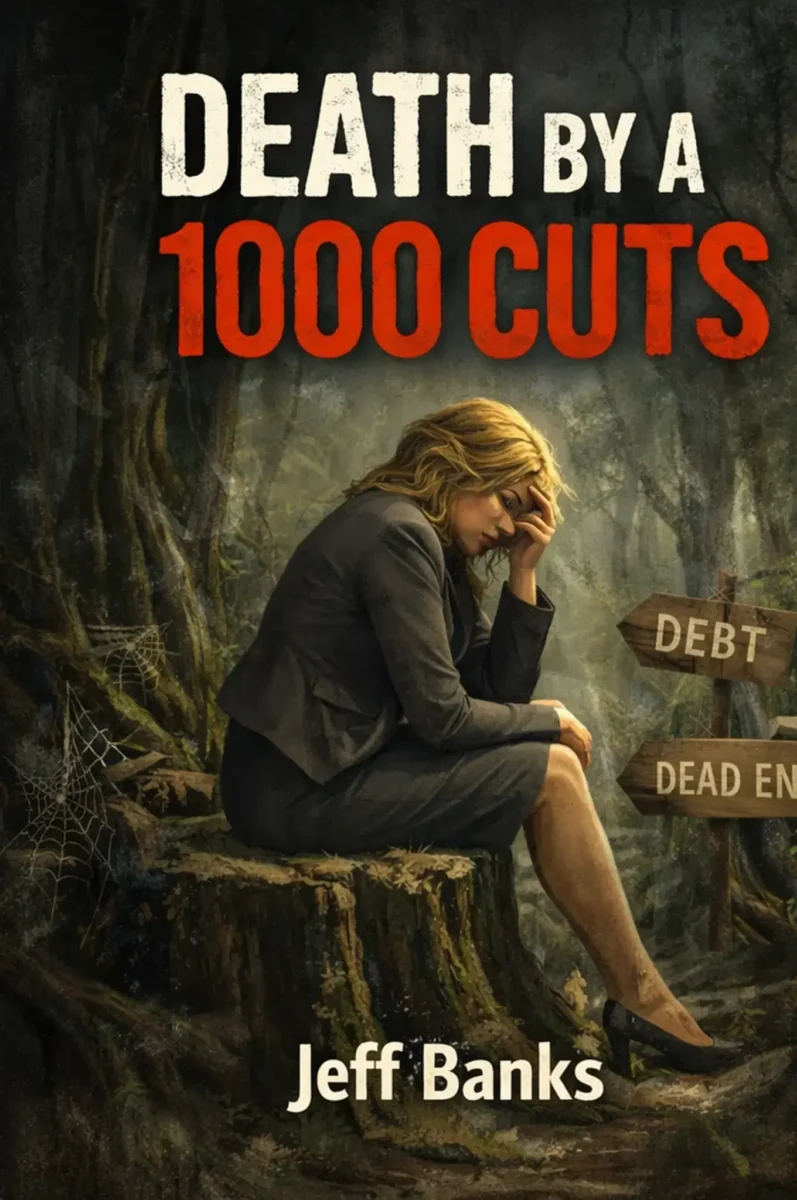
DEATH BY A 1000 CUTS
Chapter 2 – The Trigger
There’s usually a moment, a single point in time, that pushes someone from thinking about self-employment into actually doing it. People like to dress it up as strategy, or opportunity, or finally being “ready,” but more often than not it’s something far simpler: they hit a wall they can’t climb, and the only direction left is forward.
For Mandy, the wall was her marriage.
It didn’t collapse all at once. These things rarely do. They erode quietly, the same way a shoreline changes shape over years of tides that nobody pays attention to until one day the beach looks nothing like it used to. Her marriage had been like that. A long, slow fading of colour. Enough to feel but not enough to justify panic. And then, suddenly, it was gone.
The divorce left her standing in a silence she hadn’t asked for, holding the hands of two young kids who were looking up at her as if she had all the answers. That’s the thing about children: they don’t understand timing, or emotional bandwidth, or how close you might be to the edge. They just need you. And needing you becomes the thing that keeps you upright.
I met her not long after that. There was something about the way she spoke that showed the fault lines before she ever admitted they were there, the carefulness, the slight delay before answering a question, the way she always looked like she was carrying something heavier than the bag over her shoulder. She was trying to rebuild herself at the same time she was trying to hold everything else together.
And that was the moment the myths came flooding in. They always do. Self-employment has a way of appearing like a life raft when someone feels pulled under. The idea that you can work for yourself, set your own hours, earn more, control your environment, it becomes intoxicating, especially when the alternative feels like letting someone else control the story you’re trying desperately to rewrite.
She told me once, in a quiet moment, “I just need to make a life that’s mine again.”
I knew exactly what she meant. I’ve heard those words from more people than I care to count. Divorce does that to you. It strips the scaffolding away and leaves you staring at a version of yourself you’re not sure you recognise.
But that’s also the danger. Because in that raw, fragile space, the myths of entrepreneurialism become louder and more convincing. And Mandy, like so many others, started believing them, one by one.
She believed she’d have more time. More control. Significantly more income. Much more flexibility, especially with the kids.
She believed she could do it better than anyone who had ever employed her, a belief born not from arrogance but from years of watching other people mismanage things she knew she could handle differently. And that belief didn’t appear in a vacuum. It had been simmering for years out there on the mines, long before the divorce, long before the business, long before she realised she’d been carrying a version of herself that had never really been allowed to breathe.
Mandy had been a FIFO worker, a woman behind the wheel of those colossal haul trucks, the kind that make ordinary vehicles look like toys abandoned at the feet of giants. There’s something about the mining world that carves a person, especially a woman. It’s loud, unforgiving, brutally practical, and built around a culture where the machinery is often treated with more respect than the people operating it.
She learned quickly that if you want to survive in that environment, you don’t just develop thick skin, you develop radar. You learn to read a room before you walk into it, a roster before you sign it, a manager before they’ve even finished their sentence. And you learn, with painful clarity, the difference between authority and competency.
The mines were full of people who had one and lacked the other.
She used to tell me stories, not in a dramatic way, but in that dry, matter-of-fact tone people use when absurdity has become routine. Supervisors who’d never sat in a haul truck giving orders about fuel efficiency. Managers who talked about safety like it was a slogan rather than the reason people came home alive. Decision-makers who couldn’t have reversed a loader if their lives depended on it, but somehow held the power to decide when everyone else should.
She saw things they didn’t. Patterns they missed. Risks they underestimated. People they failed to understand, or bothered to.
The “big boys’ toys” culture fascinated her. On the surface, it was all swagger and machinery, men comparing horsepower the way suburban dads compare lawnmowers. But underneath that was something more troubling: a kind of institutional complacency, the belief that the machines would keep running and the staff would keep coping no matter how many poor decisions trickled down from above.
She watched accidents narrowly avoided, efficiencies ignored, common sense dismissed because it came from the wrong mouth. And every time one of those moments happened, every time a manager made a decision that put someone at risk, every time a problem was allowed to fester because no one wanted to challenge the chain of command, another small part of her grew convinced she could do it better.
Not because she wanted to take over. But because she understood something most of them never seemed to: people and processes matter more than size and noise.
And out on those mine sites, where the dust hangs in the air like a permanent reminder of what you’re breathing in, she began to build a quiet catalogue in her mind, a ledger of all the ways leadership could be done differently. Not perfectly. Just better.
But here’s the truth I’ve seen in so many like her, truth she didn’t yet understand: seeing and surviving are two very different skills.
Being right about how things should run doesn’t prepare you for running them on your own.
Identifying flaws in a system doesn’t equip you to withstand the weight of building one yourself. And noticing mismanagement in others doesn’t insulate you from the emotional and financial pressure that comes when you’re the one holding all the moving parts.
It’s a lesson almost every entrepreneur learns the hard way, that clarity is not the same as readiness, and competence is not the same as resilience.
Mandy walked into business carrying all the observations she’d collected from years on site, the inefficiencies, the missed opportunities, the managers who shouldn’t have been managers. What she didn’t know yet was that her business was about to become its own kind of mine site: big machinery to control, fragile systems to maintain, pressure that didn’t care how tired she was, and a constant awareness that one mistake could send everything sliding the wrong way.
The difference now was stark and unforgiving: in the mines, she could shake her head at the decisions made above her. In the business, she was the decision-maker.
And there is no training for that. Only the realisation, usually far too late, that being able to see the problems never guarantees you’ll survive them.
What she didn’t realise, what nobody realises at the beginning, is that self-employment doesn’t give you time, it consumes it. It doesn’t grant you freedom, it tests it. And it doesn’t make life easier, it makes everything sharper, louder, and far more personal.
But at that moment in her life, fresh separation, the sting of disappointment, two kids who needed stability she wasn’t sure she could give, the myths felt like a way out. Or at least a way forward. When someone is drowning, even a rough plank of wood looks like a boat.
And so she jumped. Not because entrepreneurship was the dream, but because survival demanded something different than what she had before. She needed to feel capable. She needed to feel in control of something, anything. And becoming her own boss felt like the only place left where she could take ownership without asking permission.
The trigger wasn’t ambition. It wasn’t vision. It wasn’t the classic entrepreneur origin story people like to brag about. It was far simpler, and far more human: her life had fallen apart, and she needed something she could build.
It’s only later, once the dust settles, that the myths start showing their cracks, the long nights, the fear of inconsistent income, the exhaustion of running a business and raising children alone, the emotional whiplash of wins followed by weeks of silence. But you don’t see those things in the beginning. You just see possibility. You see escape. You see the promise that if you work hard enough, maybe the world will give something back.
Those early days, Mandy walked into self-employment carrying hope in one hand and obligation in the other, both of them heavier than she would ever let on.
What came next, of course, was the slow accumulation that gives this book its name, the thousand tiny cuts that begin the moment the dream stops being theoretical and becomes real.
Mandy didn’t so much ease into self-employment as throw herself at it with the force of someone who could no longer bear the weight of what her life had become. It wasn’t measured or strategic. It wasn’t the slow, sensible transition that business books recommend. It was the kind of headlong dive people take when they are desperate to reclaim something, anything, after life has carved off a piece of their identity.
Divorce does that. It rearranges the furniture of your self-worth. Even when it’s the right decision, even when it’s unavoidable, it whispers failure in the quiet moments. Failure as a partner. Failure as a family. Failure as a version of yourself you had once promised to become.
And for someone like Mandy, who had spent years pushing through male-dominated mine sites, raising kids with more grit than support, and learning to trust her own judgement in the shadows of people who didn’t, that whisper hit deep.
She couldn’t afford to carry failure. She couldn’t afford to be seen as someone whose life had come undone. She needed to achieve, if not to prove something to her ex, then to prove it to herself.
So she didn’t step into business. She launched herself into it. Not with confidence, but with urgency. With a kind of ferocity that comes from trying to outrun the parts of your life that hurt too much to look at directly.
The business wasn’t so much a dream she had been nurturing, although the initial threads had probably always indeed there. It wasn’t a passion she’d been saving for the right moment. It wasn’t the culmination of years of planning.
It was something far more raw than that.
It was a lifeline.
A way to define herself on her own terms. A way to show the world, and maybe more importantly, her children, that she wasn’t broken, just beginning again. A way to turn the sting of divorce into momentum rather than paralysis.
But beneath that drive lived something more fragile, something she didn’t share with anyone:
the fear that if she didn’t build something now, something fast, something successful enough to silence the self-doubt that divorce had left sitting on her chest, then the story of her life would be written by the wrong hands.
So she called it ambition. She wrapped it in the language of business plans and client acquisition and growth pathways because those were the words people understood. But underneath that polished vocabulary was something far more elemental: the need to build a home.
Not a rental. Not someone else’s investment property with thin walls and stricter rules. She wanted a place where the kids could paint their bedroom walls without asking permission, where school photos could stay pinned to the fridge year after year, where Christmas mornings didn’t depend on a lease renewal.
She wanted roots, not just for them, but for herself. A place that didn’t move, or shift, or disappear because a landlord decided to sell. A place that wasn’t shaped around someone else’s choices. A place that said: We are safe here. We belong here.
That was the real engine beneath all of it.
Every late-night calculation, every frantic early morning, every risk she took without having the full courage to take it, all of it came back to that simple desire to give her children a home she could hold onto with both hands.
In that light, the business wasn’t just a venture. It was a vehicle. The only visible path to stability in a life that had been shaken loose.
It wasn’t a passion project; it was a promise. A promise that their future wouldn’t feel as uncertain as her present. A promise that she could carve out a corner of the world that belonged to them, and to no one else.
So when she talked about opportunity or independence or “finally doing things my way,” what she really meant was: If this works, I can buy us a home. I can give my kids a place to grow without fear of being shifted again.
The business, her business, wasn’t just the answer to “What now?” It was the battleground where she would fight to turn temporary into permanent, instability into security, and fear into something she could stand on.
And somewhere beneath all the noise and chaos and uncertainty, that hope, that quiet, aching need to give her children a foundation, became the version of herself she was determined to chase, no matter how many cuts it took along the way.
But life doesn’t pause while you reimagine yourself. The kids still needed lunches packed, school forms signed, arguments settled, bad dreams soothed at 2am. The house still needed cleaning, bills still needed paying, the world still demanded its usual quota of patience. And woven through all of it was the quiet, repetitive bureaucracy of separation, emails from lawyers, messages from her ex, the administrative weight of dividing a life in half.
It’s a strange kind of pressure, that combination. On paper it looks manageable. After all, plenty of people raise children. Plenty of people run businesses. Plenty of people survive divorce. But when you stack all three on a woman who is trying to stitch herself together at the same time… it’s not a load, it’s a fracture line.
She never said that, of course. Women like Mandy rarely do. There’s a particular kind of strength in women who have been blindsided by life, they don’t complain, they don’t collapse, they just absorb. They build a routine around the chaos and hope the routine will eventually become a life again.
But I could see it. The signs are always small. The way she hesitated before answering messages. The way her shoulders tightened when she mentioned her ex. The way she looked at her kids with a love so fierce it bordered on fear, fear of failing them, fear of not being enough, fear that one wrong choice would ripple out and touch them in ways she couldn’t mend.
Entrepreneurship, in those early days, seemed almost like an act of defiance. A way of saying, I can do this on my own. I can be more than what happened to me. And in some ways, she needed that belief. It gave shape to her days. It gave purpose to the unravelling.
But the myths still whispered to her, the same way they whisper to everyone who steps into the world of self-employment. The myth that she would have time. The myth that she would have control. The myth that she would earn more than before. The myth that she could fix her life through work alone.
And slowly, almost imperceptibly, those myths began to twist. What began as empowerment became pressure. What began as freedom became responsibility. What began as an escape became another set of walls.
I remember her telling me, one afternoon, that she felt like she was living between two worlds, the world she had left behind and the one she hadn’t yet built. It’s a common sensation among newly self-employed parents: that limbo between survival and aspiration, where nothing feels stable but everything feels urgent.
She didn’t dream of running a business. Not then. Not in any conscious, deliberate way. What drove her wasn’t ambition or vision or even opportunity, it was need. A raw, driving need that lodged itself under her ribs the moment the house keys landed back in her ex-husband’s hand instead of hers.
What she wanted, what she had to have, was a home for her children. A real one. Not a temporary space coloured by someone else’s choices or someone else’s rules. A place that didn’t shift when paperwork expired. A place where her kids could feel the ground beneath them stop moving.
That was the trigger.
Not the business idea. Not a passion she’d been waiting to unleash. Not a burst of entrepreneurial spirit.
It was the quiet, crushing realisation that divorce doesn’t just split a marriage, it splits the landscape of your children’s lives. And in that split, she saw instability gathering like a storm. She saw the possibility of years spent being bounced between rentals, of belongings kept in boxes because “we’re not here long,” of birthdays celebrated in spaces that never quite felt like theirs.
She couldn’t let that be their story. She wouldn’t.
So when everything inside her screamed that she’d been judged by life and found lacking, she did the only thing she could: she pushed back. Not with a plan. Not with certainty. Just with movement. Forward, because backward wasn’t possible, and standing still felt too much like failure.
That’s what people don’t understand about triggers. They aren’t inspirational. They’re uncomfortable. They’re the point where something snaps, not loudly, but with a finality you feel in your spine.
For Mandy, the snap wasn’t the end of her marriage. That had been unfolding for years. The snap was seeing the future laid out in front of her as a single mother with no permanent place to anchor her children. That was the moment the ground tilted beneath her feet and the only choice she had left was to build something of her own, whatever that turned out to be.
She didn’t wake up thinking, I’ll start a business. She woke up thinking, I have to find a way to make our life solid again. And self-employment was the only door that didn’t look bolted shut.
She walked toward it not because she wanted that life, but because it was the only path that didn’t lead back into someone else’s version of her future.
It wasn’t a plan. It wasn’t a dream. It wasn’t even hope, not yet.
It was the trigger, the moment the story tipped over its edge, and gravity did the rest.
Author