

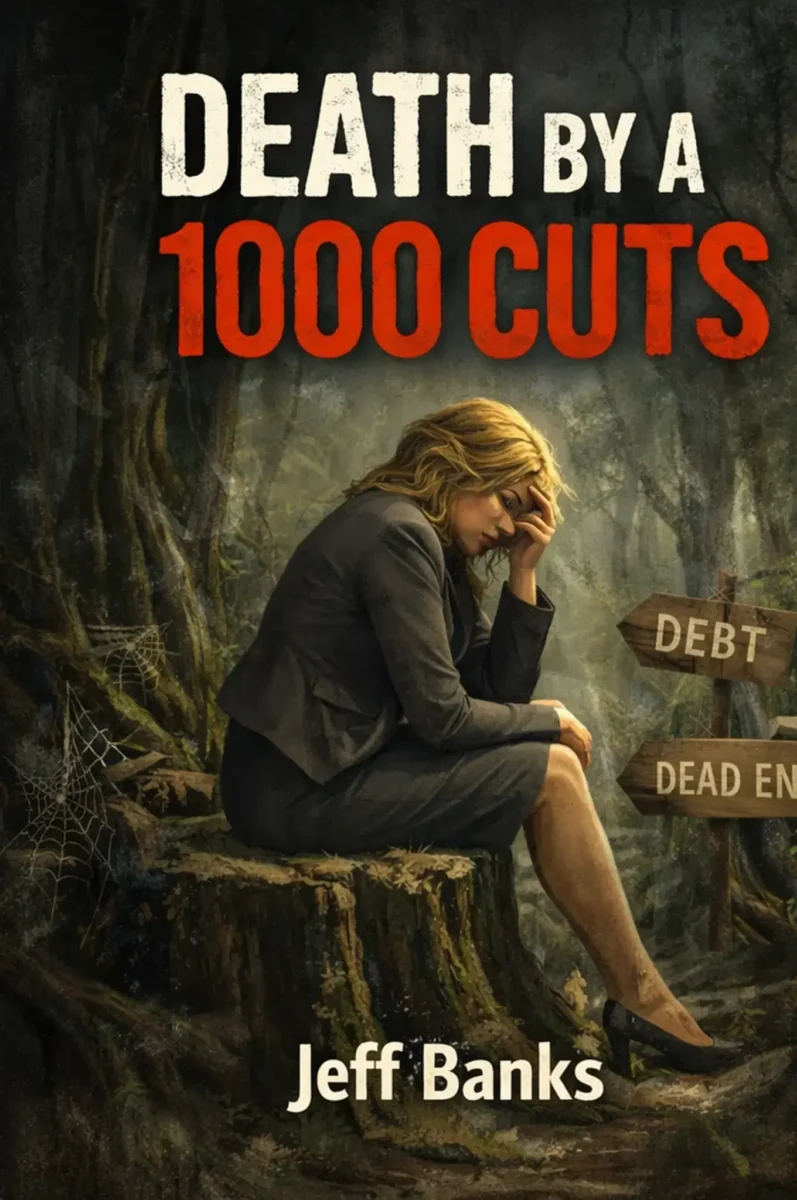
Mandy was right in that emotional corridor, right between heaven and hell, living the sequel Chapin sang about before she even knew her first story had ended.

Complete the form below and get an email every time we post.

Mandy was right in that emotional corridor, right between heaven and hell, living the sequel Chapin sang about before she even knew her first story had ended.
DEATH BY 1000 CUTS
Chapter 1 – I Am Not Employable
Let me tell you a story, if I will. Starting with a few lines from Harry Chapin’s song “Sequel.”
“I guess it’s a sequel to our story
From the journey ‘tween heaven and hell
With half the time thinkin’ of what might have been
And half thinkin’ just as well.”
There’s something about those lines that only sinks in once life has worn off a few of your sharper edges. Chapin always had a way of writing about the space between hope and regret, and in those few short bars he captured that strange territory where most big life changes really begin. Not in triumph, not in catastrophe, but in that uncertain corridor between heaven and hell, where half the heart is clinging to what might have been and the other half is quietly relieved it’s over.
That space is exactly where this story starts, out on the red dirt of Banka Banka Station, at the tail end of a long day, when the light goes soft and the shadows lengthen, and even the air seems to pause before the sun slips away. Robyn and I had pulled in earlier, halfway through another gentle lap of Australia, the kind of wandering you earn after decades of grinding through the financial year from July to June. We were setting up camp when Mandy and her family arrived, their fifth wheel caravan trialer rolling in with the look of a unit that functioned more out of habit than togetherness.
It wasn’t anything obvious that gave the truth away, no dramatic confession, no pointed remarks about the man back home, but there was a distance in her story you could feel even before she named it. The kind of distance you only recognise when you’ve lived long enough to see how people hold themselves when they’re carrying far more than the bags they unpack at a campground.
She arrived at Banka Banka with just the kids, two young people on the cusp of teenagerhood, travelling with that mixture of independence and uncertainty that suggests more is happening beneath the surface than anyone is willing to say aloud. Mandy moved around the van with a quiet efficiency, the kind of competence you only develop when you’ve had to manage things alone for longer than expected.
Her husband, she explained casually, had “stayed in Perth to keep the business going.” She said it the way someone might mention the weather: factual, unadorned, rehearsed. But the absence of a second adult in a family caravan told a deeper, older story, one she wasn’t ready to speak fully yet.
Mandy looked younger than her 40 years. The bravado of the outback clothes belied the woman beneath. For the moment, she was a truckie driving a big rigged caravan.
Later, when we gathered around the communal fire, she slipped easily into the familiar script that travellers use when they meet for the first time. She spoke about the trip they were on, the dream of showing the kids Australia before they launched into their own lives, the sense of adventure she hoped they would someday remember. She smiled at the right moments, laughed in the comfortable places, and told it all with the warmth of someone who wanted the story to be true, even if it wasn’t the whole truth.
The way she spoke made it sound as though the journey had been carefully planned, a family decision made with optimism and intention. But the pauses between her sentences, the fleeting glances toward the children when she thought no one was looking, told another story, one shaped by separation, uncertainty, and the quiet courage of a woman trying to keep a narrative alive for the sake of those who still needed it..
But in the flicker of the firelight, those practiced lines softened just enough for the truth to show through. The story wasn’t false, not exactly. It was more that it had been repeated so often it had become a kind of camouflage, an acceptable explanation for a journey whose real purpose she hadn’t yet learned how to articulate. The marriage, we would come to understand, had been drifting apart long before the wheels of the van touched the Stuart Highway. This trip wasn’t a beginning; it was a delay. A long pause before an ending neither of them knew how to manage.
She didn’t say that, though. Not then. That first night she still carried the hope, or the fear, sometimes they’re the same thing, that things might somehow settle into the shape they once were. The kids knew more than she thought. You could see it in the way they hovered just close enough to listen, and just far enough to pretend not to. Children read tension the same way we read a spreadsheet, pattern first, detail later.
As the fire settled into a slow bed of coals, our conversation shifted from pleasantries to something quieter. She told us a bit about her life: the years spent raising two children now on the cusp of adolescence; the responsibilities in the family business she carried but was never credited for; the administrative load that kept the business’s doors open more than her husband realised; and the gradual shrinking of her own professional identity until it was something she thought about the way people think about clothes in a wardrobe that no longer fit.
Before marriage, before children, before the business, she’d had a career path. Skills. Ambition. A sense of direction. But life has a habit of folding people into roles they never consciously choose. Somewhere between the school drop-offs and the invoicing, the family dinners and the payroll runs, the certainties she once held about who she was had faded into the background.
Eventually, she looked down at the dirt near her feet, drew a small aimless shape with the toe of her sandal, and said quietly, “I don’t know where I go from here. I’ve been out of the workforce so long… I don’t think I’m employable anymore.”
She didn’t say it with drama or despair. It was simply the truth as she understood it: a statement delivered the way a doctor might deliver a diagnosis. And yet it carried the weight of something much larger. It was the confession of a woman realising that the life she had built was ending, and the life she would need to build next was one she no longer felt qualified to pursue.
Looking back, that was the first cut, gentle, almost invisible, but deep. People imagine entrepreneurialism begins with ideas, plans, or passion. It never does. It begins in moments like that: quiet admissions whispered into the night, when someone realises the life they’ve been living no longer has a place for them. When the old role dissolves and nothing new has taken shape yet. When a person is standing at the edge of their own life, unsure where the path leads, only certain it cannot lead backward.
That evening at Banka Banka, Mandy wasn’t dreaming of a business or plotting a reinvention. She was barely holding together the pieces of the life she still had. And yet, everything she said, everything she feared, was already forming the bones of the entrepreneur she would become. Not out of ambition. Not out of inspiration. But out of necessity and the faint, flickering belief that she might still be more than the version of herself she had been allowed to be.
She didn’t know it then. Not as the fire cooled. Not as the kids retreated to their bunks. Not as the desert night folded itself around us. But she was already stepping into that strange territory Chapin wrote about, the journey between heaven and hell, between regret and relief, between the life that had ended and the one that had not yet introduced itself.
And it all began with that soft surrender: “I am not employable.” Not as an ending. But as the beginning of everything that followed.
By sunrise, Banka Banka had taken on that early-morning stillness unique to outback campgrounds, the kind where the cold hangs stubbornly in the air and every sound echoes just a little more than it should. The red dust hadn’t yet been stirred by tyres or footsteps, and the birds were only beginning their tentative announcements that another day had arrived whether we were ready or not.
I had stepped outside the van to stretch when I noticed Mandy walking slowly between the caravans, a mug in her hands, empty, I assumed, because she didn’t seem the type to drink anything hot just for herself. It was the kind of walk people take when they’re trying not to wake anyone, but also trying to avoid being alone with their thoughts. Robyn joined me a moment later, and we exchanged that look married couples get when they’re thinking the same thing without needing to say it aloud: she’s carrying something heavy.
We called out a quiet “morning,” and she offered one back. But even in that single word, the mask she’d worn the night before had slipped a little. Tired eyes, tight smile, voice softer than the person inside her probably wanted it to be.
The kids were still asleep. So for the first time since meeting her, it was just her, no audience, no expectations, no performance.
She stood with us for a moment, arms folded, mug cradled as if it had a temperature. The silence lengthened, not awkward, but waiting.
Eventually she sighed. Not a dramatic sigh. Just one of those deep, tired exhales you give when your soul is carrying a weight your body can’t disguise.
“That story I told last night…” she began, then shook her head lightly. “It’s not the whole story.” We didn’t push. You learn, with age, that people open doors themselves; you don’t need to reach for the handle.
She looked out toward the dusty driveway leading back to the highway, and her words came slowly, forming shape only as she said them.
“The marriage hasn’t been right for a long time. This trip… I thought maybe we could fix it. Or at least hide from the problem long enough to pretend it wasn’t there.” She paused. “But every kilometre we travel just seems to stretch the distance between us.”
Robyn nodded gently, encouraging but not probing. I stayed still, listening, aware that this was one of those moments people remember years later, not because of what was said, but because of what they finally allowed themselves to say.
Mandy ran her thumb along the rim of the mug, not out of uncertainty, but from the exhaustion of having lived inside a decision for far longer than she’d ever admit aloud. “It’s already over,” she said quietly, eyes fixed on the pale line of dust where the sun was beginning to catch. “We haven’t made any kind of announcement yet, not to the kids, not to the friends who think this is some big family adventure… but the marriage is done. That part of my life is finished.”
There was no drama in her voice. No wavering. Just the steady resignation of someone who had carried the truth alone for months and was finally allowing it into the daylight.
“The trip wasn’t a holiday,” she continued. “It was the only way to move things forward without blowing everything up at home. The kids needed distance. I needed space. And he… well, he stayed behind to keep the business running. That says enough.”
She drew a slow breath, steady but heavy all the same. “What scares me isn’t leaving. That part was decided a long time ago. What scares me is what comes after. I’ve been part of that life for so long that I’m not sure who I am when I’m not holding it together.”
The words didn’t fall like a confession, they settled like sediment, the residue of years of compromises and silences and holding patterns. Not the weight of the last few days, but the accumulated heaviness of an entire era quietly ending.
It’s remarkable how quietly people disappear from their own lives. Not all at once, more like erosion. A little bit here, a compromise there. A decision made for convenience, another made for peace, another made because someone else needed something at the time. None of it malicious. None of it even noticeable in the moment.
And then one morning you wake up in the middle of the Northern Territory with the realisation that you haven’t chosen your own direction in so long that you’ve forgotten what the first step even feels like.
I could see it in her posture: shoulders slightly turned inward, as though apologising for taking up space. The way her eyes stayed on the horizon rather than meeting ours, trying to picture herself somewhere she felt she belonged. And the way she kept returning to that same quiet refrain: “I don’t know what I am anymore.”
As an accountant, you get used to people confiding in you. Not the numbers, they almost never care about the numbers. It’s the life behind the numbers that leaks out in conversations over fading coffee, lost receipts, or failed BAS returns. You start to understand that financial problems are rarely financial. They’re emotional. Structural. Relational. And nearly always, they’re about identity.
Mandy wasn’t just afraid of losing a marriage. She was afraid of losing the version of herself she’d been told she was supposed to be.
There is something strangely sacred about early-morning conversations between caravans. No pretense, no audience. Just a few square metres of gravel, a couple of folding chairs, and the implicit permission to say things you’d never admit under a normal roof.
As the sun crept higher, her words became steadier, as though she’d been waiting for someone to shoulder a fraction of the burden she’d been carrying alone.
“I used to have a career,” she said. “A real one. Before the business. Before the kids. Before… all of this.” She gestured vaguely toward her van, but the motion seemed to encompass her entire life.
“And now?” Robyn asked softly. She shrugged. “Now I’ve got a fifteen-year gap and a head full of skills that don’t fit into a job description.”
“But they fit into a life,” Robyn replied.
Mandy managed a half-smile at that, but the fear remained beneath the surface. “If everything falls apart, I don’t know how I start again. I don’t feel employable. I don’t feel… anything that leads somewhere.”
I could feel the chapter of her life shifting right there on that dusty patch of outback earth. It wasn’t dramatic. It wasn’t obvious. But it was foundational. The moment a person stops looking backward and begins, however reluctantly, to see that forward exists.
She didn’t yet understand that the feeling of being unemployable was not a failure; it was a precursor. A sign she was leaving one life before she could fully see the next. She didn’t know that almost every entrepreneur I’ve ever met has had that exact moment, somewhere between exhaustion and awakening, when they realised they simply didn’t fit the mould anymore.
Most people think entrepreneurialism begins with confidence. It doesn’t. It begins with dislocation.
With the slow dawning that you cannot return to who you were, and you have no clear map of who you are becoming.
Mandy was right in that emotional corridor, right between heaven and hell, living the sequel Chapin sang about before she even knew her first story had ended.
As the day warmed and the camp came to life, the conversation drifted to practicalities, water tanks, tyre pressures, where they were heading next. But beneath the ordinary topics, something had changed. She was no longer holding her breath. She was no longer pretending everything was fine.
That morning didn’t fix anything. It didn’t need to. It simply cracked the door open.
Long after they packed up and pulled away in a cloud of red dust, I could still see the way she had stood between the caravans, tired, almost frightened, but unmistakably at the beginning of something.
Something she didn’t yet have words for. Something that would eventually become a business, and then a burden, and then a lesson learned the hard way. Something that would unravel her and shape her and, ultimately, become the story told in this book.
But back then, at Banka Banka, it was only a feeling. A quiet, fragile truth whispered into the morning: “I am not employable.”
We didn’t know it yet, but that was the first turn of the wheel.
And as she pulled out of Banka Banka in a cloud of soft red dust, children in the back seats, maps and plans half-formed in her head, I realised something she had not yet understood herself.
She was already living the opening verse of that Harry Chapin song. Acting happy. Projecting certainty. Smiling through the ache. Balancing between the life that might have been and the life she was glad to be free from, though she wouldn’t admit that second part for a long time yet.
Because that’s where entrepreneurs often begin: in that strange, suspended place between regret and relief, between endings and beginnings, between heaven and hell.
Or, as Chapin wrote so plainly, words that now seemed written for her rather than by him:
“I guess it’s a sequel to our story
From the journey ‘tween heaven and hell
With half the time thinkin’ of what might have been
And half thinkin’ just as well.”
And with that, her wheels turned, her caravan straightened behind her, and the façade held for another day.
The truth, her truth, would come later.
But the journey had already begun.
Author
Complete the form below and get an email every time we post.