

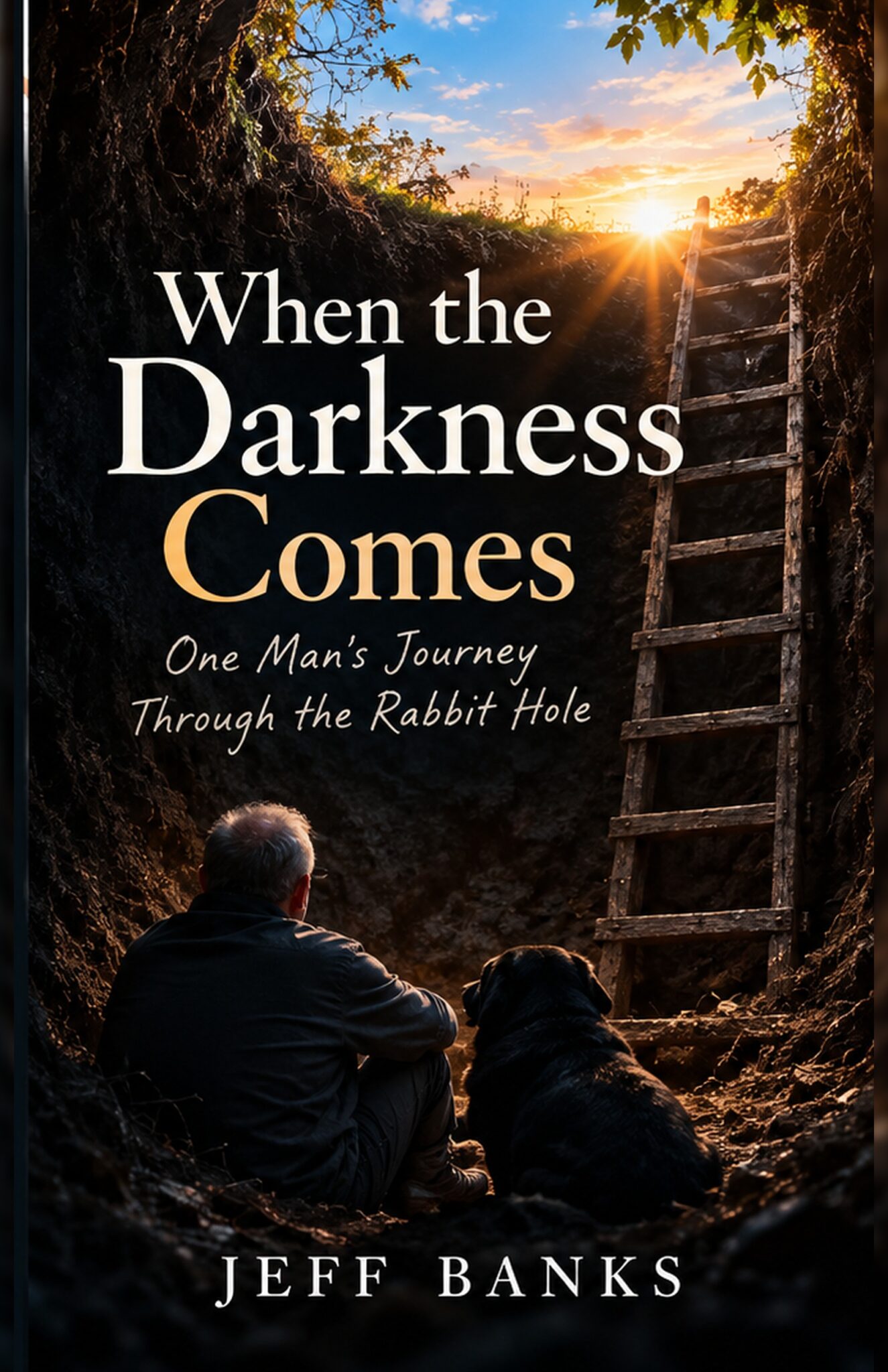
WHEN THE DARKNESS COMES - Chapter 2 - Before We Had a Black Dog

WHEN THE DARKNESS COMES - Chapter 2 - Before We Had a Black Dog | Travelling Around Australia with Jeff Banks

Emotion complicated things, while action appeared to solve them. That was a remarkably useful philosophy for a boy who would become an accountant, businessman and professional problem-solver, but useful and complete are not necessarily the same thing. I wouldn't discover that distinction for a long time.

WHEN THE DARKNESS COMES

One Man’s Journey Through the Rabbit Hole

Chapter Two

Before We Had a Black Dog

I can still see myself walking away from the house with a rifle over my shoulder. There was nothing particularly remarkable about that on a farm in those days, and certainly nothing that would have caused anybody to wonder about the mental wellbeing of the boy carrying it. A rifle was a tool, rabbits and other vermin were targets, and a boy disappearing into the bush for a few hours was simply a boy disappearing into the bush for a few hours. Except I knew why I was going. I didn’t want to be at home.

Sometimes I walked and sometimes I saddled a horse and took the dogs, but the destination was less important than the direction. Away was the direction, and I could come home from school and, within ten minutes, be gone again, staying out until around dark because there was freedom out there that didn’t exist inside the house. I wasn’t wandering around contemplating my childhood, analysing my emotions or wondering whether I was psychologically damaged by anything happening at home. I was chasing rabbits, shooting vermin, riding a horse and filling the hours between school and darkness in a way that suited me perfectly well.

Dad had a temper, and we knew what happened when that temper arrived. The rage could be taken out on us kids, sometimes leaving welts that might still be there when we went to school, although I never saw him raise a hand to Mum. None of this produced conversations among my mates about what was happening at home because boys didn’t have those conversations, or at least the boys I knew didn’t. My mates may occasionally have seen the evidence, but nobody ever asked and I never volunteered an explanation.

We were much more likely to discuss the latest indignity inflicted upon us by the “barber”, although barber is probably granting a professional status that none of the men involved had earned. The barber was usually our father, the salon was wherever he decided to plug in the clippers, and consultation over the preferred style was not part of the service. There were no magazines to flick through while waiting, no discussion about what might suit the shape of your face and certainly no question about how much you wanted taken off. You sat down, Dad fired up the clippers and somewhere between the first pass and the last you discovered what haircut you were getting.

The objective seemed to be efficiency rather than appearance. A bowl cut was not so much a style as an agricultural solution to the continuing problem of hair, while “having your ears lowered” suggested a degree of surgical precision rarely evident in the procedure itself. The clippers could pull as readily as they cut, particularly when they were getting old or hadn’t encountered anything resembling maintenance for a while, but complaining merely extended the experience. The safest strategy was to sit still, endure it and wait for Dad to announce that he had finished.

That was the part my mates and I could talk about. We could compare the indignity of the finished product, laugh at whoever had received the worst assault that week and complain about looking ridiculous until enough hair grew back to restore some dignity. What we didn’t discuss was the other pain some of us might have experienced at home, even when there were welts visible enough for somebody to notice. Apparently we could admit that our fathers had butchered our hair, but not that anything else they did might have hurt us.

Looking back, there is something revealing in that distinction, although none of us would have recognised it at the time. The haircut was safe territory because everybody could laugh about it, whereas what happened behind the doors of our respective homes remained there. We weren’t concealing our feelings through some carefully constructed masculine philosophy; we simply hadn’t learned that those feelings were things boys might discuss. A bad haircut could be taken to school and shared with your mates, but the rest of it went home with you.

I don’t remember anybody using the expression mental health. Depression certainly wasn’t something children had, at least in the world in which I grew up, and I don’t remember anybody suggesting otherwise. There were people with nerves, people who had breakdowns and people who perhaps weren’t coping particularly well, but much of the adult world was deliberately kept from children. Health problems belonged to the adults who had them and, unless somebody needed to tell us something, they remained there.

That was particularly strange because depression was already inside our house. Mum suffered from it significantly, although we children didn’t know that at the time, and there was no reason we should have known because nobody told us. She had trained and worked as a nurse, coming from Condobolin in the Central West, which might not have been Sydney but was at least a town, and then found herself living on a farm miles from anywhere. Looking backwards, the isolation must have been enormous.

One of the ways she seemed to reach beyond it was through letters. Mum wrote copiously to family and people she loved, sending words across distances she couldn’t easily cross herself. I don’t know what was in all those letters and don’t intend to retrospectively turn every envelope into evidence of depression, but I do understand now that the woman writing them had an interior life her children knew very little about.

At some point during my teenage years Mum had what was described as a nervous breakdown. She went away for a period and we weren’t told where she was, nor were we allowed to visit her, which makes me suspect now that wherever she was, it wasn’t the local hospital. There was talk of some sort of operation involving a nerve and the possibility that memories might be affected, but that was adult information leaking through the walls rather than anything explained to us properly.

Life simply continued around her absence because that was what life did. We went to school, came home and did our chores because the alternative could involve the whip, and when the September school holidays arrived we became part of the shearing team because sheep didn’t suspend operations while somebody in the family was having a nervous breakdown. There was mustering to be done, work around the shed and whatever else the farm demanded. Mum wasn’t there, but she would be back, and that seemed to be about as deeply as I examined it.

When she did come home, there were changes. One side of her face seemed to have dropped and there were indeed gaps in her memory, although the one that survives most clearly in mine is wonderfully mundane: she forgot that I didn’t like beetroot. There were presumably far more significant consequences than an unwanted vegetable arriving on my plate, but that is what memory has chosen to preserve. Perhaps that is appropriate because nobody sat us down and explained the significant consequences anyway.

I don’t remember being frightened when Mum disappeared. That may sound strange now, but families can become extraordinarily good at establishing boundaries around what children are permitted to know, and ours had insulated us remarkably well from the private areas of our parents’ existence. Dad had already suffered heart problems while still a young man, yet those belonged largely to him, just as Mum’s problems belonged to her. My brother David’s asthma was different because childhood illness was visible and therefore discussed, but whatever was happening inside the adults remained behind another door.

Medicine itself was something that appeared when required rather than something we discussed. Doctors were consulted when somebody was sick enough to need one, hospitals simply entered the story when an injury or something such as croup required them, and I have no childhood memory of conversations about medications beyond the perennial Australian prescription to “have a Bex and a good lie down.” Dad had a scotch before dinner because apparently that had been “prescribed” for his heart, Mum enjoyed the occasional plonk, particularly when members of her family were around, and both might have a quiet beer from time to time.

Mum took plenty of pills, but we didn’t know why, and there is something almost perfect about that as a description of the period. The pills themselves could exist in plain sight while the reason for them remained private. Medical science was developing an increasingly impressive pharmaceutical vocabulary for anxiety and depression while families like ours remained considerably less well equipped with an emotional one.

The pharmaceutical world itself was changing quickly. The first modern antidepressants, including MAO inhibitors and tricyclics, had emerged during the 1950s, and the 1960s brought an expanding range of drugs intended to deal with anxiety, depression and other psychiatric conditions. Benzodiazepines became increasingly prominent, while amphetamines and barbiturates were also part of the wider medicinal landscape. None of that medical progress meant much to the boy wandering around our farm with a rifle over his shoulder because whatever was happening in consulting rooms and psychiatric medicine was occurring in a different universe from mine.

Valium arrived in the early 1960s and would become one of the great pharmaceutical cultural references of the period. Years later there would be much more discussion about benzodiazepines, dependence, withdrawal and whether some of the solutions medicine had enthusiastically embraced brought problems of their own. At the time, though, those debates were nowhere near our dinner table, and I certainly wasn’t sitting there contemplating the emerging pharmacology of depression.

My knowledge of “uppers and downers” came principally from television. Programs such as The Mod Squad (1968 – ABC) presented a world in which drugs, counterculture and a different set of social rules existed somewhere beyond our farm, but I had very little understanding of what any of it actually meant. I never touched drugs and never smoked, despite both my parents smoking until Dad finally stopped after his fourth heart episode before his fortieth birthday. Uppers and downers belonged to television people doing television things, not conversations around our dinner table.

There is that wonderful line about the sixties that says if you remember them, you weren’t really there. I was there, although being a boy on an isolated Australian farm was probably not what whoever invented the expression had in mind. There wasn’t much flower power drifting over the paddocks, and whatever sexual, pharmaceutical and cultural revolutions were occurring elsewhere had a considerable distance to travel before they reached us.

Isolation left plenty of gaps, though, and gaps could be filled with imagination. A child’s mind could disappear down rabbit holes of fantasy where the boundaries between the possible and impossible were fairly elastic, while the physical world around me offered an enormous amount of freedom provided the work was done and I remained on the correct side of expectations. I could dream as much as I liked, but eventually there would still be chores waiting.

Was I happy? I have trouble with that question because happy is one of those words that becomes far too easy when applied retrospectively to an entire childhood. I was driven, I achieved things and I generally found ways of doing what I wanted, provided I avoided the whip. I dreamed enormously and could lose myself in those dreams, although never sufficiently to escape the practical realities waiting when I came back.

Sport became one of those places where achievement made sense. Shows and gymkhanas brought satisfaction and occasionally prize money, although money had a somewhat theoretical quality when you were a kid living miles from anywhere worth spending it. At school, sport increasingly provided another escape, and by my final year I had represented the school in more than ten disciplines and was named Sportsman of the Year.

There was nothing in any of that which I recognised as depression, and I don’t want to rewrite the boy simply because I now know the man. It would be too easy to put a Black Dog behind every childhood tree, turn every unhappy afternoon into a symptom and transform every ride into the bush into an early psychiatric event. I went into the bush because I didn’t want to be at home, and once I was out there I had horses, dogs, rabbits, rifles, space and something to do. That is enough explanation without inventing another one fifty years later.

The men around me weren’t offering much alternative instruction in the handling of emotion anyway. Their inner selves were largely hidden in the traditions of what manhood was supposed to be, and when something terrible happened the conversation tended to concentrate upon what had physically occurred rather than what anybody felt about it. I remember a neighbour being killed when a tractor rolled onto him, yet the conversations I remember were about how long it took to reach him and how the tractors driven flat out to the accident seemed merely to limp towards the scene.

Perhaps that was simply how difficult things were made manageable. You dealt with the tractor, the accident, the sheep, the harvest, the broken machinery or whatever practical problem presented itself because practical problems had practical answers. Asking what all of it was doing inside you belonged to another world, assuming the question occurred at all.

That was certainly true among my mates. We were probably as brittle as one another, although I couldn’t have known because none of us talked about it. We saw one another at school and occasionally had weekends together, when somebody might come to the farm and we would wander off shooting or find some other primary-production pursuit to occupy us. We were far more comfortable playing at being the “death and glory boys” pursuing our prey than discussing fear, sadness or what might be waiting for somebody when he went home.

Then, at seventeen and with the HSC still immediately ahead of me, something happened for which I had no practical answer. The exams were supposed to represent the culmination of school and the gateway to whatever came next, but I thought I already knew what next looked like. The Air Force was going to be part of it, and in my mind that future had become sufficiently certain that everything else, including the HSC itself, was being measured against the destination I believed was waiting for me.

Just before those final exams, Dad and I made the pilgrimage to Sydney for the selection process at the Defence Force offices near Central Station. For two days they poked, prodded, tested and generally examined those of us hoping to get through, progressively reducing the field as each hurdle was cleared. I wasn’t approaching it as somebody casually exploring one possible career among many; this was the path I expected to take, and getting through each successive stage simply reinforced my belief that the plan was unfolding as it should.

That timing would matter far more than I understood while I was sitting in those rooms. Had the rejection come after the HSC, I might at least have completed school with the original objective intact and dealt with the consequences afterwards. Instead, the destination disappeared just before I was supposed to summon whatever enthusiasm remained for the examinations that had been intended, at least in part, to help me reach it. The HSC hadn’t changed, but almost overnight my reason for caring terribly much about the result had.

They needed five people for the program, and by the time the psychological testing began I was one of the final six. There had been a written examination before I was summoned into a room with a doctor, and the questioning somehow reached the subject of talking in my sleep. According to my memory of the conversation, the doctor told me that this ruled me out because the Air Force couldn’t have national secrets being divulged in my sleep.

There is a wonderful absurdity to the idea that seventeen-year-old Jeff Banks might have been lying unconscious somewhere announcing matters of national security to anybody within earshot. I had survived all the poking, prodding and testing necessary to get from the original group down to the final six when only five were required, yet apparently the thing that was going to bring me undone was what I might say while asleep. Once the effective decision had been made, the mood in the room lightened considerably and we moved from talking in my sleep to sleepwalking, which allowed me to contribute one of the better examples available.

Mum had supposedly watched me get out of bed one night, walk outside and bowl eight overs down the cricket practice area beside the house. Not one or two deliveries before waking up and wondering what the hell I was doing there, but eight complete overs, forty-eight imaginary balls delivered to an equally imaginary batsman in whatever Test match my sleeping brain had arranged. I have no idea whether I appealed for LBW, set a field or gave the imaginary batsman a send-off, although given the way I approached sport at the time I wouldn’t rule any of them out.

Perhaps that was the greater irony. Earlier in life my mates and I had played at being the “death and glory boys”, heading off with rifles and an enthusiasm for the hunt that owed rather more to imagination than military strategy. Sport operated on much the same principle for me. You competed, you chased the result and, if there was a contest underway, you wanted to win it. By the end of Year Twelve I had represented the school across more than ten sporting disciplines and been named Sportsman of the Year, so the evidence available to me suggested that the death-or-glory approach worked rather well.

Even asleep, apparently, I was still putting in the overs. There is something wonderfully ridiculous about a seventeen-year-old so committed to the contest that going to bed didn’t necessarily end the day’s play, yet it was that same nocturnal enthusiasm that helped remove me from the contest that mattered most. All those sporting results, all that competitiveness and all that determination had helped construct the person sitting in the doctor’s room, but none of them could answer the problem of what that person might do once somebody turned the lights out.

That created a conundrum I certainly didn’t recognise at seventeen. My experience to that point had taught me that results mattered: run faster, jump higher, bowl another over, win the event, get through the next test and remain in the competition. The Air Force selection process had seemed to operate according to exactly the same rules. There had been a field, then progressively fewer applicants, until finally there were six of us competing for five positions and I was still standing.

Except this wasn’t a game in which I could simply try harder. I couldn’t promise not to talk in my sleep, train myself out of sleepwalking before the next round or ask for another event in which to make up the points. For a death-or-glory boy accustomed to believing that effort and performance eventually produced the result, there was something completely foreign about being eliminated by something over which I apparently had no conscious control.

Under different circumstances, the eight overs would have been a bloody good story. In that room it became part of the strange conversation surrounding the end of a future I had regarded as virtually settled, and somewhere between the written test, the talk about national secrets and my imaginary cricket match, the arithmetic became brutally simple. They needed five, there had been six, and now there were five.

I wasn’t one of them.

The future that had seemed settled simply ceased to exist. There was no period of gradual adjustment, no alternative career plan waiting in another folder and no sophisticated conversation about what losing the future I had constructed might be doing to me. Dad was there, though, and I suspect he began solving the practical problem before the train carrying us home had travelled very far.

He knew the legendary shearing contractor George Johnson, and if the Air Force wasn’t going to take me there was work available in the sheds. One shed next door became another shed and then another, and somehow the next version of my life began. As far as I was concerned, it just happened, because that was how most significant things seemed to happen in those days.

My HSC was still there somewhere, but my heart wasn’t particularly interested in it after the Air Force debacle. Sport had already received far more of my attention than study, and now the destination that had given Year Twelve whatever larger purpose it possessed had disappeared. I eventually received 215 out of 500, a result that would look rather interesting when placed beside things I learned much later about my intellectual ability, but at seventeen there wasn’t much appetite for analysing contradictions.

There was numbness and there was shearing, and the second was considerably more demanding of immediate attention than the first. Sheep provided remarkably little opportunity for existential reflection, while a shearing contractor had far more interest in whether I could do the job than whether my carefully constructed future had disappeared somewhere near Central Station.

I still wouldn’t call what happened depression because I didn’t call it that then and I cannot honestly diagnose the seventeen-year-old retrospectively. Something had certainly happened, though, because a future I had regarded as certain disappeared during a conversation that somehow involved national security and eight overs of imaginary cricket. My response was essentially to move onto the next thing because that was what life had taught me to do.

That response would become much more deeply embedded as I grew older. There was work to do, qualifications to acquire, money to earn and eventually businesses to build, and I developed a philosophy that I didn’t merely repeat for effect. I genuinely believed there was no such thing as stress.

If an assignment was due and work pressures meant there weren’t enough hours available, the solution wasn’t to become stressed about it. The solution was not to sleep until the assignment was finished, which might have been a questionable health strategy but had the enormous advantage of producing a completed assignment. Completed things made far more sense to me than feelings about incomplete ones.

I knew I could deal with whatever arrived. Later I could sit with someone such as Professor Morrow, with his eidetic memory, and enjoy arguing thought against the written word, trying to construct a proposition strong enough to prevail over precedent. I could write an objection to the Tax Man and experience the satisfaction of receiving the letter agreeing with my argument. Problems were things to attack, understand and solve, and the harder they were the more satisfying the solution could become.

Even enormous reversals could be processed that way. I could become a millionaire at thirty and be broke at thirty-one and still go on, because going on was what you did. The end of my first marriage hurt, and a bout of glandular fever around that period seemed to magnify everything, but even then I don’t look backwards and confidently announce that the Black Dog had arrived. Life was getting in the way of that sort of analysis, and I was far too busy dealing with it to stop and give it a name.

I can see something now, though, without pretending it amounts to a retrospective diagnosis. “There is no such thing as stress” worked extraordinarily well if the objective was to keep moving, but what it didn’t contain was a release valve. My solution to pressure was invariably more effort, less sleep, another problem solved and another obstacle dragged out of the way.

Life is a funny thing because we can ignore certain facets of it and convince ourselves that they have disappeared. Perhaps they do disappear, or perhaps they accumulate somewhere out of sight until enough water builds behind the wall and the dam eventually bursts. I didn’t think in those terms then because emotion only seemed to get you into trouble, while action usually produced something tangible.

That probably had roots much further back than I understood. Mum could disappear with a nervous breakdown and the children still went to school; a neighbour could die under a tractor and the men could talk about how slowly the tractors seemed to travel while racing to reach him. A boy could lose the future he had mapped for himself in Sydney and, by the time the train delivered him home, another practical future could already be taking shape in a shearing shed.

Emotion complicated things, while action appeared to solve them. That was a remarkably useful philosophy for a boy who would become an accountant, businessman and professional problem-solver, but useful and complete are not necessarily the same thing. I wouldn’t discover that distinction for a long time.

It would be many years before I sat in a doctor’s room for a very different conversation and encountered medication intended to reduce the highs and lows. By then medicine had changed, the language had changed and, to some extent, I had changed with it. That story belongs further down the road because the boy in this one still had no Black Dog, no depression to manage and no reason to believe that his philosophy required examination.

If home became somewhere I didn’t want to be, there was a horse, a couple of dogs or a rifle and thousands of acres into which I could disappear until dark. If the Air Force said no, there was a shearing shed waiting when I got home, and if life presented another problem after that, I would deal with that one too. There was no such thing as stress because, as far as I understood the world then, there was only life.

Author

Menu