

WHEN THE DARKNESS COMES - Chapter 19 - When Darkness Speaks Softly

WHEN THE DARKNESS COMES - Chapter 19 - When Darkness Speaks Softly | Travelling Around Australia with Jeff Banks

There is still tomorrow, which is ultimately the only proposition I have ever needed the darkness to leave intact. I don't know what tomorrow contains, I don't know which version of me will wake up to meet it, and I certainly don't know whether the pendulum will be travelling up or down when I get there, but after everything life has already managed to put in front of me, one possibility remains sufficiently intriguing to keep me watching: I ain't seen nothing yet.

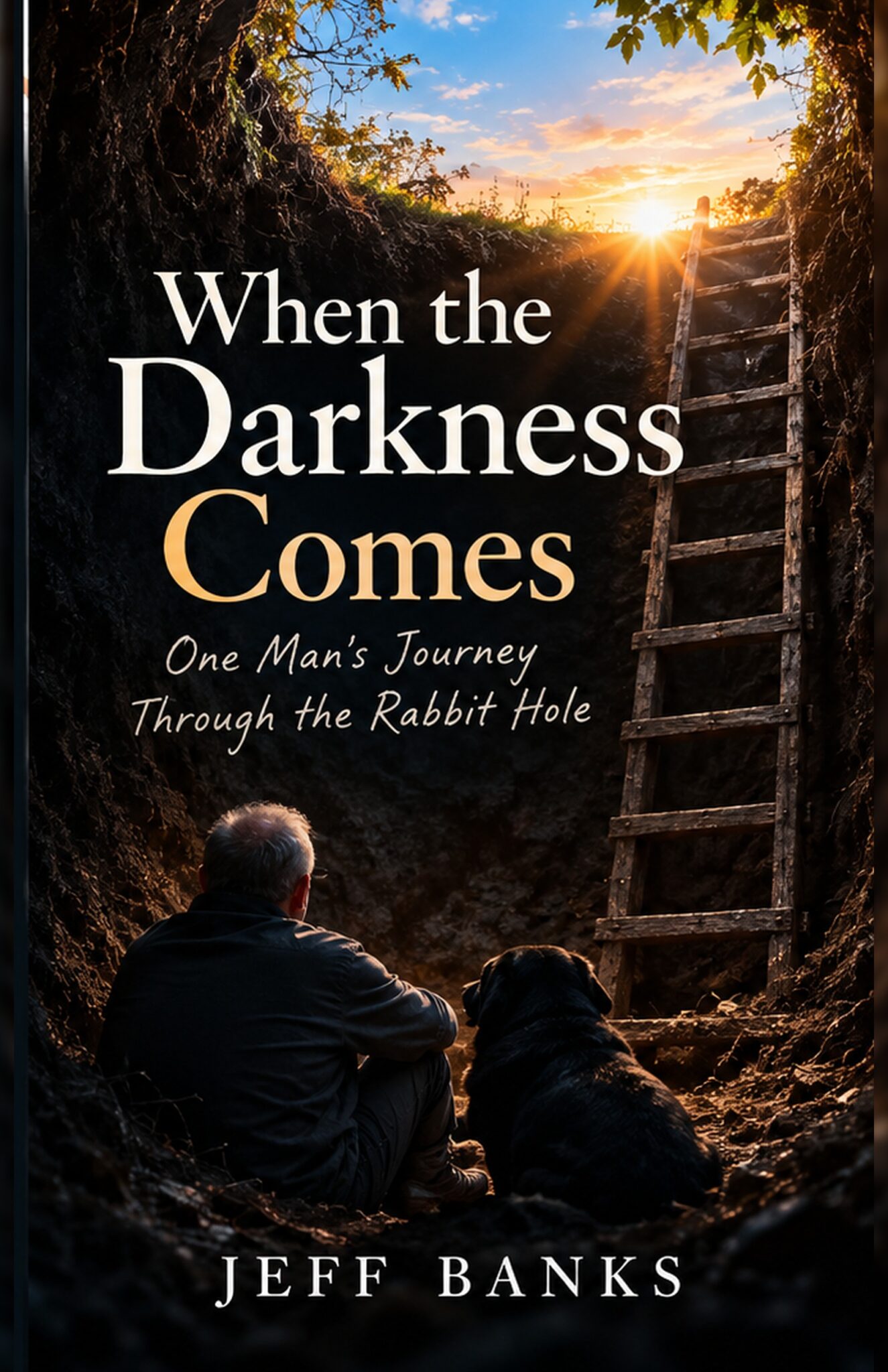
WHEN THE DARKNESS COMES

One Man’s Journey Through the Rabbit Hole

Chapter 19

When Darkness Speaks Softly

There was one question on the bloody test that I could answer without having to search for the correct word, interpret what the doctor might have meant or somehow translate what was happening inside my head into one of four little boxes. By then I had already discovered that possessing a perfectly serviceable English vocabulary was not the same thing as knowing which words applied to me, and the questionnaire had become an unexpectedly difficult exercise in trying to describe something I did not properly understand. Then it asked about suicide, and suddenly the answer was easy: no.

I don’t remember pausing over it or conducting some profound internal examination before selecting the answer. Suicide simply wasn’t in the vocabulary I had brought into the room, and the question seemed almost sufficiently irrelevant to be dismissed with disdain. Whatever else might have been happening to me, whatever had persuaded Robyn that perhaps a visit to the doctor was warranted, and whatever the other answers on that sheet were beginning to reveal, I wasn’t contemplating killing myself.

It was probably the only question on the test about which I felt completely certain. That certainty became considerably less comfortable once the scores were added up and the doctor began explaining where the questionnaire had placed me, because suddenly the apparently ridiculous question had been sitting among a collection of questions whose combined answers were being taken very seriously indeed. Hospitalisation was mentioned, the severity of what I had regarded as something I should be able to deal with was placed in language rather more confronting than my own, and the throwaway answer acquired a significance it had not possessed when I gave it.

The answer didn’t change. What changed was my understanding of why somebody had thought it necessary to ask the question in the first place, and that disturbed the comfortable arrangement I had maintained with myself until then. There is something disconcerting about discovering that a question you regard as completely irrelevant sits legitimately on a form designed for people occupying roughly the territory in which a doctor has just informed you that you are standing.

For a while I think my reaction was still mostly disdain. I could understand the arithmetic of the questionnaire without accepting that every question contributing to that arithmetic necessarily belonged to me, rather like being given a tax return containing schedules that exist perfectly legitimately but have absolutely nothing to do with the taxpayer sitting in front of you. Suicide was one of those schedules as far as I was concerned, and I had ticked the appropriate box and moved on.

Only later did the existence of the question itself begin to bother me, although never sufficiently to change the answer. There was doubt, certainly, but the doubt was not Do I actually want to die? because I didn’t, and it would be dishonest to retrofit that thought into my history simply because it makes a chapter about depression darker. The doubt was more awkward than that: how could I be sitting at the darker end of a depression questionnaire while simultaneously regarding its darkest question as belonging to somebody else?

Perhaps that is one of the problems with trying to draw lines through something as untidy as depression. We like a boundary because it tells us where one thing finishes and another begins, whereas my experience has been much more like watching the pendulum swing and discovering that somebody has removed the markings from the clock. I can recognise that it has travelled lower than before without necessarily knowing where the bottom is, and I have experienced enough of those swings to know that sometimes the most important achievement of the day is simply enduring where it has taken me.

Looking back, I sometimes wonder whether the doctor and I were even trying to answer the same question. He had a questionnaire, a scoring system and a clinical framework into which my answers apparently fitted with sufficient certainty to produce a result considerably more severe than the one I thought I had walked into the surgery carrying. I had arrived asking something rather different: what the hell was happening to me, why couldn’t I control it in the way I controlled most other things in my life, and was there some way of getting back to the Jeff I thought I was supposed to be?

Perhaps the doctor had not misread my answers at all. Perhaps he had read them perfectly within the framework available to him, while I was asking questions that framework was never designed to answer. The bloody test could measure how far down the pendulum appeared to have travelled, but it could not necessarily tell either of us what I meant when I said I wanted the feeling to stop, what I was trying to recover when I talked about wanting to be happy, or why the question about suicide seemed so completely foreign to the conversation I thought I was having.

That leaves me wondering whether, somewhere in that consultation, we began trying to push a square peg into a convenient round hole. The round hole was not necessarily wrong, and the doctor was not necessarily wrong for recognising that my answers placed me within it; depression was clearly sitting in the room whether I understood it or not. The square peg was the bloke sitting opposite him, trying to explain an experience for which he possessed plenty of words but apparently none of the right ones, and wondering whether the questions being answered were quite the same as the questions he had been asking himself.

Perhaps that distinction matters more to me now because I can see how easily a clinical question and a personal question can pass each other while appearing to occupy the same conversation. The doctor needed to know how dangerous the trough might be and whether suicide existed anywhere within it, while I wanted to know why there was a bloody trough in the first place and how I could get out of it without losing the peaks as well. Both were legitimate questions, but they were not the same question, and I am no longer certain that either of us fully recognised the difference at the time.

There have been plenty of times when I have desperately wanted the feeling to stop. That sentence looks more alarming on the page than it necessarily felt inside my head because the English language allows two very different ideas to stand uncomfortably close together: wanting a life to stop and wanting the way that life currently feels to stop. My experience belongs firmly with the second, but I understand far better now why somebody asking questions about depression cannot afford to assume the distinction.

When the pendulum has travelled particularly low, my defensive repertoire has never been terribly sophisticated. I withdraw, which can mean disappearing into another room, removing myself from whatever is happening around me or simply deciding that there is nothing useful to be gained by continuing to participate in the day. If sleep looks available, the bedroom can become the closest thing I have to a reset button.

There is no grand philosophy involved in that retreat. Sometimes there is merely the possibility that the Jeff who wakes up might be a slightly different Jeff from the one who climbed into bed, because experience has taught me that the pendulum can move without requesting my permission or explaining why. It can swing down when nothing happened to justify the movement, so there seems no logical reason why it cannot occasionally move in the opposite direction with equally little explanation.

That is one of the peculiar cruelties of depression for somebody who has spent a lifetime expecting accounts to reconcile. If something has gone wrong, I naturally want to identify the transaction, find the error and make whatever adjustment is required to bring the ledger back into balance. Depression has never shown much respect for double-entry bookkeeping, and sometimes the emotional accounts simply refuse to tell me why yesterday was tolerable and today isn’t.

Medication once offered the prospect that perhaps somebody else had discovered the missing journal entry. We tried more than one approach, and for a time I was prepared to accept the proposition that chemistry might provide what my own efforts had failed to produce. Eventually, however, I came to the conclusion that the version of better I was looking for and the version I seemed to be receiving were not necessarily the same thing.

I was looking for happy, which may have been an unreasonable instruction to give medicine in the first place. I wasn’t simply asking for the bottom of the pendulum to be raised so that the darkest days became less dark; I wanted the whole bloody thing moved. Somewhere in my mind there was an imaginary line marked happy, and if medication was going to change the boundaries within which I lived, I expected those boundaries to begin migrating towards that line.

That wasn’t how it seemed to work. The medication appeared capable of keeping me within a narrower path, reducing some of the distance between the troughs and the peaks and making the extremes less extreme, but the path itself did not seem to move. If anything, I felt as though somebody had erected guardrails on either side of the road while leaving the road running through exactly the same country. I was less able to wander as far into the darkness, perhaps, but I wasn’t travelling through noticeably brighter territory either.

That distinction became increasingly important to me because I wasn’t looking merely for less sad. I was looking for some evidence that the emotional centre of gravity had shifted, that whatever line represented normality, contentment or preferably happy had moved closer rather than simply becoming harder to depart from in either direction. Instead, the medication seemed to say that if it could prevent me travelling too far below the line, I would have to accept that it might also prevent me travelling too far above it.

From a clinical perspective, perhaps that was precisely the point, and I can understand the logic of it much better now than I appreciated it at the time. If the trough represents the dangerous part of the journey, reducing its depth is an entirely rational objective, particularly for the doctor whose responsibility is to stop the patient disappearing further into it. The problem was that I was the bloke living inside the new boundaries, and my question remained stubbornly different from the one the treatment appeared to be answering.

I wanted the road moved, not merely narrower.

Perhaps medicine was successfully keeping me inside the path while I was waiting for somebody to relocate the path towards the happy line. When that relocation never seemed to occur, the narrower path began to feel less like progress and more like containment, particularly when the peaks I valued appeared to have been brought down along with the troughs I wanted lifted. The pendulum might have been travelling through a smaller arc, but nobody seemed to have moved its centre point.

That was the part I struggled to reconcile. If the objective was to make the worst moments less severe, then perhaps the medication could claim some success, but if my objective was to feel genuinely better rather than merely less bad, I could not see that we were measuring the same outcome. It returned me to the uncomfortable possibility that the doctor, the medication and I were all working on the same problem while using quite different definitions of what solving it was supposed to look like.

Once the side effects were added to that calculation, the price eventually became more than I was prepared to pay for the result I thought I was receiving. I was being asked, as I saw it, to surrender some of the height of the peaks in exchange for protection from some of the depth of the troughs, while the entire emotional pathway remained stubbornly on the same side of the happy line I had wanted to approach in the first place. Once medication lost that argument with me, it ceased to be one of the defensive measures I reached for when the darkness returned.

That left withdrawal, sleep, time and the irritating knowledge that the pendulum had moved before. None of them guaranteed anything, and none came with instructions promising that tomorrow morning would be better than tonight. They merely provided somewhere to wait while life continued doing what life apparently does whether I am enjoying my participation in it or not.

The strange part is that somebody watching me during one of those periods might not notice very much at all. I may disappear for a while, but disappearing can be explained by being tired, wanting to do something in the office or simply not feeling particularly sociable, and I have had decades to perfect a veneer sufficiently convincing that most people have no reason to question what sits underneath it. Functionality is remarkably effective camouflage.

Accounting helps because a large part of accounting is science, and the science doesn’t require me to be happy before two plus two agrees to remain four. A client can ring with a question about a tax treatment I have dealt with fifty times before and receive exactly the same answer whether the pendulum is sitting comfortably in the middle or scraping somewhere along the bottom. The legislation doesn’t become more complicated merely because I do.

The more interesting camouflage appears when the answer requires the part of me that isn’t particularly available at that moment. Fortunately, professional life has supplied an entirely respectable response for that situation: I need to do a little research and get back to you. The client hears diligence and probably imagines me reaching for legislation, rulings or whatever other obscure material accountants keep around to justify their invoices, while I know that the research may include waiting for the rest of Jeff to report for duty. That is the veneer at work, doing precisely what it has been trained over decades to do.

It has worked for a very long time, and Robyn is probably the person most likely to recognise when something underneath it has shifted. Even then she does not demand a report, insist that I explain something for which I may not possess the vocabulary or require me to provide an estimated completion time for the latest visit from the Black Dog. She does what she has done through most of the journey and accompanies me, which sounds simple until you consider how much patience can be hidden inside the word accompanies.

I have not generally announced that I cannot keep feeling like this or told her that I desperately need the darkness to stop, other than suggest she accompany me to the doctor. Perhaps part of that is the veneer and part is the difficulty I have always had selecting words for something I don’t completely understand myself. It is hard to tell another person precisely what is happening when the bloke experiencing it cannot produce a reliable description for his own benefit, and considerably harder when the person you would be trying to explain it to is the person whose concern you are most likely to increase by getting the explanation wrong.

Finding the words is only the first problem anyway. Even if I could assemble them into something approaching an accurate description, there remains the question of finding the courage to actually use them, because saying something aloud gives it a substance that allowing it to wander around inside your head somehow does not. There is a difference between knowing privately that the pendulum has travelled further down than you would like and looking at the woman who has shared your life and saying that this one is particularly bad.

Before any of that can happen there is an even more basic problem: how the hell do you start the conversation? There is rarely an obvious opening between What do you want for dinner? and By the way, the Black Dog is giving me a particularly good kicking today, and I have never developed the conversational equivalent of an on-ramp that gets me from ordinary life into that territory. Sometimes the difficulty is not that I have decided to conceal what is happening; it is that I cannot find the first sentence that would allow me to stop concealing it.

Perhaps that is another service performed by the veneer. If I continue functioning, continue answering questions and continue behaving sufficiently like the Jeff everybody recognises, then there is no moment at which the conversation absolutely has to begin. Silence becomes easier not because there is nothing worth saying, but because speaking would require me first to identify what I am trying to say, then decide that I am prepared to expose it, and finally find an opening through which the words can escape.

Robyn has never required me to solve that problem for her. She does not need a formal announcement that the pendulum has moved, and after all these years I suspect she recognises considerably more than she ever tells me she recognises. Whether she sees the withdrawal, the tiredness, the disappearance into another room or simply something in the bloke she has been looking at for most of her adult life, she does what she has always done remarkably well: she remains there.

There is another word attached to our relationship that has followed us for almost as long, although it arrived courtesy of my first in-laws rather than either of us. Apparently I had potential, which at the time was not necessarily offered as an entirely complimentary assessment of the bloke their daughter had chosen. Potential can be a wonderfully convenient word when there is insufficient evidence to support achievement, because it allows everybody to acknowledge that something might eventually emerge while reserving judgement about whether it ever will.

The jibe has survived because, like most good family jibes, there was enough truth hiding inside it to keep it alive. Robyn married a bloke with potential and then had the considerable inconvenience of having to hang around long enough to discover whether any of it would actually turn up. Some of it did, some probably didn’t, and some remains subject to audit, but the more interesting question now is what it meant for the person who had to live beside the process rather than the bloke supposedly demonstrating the potential.

It would be very easy for me to make Robyn’s staying sound romantic, as though remaining beside somebody through difficult periods is simply evidence of an extraordinary love story. There is undoubtedly love in it, but remaining can also be bloody hard work, and sometimes leaving may have offered the simpler route. She has had to live not only with the Jeff who built businesses, raised children with her, made her laugh, irritated her, frightened her occasionally with another idea and eventually accumulated enough stories to fill books, but also with the Jeff who sometimes disappears behind a veneer without being capable of telling her where he has gone.

Perhaps that old word potential acquires a different meaning when viewed from her side of the marriage. Potential is always about something that has not happened yet, which means believing in it requires somebody to continue investing in a future for which there is no guarantee. For Robyn, remaining may have meant keeping open the possibility that whatever she could see in me would continue to emerge, while accepting that the darkness was also part of the bloke in whom she had made that investment.

That is not necessarily an easy bargain. Every time the pendulum moves down, she is not simply watching me endure another trough; she is living alongside whatever version of me that trough produces, without knowing precisely when the pendulum will move again or what will be available when it does. If I withdraw, she is left with the withdrawal, and if I cannot find the words, she is left with the silence surrounding them.

There must be a toughness required to remain in that position that I probably haven’t always acknowledged. I have tended to think about endurance from the perspective of the person experiencing the depression, because naturally enough I am the bloke standing in the middle of it, but Robyn has been required to endure something of her own. She has had to remain beside a battle she cannot fight for me, without necessarily being told how the battle is progressing and sometimes without even receiving confirmation that a battle is underway.

That does not mean she has spent our marriage waiting patiently for some mythical finished version of Jeff to emerge. If anything, the years have probably demonstrated that there is no finished version coming, because the potential and the Black Dog are not opposing candidates competing to determine which one represents the real me. They have both travelled through the same life, sometimes inconveniently occupying it at exactly the same time.

Perhaps remaining has therefore involved keeping faith not merely with the potential I might one day realise, but with the possibility that there would always be more of it to discover. That is a considerably harder proposition than standing beside somebody until he is fixed, because there has never been a finish line at which Robyn could collect the bloke she originally backed and declare the investment complete. She has had to accept that tomorrow might contain another success, another ridiculous idea, another book, another adventure or another trough, and she doesn’t get to choose which one arrives first.

There is a curious connection there with my own need to see tomorrow. I want to know what the children do next, what ridiculous turn life takes next and whether the bloke with all that alleged potential still has something left that neither Robyn nor I have seen. Robyn, by remaining, has kept that possibility alive from the other side of the relationship, although the price she has paid for doing so belongs to her rather than me and I should be careful not to pretend I can calculate it.

That may be one of the reasons her presence is such a comfort even when we never discuss what is happening. It is not the comfort of believing that she possesses an answer, because she doesn’t, and it is certainly not the comfort of assuming my depression costs her nothing because decades beside me suggest that would be absurd. It is the comfort of knowing that somebody who has had ample opportunity to discover the difference between my potential and my reality is still there.

Robyn cannot move the pendulum for me, manufacture the words I cannot find or somehow love the depression out of existence, and it would be unfair to turn her loyalty into another remedy on a list of things supposedly capable of defeating the Black Dog. Sometimes the most important thing she provides is much less dramatic than that: the knowledge that while I am struggling to explain where I have gone, I have not been abandoned there.

There is considerable comfort in knowing that without needing to test it every time the darkness arrives. I don’t have to sit Robyn down and explain the latest movement of the pendulum before her presence counts, and she does not have to understand every part of something I cannot properly explain myself before I can know she is beside me. It provides no answer to why the darkness arrived, how long it intends to stay or what will eventually persuade it to move on, but perhaps comfort does not have to answer a question before it is allowed to matter.

That difficulty with words becomes even more important when we start talking about suicide because language can make distinctions look much neater than experience ever was. I can now say quite comfortably that I wanted the feeling to end but did not want my life to end, and written here in the relative safety of hindsight the distinction appears clean, considered and almost clinical. It sounds as though I had reached that carefully reasoned conclusion while sitting in the darkness and could have explained it just as neatly to Robyn, the doctor or anybody else who happened to ask.

I hadn’t, because there was no carefully prepared statement waiting inside me to be delivered. Mostly I simply endured it, sometimes without possessing the words to describe what I was enduring and sometimes without the courage or conversational starting point required to try. Endurance was not an answer either, but there were times when endurance was all the rut brought to the table, while somewhere alongside it sat the quiet comfort of knowing that Robyn was still there even when I could not tell her exactly where I was.

Perhaps there is one final irony in that old accusation of potential. For much of our marriage it was supposedly mine, something I might or might not eventually realise if Robyn remained around long enough to witness it, but perhaps remaining itself required her to believe in potential every bit as much as I did. She had to keep accepting the possibility of tomorrow without knowing which Jeff would arrive with it, and maybe that is another reason I understand now that simply staying can require a form of courage all its own.

There wasn’t necessarily a stirring speech going on inside my head about Robyn, the children, the future or all the wonderful reasons I had to remain alive, and I don’t want to retrospectively supply one merely because it would make me sound more courageous. Sometimes I simply kept going because that was what I did, and somewhere within that was an expectation, however poorly articulated, that tomorrow remained worth seeing. There is another word I am prepared to put into that calculation even though it isn’t particularly flattering, and that word is cowardice.

I have no intention of dressing cowardice up as secret bravery simply to make myself feel better about it. If part of the reason I have never contemplated killing myself is that I am frightened of deliberately inflicting pain upon myself, then that defence is entitled to stand beside all the nobler ones without being required to change its clothes. If cowardice helped keep suicide out of my vocabulary, I am not going to sack it from the defensive line because courage would read better in a memoir.

That is a statement about me, not about somebody whose depression has carried them somewhere mine has not. I have lived close enough to darkness to understand that another person’s experience does not become mine merely because we use the same word depression, and I have no ledger capable of measuring what somebody else endured before reaching a place I have never reached. My cowardice, if that is what it was, belongs entirely to my side of the accounts.

There were other things standing beside it anyway. Stubbornness was probably there, habit almost certainly was, curiosity has always been difficult to remove from me, and FOMO may be considerably more powerful than any psychologist has ever given it credit for. Then there are Robyn and three children who have made the concept of voluntarily missing tomorrow seem increasingly ridiculous.

I have watched Justin do things I could not have predicted when he was a boy. He became the only person at the time he did it, to win the same section of the international Unisong Competition twice, then wrote, shot, directed and produced short films that earned recognition far beyond the places in which they were made, including a win in Colorado and mention at Cannes. If somebody had handed me that script when he was young and told me it represented part of his future, I would probably have asked what the writer had been drinking.

Julian has been no more cooperative with attempts to predict him. At thirteen he became his home club’s minor singles lawn bowls champion and South Pacific Junior Champion soon after, achievements which might have suggested one particular direction before life decided to send him somewhere completely different. He has since represented Australia twice in international cheerleading competitions, which is the sort of sentence that demonstrates why predicting what any of my children will do next is a mug’s game.

Then there is Kirsten, who appears to breathe astrophysics and has managed to turn her love of science into a capacity to make other people interested in it as well. Television appearances, a TED Talk, prizes for promoting science and STEM, around fifteen million social-media views in one year and nomination for Young Australian of the Year have all become entries in a story that seems determined to keep writing itself faster than I can comfortably keep up. Somewhere along the way she also came to us with a question that probably summarises better than anything else the environment Robyn and I tried to provide for all three of them.

The question was whether we minded if her next address was the International Space Station, which is not one of the parental questions for which I remember receiving any preparation. Apparently there are some moments for which the universe simply expects you to improvise, and Robyn’s apprehension was understandable because space travel has never been entirely successful in persuading mothers that it is just another form of public transport. Those of us who lived through Challenger had also encountered the magnificently inappropriate translation of NASA as Need Another Seven Astronauts, so we knew people had died pursuing precisely the sort of ambition our daughter was talking about.

Knowing that did not entitle us to make our fear the boundary of her world. We could be apprehensive, we could worry and we could privately wonder whether one of the children had finally come up with an ambition sufficiently outrageous to test the policy, but we were not going to hold them back merely because their courage exceeded our comfort. If Kirsten wanted to contemplate an address several hundred kilometres above the planet, then apparently Robyn and I were going to have to contemplate it with her.

That was the arrangement we had tried to maintain while the children were growing up. I would like to believe the environment we provided had at least something to do with the adults they became, although the directions in which they subsequently took that freedom were entirely their own. Watching them has also left me with a slightly selfish interest in their futures, because I have invested decades in these three stories and I am buggered if I am voluntarily leaving the theatre before I find out what happens next.

That may be where one of my favourite songs earns a place in this chapter even though Bachman-Turner Overdrive certainly didn’t write it about depression. I understand perfectly well that You Ain’t Seen Nothing Yet belongs to a very different story and that its narrative is about the development of a relationship. I don’t need to conscript the song into the Black Dog’s army to recognise that the notion contained in its title has always appealed to something in me.

The proposition that you ain’t seen nothing yet is wonderfully presumptuous because it assumes that whatever has already happened is merely preparation for something still waiting. There is no evidence supplied, no timetable attached and certainly no guarantee that what comes next will be better than what came before. It simply points at tomorrow and suggests that perhaps the show isn’t finished, and apparently that has always been enough to get my attention.

That notion has probably always suited me better than promises about happiness. Happiness is a word I have spent years trying to define, occasionally wondering whether I am experiencing it without recognising it and sometimes suspecting that everybody else received an instruction manual that was missing from my box. Tomorrow requires considerably less precision because tomorrow merely asks whether I am interested enough to turn up and see what it contains.

Even curiosity may be too neat an explanation, because I don’t want to replace one manufactured answer with another. There are days when curiosity may have nothing whatsoever to do with it and I simply allow life to occur while the pendulum moves according to rules it has never bothered explaining to me. There may even be days when I am actually happy and fail to recognise the event because I am too busy waiting for happiness to announce itself with greater ceremony.

The children nevertheless make the proposition of tomorrow particularly difficult to dismiss. After Justin, Julian and Kirsten have already demonstrated what they can produce, answering the question What next? with anything other than I haven’t got a bloody clue would require a confidence unsupported by the available evidence. What I do know is that history suggests the answer may be worth hanging around to see.

For most of my life that has been enough to leave the suicide question where I originally put it on the doctor’s form. It was not contemplated, not debated and not defeated after some heroic internal struggle because there was no struggle to defeat. The question appeared, I answered no, and for a long time my principal reaction was annoyance that it had intruded into a vocabulary where I had never given it a place.

Then, about this time last year, I went back to school for its 150th anniversary. I made a point of attending because the anniversary sat at an interesting intersection in my own history, somewhere between my final year at the school and the school’s first success in the East West/Cook Cup rugby league competition of which I had been part. There was enough of my own history wrapped around the occasion to make attendance feel worthwhile rather than merely nostalgic.

Among the people I encountered was an old schoolmate, Trevor. I saw him only briefly, and nothing about the encounter presented itself as important enough to be stored away for future examination. He was another person from a shared past appearing momentarily in the present, and whatever demons may have been occupying his private world were not sufficiently obliging to introduce themselves or suggest that they were winning.

That observation has to remain exactly as limited as it is because I don’t possess the right to write the rest of Trevor’s internal story. We had not maintained some close friendship in which I had failed to notice obvious warning signs, and none of my old schoolmates had made much effort to keep up with me over the years either. Where contact existed, I was generally the one who initiated it, so there is no retrospective case to be constructed around conversations I should have had or clues I ought to have recognised.

The Big Chill offered a generation of us that uncomfortable I should have known response to the suicide of a friend, but it has no legitimate place here. I shouldn’t have known because there was nothing available to me from which I reasonably could have known, and pretending otherwise would make Trevor’s death partly about me when it wasn’t. I saw an old schoolmate for a short time at a reunion and then went back to my own life.

About a month ago, I learned that Trevor had taken his own life, and suddenly that brief encounter acquired a significance it could never have possessed at the reunion. Whatever had been happening behind the surface was not something I had been invited to see, and the veneer had apparently worked until, tragically, it didn’t.

That thought is more disturbing to me than any retrospective guilt could be because veneers are something I understand rather well. I know how easily somebody can answer a telephone, conduct a conversation, perform a familiar task and provide absolutely no useful access to what is happening behind the performance. I have spent much of my professional life proving that competence and internal wellbeing are not required to occupy the same chair.

It does not follow that Trevor’s death suddenly made me frightened that I would do the same thing. That would give a moment more significance than it had and rewrite the certainty I have maintained throughout my own experience. If there was fear at all, it probably existed for something approaching the microsecond Data once tried to explain in Star Trek (Star Trek:First Contact – 1996 – Paramount Pictures), which is still a microsecond and should not be inflated merely because this chapter happens to be about darkness.

The usefulness of the Data comparison is not that an android’s microsecond somehow resembles suicidal thought. It is that experience belongs to the entity at the centre of it, and its scale cannot necessarily be measured by those standing nearby. What looks like an instant to somebody else may contain an extraordinary amount for the person, or android, actually living through it.

Depression has often felt like that to me. Somebody else may see me disappear into the bedroom for a couple of hours because I am tired, while I know that I went there hoping sleep might return a different version of me to the day. A client may hear me promise to conduct some research, while I know that the unavailable information isn’t necessarily confined to tax legislation.

Robyn may know more because she has had decades to study the veneer at close range, although she rarely lets on that she does. The children may see their father doing whatever their father normally does, and friends may encounter the same bloke they have always encountered. Meanwhile the person at the centre of the experience measures the distance differently because he is the only one travelling every centimetre of it.

Trevor’s death did not put suicide into my plans. It did, however, make it impossible to regard the subject entirely as a stupid question on an old medical questionnaire because somebody I had known had occupied territory I could not see and eventually arrived somewhere I never have. That deserves respect rather than an attempt from me to explain how he got there.

Perhaps that is also why I am less comfortable now with easy judgements about the difference between somebody who continues and somebody who doesn’t. I can describe the things that have operated in my own life and even admit that some of them are considerably less noble than others, but I cannot know which of those things were available to Trevor when he needed them. I certainly cannot take the fact that my pendulum has always moved again and turn it into evidence that everybody else’s must.

Mine has moved because mine has moved, and that is about as far as the evidence allows me to go. Anything beyond that would require me to turn my own experience into a rule for somebody else’s, which is precisely the sort of certainty depression has taught me to distrust.

The original questionnaire remains useful because it caught me before I had learned enough about depression to understand why the suicide question belonged there. I could answer it truthfully then and can answer it truthfully now, but the years between those answers have given me considerably more respect for the territory surrounding the box I ticked. The answer remains no while the simplicity of the question has largely disappeared.

What remains difficult is explaining why, despite having all the words necessary to construct an impressive answer. I could talk about love, responsibility, resilience, courage, family, hope and purpose and probably produce something sufficiently polished to sit comfortably on a mental-health poster. The problem is that I would then be pretending to understand something I still don’t understand.

Somewhere in the real answer is Robyn, who continues accompanying me without requiring a running commentary. Somewhere are Justin, Julian and Kirsten, whose lives have made tomorrow an ongoing exercise in wondering what the hell they will do next. Somewhere there is stubbornness, habit, FOMO and the possibility that the pendulum will move simply because it has moved before, and somewhere, if I am prepared to be completely truthful, there is cowardice.

I don’t know which one gets the credit on any particular day, and perhaps allocating credit is simply another attempt by the accountant to reconcile a set of accounts that has never agreed to be audited. There may not be a single transaction labelled reason for tomorrow, and I am increasingly suspicious of any explanation that claims to have found one.

What I do know is that even at the bottom of the swing I have never wanted to surrender tomorrow. I have wanted the feeling accompanying me towards it to bugger off, sometimes with considerably greater urgency than I have been capable of expressing, but tomorrow itself has remained out there with all the uncertainty that makes tomorrow what it is. The distinction may look narrow to somebody reading the words, but from where I have lived it has been enormous.

Perhaps tomorrow will contain another low point and another retreat to the bedroom. Perhaps I will wake with the radio in my head playing something entirely inappropriate, answer a client question while the veneer does its job, discover that one of the children has embarked upon another project nobody thought to warn me about, or hear Kirsten has decided the International Space Station was insufficiently ambitious and Mars now has better prospects. None of those things is promised, which may be part of why I still want to know.

I cannot tell you which word describes that desire because I still cannot pick the right one from the vocabulary available to me. Maybe there isn’t a right one, and perhaps after all these years I can finally allow that particular account to remain unreconciled without inventing an adjustment merely to make the columns agree.

There is, however, a song I have loved for years whose title makes a proposition I am still prepared to entertain. It does not promise happiness, explain depression or tell me that darkness inevitably passes, and I have no intention of pretending Bachman-Turner Overdrive wrote it with any of those things in mind. It merely leaves open the possibility that whatever I have already witnessed may not be the most extraordinary thing life has left to show me.

After sixty-six years, Robyn, three children, businesses, failures, successes, ridiculous ideas, unexpected turns, dark rooms, good days, bad days and a pendulum that still refuses to explain who winds the bloody thing, I remain curious enough to find out what comes next. I may also be cowardly enough, stubborn enough and selfish enough not to surrender my seat before the next act begins, and I am perfectly comfortable allowing all of those explanations to share the credit.

There is still tomorrow, which is ultimately the only proposition I have ever needed the darkness to leave intact. I don’t know what tomorrow contains, I don’t know which version of me will wake up to meet it, and I certainly don’t know whether the pendulum will be travelling up or down when I get there, but after everything life has already managed to put in front of me, one possibility remains sufficiently intriguing to keep me watching: I ain’t seen nothing yet.

Author

Menu