

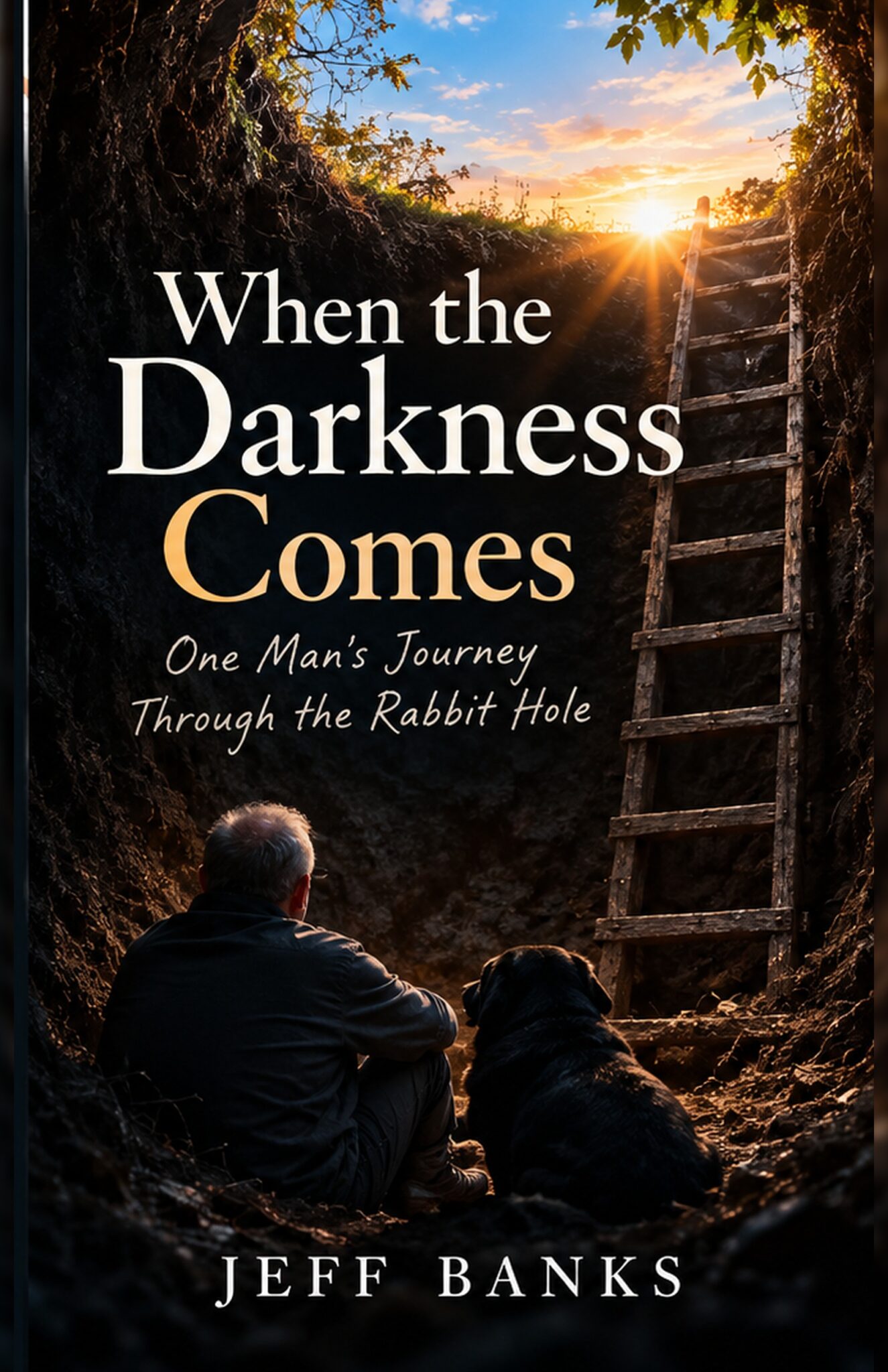
WHEN THE DARKNESS COMES - Chapter 18 - The Retirement Brochure Lied

WHEN THE DARKNESS COMES - Chapter 18 - The Retirement Brochure Lied | Travelling Around Australia with Jeff Banks

The brochure could never have fitted all of that on the front page, and perhaps nobody would have bought the product if it had tried. It would have needed to explain that work might be exhausting and still provide structure, that retirement might be liberating and still create stress, and that having enough money does not necessarily teach anybody what enough means.

WHEN THE DARKNESS COMES

One Man’s Journey Through the Rabbit Hole

Chapter 18

The Retirement Brochure Lied

It is Wednesday morning at Smiths Lake and the sun is shining, which means golf will be on. We tee off at one o’clock, although I will be at the course by eleven because there are things to be set up and, along with one of my mates, I have somehow become one of the people responsible for making sure they are set up. After the golf there will be another couple of hours packing everything away, reconciling the money, doing the reports and completing the other paperwork required to put Wednesday to bed before another Wednesday comes around.

This, apparently, is retirement, although I am beginning to suspect somebody has been fairly liberal with the definition. From the outside it probably looks convincing enough because I live at Smiths Lake in a house overlooking the ocean, I no longer have to fight Sydney traffic to get to an office, there is no staff waiting for me when I arrive and I can spend a sunny Wednesday playing golf.

If somebody wanted a photograph for the front of a retirement brochure, there are worse places to take it. They might want to crop out the bloke arriving two hours early with paperwork under his arm, but advertising has always depended to some extent upon deciding what not to put in the photograph.

Smiths Lake was never supposed to become another office. Moving here was one of the substantial markers in the transition from the working life we had known in Sydney to whatever was supposed to come afterwards, and the word retirement began to be bandied around with increasing regularity.

The problem was that a small group of clients apparently did not receive the memo, or received it and decided it did not apply to them. They still wanted the Jeff Banks they had always known, and they were sufficiently accustomed to having me available that my retirement became almost part of the joke.

I could tell them I was retired and they could acknowledge the information before proceeding to ask the question they had rung to ask anyway. In their world Banks Consultancy may have changed, but Jeff Banks was still there, and for some purposes that was all that mattered.

I complain about them, of course, because it would be unlike me to allow several decades of professional experience to disappear without retaining the right to complain about clients. What I have been slower to acknowledge is that there is another side to those calls, because the alternative to somebody wanting me is somebody no longer needing me. Having said that because of them I have not needed to touch my super as yet either.

That thought lands differently, although I cannot pretend I have completely worked out why. The phone not ringing can mean that people are finally leaving me alone, but somewhere inside my head it can also become evidence that they don’t need me anymore. It is not that I am frightened of silence, because I actually enjoy it. I like solitude, and there is a considerable difference for me between being alone and being lost in a crowd.

Some of the periods I enjoyed most in accounting involved disappearing into the office on a weekend when nobody else was there. I could close myself away with a pile of work and know that for several hours the telephone was unlikely to ring and nobody was going to appear in the doorway with another problem.

The period from July through to about the middle of September could be one of the busiest times of my professional year and, strangely enough, one of the most satisfying. I could go into the office on a weekend and simply engross myself in the work, getting through enough that when everybody arrived on Monday morning they effectively had to catch up with me.

That, in turn, sometimes allowed me to remain in the solitude of my office because I had pushed the work far enough ahead that the rest of the machinery was temporarily occupied trying to follow. There was satisfaction in being ahead of it, even though I knew perfectly well that accounting had an almost unlimited capacity to manufacture something else requiring attention.

There was stress in those months, but there was also certainty. A tax return had to be completed, a deadline had to be met, somebody had to be dragged kicking and screaming towards compliance, and another job was already waiting when the current one was finished.

One of the pillars of Banks Consultancy was that we would encourage clients to compliance, and sometimes the word encourage was doing a considerable amount of diplomatic work, we liked to use the term “kicking and screaming”. The pillar was not negotiable, though, which meant there was always a direction in which we were supposed to be travelling even when the client appeared determined to head the other way.

The Tax Office was also very obliging in providing dates. Whether I felt enthusiastic, flat, distracted, irritated or somewhere considerably darker, a deadline remained a deadline and did not enquire about my emotional wellbeing before deciding to arrive. The client who had ignored requests for information for the previous six months could likewise be relied upon to discover urgency once there were only a few days left. Their newly discovered urgency then became part of mine, whether I had invited it or not.

Accounting has a particular cruelty for anybody attracted to completion because there is always the next one. You finish one deadline and experience the satisfaction of getting through it, only to discover that the next light is already visible further down the tunnel. Ordinary accounting work keeps moving while advisory work gets splattered through the middle. Before long you are heading towards another light regardless of whether you have properly acknowledged passing the last one.

I have used the idea of the rut negatively plenty of times because ruts stop you changing direction. They keep you travelling along the same piece of ground and can become so deep that eventually you follow them simply because climbing out requires more effort than continuing.

What I had not considered until much later was that a rut can also stop you bouncing from wall to wall. If there is a track beneath you and a light somewhere ahead, at least there is some indication of which way you are supposed to be travelling. Work did that for me at times, although it would be dangerous to make the proposition any neater than that. The rut could hold me in the middle of the tunnel while also carrying me towards pressures that were doing damage of their own.

It would therefore be tempting, and completely wrong, to rewrite Banks Consultancy as some great protective device against depression. Running the practice became a huge burden, and much of that burden came not from accounting itself but from everything surrounding it.

The staff, the management, the interruptions, the responsibility and the requirement to keep an organisation larger than me moving could drag me down in ways that sitting quietly with a tax problem rarely did. The bigger the practice became, the harder it was simply to disappear into the work and let the rut carry me.

The telephone was a perfect example of that contradiction. A telephone rings because somebody else has had a thought at a particular moment and has decided that you should participate in it immediately, with very little consideration of what you were doing before they pressed the button. Their problem enters your day without an appointment, and the chain of thought you had carefully constructed around something else can disappear while you deal with whatever has just arrived. From their side of the telephone they have simply made a call, while from mine they may have dismantled the previous twenty minutes.

I hated that interruption because what I wanted was for the rut to win. I wanted the job in front of me, all the information required to complete it and enough uninterrupted time to make it happen.

Accounting practice rarely delivers that perfect combination because something is always missing, somebody always needs something and somebody else’s definition of urgent is constantly attempting to outrank yours. The profession may deal in numbers, but much of practice management involves dealing with people who have failed to provide them. Yet the interruption carried another message that I barely noticed at the time. Somebody had a problem and believed Jeff Banks might know what to do about it.

The same telephone I occasionally wanted to throw through the window was therefore delivering repeated evidence that I was useful. I could resent the interruption while depending, perhaps without knowing it, upon part of what the interruption represented.

That is where retirement becomes more complicated than the brochure. I do not want the old Banks Consultancy back, but that does not mean everything contained inside it was something I wanted removed from my life.

There is too much hurt attached to what the practice became, too much pressure in the full-time, full-on, full-drive version of it, and I am simply too tired to do that again. If somebody arrived tomorrow morning offering me the whole thing exactly as it once was, staff, clients, deadlines, interruptions and all, I would not regard that as the solution to anything.

The handful of clients who remain are different because I now possess a professional tool that was rarely available to me before. If the telephone rings and I do not want to answer it, I don’t, and the discovery that a ringing telephone is a request rather than a court order has been one of retirement’s genuine pleasures. I can allow enough time between incidents to deal with one annoyance before inviting the next one into the room. That distance matters because the old practice often provided no such space.

Those clients nevertheless provide something I would notice if they disappeared. They are the antithesis of the thought that occasionally arrives with retirement, the one that says they don’t need me anymore.

They quite clearly do need something from me, even if there are moments when I wish they would demonstrate their affection less frequently. Their continued presence allows me to complain about being needed while quietly protecting me from discovering how I would react if nobody needed that version of Jeff Banks at all.

Perhaps that is why retirement has never become entirely real to me. My sleeping brain certainly does not believe it, because from time to time I still have dreams in which I need to get up, get showered, put on the suit and tie and head to work.

They are not always particularly dramatic dreams, but they can be extraordinarily vivid. There is something disorientating about waking in the cold hard light of morning and realising that the urgency which seemed so real a few seconds earlier belongs to a life I no longer live.

The university dreams are stronger, and perhaps that is because their deadline was even more physical. I completed my degree around 1985, having done the work by correspondence, which meant assignments had to move from wherever I completed them to wherever somebody could officially record that they had arrived.

Assignments could be posted if you finished them early enough, but there was also a place at Ryde where you could deliver an assignment on a Sunday night and have it delivered on Monday morning. That meant it would be considered lodged on time, and I made use of that service often enough for the drive to Ryde and home again to become part of the academic experience.

Even when an assignment had been completed on Saturday, there was comfort in knowing I could drive it to Ryde on Sunday night rather than put it into an Express Post bag on Monday and know that somewhere in the system it was going to be recorded as late. The job was not finished when the final answer had been written because it was finished when the assignment had physically reached the place where responsibility for it passed from me to somebody else.

More than forty years later, I can still dream about getting it there. Apparently whatever part of my brain was responsible for assignment lodgements has never received confirmation that the degree was awarded and the file can safely be archived.

There is one particular assignment and one particular question that returns from time to time, along with memories of a group of people I met during those academic years. Some had a habit of perceiving what they thought a question was asking and answering that instead of reading the words in front of them and answering what had actually been asked. They could become caught up in what they thought the lecturer wanted, what the question might really mean, how difficult the subject was supposed to be or how much hung on getting the answer right, until the perceived stress surrounding the question became larger than the question itself.

Perhaps there was already enough accountant in me to find that incomprehensible. The question was sitting there in front of us in black and white, so read the bloody thing, identify what was actually being asked and deal with that before inventing another problem that might or might not exist. There was little point constructing an elegant answer to a question nobody had asked simply because the imagined version seemed more sophisticated, more difficult or more consistent with what we thought an academic assignment ought to require.

Looking back, there may have been something much more fundamental developing in me than an approach to university assignments. Deal with what is in front of you. Whatever stress surrounds it, whatever consequences might follow and whatever your mind is already predicting could happen next, the first task is still the one actually sitting on the desk. You cannot solve tomorrow’s problem by guessing what it might be, particularly if doing so prevents you dealing with today’s problem while it is still manageable.

That became remarkably close to the way I approached accounting. A client could arrive convinced the Tax Office was going to destroy him, the bank was going to close him down or some transaction was going to produce a financial catastrophe, and all of those things might eventually have deserved consideration. Before any of that, though, there was usually a set of facts sitting in front of us that needed to be understood. What actually happened? What do the numbers say? What has the Tax Office actually asked? What needs to be done now?

The perceived stress did not necessarily disappear simply because the immediate question had been identified. Sometimes the consequences really were serious, just as there was genuine pressure attached to getting an assignment completed and delivered to Ryde on time, but worrying about the drive to Ryde did not answer the question on the assignment paper. The pressure belonged around the task rather than inside it, and confusing the two only made the task harder.

Perhaps that was another reason deadlines could provide such an effective rut for me. However much noise existed around them, they eventually reduced the world to something immediately in front of me that could be acted upon: read the question, do the work, finish the assignment and get it to Ryde. Forty years later, my sleeping brain may still be trying to make the drive, but the underlying discipline has hardly changed: deal first with what is actually there, rather than exhausting yourself dealing with everything you imagine might be.

There is a beginning, a process and an end in that sequence. More importantly, there is a deadline that provides the whole thing with a reason to happen, and apparently some part of my brain became sufficiently accustomed to that machinery that it can still start the engine forty years later.

Retirement can close the office, remove the commute and dispose of most of the clients, but it cannot necessarily persuade the sleeping Jeff that there isn’t something due on Monday. Somewhere in the night the old machinery can still decide that something is due and therefore Jeff must act.

The dream about getting dressed for work operates in much the same way. I do not wake longing for the staff problems or wishing I could once again spend the day being interrupted by telephone calls, but I can wake shocked by how completely my mind has reconstructed the requirement that I must get up and go somewhere because somebody is expecting me.

That requirement existed for so long that perhaps it became something more than a diary entry. It became part of the architecture, and removing the office did not automatically demolish the part of me that expected to report there.

That architecture had already survived the loss of something else I once imagined might define me. Flying had been one of those possibilities, and over the years I took several flying lessons without ever having the cash flow to continue long enough to turn the possibility into the life.

In one of those peculiar turns that life occasionally provides, I later became a director of an airline despite never becoming a pilot. My fellow director would sometimes take me up in our plane and I would sit in the co-pilot’s seat and be allowed to fly with George.

George sounds like a reassuringly experienced aviator until I explain that George was the autopilot. For a while I could sit there with the controls in front of me and occupy a version of a life that had gone in another direction, before we landed and I returned to the life that had actually happened.

That life made me an accountant, and over time the occupation became an identity. There have been sporting achievements, businesses, premierships, speaking engagements, family, golf, fishing and all sorts of things around the edges, but accounting became the central professional description.

Even now I suspect that if ninety-nine per cent of the people around me were asked to describe Jeff Banks in one occupational word, accountant would beat writer comfortably. I am not sure whether I resent that, take pride in it or depend upon it, and there is probably enough of all three to prevent a clean answer.

Life seemed to establish the rut and I travelled along it, trusting that the light at the end of the tunnel was not a freight train coming the other way. Once flying had disappeared as a realistic destination, accounting was what remained, and I became sufficiently good at it that the identity eventually fitted very comfortably.

The difficulty is that retirement supposedly asks you to remove the occupation without disturbing the identity attached to it. Nobody ever explained how that particular piece of surgery was supposed to be performed.

Writing has complicated the question because it arrived almost accidentally rather than as some carefully planned second career. I began taking notes during a court case for the family, those notes became something readable, and people whose opinions mattered suggested I might have a knack for turning things into words.

Somewhere inside that was probably the same instinct that sat behind the first pillar of Banks Consultancy: speak in your language. I had spent years taking taxation and accounting concepts and trying to explain them in terms the person sitting opposite me could understand without removing the parts that actually mattered.

That did not mean reducing everything to four lines because sometimes four lines cannot contain the answer without throwing away the consequences, qualifications and things sitting around the periphery. I have been accused since school of being able to use a hundred words where three might do, so becoming an author may simply be the first occupation in which verbosity can occasionally be presented as a professional asset.

Writing nevertheless arrived after accounting and did not erase what had come before. It has not yet persuaded the world around me that Jeff Banks has ceased being the bloke you ask about tax and become the bloke whose books you might read, and perhaps I have not entirely persuaded myself either.

That is where the question of being needed begins to get under my skin. There is plenty of evidence that I remain useful, but the evidence does not always carry the same weight inside my head.

The remaining clients prove it every time they ring, the golf club provides its own collection of jobs, the family still has plenty of uses for me and projects have a habit of appearing without any deliberate search on my part. Logical Jeff could prepare a spreadsheet demonstrating ongoing relevance without much difficulty.

The other Jeff can still hear the proposition that they don’t need me anymore. He is not particularly interested in the spreadsheet when that thought has already found somewhere comfortable to sit.

There is something specifically powerful about professional usefulness because it occupied so much of my life. Being the bloke somebody rang because they trusted him to understand the problem became part of the architecture of who I was, even while I complained about the bloody telephone ringing.

When fewer people require that version of Jeff Banks, the rational explanation is that I deliberately reduced the practice and retired. The less rational interpretation can be that I am no longer required, and knowing that the second interpretation is unfair does not automatically prevent it arriving.

The golf club should be evidence against it, but strangely it does not always register in the same place. I can contribute locally, do the administration, set things up, reconcile the money and help keep things moving, yet some part of me still distinguishes that from the advisory sphere where somebody has specifically sought out Jeff Banks because of what he knows.

That may be completely unreasonable, but depression has never promised to apply reasonable accounting standards. Logical Jeff can recognise the asset while the other Jeff refuses to bring it to account.

Money presents a similar problem because a number on a page is not as tactile as understanding what that number actually means. The superannuation industry can produce projections, balances and carefully designed marketing showing what retirement should look like, but none of those things answers the question that bothers me most.

How much is enough, and how am I supposed to know when I have reached it?

At thirty I was going to be a millionaire. I got there, and at thirty-one I had nothing, which is probably a fairly effective way of teaching somebody that a number which looked wonderfully reassuring yesterday can become considerably less impressive tomorrow.

Once “enough” has disappeared in front of you, accepting the word on somebody else’s calculation becomes more difficult. The arithmetic may be impeccable while the experience sitting behind it keeps asking questions the arithmetic cannot answer.

Years later, when Banks Consultancy and the house at Belrose had been sold, our financial planner could look at the position and say that we had enough to retire. The numbers supported the statement, and I was perfectly capable of following the mathematics.

The problem was not whether the arithmetic worked because the problem was that I did not know what enough was supposed to feel like. A financial planner can calculate a position, but he cannot necessarily provide the tactile experience that allows the person looking at the calculation to believe it.

There is a difference between seeing a number on a statement and having some physical understanding of what that number represents. Putting your hands on a million dollars would presumably feel very different from looking at a balance sheet containing the same number, although I have never felt the need to ask the bank to provide the experiment in used twenties.

One is physical enough for the mind to comprehend while the other remains digits on a page accompanied by an assumption that they represent security. My professional life trained me to understand the digits, but my personal history had already taught me not to assume they could never disappear.

The only firm line society seems willing to give us is age. Sixty-seven becomes retirement because somebody has decided that sixty-seven is the relevant number, and superannuation marketing then builds a whole destination around it.

It reminds me of the computer in The Hitchhiker’s Guide to the Galaxy (2007 – Douglas Adams – Random House) producing 42 as the answer to the ultimate question of life, the universe and everything. An answer is not much use if you do not know what the question means.

We teach people to work, improve, accumulate, strive, build and keep going. We provide qualifications for careers, financial plans for wealth, budgets for expenditure and performance measures for businesses, but I cannot remember anybody offering a course called How to Know When You Have Done Enough.

At some point the same person who has spent forty years being rewarded for continuing is apparently expected to recognise a line in the sand and stop. Nobody seems terribly concerned about whether anybody ever showed him where the line was.

The movie Babe (1995 – Universal Pictures) offers a wonderfully simple version of something life does not. James Cromwell’s farmer can look at the pig after the job has been done and effectively tell him that it will do, and the statement carries authority because somebody outside the pig has determined that the required standard has been reached.

There is no equivalent figure standing at the end of my working life waiting to tell me that I have lodged enough returns, helped enough clients, accumulated enough, achieved enough and can stop wondering whether something else is required. Even if there were, I am not certain I would believe him because experience has made the word “enough” considerably more slippery than that.

Perhaps the problem is not that I keep moving the line. I have never felt that I deliberately achieved one target and immediately shifted it further away simply because reaching it was not enough.

It is more that nobody ever properly defined the line in the first place, and experience taught me early enough that standing on one side of it today did not guarantee I would still be there tomorrow. At thirty, enough disappeared, and the memory of that disappearance did not vanish merely because the numbers eventually recovered.

Decades later, the financial planner said enough had returned. The accountant could see the numbers supporting him, but the bloke who had once watched everything vanish could not necessarily turn that calculation into a feeling of permanence.

Retirement therefore arrived carrying another contradiction. The figures said I could stop while something inside me continued asking what would happen if I did.

The question becomes even more complicated because stopping does not always suit my head. I do not particularly like sitting doing nothing, although I do not consciously go looking for an endless procession of projects to prevent it. They simply seem to arrive and take over the rut. Writing came from the court case, woodworking provides another place to disappear, Sandbar creates its own obligations and something around the house or garden is always capable of becoming more important than it appeared ten minutes earlier.

Sometimes that movement is voluntary and enjoyable, while at other times it is considerably closer to retreat. There are mornings when I sit in the office and know that whatever is in front of me is not going to happen.

I can stare at the work and recognise that I do not have the willpower to process it, even though another part of me understands perfectly well what needs to be done. In years gone by I might have called that apathy, but the longer I live with the Black Dog the less comfortable I am with such a simple word.

On those days I may wander into the garden and start looking for weeds. They do not necessarily need picking, and there may be nothing remotely urgent about the garden, but a weed provides a different problem from whatever is sitting inside my head. I can see it, reach for it, pull it out and know immediately whether I have succeeded. There is no interpretation required and no argument between Logical Jeff and the other Jeff about whether the weed exists.

The struggle then moves from mental to physical, which gives the mind something different to deal with. Bending down and standing up again brings its own problems these days because I can become lightheaded, get out of breath if I do too much or discover that kneeling on the wrong surface hurts.

Then there are the prickly plants and the weeds that have had the good sense to establish themselves underneath the part least accessible to a sixty-something bloke trying not to injure himself. The immediate problem becomes where to put my knee, how far I can reach and whether the weed is worth the amount of discomfort involved in extracting it.

There is stress in all of that, but it is a different stress. For a while the problem is physical and immediate rather than whatever had been circling inside my head at the desk.

The thing happening in my head has not necessarily disappeared, but it is no longer the only thing demanding attention. Sometimes changing the argument is as much as I can manage.

I would like to say that somewhere along the garden bed enlightenment arrives, but it doesn’t. Sometimes all I have achieved is becoming tired while producing a slightly tidier patch of dirt, and the Black Dog is perfectly capable of waiting while I pull weeds.

What has changed is the battleground rather than the war. The mind has had to surrender some territory to knees, lungs, prickles and the practical problem of getting back upright without making a fool of myself.

The same is true of disappearing into the Man Cave or the Men’s Shed. I can move into a physical environment where something requires my hands and where the immediate problem might involve timber, a tool or simply deciding what I am going to do next.

Particularly at the Men’s Shed, I can even be surrounded by people, resplendent in hi-vis gear, and still manage to become almost invisible. There is a strange comfort in being in a crowd without having to become part of the crowd.

That is not treatment either, and I do not want to turn it into one. It is somewhere else to be when sitting at the desk has become harder than it should be, and sometimes somewhere else is enough to get through that part of the day.

I have learned to be suspicious of anything presented as the answer to depression because the Black Dog has spent too many years demonstrating his ability to ignore answers. Retirement was never going to receive a special exemption from that rule. If anything, the gaps in the timeline have occasionally made access easier for him. Sitting around contemplating one’s navel provides opportunities for old memories to wander in, and watching an old movie can open a door I did not know I had left unlocked.

Something that happened decades ago can suddenly be in the room again because there is no client deadline, telephone call or immediate problem making enough noise to drown it out. The absence of an external demand does not guarantee the absence of an internal one.

That does not mean I need to fill every moment because I enjoy the silence too much for that. I would hate to replace the old pressure with some artificial retirement schedule designed to ensure I never have time to think.

Solitude has always mattered to me, and there are times when the quiet of Smiths Lake is precisely what I wanted when I imagined leaving Sydney. The problem is not silence itself but what occasionally walks into it. Perhaps work once made enough bloody noise that I could not always hear the Black Dog scratching at the door. That does not mean he was outside, because there were certainly periods when he was well and truly inside Banks Consultancy with me.

Being busy did not prevent depression any more than retirement caused it. Functionality has always been one of the better hiding places available to him because a depressed accountant can still answer a telephone, solve a tax problem and get something lodged by the due date. The deadline did something nevertheless because it provided direction when direction might otherwise have been harder to find. It gave the day a shape that did not depend entirely upon how I felt when I woke.

Even when the rut was unpleasant, it could keep me moving towards a light. Sometimes that may have been all it achieved, but there are days when simply knowing which direction to move has considerable value.

Retirement removed some of those lights, although it also removed pressures I have absolutely no desire to recover. The mistake would be to conclude that because some parts of work were structurally useful, I therefore need the old tunnel back.

I don’t want it back because the tunnel came with staff problems, relentless interruptions, responsibility, pressure and enough hurt that I know returning to the full version of Banks Consultancy would be an extraordinarily poor answer to the question. I can acknowledge that something helped hold me upright without wanting to reconstruct everything that surrounded it.

That is the contradiction I am still learning to live with, and Robyn has not exactly embraced the textbook version of retirement either. Once Banks Consultancy stopped consuming so much of our lives, she found room to build the nurturing business she perhaps should have had the opportunity to build much earlier.

Business Blueprint gave her tools to turn some of that thinking into something real, so the two of us arrived at the supposed destination called retirement and promptly found different things to do. She does not hold me back, and she does not push me out.

We seem to have developed a version of retirement in which neither of us is particularly interested in sitting permanently in the deckchairs that were apparently waiting for us. Perhaps the brochure would regard both of us as difficult customers.

Smiths Lake still looks like the right place for those deckchairs, though. There is something in John Denver’s Rocky Mountain High that has always resonated with the move for me, particularly that wonderful idea of coming home to a place I had never been before. There is a contradiction buried inside the thought that somehow makes perfect sense: how can somewhere be home when you have no childhood memories there, no family history tied to the ground and no collection of old stories proving that you belong?

Yet Smiths Lake felt something like that to me. It was not a return in the conventional sense because I wasn’t coming back to somewhere I had left; it was more a recognition that somewhere I had arrived seemed strangely familiar in what it offered me. The lake, the ocean, the bush, the quieter roads and the distance from the machinery that had driven so much of my working life combined to create the feeling that perhaps this was where I had been heading without knowing there was a destination.

That is different from simply finding a nice place to retire. Plenty of places are beautiful enough to make you imagine living there, particularly when you encounter them while temporarily released from the obligations waiting at home. Smiths Lake seemed to carry something deeper, almost as though the environment fitted a part of me that Sydney and the working life had increasingly stopped fitting. I could look around and think that I belonged here despite having none of the conventional evidence that usually supports the word belong.

Perhaps that is what coming home to somewhere you have never been actually means. Home does not necessarily have to be the place containing your history; occasionally it might be the place that seems capable of containing whatever part of your future remains. At this stage of my life, that distinction matters because I was not trying to recreate the younger Jeff or transplant Banks Consultancy into more attractive surroundings. I was supposedly moving towards something else, even if I had very little idea what that something else was going to be.

The difficulty is that recognising a place as home does not automatically tell you who you are supposed to become once you get there. Smiths Lake could provide the scenery, the quiet, the water and the physical separation from the life I had known, but it could not issue me with a new identity at the local post office. Coming home to a place I had never been before still required me to work out where I fitted once the excitement of arriving had given way to the ordinary business of living there.

That may be one of the subtler stresses hidden inside retirement. You can change almost every external marker of your life and discover that the internal ones have travelled with you. The suit may spend considerably more time in the wardrobe, the commute can disappear, the staff can be somewhere else and the Sydney office can cease to exist, but the bloke who spent decades responding to deadlines, solving problems and measuring much of his usefulness by whether somebody needed his advice has arrived at Smiths Lake in the same removal truck.

Changing the view outside the window does not automatically change the bloke looking through it. In my case the view became immeasurably better, and there are mornings when looking across this part of the world still reinforces the feeling that I somehow came home to somewhere I had never been before. What I did not understand when I arrived was that finding the place where I belonged geographically was not necessarily going to answer the considerably harder question of where I belonged inside the life I was now supposed to live.

Perhaps that is why Smiths Lake can simultaneously feel like home and still require something from me. I did not arrive as a blank sheet of paper ready for retirement to write a completely new character across it; I arrived carrying the accountant, the husband, the father, the golfer, the businessman, the emerging writer and every other version of Jeff that had accumulated along the way. I also arrived carrying the habits, memories, fears and ruts that had survived every previous change of scenery.

And, of course, I brought the Black Dog with me. Apparently even coming home to a place I had never been before did not confuse him about the forwarding address.

I brought the accountant with me, along with the husband, father, golfer, fisherman, businessman, writer and bloke who can spend far too much time thinking about things that might have been better left alone. Most importantly for this story, I brought the Black Dog because apparently he was not covered by the removalist’s exclusion list.

The retirement brochure had left him out of the photograph, but it had left out plenty of other things as well. It never mentioned that some of the things I spent decades wanting to escape had been providing structure at the same time as they were creating stress.

The client who interrupted me was also telling me I was needed, and the deadline that annoyed me was also telling me where I had to be. The endless procession of work that exhausted me was also making sure there was another light further down the tunnel.

Removing the pressure did not selectively remove only the bad parts. Life has never been considerate enough to package its assets and liabilities separately.

Wednesday at Sandbar may be my current version of learning that distinction. I know where I need to be and roughly when I need to be there, and there are things that will happen because I turn up.

Nobody has imposed the day upon me in the way the Tax Office once imposed deadlines, and if I eventually decide I have had enough of doing it there is no professional practice collapsing around me because I walked away. Yet the day still provides rails, and apparently I continue to find some comfort in knowing where they lead.

And still, by eleven o’clock I will be at the course with one of my mates setting things up. By one o’clock we will tee off, and after the golf I will be packing up, reconciling, doing reports and completing the paperwork required to finish the day.

There will probably be some annoyance somewhere in the process because human beings remain stubbornly unwilling to organise themselves entirely for my convenience. There will also be a point at which the equipment is packed away, the reconciliation is done, the reports are completed and Wednesday’s obligations have been met.

That small completion may matter more than I once understood. Nobody will need to tell me whether Wednesday was enough because the physical evidence of its completion will be sitting in front of me. Then there will be another Wednesday, which means I have somehow managed to retire from accounting and recreate one of its defining characteristics at the golf club. There is always another deadline, although this one arrives wearing golf shoes and does not generally threaten anybody with penalties for late lodgement.

Perhaps that is why it works. I can have structure without rebuilding the practice, and I can be useful without carrying every problem that once arrived through the front door. I can also allow the phone to ring without accepting that somebody else’s decision to call automatically becomes my instruction to answer. There is enough of the old rut to provide direction without requiring me to climb back into the deepest part of it.

Whether that is retirement I still don’t know, because the word seems far too neat for what actually happens when a working life begins to recede. It suggests a transaction in which one thing ends and another begins, when my experience has been much messier.

The office may disappear before the accountant does, and the clients may reduce before the sense of responsibility does. The deadline may vanish from the calendar while the sleeping brain still insists an assignment needs to get to Ryde by Monday morning.

There is also no guarantee that removing stress removes the Black Dog. Sometimes it merely makes his footsteps easier to hear, while at other times the same silence is precisely what I want.

A sunny morning overlooking the ocean can contain more room for him than a frantic Tuesday in an accounting office ever did, not because the sunny morning is bad but because nothing else is demanding the space. That is one of the contradictions the brochure did not have room to explain.

Logical Jeff would prefer a formula because formulas are considerably easier to work with than contradictions. He would like A plus B to equal C, with A representing the years of work and effort, B representing the point at which sufficient financial security has been accumulated and C producing the word enough.

The problem is that life has never provided the definitions necessary to complete the equation. Without knowing what enough actually means, all the arithmetic in the world merely produces a more precise version of the question.

At thirty I thought I knew what enough looked like, and at thirty-one I discovered how temporary that knowledge could be. Decades later, a financial planner could tell me the numbers said enough had arrived again, while some other part of me continued to ask what happened next.

Neither sixty-seven nor a superannuation balance can answer a question that was never entirely about age or money. They can tell me whether retirement is financially possible without telling me what retirement is supposed to be for the bloke doing it.

Maybe the drive itself is part of the answer, although that creates another question I cannot resolve. If the drive eventually stops, does that mean I have finally reached enough, or does it mean something inside me that has always pushed towards the next light has gone quiet?

I am not certain I want to find out, and perhaps that uncertainty explains why projects continue finding me without any deliberate search on my part. A completely empty road may be freedom, but after a lifetime of travelling towards something I am not sure I would know where to point the vehicle.

For now, there is Wednesday, and the sun is shining over Smiths Lake. Golf will be on, I will arrive two hours early, spend the afternoon playing, remain afterwards to pack up and do the reconciliations, and probably complain at some point about how much work is involved in being retired.

Tomorrow may have fewer rails, and that is not necessarily a bad thing. If the Black Dog is particularly loud, I may wander into the garden and look for a weed that has done nothing to deserve what is coming, or disappear into the Man Cave until whatever was impossible at the desk becomes possible again.

If the phone rings, I may answer it or I may enjoy the relatively recent discovery that I don’t have to. Somewhere on the whiteboard there will still be a small collection of clients waiting for the Jeff Banks of old to attend to something, providing irritation and reassurance in roughly equal measure.

I do not want the old Banks Consultancy back, and there is no nostalgia strong enough to change that. I can miss the structure without missing the pressure, value being needed without wanting to be needed every minute, enjoy silence while recognising that sometimes the gaps inside it are dangerous, and accept that retirement has given me freedoms without pretending those freedoms automatically cure anything.

Those contradictions can sit beside each other because, inconveniently for the accountant, they all appear to be true. There is no requirement for the emotional ledger to balance simply because I would prefer that it did.

The brochure could never have fitted all of that on the front page, and perhaps nobody would have bought the product if it had tried. It would have needed to explain that work might be exhausting and still provide structure, that retirement might be liberating and still create stress, and that having enough money does not necessarily teach anybody what enough means.

It might even have had to admit that after forty years of deadlines, the bloke lying asleep in an idyllic house at Smiths Lake can still dream that he needs to get an assignment to Ryde before Monday morning. The photograph of the smiling retired couple walking along the beach would have required a considerably longer caption.

By eleven today I will have somewhere to be, and perhaps that is the only answer I need for today. There will be things to set up, people expecting me and a sequence to the hours ahead, followed by golf, packing up, a reconciliation and the quiet satisfaction of another Wednesday being completed.

The Black Dog may come with me or he may not, because he has never shown much respect for my diary. Either way, I am not rebuilding the old tunnel merely to keep him outside, because I already know too much about what living permanently inside that tunnel cost me.

I am simply discovering that, after a lifetime spent travelling in ruts towards the next light, retirement may require me to lay a few rails of my own. For today, they lead to the golf course, and tomorrow I will work out where they go next.

Author

Menu