

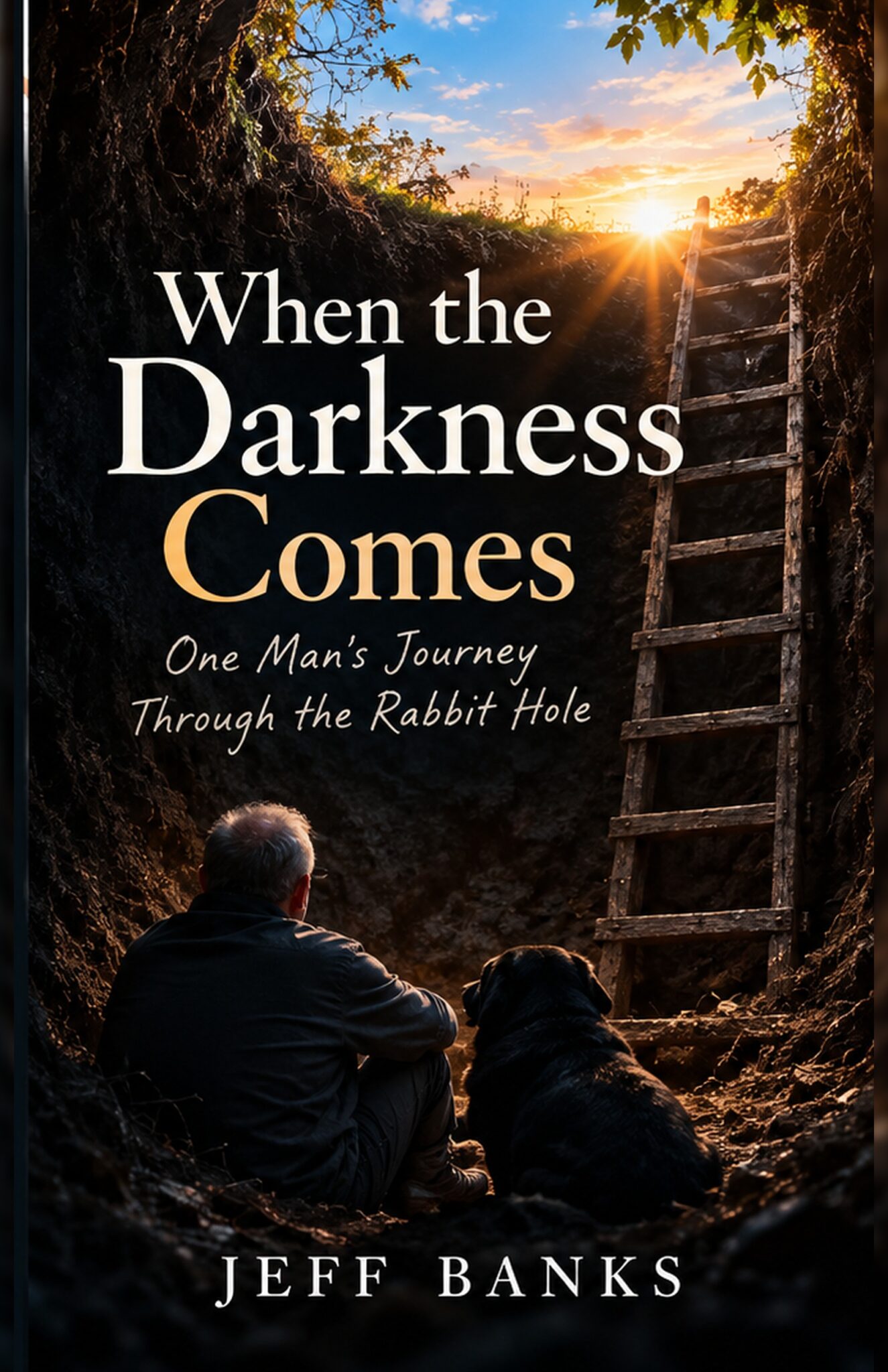
WHEN THE DARKNESS COMES - Chapter 13 - Things That Work Until They Don't

WHEN THE DARKNESS COMES - Chapter 13 - Things That Work Until They Don't | Travelling Around Australia with Jeff Banks

There have been times when I have laughed while depressed. I have solved complicated problems while depressed, played golf while depressed, written while depressed, helped other people while depressed and probably appeared entirely normal while depressed. Functioning and being okay have never been synonyms, any more than enjoying two hours of fishing proves that everything waiting back on shore has somehow disappeared.

WHEN THE DARKNESS COMES

One Man’s Journey Through the Rabbit Hole

Chapter 13

Things That Work Until They Don’t

There is a particular tee location on the golf course at Sandbar that probably explains my exercise regime better than any discussion about mental health ever could. It isn’t Mount Everest and I doubt anybody has considered establishing a base camp halfway up, although that is where the ladies tee exists, but it involves a reasonably long walk up a relatively short incline, and there have been times when arriving at the top ready to hit a golf ball has seemed a considerably greater achievement than the shot that follows.

That is one of the reasons I get onto an exercise bike and ride ten kilometres. It wasn’t the original reason, because the original plan involved losing weight, and on that measure the bloody thing has been a spectacular disappointment. I have pedalled enough imaginary kilometres to have reached destinations I have no desire to visit, while apparently leaving most of the kilograms exactly where they started.

Perhaps the only reason I tolerate the thing as well as I do is that it sits in front of the television. I don’t particularly want to spend twenty minutes watching an odometer slowly tick its way from one kilometre to ten, because there are few forms of entertainment quite as uninspiring as watching evidence accumulate that you are still pedalling without actually going anywhere. Put a movie on, however, and I can disappear somewhere else for a while, allowing the legs to keep doing whatever they are supposed to be doing while the rest of me becomes involved in somebody else’s story.

There is something useful in that separation. The physical part of me can be sitting on an exercise bike in Smiths Lake, sweating away and waiting for the bloody odometer to finally surrender the last kilometre, while my mind can be involved in a car chase, a war, a comedy or some other piece of complete fantasy where none of my own problems requires attention. I am not exercising because the movie makes me feel better, and I am not watching the movie because I have developed some sophisticated mental-health strategy; I am simply making the drudgery of one activity tolerable by losing myself in another.

Sometimes I become sufficiently absorbed that the kilometres pass almost unnoticed, which is probably the closest the exercise bike ever comes to performing a trick I genuinely appreciate. Instead of watching every hundred metres arrive and calculating how much further I still have to go, I look down and discover that several kilometres have disappeared while I wasn’t paying attention. There may be a small analogy to the darker days buried in there somewhere, although I am wary of giving an exercise bike more philosophical importance than it deserves: sometimes it is enough to stop

There is something particularly discouraging about doing something you don’t especially enjoy in pursuit of a result that steadfastly refuses to occur. Once the routine breaks, getting back onto the bike becomes disproportionately difficult because there is a perfectly reasonable voice asking why I should bother doing something that hasn’t achieved what I originally wanted it to achieve. Logical Jeff can respond that cardiovascular fitness has value, that I can walk up that hill at golf without gasping for breath and that exercise is generally regarded as a good thing, but Logical Jeff has never had exclusive voting rights inside my head.

The bike has therefore become part of the rut. I get on it because getting on it is something I do, and sometimes that is sufficient reason to do something when finding a better reason requires more enthusiasm than I happen to possess. It does not make me leap off after ten kilometres filled with optimism, rush outside to embrace the morning and announce that depression has once again been defeated by stationary cycling.

What it does is get me up the hill, and there are days when that is enough justification for having done it. Perhaps that is the first problem with calling these things remedies, because the benefit I receive from something may have absolutely nothing to do with depression.

Golf itself is considerably less reliable, which is unfortunate because golf sits comfortably among the sorts of activities people assume must be good for you. I am outside, I am walking, I am with other people, I am concentrating on something other than work, and for several hours there is theoretically no reason why the Black Dog should be anywhere near the place. Unfortunately, nobody has explained the arrangement to either the Dog or my golf swing.

Golf is a dangerous pastime for somebody who knows he can be better than the shot he has just played. On one day I can hit a particular shot and regard it as perfectly acceptable, while on another I can hit almost exactly the same shot and regard it as an absolute affront to whatever ability I believe I possess. The ball hasn’t developed a different opinion about me between the two occasions, but apparently I have.

Anger can burble towards the surface after a bad shot, and the absurdity is that I know exactly how little the shot matters. Nobody’s house is being repossessed because I missed a green, no client is receiving a tax assessment as a consequence of my putting and the Australian economy will probably stagger onwards despite my inability to hit a six iron in the direction I intended. None of that prevents the emotional reaction from being entirely disproportionate to the significance of the event.

Golf therefore works until it doesn’t, except even that gives golf more responsibility for the outcome than it probably deserves. Sometimes I enjoy it, sometimes I don’t, and increasingly it has become another part of the routine rather than an escape from it. I play once a week, which is nowhere near enough to develop the repetition that might make the body consistently perform what the mind thinks it understands, so the argument between technique and application continues for eighteen holes and resumes the following week.

That word routine is complicated because I have spent much of my life depending upon it. Accounting practices operate on routine, deadlines and repetition, and there is a certain comfort in knowing that something has to be done regardless of whether you particularly feel like doing it. Tax returns do not normally enquire about the emotional condition of the accountant before insisting upon completion.

That capacity to continue has undoubtedly helped me, but it has also hidden me. There have been periods when the process side of accounting could carry me because much of it is science: numbers arrive, established rules are applied, accounts are reconciled, returns are prepared and things move from one side of the desk to the other.

I could function inside that machinery even when the bloke operating it wasn’t travelling particularly well. From the outside the distinction could be almost impossible to see, particularly when the work being produced remained technically correct and the client had no reason to suspect there was anything happening behind it.

The difficulty is that routine can become a rut, and a rut can be both useful and dangerous. It can keep the wheels pointing roughly forward when I don’t have enough energy to steer, but it can also become so narrow that anything sitting just outside it ceases to exist. A shower can be missed, a meal can become something I’ll worry about later, and the concentration supposedly keeping me functioning can become another way of reducing the world to whatever happens to be immediately in front of me.

I have often thought of my moods as movement between the walls of a tunnel. There are better periods and worse periods, and sometimes all I appear to be doing is bouncing from one wall towards the other. The temptation is to identify whatever I happened to be doing when the direction changed and award it the credit.

Perhaps I exercised that morning, so exercise must have worked. Perhaps I played golf, went fishing, worked in the garden, solved a client problem or spent several hours writing, and by evening I was travelling better than I had been earlier. The accountant in me would quite like that relationship because it gives me a debit, a credit and something approaching a reconciled emotional ledger.

Unfortunately, I don’t think it works like that, because I have never been able to establish the necessary cause and effect. The same activity can coincide with the pendulum moving one day and apparently have no influence whatsoever on another.

On really bad days the garden is probably the activity of last resort. There is something about getting outside and pottering around among things that need doing without requiring a board meeting to decide how they should be done. A weed is generally a weed, something needs pruning or moving, and the garden doesn’t particularly care whether I am cheerful while doing it.

That makes rain far more significant than weather ought to be. Rainy Days and Mondays (1971 – The Carpenters – A&M Records) has always offered a pretty decent analogy, although perhaps not quite in the way the song originally intended, because rain can become a stopper regardless of which side of the pendulum I happen to be on when it arrives. If I am already down, one of the remaining possibilities has just been removed, but even if I am having a good day the same rain can close off something I wanted to do and leave me wondering what takes its place.

On a bad day that can be particularly tough because getting into the garden may have been the one thing still sitting somewhere within reach. I can look through the window and know that pottering around outside might help, while simultaneously watching the rain make the decision for me. It isn’t simply disappointment about not being able to garden; it is the removal of an option at precisely the time when having options can matter, and depression seems particularly adept at making whatever remains afterwards look considerably less attractive.

The strange part is that the same rain can have an effect when I was travelling perfectly well before it started. I might have planned to spend several hours outside, had something particular I wanted to plant, prune, move or build, and suddenly the day I had loosely constructed in my head no longer exists. Logical Jeff knows perfectly well that rain is not a personal attack, the garden probably needs the water and there are dozens of other things I could do instead, but the interruption can still be enough to change the rhythm of the day.

Perhaps that is where Rainy Days and Mondays works best for me as an analogy. The rain doesn’t necessarily create the mood any more than the garden necessarily cures it; it simply changes the available landscape. On a good day it can be an irritation that removes something I was looking forward to, while on a bad day it can feel as though somebody has quietly taken away one of the few handholds I might have reached for.

That distinction matters because otherwise it would be too easy to say that rain makes me depressed, and that isn’t what I mean at all. There will be rainy days when I am perfectly content to stay inside, just as there will be beautiful sunny days when getting through the back door and into the garden seems beyond me. The weather does not control the pendulum, but sometimes it puts a barrier across the particular direction I was hoping to travel, and whether I was having a good day or a bad one before the first drops arrived can determine just how significant that barrier becomes.

Woodworking and the Men’s Shed occupy similar territory for slightly different reasons. I don’t go there under any illusion that I am a master carpenter because evidence would be available to contradict me reasonably quickly. I have enough tools and sufficient ability to get myself into trouble, which has always struck me as a perfectly respectable qualification for owning more tools.

There is satisfaction in making something physical because the result exists in front of me. Accounting produces plenty of outcomes, but few of them can be picked up, sanded, turned over in the hands and placed somewhere afterwards. A piece of timber also tends to be relatively honest about whether I have cut it in the wrong place, although unlike the Black Dog it normally allows me to identify exactly where the mistake occurred.

None of that makes the shed a treatment room, and I don’t walk through its doors expecting a measurable improvement in my mental state. Sometimes I go because I want to make something, sometimes because I can, and sometimes because I want somewhere to hide. Woodworking provides that opportunity remarkably well because concentrating on a piece of timber gives me a perfectly legitimate reason to withdraw from almost everything else while still appearing to be doing something useful.

The Men’s Shed takes that contradiction even further because it allows me to disappear in a crowd. I can be surrounded by blokes, machinery, conversation and activity, resplendent in Hi-Viz gear that should make me visible from several suburbs away, and still become almost completely invisible. There is a certain absurdity in dressing specifically so nobody can possibly fail to see you and then discovering that emotionally it is one of the easiest places to hide.

Nobody necessarily expects a deep conversation because everybody has something in front of them. Somebody is cutting timber, somebody is sanding something, somebody is looking for a tool that was definitely on that bench five minutes ago, and somebody else is explaining at considerable length why whatever you are doing would be much easier if you did it his way. I can participate when I want to, retreat into whatever I am making when I don’t, and neither behaviour looks particularly unusual in a workshop.

That can make the Men’s Shed less an escape from depression than an escape from having to explain it. I don’t have to sit alone in the Man Cave or retreat to the recliner to withdraw because I can withdraw while surrounded by people, which is a trick I have practised in other parts of my life as well. Public Jeff remains technically present, appropriately dressed and apparently occupied, while private Jeff can pull the shutters considerably further down.

There is comfort in that because isolation does not always require solitude. Sometimes I don’t particularly want to be alone, but neither do I want the demands that can accompany being with people: conversation, questions, decisions, explanations or the requirement to demonstrate that I am enjoying myself. The Men’s Shed can provide something in between, where I am among people without necessarily having to surrender the privacy of whatever is happening inside my head.

Perhaps that is why woodworking belongs among these things that work until they don’t. Making something can absorb me, the Men’s Shed can get me out of the house and the people around me can provide company, but all three can also become camouflage for withdrawal. The important part may simply be that there remains another place available to me besides the office, the recliner and whatever part of my own head has become excessively noisy, even if occasionally I go there not to emerge from hiding but to find a different place in which to do it.

Fishing should be even more reliable because I love fishing. I love being on the water and I particularly love fishing with my son, where there is a silent banter between us that is different from fishing with anybody else. We don’t need to manufacture conversation to prove that we are enjoying each other’s company, and the day can contain long periods when very little needs to be said.

Yet lately the boat has sat in the garage for months, which rather undermines any theory that loving something automatically provides the motivation to do it. The boat is there, the water isn’t far away and I know perfectly well that there is a fair chance I will enjoy myself once I am out there, but knowing all of that does not necessarily get the boat through the garage door.

That is one of the great flaws in the theory that the answer to depression is simply to do more of the things you enjoy. Sometimes the very thing that might help sits twenty metres away and the distance between knowing I would enjoy it and actually getting the boat onto the water might as well be twenty kilometres. Apathy is extraordinarily effective at turning a simple sequence of physical tasks into something that can be postponed until tomorrow.

I have still been fishing, but increasingly it has required somebody or something outside me to provide the momentum. I went to Swains Reef because other people were involved, and I have gone on charters with mates because arrangements had been made and there were external reasons to move. Sometimes being dragged somewhere is more useful than being invited because the decision has effectively been taken out of my hands.

That does not mean I emerge from every fishing trip cured, and it certainly does not turn fishing into medicine. It means I went fishing, enjoyed at least parts of the experience and spent some time living outside whatever rut might otherwise have contained the day. Sometimes being on the water gives my head somewhere else to be for a few hours, which may be benefit enough without requiring me to describe it as therapy.

There is, however, another complication because Robyn is not overly enamoured with fishing, and certainly not with my capacity to disappear onto the water for what she regards as “hours on end.” Somewhere in my head there is a little of Captain Marko Ramius in The Hunt for Red October (1990 – Paramount Pictures), standing on the bridge contemplating a life where he might like to live in Montana, marry a round American woman and raise rabbits. My equivalent fantasy is considerably less ambitious: give me a boat, some fishing gear, a patch of water and enough time for nobody to expect very much from me.

The problem is that what I experience as peace does not necessarily look peaceful from Robyn’s side of the equation. Sitting on a boat for hours waiting for a fish to become sufficiently cooperative to participate in proceedings holds very little attraction for her, and the idea that this might constitute relaxation probably requires a definition of relaxation she has never felt compelled to adopt. Where I can see escape, water, concentration and that peculiar silence that exists between periods of activity, she can quite reasonably see several hours in which her husband has disappeared to sea.

That difference occasionally comes with commentary about the amount of time fishing consumes. There can be annoyance about me being away for so long, although what makes the conundrum interesting is that there isn’t necessarily an alternative activity waiting in the wings that we would otherwise have been doing together. It is not generally a case of abandoning some carefully planned romantic afternoon so that I can chase flathead around the lake; sometimes the objection is simply that fishing has taken me away for hours, without any particular proposition about what those same hours should have contained instead.

I can understand that position intellectually while still finding it difficult emotionally. If fishing is one of the relatively few things capable of getting me out of the rut, then feeling guilty about going fishing can reduce some of the very benefit I went looking for, even though Robyn has every right to have a view about how much time I spend doing it. The activity that gives me some space can therefore create another little piece of tension waiting for me when I come home, which rather spoils any attempt to put fishing neatly into the column headed Things That Work.

Perhaps that is another reason the Marko Ramius comparison appeals to me, even if mine involves rather less geopolitical intrigue and considerably more bait. Peace is an individual concept. For me there can be something deeply peaceful about sitting on the water for hours on end with nothing much happening, while for Robyn the phrase “sitting on the water for hours on end” probably contains within it the complete explanation of why she would rather be almost anywhere else.

So even fishing comes with conditions attached. It can get me out of the house, interrupt the rut, put me beside my son or mates and allow the noise in my head to compete with water, wind, engines and the possibility that something might eventually pull on the line, but it also takes me away from home and from Robyn. Like so many of the things in this chapter, whether it “works” depends partly upon which part of the equation I happen to be measuring.

Writing began with another theory altogether. I had accumulated a great deal inside my head over the years and writing seemed to offer the possibility of getting some of it out, almost like the Pensieve in Harry Potter (Harry Potter and the Goblet of Fire – 2005 – Warner Bros) . Put the memory somewhere else, examine it from a distance and perhaps free up some room in the original storage facility.

It is an attractive proposition, particularly to somebody who likes solving problems by putting things into some form of order. I could take events that had lived as fragments, feelings and occasional unwanted visitors, turn them into sentences and paragraphs and leave them safely on the page. The only difficulty was that nobody had explained to the memories that once transferred to Microsoft Word they were supposed to vacate the premises.

I discovered that particularly while writing about the circus incident from the bankruptcy years. I had taken the boys to the circus and could afford the tickets but not the extras, including a glow stick they wanted. They didn’t complain or throw tantrums; in fact, they apologised for asking, which somehow managed to make the memory worse rather than better.

Writing that story did not remove it from my head. To write it properly I had to go back into it, and going back into it hurt badly. The Pensieve turned out not to be an extraction device at all on that occasion, because the act of putting the memory onto the page required me to pick it up first and hold it for long enough to describe it.

I still write, obviously, and I have written an extraordinary amount over recent years. There are times when the process absorbs me completely because an idea starts running and I want to discover where it goes. Writing gives the analytical part of my brain something to do while allowing another part to rummage through places I might otherwise leave alone.

Sometimes that is helpful, while on other occasions I apparently hand the Black Dog a shovel and invite him to assist with the excavation. The same process that can occupy my mind for hours can also uncover something I had managed not to think about for years, so even writing refuses to stay obediently in the column marked Things That Help.

Music behaves differently again because I don’t normally choose it as a remedy. The radio in my head has never taken requests particularly seriously and has shown no discernible respect for my musical preferences. Harry Chapin is my favourite songwriter, yet Chapin songs rarely arrive uninvited, despite there being plenty of them that I would happily have playing in there.

Instead, something else appears for no obvious reason. I can fantasise about standing on a stage singing Chapin, the Seekers, the Eagles or even Alice Cooper, much as one of my sons actually performs professionally, but the internal radio has its own programmer and I have never met him. Sometimes a song seems appropriate to my mood and sometimes it is so completely unrelated that trying to interpret it would require considerably more psychology than I possess.

I have therefore never been particularly interested in constructing a playlist to beat depression. Music is part of my life, occasionally part of my mood and sometimes an early indication that something is happening inside my head before I have consciously identified it. It isn’t a switch I can flick from miserable to happy, and I suspect I would distrust it if it were.

Humour comes closer to something I have deliberately used, although perhaps camouflage is a better description than remedy. Being the village idiot is a highly honed skill, and I have had decades of practice. I learned reasonably young that frivolity can make everybody else comfortable while revealing remarkably little about what is happening underneath it.

That creates another problem with the assumption that laughter means somebody is all right. Abbott and Costello doing Who’s on First? will get me, and a good Robin Williams interview can still make me laugh, particularly his description of the origins of golf. I can be carrying something considerably darker and still find something funny because apparently the human brain is capable of holding more than one emotional position at a time.

I see similarities between myself and Robin Williams sometimes, although I make no claim to understand what was happening inside his head and would never pretend that I did. What I recognise is the ability to occupy a room through humour, to become the source of frivolity and to make other people laugh. I know from my own life that performing that function tells an observer very little about what else might be happening inside the person doing it.

The reverse can actually irritate me. I don’t suffer idiots particularly well, and somebody else doing the sort of thing I do when I am playing the village idiot can get under my skin surprisingly quickly. Apparently I reserve the right to be ridiculous while simultaneously maintaining quality-control standards over everybody else’s ridiculousness, which may not be entirely reasonable but has at least been consistently applied.

Being needed operates at a deeper level. My sons will ring occasionally and ask me questions about things that have nothing whatsoever to do with taxation or accounting, and there is something enormously satisfying about that. They are grown men with their own lives, knowledge and capabilities, yet occasionally the person they decide might know something useful is still Dad.

I don’t even have to know the answer for the phone call itself to matter. Being asked provides a lift because there remains a place for me in whatever problem they are trying to solve, although not being able to solve it can sometimes push me in the opposite direction. The very thing that provides the boost can contain the mechanism for taking some of it away again.

That connects with something far more fundamental than whether being needed improves my mood. My children and what they might do tomorrow have always been part of my attachment to tomorrow itself. I want to know what happens next, what they do next and what surprising direction their lives might take next, and that curiosity has survived periods when I desperately wanted the feeling I was carrying towards tomorrow to stop.

Family, however, does not automatically produce that same sense of connection merely because enough relatives have been placed in the same room. Large family gatherings can daunt me, particularly on my mother’s side, where I can try to become part of the gathering while still feeling that I don’t quite belong. I wasn’t born in Condobolin, which sometimes seems to be an entrance qualification I failed to acquire, and there have been occasions when I have felt more relevant when somebody wanted something than when everybody was simply together.

Then there is Aunty Kerre, the matriarch, whom I can ring from time to time intending perhaps to unload something of my own. The conversation can very easily turn around until she is unloading to me instead, and before long I am doing what I have done for much of my life: becoming the Soft Shoulder rather than the person intending to lean upon one. Strangely, that can help too, because somebody else needing me can shift my attention without requiring whatever was happening inside me to have been resolved.

This is where the whole idea of remedies becomes increasingly difficult to defend. Work can help because it gives me something to solve, but work can also become the place where I hide. Family can make me feel needed, but a family gathering can make me feel peripheral. Golf gets me outside but can make me angry, fishing is something I love but apathy can prevent me doing it, writing can empty my head or force me back into the very memory I would prefer to escape, and routine can keep me functioning while simultaneously digging the rut deeper.

Even the garden, perhaps the most reliable activity of last resort, is dependent upon the weather. Apparently my mental-health strategy can occasionally be defeated by a low-pressure system somewhere off the New South Wales coast, which is not the sort of control mechanism an accountant would willingly design.

There is no sequence I can write on a whiteboard that says that if depression reaches Level Seven I should complete ten kilometres on the bike, weed the vegetable garden for forty-five minutes, listen to Harry Chapin, ring one of the boys, play nine holes of golf and finish with two hours of woodworking. Apart from being a fairly exhausting day, there is absolutely no guarantee I would feel any different at the end of it. Depression has never shown much respect for systems merely because I have designed them.

When one thing doesn’t work, I tend to look for the next thing. If I can’t do whatever is next on the list, I can make another list, ignore parts of that one and move onto something else. There is undoubtedly avoidance contained in that process, but there is also movement, and movement sometimes matters even when I cannot demonstrate that it has produced improvement.

That is where another image has stayed with me from the second G.I. Joe movie. The Rock and several of his colleagues end up at the bottom of a well, and when the melee is over they have the minor problem of getting back out. They lock themselves together and effectively walk their way up the wall.

Depression can feel a little like being at the bottom of that well, except there is no conveniently assembled team of action heroes waiting to form a human ladder. There are simply whatever handholds happen to be available: work, the garden, writing, a telephone call from one of the boys, the Men’s Shed, golf, fishing, a ridiculous piece of humour or the exercise bike I bought to lose weight and didn’t. None is necessarily the answer, but sometimes one of them is somewhere to put a hand while I look for somewhere to put the other one.

I don’t even experience the climb as a great moment of recovery. There is rarely a point where I recognise that something has worked and announce that I am now four points happier than I was three hours earlier. If the mood shifts, I often notice it only retrospectively, if I notice it at all.

The pendulum simply moves, and I cannot necessarily identify what gave it the push. That is probably the closest I can come to explaining what “working” means because there are good days, bad days and worse days, and the movement between them does not provide me with a detailed explanation of what supplied the force.

The good days are not necessarily euphoric and the bad days are not necessarily incapacitating. Much of life occurs somewhere between the walls while I continue doing whatever the day has put in front of me, sometimes aware of where the pendulum is heading and sometimes discovering only afterwards that it has changed direction.

Perhaps the bike contributes. Perhaps the garden does, or the golf, the fishing, the writing, the family, the humour, the routine, the work or the satisfaction of solving something that five minutes earlier I didn’t know how to solve. Perhaps sometimes they merely occupy enough of the day for the movement to happen without my noticing it.

That uncertainty matters because I would be very uncomfortable writing a chapter suggesting that somebody experiencing depression should simply exercise more, get a hobby, go fishing, spend time with family or discover the therapeutic properties of a cordless drill. I have done all of those things in one form or another, and I have still been depressed. I have also done them while depressed and enjoyed myself, which is one of those contradictions that becomes perfectly possible once I stop insisting that depression must occupy every available part of me at the same intensity.

There have been times when I have laughed while depressed. I have solved complicated problems while depressed, played golf while depressed, written while depressed, helped other people while depressed and probably appeared entirely normal while depressed. Functioning and being okay have never been synonyms, any more than enjoying two hours of fishing proves that everything waiting back on shore has somehow disappeared.

Maybe that is why I have become wary of the word remedy. A remedy suggests a reasonably dependable relationship between what I do and what happens afterwards. Take this, do that, apply the prescribed quantity and wait for the expected result, and I have never found depression sufficiently cooperative to honour that sort of arrangement.

My experience has been nowhere near that orderly, which is perhaps why I no longer go looking for a single thing that works. What I have instead is a collection of things that are part of my life, and their value does not depend entirely upon whether they can be credited with changing my mood.

Some give me purpose, some distract me, some absorb me, some make me laugh, some make me swear, some get me outside and some remind me that there are people who still occasionally want Dad to know the answer. On the right day one of them might provide a handhold on the wall of the well, while on another day I can reach for exactly the same place and find nothing there.

Tomorrow morning the exercise bike will still be waiting. I may get on it and ride ten kilometres, not because I expect to defeat depression before breakfast but because somewhere on the golf course there is a short hill I would prefer to walk up without arriving at the top completely buggered. After that there will be whatever else the day happens to contain, and some of it may help while some of it won’t.

I no longer know whether any of that qualifies as things working, and perhaps I have been asking too much of the word work in the first place. Time simply goes on and the pendulum comes back, and sometimes the most useful thing I can do is keep finding enough purchase on the wall to still be there when it does.

Author

Menu