

Sometimes that something is financial. Sometimes it is emotional. Often, it is both.

THE BUSINESS WE MEANT TO BUILD – Chapter 23 – The Business We Meant to Build
- Books, The Business We Meant to Build
Sometimes that something is financial. Sometimes it is emotional. Often, it is both.
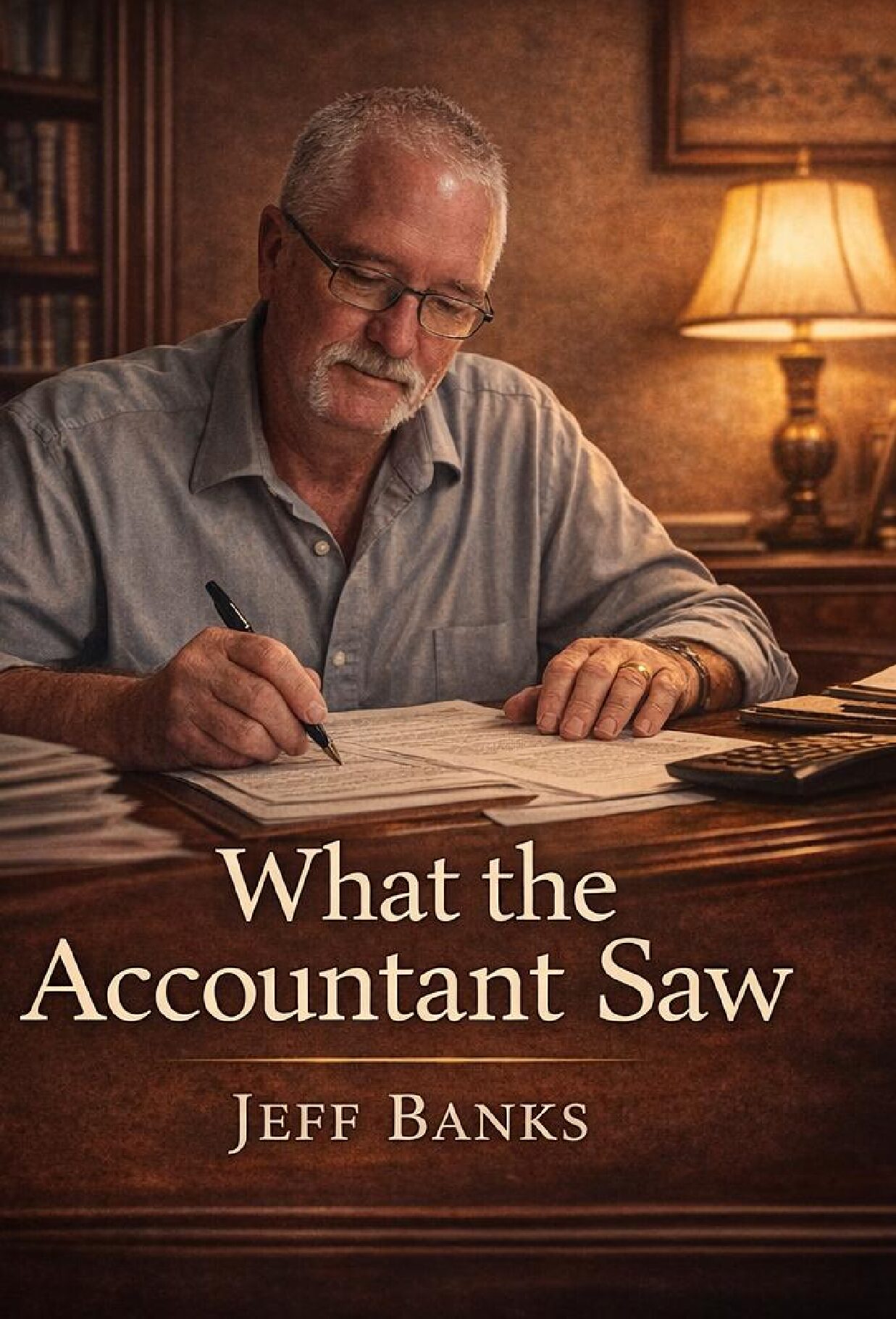
WHAT THE ACCOUNTANT SAW
Foreword
There is a particular honesty that emerges only after time has done its work.
Not the kind of honesty that sits neatly in textbooks or compliance manuals, but the kind that is earned through years of conversations across desks, over kitchen tables, in hurried phone calls and in those quiet moments where a client pauses just long enough to reveal what is really going on beneath the numbers. It is in that space, somewhere between the ledger and real life, that this book finds its footing.
What you are about to read is not a technical manual, although there is more than enough experience within it to fill several. Nor is it a collection of war stories designed to impress or to warn. It sits in a far more uncomfortable and, ultimately, more useful place than either of those. It is an exploration of behaviour. Of patterns. Of the small decisions that, over time, become defining ones.
For those who have spent any length of time working with small and micro businesses, much of what is contained in these pages will feel familiar. The rationalisations. The optimism. The selective interpretation of rules. The quiet belief that somehow things will work themselves out. These are not the traits of the reckless or the dishonest, at least not in the way they are often portrayed. More often, they belong to people who are simply trying to survive in an environment that rarely accommodates the realities of how small businesses actually operate.
That is what makes this book particularly important.
It does not stand at a distance and judge. It does not present the author as someone removed from the situations he describes. In fact, one of its greatest strengths is the opposite. There is a clear acknowledgement that the line between advisor and participant is not always as distinct as it should be. That at various points, the same patterns being observed in clients can be found, in some form, within the advisor as well.
That level of self-awareness is rare, and it gives this work a credibility that cannot be manufactured.
Across these chapters, you will encounter a series of stories that at first appear specific, individual clients, particular situations, moments in time, but which gradually reveal themselves to be far more universal. The details may change, but the underlying themes remain remarkably consistent. The tension between what is known and what is done. The gap between intention and execution. The ever-present temptation to prioritise the immediate outcome over the longer-term consequence.
There is also, running quietly beneath it all, a deeper question.
Not whether the tax system is fair. Not whether the rules are overly complex or inconsistently applied. Those debates have been had, and will continue to be had, long after this book is read. The question here is more personal than that. It asks whether the life being lived and the business being run are aligned with the full reality of the obligations that come with them.
Because when they are not, something has to give.
Sometimes that something is financial. Sometimes it is emotional. Often, it is both.
This book does not offer easy answers, and it does not pretend to. What it offers instead is perspective. The kind that can only be developed through decades of observation, participation, and reflection. It invites the reader to recognise themselves in the stories, not as a point of criticism, but as a starting point for understanding.
There is also a quiet generosity in the way these stories are told. While some of the behaviours described may be frustrating, even exasperating, they are not presented with ridicule or disdain. There is an underlying respect for the individuals involved, and an understanding that most are doing the best they can with the information, resources, and pressures they have at the time.
That balance, between honesty and empathy, is what makes this work resonate.
For advisors, it will serve as both a mirror and a reminder. A mirror of situations they have encountered, and a reminder of the responsibility that comes with the role. Not just to provide technical advice, but to recognise when the conversation has moved beyond numbers and into something far less certain.
For business owners, it offers something equally valuable. The opportunity to step back and see the patterns more clearly. To recognise where decisions are being driven by necessity, where they are being driven by habit, and where they may be driven by something else entirely. And perhaps most importantly, it provides a chance to ask better questions.
Not just of the system, or of advisors, but of oneself. Because in the end, the stories in this book are not about tax.
They are about people.
Handle them accordingly.
About the Author
Jeff Banks is an accountant, advisor, and mentor with more than four decades of experience working alongside small and medium-sized businesses across Australia.
Over the course of his career, Jeff has built a reputation for providing practical, commercially grounded advice that extends well beyond the preparation of financial statements and tax returns. Through his work with Banks Consultancy Pty Ltd and a range of associated ventures, he has guided clients through the complexities of business structuring, taxation, property investment, and long-term financial planning.
What distinguishes Jeff’s approach is not just technical knowledge, but an understanding of the human side of business. Having spent years in direct conversation with business owners, from early-stage entrepreneurs to established operators, he has developed a deep appreciation for the pressures, motivations, and decision-making patterns that sit behind the numbers.
Jeff’s work often places him at the intersection of compliance and reality, where legislation, commercial pressure, and personal circumstance rarely align as neatly as theory might suggest. It is in this space that he has spent much of his career operating, helping clients navigate not only what they can do, but what they should do.
In addition to his professional work, Jeff is actively involved in community organisations, including long-standing roles in local sporting and volunteer groups. These experiences have further shaped his perspective on leadership, responsibility, and the challenges of sustaining small organisations in changing environments.
As a writer, Jeff brings the same observational clarity and honesty to his work as he does to his advisory role. His writing blends anecdote, reflection, and practical insight, drawing on real experiences to explore broader themes around business, responsibility, and human behaviour.
This book reflects not only the clients he has worked with, but also his own journey, acknowledging that the lessons learned along the way are rarely one-sided.
He remains, at heart, what he has always been: not just an accountant, but an observer of people trying to make things work.
Author