
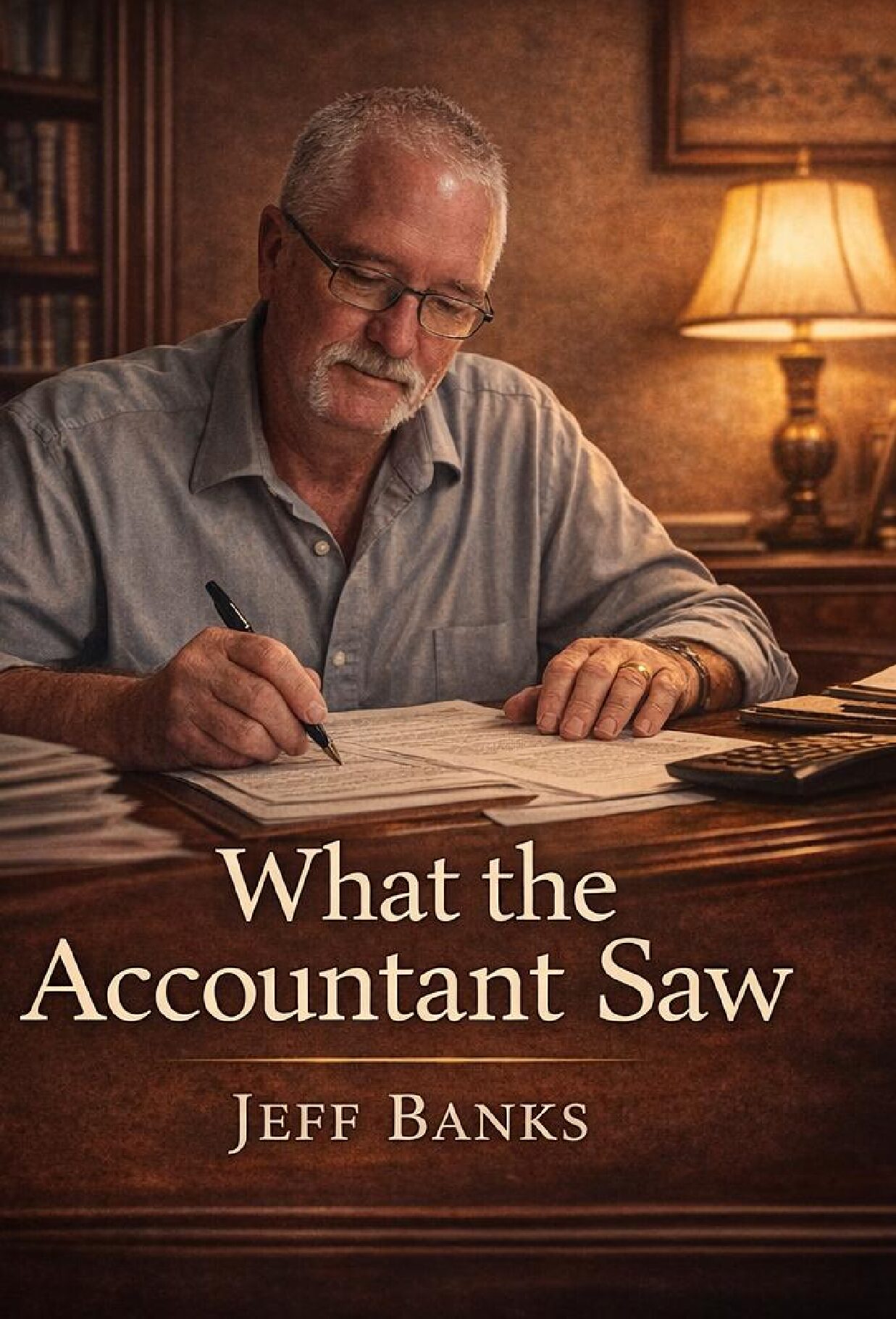
What the Accountant Saw Chapter 13 - Accountants Dont Simply Record

What the Accountant Saw Chapter 13 - Accountants Dont Simply Record | Travelling Around Australia with Jeff Banks

It lies in the willingness to pause before acting, to consider not just the immediate objective but the structure through which that objective is being pursued. It lies in recognising that small decisions rarely remain small, that they accumulate and interact in ways that are not always obvious in the moment. It lies, too, in accepting that foresight, while never perfect, is almost always less costly than repair.

WHAT THE ACCOUNTANT SAW


Chapter 13 – Accountants Don’t Simply Record


So much of what has sat beneath these pages has turned on the same dangerous human instinct: the belief that wanting something to be true somehow brings it into existence. I think it, therefore it is. I call it a misunderstanding, but in truth it is often something deeper than that. It is hope dressed up as logic. It is convenience masquerading as principle. It is the deeply held desire for outcomes to align with intention, regardless of whether the law, the facts, or the structure surrounding the transaction have any interest in cooperating.


That pattern has appeared again and again throughout this book. Sometimes it has shown itself in the belief that a home can somehow be both castle and commercial battlefield without consequence. Sometimes in the assumption that cash jobs are victimless, that GST is optional if nobody writes anything down, or that tax is merely a matter of interpretation rather than obligation. Sometimes it has been seen in the entrepreneur convinced that movement is the same thing as progress, or the investor who confuses asset ownership with understanding. The names and facts may change, but the underlying proposition remains startlingly consistent. People act first, justify second, and are offended later when reality refuses to bend to the shape of their preferences.


Against that backdrop sits one of the ideas that defined Banks Consultancy from the beginning. It was never enough for us to be record keepers. Never enough to sit quietly at the back end of a financial year, gathering invoices, reconciling accounts, and reporting to clients what had already gone wrong. There are accountants who see their role that way, and for some purposes perhaps that is sufficient. They receive the box of papers, or more recently the login and the data feed, process the information, produce the compliance documents, and move on to the next file. Their lot in life, if one wanted to put it a little harshly, is to be historians of other people’s decisions.


That was never how I saw the work.


From very early on, I believed the value of an accountant was not in recording the past but in influencing the future. The numbers mattered, of course they did, but not simply as a summary of what had happened. Their real value was as a warning system, a map, a language through which risk could be identified before it became loss and opportunity could be structured before it was wasted. It was this philosophy that eventually found its way into one of the pillars upon which Banks Consultancy was built: we will be more than a silent partner in your business.


That line meant something very specific. It was not a throwaway piece of branding, nor some clever little slogan designed to make an accounting firm sound warmer than its competitors. It was a statement of intent and we lived by it as much as possible. It was the recognition that the real work often begins well before a tax return is prepared or a set of financial statements is signed. By the time a set of accounts lands on a desk showing the damage, the opportunity to prevent much of it has usually long passed. The horse has not only bolted, it has often done so after kicking holes through the stable wall and trampling the flower bed on the way out. And that is where the distinction between cost and value begins to matter.


There are few professions more frequently judged by price than accounting, and few where the consequences of shopping on price can be so profound. Too often the conversation starts and ends with the fee. How much to do my tax? How much to set up a company? How much for the trust deed? How much to advise on the restructure? The questions are understandable, because money is tangible and immediate. The invoice arrives now. The benefit, by contrast, sits somewhere in the future, uncertain and often invisible. It is hard to become excited about paying for the avoidance of a mistake that has not yet happened. Human beings are not naturally wired to value disasters averted. They are far more comfortable paying to clean up a mess they can already see than to prevent one that only exists as a possibility.


Yet in business, and particularly in the building of any form of personal empire, that mindset can be ruinously expensive.


The cost of getting advice always feels real in the moment. The value of good advice often feels theoretical until the day it is not. Until the business is sued. Until a development goes wrong. Until an asset is exposed that should never have been within reach. Until profits begin to flow and are trapped in a structure that offers no flexibility. Until a family group discovers too late that income has been earned in the wrong entity, capital gains are sitting where they cannot be efficiently distributed, or a business that was meant to create wealth has instead created an avoidable tax burden. In those moments the earlier invoice, the one that once looked excessive, takes on a very different character.


Forethought, unlike repair, rarely looks dramatic. It does not come with the theatre of rescue. It has no crisis to frame its brilliance. It is quiet, almost unimpressive work. It is the conversation before the contract is signed. The question asked before the property is purchased. The entity established before the risk is assumed. The ownership proportions considered before profits arrive. The trust deed drafted with an eye not just to today’s convenience but tomorrow’s flexibility. It is, in other words, the kind of work that many people do not properly value because its success is measured by the absence of pain.


But absence of pain is not absence of value. In many cases it is the clearest expression of it.


This becomes particularly important when one begins to look at the quarantine of risk. For all the romance attached to business ownership and wealth creation, the reality is that every expanding enterprise generates exposure. Trade invites creditors. Employees invite obligations. Property invites disputes. Growth invites complexity. The larger the empire, or the stronger the ambition to build one, the less sensible it becomes to own everything everywhere all at once and hope for the best. Hope is not a strategy. It is certainly not a structure.


That is why the creation of separate entities, although often viewed by the uninitiated as an expensive indulgence, can become one of the cheapest forms of protection a person ever buys.


The old shorthand, particularly in earlier years, was often to talk about “the $2 company,” as though the mere act of incorporating solved the problem. There was always a seductive simplicity to that notion. Put the business into a company, pay the fee, issue the shares between mum and dad or even business partners for that matter, and consider the matter dealt with. For some, that was enough. For many, it was merely the beginning of the conversation, not the end of it. Because the real question was never just whether a company should exist. The real question was what role it was intended to play within the broader architecture of the family or business group.


A trading company, properly considered, is often best understood as a vessel for risk. It conducts the activities that expose the enterprise to the world. It enters into contracts. It hires staff. It buys and sells. It takes the punches. In that sense, it becomes the working beast of the structure, the entity that does the heavy lifting and, if things go wrong, the entity within which one hopes the damage will largely remain. That alone can justify its existence. But thoughtful structuring rarely stops there.


Once one moves beyond mere existence and into design, other possibilities emerge. The shareholding of that company need not be held in the most obvious or naive manner. Ownership can be established in ways that allow greater flexibility around the eventual enjoyment of profits. The shareholders may themselves be entities, or vehicles chosen not for complication’s sake but because future circumstances are unknowable and discretion has value. If profits arise, and they do not need to be extracted immediately in the most primitive way possible, then flexibility over how wealth is directed can become extraordinarily important.


This is where the difference between those who record and those who advise becomes stark. The recorder asks what happened and enters it into the system. The advisor asks what may happen and designs accordingly.


The same thinking extends into the use of trusts, a subject so often discussed badly that they have acquired a mythology all of their own. To some they are magic. To others they are suspect. In truth they are neither. They are tools, and like any tool their utility depends entirely on the purpose for which they are employed and the skill with which they are integrated into the broader plan.


A trust can provide a degree of discretion that personal ownership simply cannot. Income may be directed with regard to the circumstances of those within the relevant group, rather than trapped in the hands of the person who happened to acquire the asset or undertake the activity. Capital gains, too, may be dealt with in a manner that takes account of who is best positioned to receive them, including those able to take advantage of the general discount where the law permits. None of this is magic. None of it is trickery. It is simply an acknowledgment that if wealth is going to be created, then the vehicle through which it arises matters enormously. And yet, because all of this costs money to establish, many resist it.


They resist it at the beginning because beginnings are expensive enough already. There is a property to settle. A business to launch. Staff to pay. Equipment to buy. Lawyers to engage. Rent to cover. Insurance to arrange. Against that background, the cost of multiple entities, trust deeds, corporate trustees, constitutions, advice meetings and the associated administration can feel like indulgence. The temptation is always to simplify. To defer. To say we will fix it later when the business is bigger, when the cash flow is stronger, when the need becomes obvious.


Later is one of the most expensive words in business.


Later often means after the asset has been acquired in the wrong name. After the risk has attached to the wrong entity. After the profits have accumulated in the wrong place. After the family circumstances have shifted. After the dispute has begun. After the tax event has occurred. After the opportunity for elegant planning has been replaced by the far uglier task of restructuring around an established mistake.


And restructuring after the event is rarely clean. It is often costly, sometimes impossible, and nearly always less effective than getting it broadly right from the start.


None of this is to suggest that there is a perfect structure waiting to be discovered for every person, like some Platonic form of commercial organisation floating above the suburban landscape. There is not. Structures must reflect the people involved, the nature of the activity, the appetite for complexity, the likely scale of operations, the family dynamics, the succession issues, the asset base, and the very human truth that life changes. The ideal arrangement for a single operator with modest ambitions is not the same as that required for a family group trying to accumulate business assets, investment properties and future generational wealth. Advice in this area is never about finding the answer. It is about finding the answer that best balances protection, flexibility, compliance, cost and commercial reality for the people actually involved.


That last point matters. Commercial reality always matters.


There is little value in drawing some magnificent structural diagram if the client will neither understand it nor maintain it. There is no point building a palace of entities if the discipline required to run it is absent. Minutes must be kept. Distributions must be considered. Loan accounts must be understood. Dividends must be declared properly. Asset ownership must reflect the documentation, not just the conversation around the kitchen table. A good structure badly administered can become little more than a more sophisticated version of chaos.


But that does not diminish the value of strategy. It merely reminds us that strategy and discipline must travel together.


What it all comes back to, in the end, is the central proposition of this chapter: accountants do not simply record. Or at least they should not. Not if they truly understand the role. Not if they appreciate the weight of what is at stake. The best work an accountant does may never appear dramatic to the outside world. It may not involve a triumphant rescue, a spectacular tax saving, or some dazzlingly clever maneuver recounted over lunch. Sometimes its greatest achievement is that the client never fully understands how much trouble they have been spared.


There is a certain irony in that. The more effective the advisor, the less visible the intervention can appear. The disaster that never happened does not make for a good anecdote. The family asset preserved by proper quarantining is rarely toasted with the same enthusiasm as a sudden windfall. The tax flexibility built into a structure years earlier is often appreciated only faintly, if at all, by those who benefit from it. Yet this is precisely where value sits. Not in the recording of the wreckage, but in reducing the chance of collision in the first place.


That was always the thinking behind being more than a silent partner. Not to dominate. Not to interfere for the sake of it. Not to burden simple enterprises with unnecessary complication. But to recognise that a good accountant, properly engaged, is one of the few professionals who can stand at the intersection of tax, business, family, risk and time and see how one decision in the present may ripple outward for years.


Recording has its place. Compliance has its place. History matters.


But for the client trying to build something of substance, preserve something of value, and avoid becoming yet another cautionary tale, foresight will almost always be worth more than bookkeeping over the ruins


What has always fascinated me, and at times genuinely frustrated me, is not that people fail to seek advice. It is when they choose to seek it, because that timing, more than anything else, determines the value that advice can ultimately deliver.


It is a rare client who walks through the door at the beginning of a venture and says, in effect, “I am about to make a series of decisions that will shape how this business operates, how risk attaches to it, and how the outcomes will be taxed. I would like to understand those consequences before I proceed.” That would represent advice at its most effective point, when nothing has yet been done and everything remains possible.


Instead, the pattern is far more predictable, and over time it becomes almost comforting in its consistency. The call comes after the contract has been signed, after the business has been operating for some months, after the property has settled or the first meaningful profits have begun to appear. By that stage, what is presented is not a question of design but a question of consequence. “We’ve done this, how does it look?” “We’re thinking of changing this, what will it cost?” “Something doesn’t feel right, can you have a look?”


At that moment, whether anyone says it out loud or not, the role of the accountant has already shifted. The “silent partner” who potentially was always there has not been introduced. The opportunity to act as architect has largely passed, and what remains is the work of a mechanic, examining something that is already in motion and, more often than not, already carrying the seeds of its own complication.


There is an understandable human logic to this behaviour. People do not naturally prioritise paying for prevention, particularly when the risk being addressed is not immediate or visible. Insurance makes sense because the threat is tangible. A car service makes sense because failure is inconvenient and often obvious. But structural advice, tax positioning and risk containment operate in a far more abstract space. There is no immediate signal that something is wrong. The business is trading, the property has settled, the income is being earned. From the outside, everything appears to be functioning as it should.


In that environment, early advice feels optional. It becomes something that can be deferred, something to be revisited once the business is “up and running” or once the cash flow improves. The language around it is always reasonable, always practical. Get started first. Keep costs down. Fix it later when there is more certainty. Besides, today its only an idea, an entrepreneurial itch.


The difficulty with that approach is that time does not sit still while decisions are being deferred. Every action taken without a defined structure begins to create its own momentum. Assets are acquired in particular names. Contracts are entered into by particular entities. Income begins to flow in ways that establish patterns. Relationships form around those patterns, both commercially and personally. What begins as a temporary arrangement, often justified as a matter of convenience, gradually hardens into something far more permanent.


By the time advice is sought in any meaningful way, the accountant is no longer dealing with possibilities. They are dealing with history.


That distinction matters more than most people realise, because history carries weight. It constrains options. It introduces cost. It limits the ability to reshape outcomes without triggering consequences that might have been entirely avoidable at an earlier point. What might have been a straightforward decision at the outset becomes, after the fact, a negotiation between competing priorities, tax, legal exposure, commercial practicality and, not least, the client’s tolerance for disruption.


This is where the conversation around cost versus value takes on a sharper edge. At the beginning, the cost of advice is measured against doing nothing. It feels discretionary, even indulgent. Later, that same advice is measured against the cost of repair, and the comparison is no longer theoretical. It is immediate and often confronting.


Repair is always more expensive. It demands more time, more complexity and, in many cases, more compromise. Transactions have already occurred and cannot be unwound cleanly. Positions have been established that must be managed rather than redesigned. Opportunities that once existed in a simple form have either narrowed or disappeared entirely. What remains is the task of improving what can be improved, rather than achieving what might once have been possible.


There is also an emotional dimension to this process that is rarely acknowledged but frequently present. People do not enjoy discovering that a decision, particularly one made with confidence, has produced a less-than-optimal outcome. The instinctive response is often to justify the path taken, to point to the information available at the time, or to emphasise the pressures that existed when the decision was made. All of which are valid in their own way, but none of which alter the reality that consequence follows action, not intention.


Within that space, the role of the accountant becomes more complex than it is often portrayed. It is not simply a matter of applying technical knowledge or identifying alternative pathways. It involves navigating the intersection between what has been done, what can now be done, and what the client is willing to accept in terms of change. Advice, in that context, is not delivered into a vacuum. It is delivered into a lived situation, with all the constraints and sensitivities that implies.


This is precisely why the idea of being more than a silent partner was so central to how I believed the work should be approached. If the accountant is only engaged after the fact, their capacity to influence outcomes is inherently limited. They can interpret, they can explain, and they can attempt to improve, but they are no longer shaping the original decision. They are working within its consequences.


To be genuinely effective, the involvement must come earlier, at the point where decisions are still fluid and the cost of getting them broadly right is at its lowest. That requires a different kind of relationship, one in which the accountant is seen not as a necessary endpoint to a process, but as part of the process itself. It requires the client to place value on conversations that do not immediately produce a document or a lodgement, but instead create clarity around choices that are yet to be made.


That shift is not always comfortable. It can feel like an additional layer of consideration in situations where speed and simplicity are appealing. There is a natural tendency to minimise what appear to be small decisions, to treat them as operational rather than strategic. A property purchase, a new business line, a change in ownership, each can be viewed in isolation as manageable, even routine.


Over time, however, it is those very decisions that accumulate into something far more significant. A structure is not created in a single moment. It emerges through a series of choices, each of which either reinforces or undermines the overall position. When those choices are made without a consistent framework, the result is often a patchwork that functions, but not efficiently, and certainly not with the level of protection or flexibility that might have been achieved with greater foresight.


It would be easy to place the responsibility for this entirely on the client, but that would be an incomplete assessment. The profession itself has, at times, contributed to this perception by positioning its role too narrowly. When the primary interaction is limited to compliance, preparing returns, issuing accounts, meeting deadlines, it is hardly surprising that clients come to see accountants as recorders of events rather than participants in their formation.


Changing that perception requires more than simply offering additional services. It requires a consistent demonstration of value, often in situations where the benefit is not immediately visible. It requires asking questions that extend beyond the immediate task, highlighting risks that have not yet materialised, and, at times, challenging decisions that appear convenient but carry longer-term implications.


Even then, advice is not always accepted. That is an unavoidable reality. Clients will weigh competing priorities, and in some cases will choose a path that prioritises short-term simplicity over longer-term efficiency or protection. The role of the advisor, in those moments, is not to insist, but to ensure that the decision is made with a clear understanding of its potential consequences. And sometimes, inevitably, those consequences will later return to the table.


When they do, the conversation changes. What was once hypothetical becomes real. The options that once existed in abundance are replaced by a smaller set of alternatives, each carrying its own cost. The work becomes one of mitigation rather than optimisation.


There is no satisfaction in that shift, only a quiet recognition of its familiarity. It is, in many respects, the reason the role exists at all.


For those willing to engage earlier, however, the difference in outcome can be profound. Not because every decision will be perfect, but because each decision will have been made within a framework that considers not just the immediate objective, but the broader implications. Risk can be contained before it attaches. Income can be directed with intention rather than necessity. Assets can be held in a manner that reflects both current needs and future possibilities.


Over time, those differences accumulate. They do not always announce themselves in dramatic ways, but they are there in the retained earnings, in the preserved assets, in the flexibility that allows a client to respond to change without triggering unnecessary cost. And in the end, that is where the real value sits. Not in the recording of what has already happened, but in the quiet, often unseen work that shapes what happens next.


There is always a temptation, at the end of something like this, to bring it to a neat and orderly conclusion. To suggest, even if only subtly, that the ideas presented form a kind of system that can be followed, that if the principles are understood and applied with sufficient discipline, the outcomes will take care of themselves. It is an appealing way to finish, because it offers a sense of control, a suggestion that complexity can be reduced to something manageable.


That has never really reflected my experience.


Across the years, I have been involved in structures that have worked exactly as intended, delivering the protection, flexibility and efficiency they were designed to provide. I have also seen structures that, while technically sound at the time they were created, struggled under the weight of changing circumstances, shifting intentions, or simple human behaviour that did not align with the original plan. In some cases, the issue was not the structure itself, but the way it was used. In others, it was the failure to adapt when the underlying reality had moved on.


And, if I am being honest, there have been moments where I have found myself uncomfortably close to the very patterns I have described throughout these pages. Moments where convenience edged out discipline, where timing dictated action, or where the clarity that comes with distance was not available in the middle of the decision. That is not an admission of failure so much as an acknowledgement of environment, because none of this exists in isolation.


Business, tax, property and structure do not sit neatly within the pages of legislation or the diagrams of advisers. They operate within real lives, shaped by urgency, ambition, pressure and, at times, a willingness to believe that things will work out simply because we need them to. Decisions are rarely made with complete information. They are made in motion, often with competing priorities, and always with an element of uncertainty that cannot be entirely removed.


Within that reality, the distinction between intention and outcome becomes critical. It is easy to assume that what we set out to do will define what has been done, that purpose will carry weight in determining consequence. Yet, as has been seen time and again, the system does not operate on intention. It responds to action, to structure, to the way transactions are actually undertaken rather than how they were imagined at the outset.


Which brings the conversation, perhaps inevitably, back to the same underlying question that has sat beneath so much of what has been discussed.


Not whether the rules are fair, or whether they should be simpler. Not whether better advice was available, or whether the cost of obtaining it felt justified at the time. But whether we are prepared to confront the reality of what we are doing, as it is happening, rather than after it has taken shape.


Because that is where the difference lies.


It lies in the willingness to pause before acting, to consider not just the immediate objective but the structure through which that objective is being pursued. It lies in recognising that small decisions rarely remain small, that they accumulate and interact in ways that are not always obvious in the moment. It lies, too, in accepting that foresight, while never perfect, is almost always less costly than repair.


Over time, those choices reveal themselves, not in theory but in outcomes. In the assets that remain protected, or those that do not. In the income that can be directed with flexibility, or that becomes fixed in place. In the tax that is managed with intent, or that arises as a consequence of earlier indifference. The numbers, in that sense, do not judge, but they do record, and in doing so they tell a story that is difficult to ignore.


After more than four decades of working within this space, both as an advisor and as a participant in the same environment, that is perhaps the most consistent observation. The story is always there. Sometimes it is visible early, offering guidance to those prepared to look. At other times it only becomes clear later, when the opportunity to influence it has largely passed.


The difference between those two outcomes is rarely luck.


More often, it comes down to whether the numbers were treated as a reflection to be recorded, or as a signal to be understood. And in that distinction sits the quiet but enduring value of seeing the role, not as one of recording what has been, but of helping shape what might yet be.

Author

Menu