

THE WORDS THAT FORMED ME - Prologue

THE WORDS THAT FORMED ME - Prologue | Travelling Around Australia with Jeff Banks

The premise of this book is therefore both serious and slightly ridiculous. A man wakes with songs playing in his head, records them in a diary and later decides to investigate what they have been doing there. Some will unlock memories, others will expose contradictions, and a few may reveal that he has carried borrowed language for so long that it has become part of his own voice. Several may reveal nothing beyond questionable employment practices within the station’s programming department.

THE WORDS THAT FORMED ME

PROLOGUE

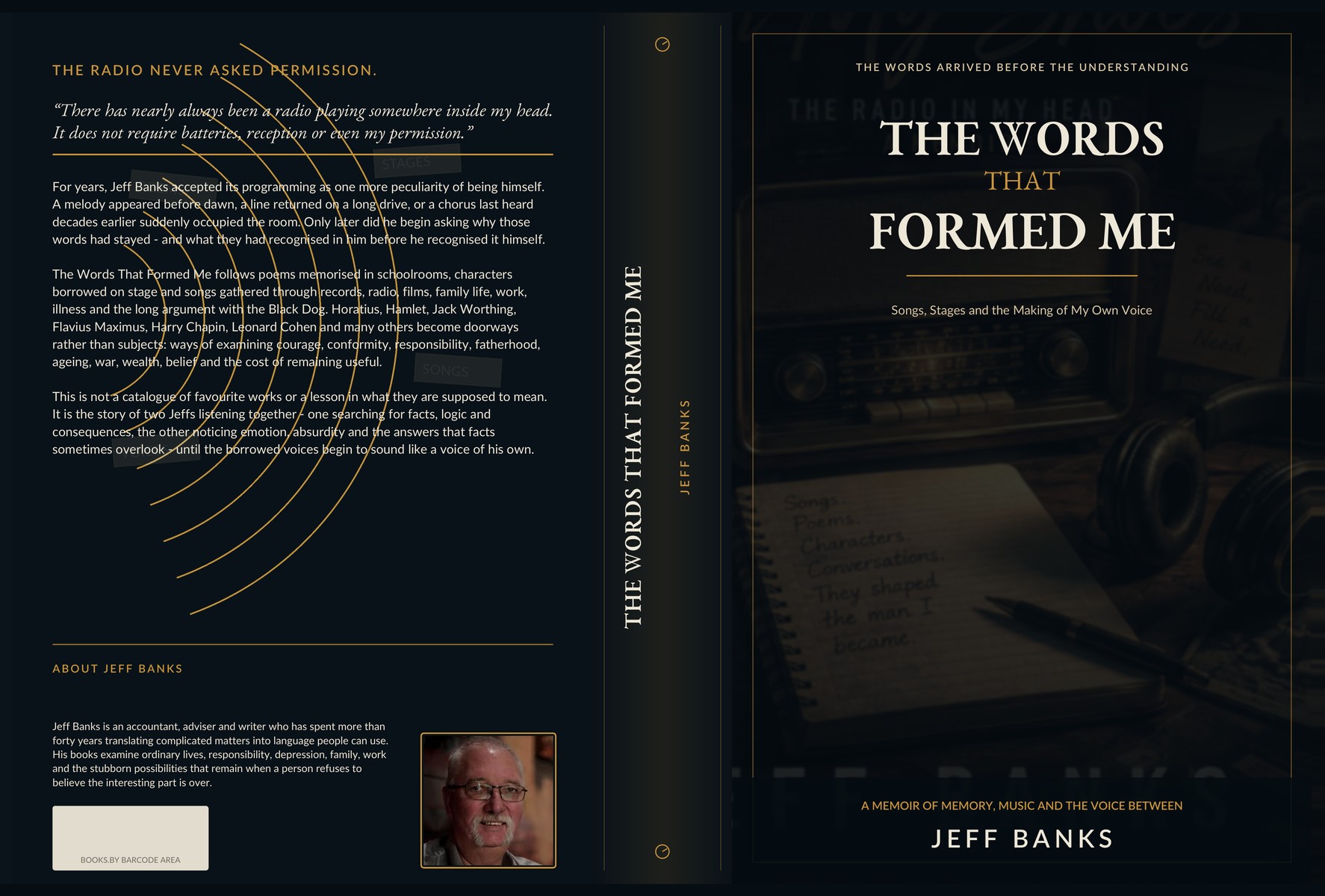
The Radio in My Head

On the morning of 1 July 2024, before my conscious mind had begun arranging the day into something resembling order, there was already music playing. I had not turned on a radio, reached for my phone or asked some electronic assistant to select an uplifting soundtrack for a man edging uncertainly towards retirement. The song was simply there, already underway inside my head, as though somebody on the night shift had placed the needle on the record and slipped out of the studio before I woke. It was I Feel a Song (In My Heart),¹ which seemed appropriate in the most literal sense possible, although literal accuracy has never necessarily been evidence of intelligent programming.

I cannot now remember whether I recognised the song immediately or whether its title arrived several moments after the melody. Memory has a habit of tidying these experiences, adding labels and sequence to events that may originally have been far less organised. What I do remember is that the music had beaten thought into the room. Before I had recalled the date, considered what needed doing or identified which part of my body intended lodging the morning’s first complaint, the radio in my head had commenced broadcasting.

That morning became the first entry in the diaries that eventually formed A Year in My Shoes. I began those diaries to record the days leading towards full-time retirement, along with the emotions, interruptions and occasional acts of avoidance that accompanied them. I thought I was writing about work, ageing, usefulness, family and the gradual loosening of an identity built across more than forty years. Without realising it, I was also recording the output of a private radio station I appeared to have been carrying for years without ever applying for a broadcasting licence.

The station did not operate according to any schedule I could identify. It did not limit itself to favourite songs, recent songs or selections carrying an obvious connection to whatever was happening in my life. Sometimes it appeared to possess an alarming knowledge of my emotional condition, choosing something that reached beneath the competent exterior before I had admitted there was anything underneath it. At other times, it demonstrated the judgement of a disc jockey who had gone to the toilet, left the studio door open and allowed the nearest passing Muppet to take control of the turntable.

That is where Mah Nà Mah Nಠenters what might otherwise have become a serious literary investigation. Any theory suggesting that my subconscious carefully studied my emotional state overnight before choosing the perfect song for the morning must survive the fact that it sometimes chose music with no obvious meaning at all. The station could move from a song that appeared to understand the weight of living to one built around cheerful nonsense syllables without showing the slightest embarrassment. Whatever else might be said about the radio in my head, its programming standards were inconsistent.

There is a temptation when writing a book such as this to pretend that every selection was meaningful. The temptation becomes stronger when looking backwards, because memory is particularly skilled at joining dots after the picture has already been drawn. I could claim that each song was prophetic, each poem a warning and every remembered line part of some grand internal design that had been patiently waiting for me to recognise it. That might make the book appear more important, but it would also require me to pretend that the program director responsible for Mah Nà Mah Nà was operating according to a spiritual plan beyond my understanding.

Even I Feel a Song (In My Heart) presents a problem if I insist upon immediate significance. Its title describes almost exactly what was happening, which makes its arrival feel deliberate even before any deeper interpretation has been attempted. Yet the song itself did not appear to offer specific instructions about retirement, depression, work, family or the possible purpose of the years ahead. It simply arrived on the first morning of the diaries and then kept coming back throughout the period they covered.

Its recurrence interested me more than its apparent message. A song that arrives once can be dismissed as a fragment of memory disturbed during sleep, but a song that repeatedly returns begins to resemble a visitor who believes unfinished business remains between you. That does not prove the visitor has anything sensible to say. It merely makes closing the door without asking the question feel slightly premature.

The analytical Jeff would prefer to keep the explanation straightforward. He understands that the brain stores music in strange corners and that a familiar melody can emerge without any mystical or psychological importance. He would probably want a spreadsheet listing each appearance of the song, the quality of the previous night’s sleep, the level of pain, the pressures of the day ahead and any other variable that might explain the recurrence. After analysing the information, he would most likely conclude that the sample size was insufficient and that no reliable finding could be reached.

The human Jeff would look at the same spreadsheet and ask why the song mattered enough to be written down. He would notice that it appeared before conscious thought had begun defending, explaining or organising anything. He would wonder why some fragments remained available for immediate broadcast while thousands of other songs had disappeared into storage. He might even suggest that the inability to prove a message existed was not quite the same as proving there was nothing worth hearing.

These two Jeffs have occupied the same body for many years without reaching complete agreement about who should be in charge. One seeks facts, evidence, systems, causes and conclusions that can be defended under questioning. The other notices emotion, memory, absurdity, relationships and the things a technically correct answer can leave behind. They are not separate personalities so much as different methods of approaching the same world, and much of my life has been spent allowing one to speak while pretending the other was not in the room.

My professional life gave the analytical Jeff considerable authority. He understood numbers, recognised inconsistencies and became suspicious when people attempted to substitute enthusiasm for evidence. He knew that coincidence was not causation, that confidence was not competence and that repeatedly saying something did not make it true. Those abilities served me well, although they also provided useful hiding places when a question could not be resolved by calculation.

The human Jeff did not disappear merely because the other one had business cards. He remained alert to the atmosphere in a room, the hesitation before an answer and the emotion hidden beneath somebody’s insistence that everything was fine. He noticed when humour opened a door that logic had been pushing against without success. He also knew that a song could alter the emotional weather of a morning even when its arrival could not be justified in a report.

The radio sat somewhere between them. It provided evidence in the form of a song that was undeniably present, then refused to explain what the evidence meant. It appealed to the human Jeff because it carried memory and feeling without waiting for permission. It irritated the analytical Jeff because its selection process could not be audited, tested or made to answer basic questions about governance.

That unresolved argument became one of the reasons for this book. The central question is not whether every song was secretly sent to guide me, because that would place an unreasonable burden upon writers and performers who had never met me. It is not whether the station was spiritual, neurological, emotional or simply the consequence of a brain that disliked an empty studio. The question is why particular words and melodies remained available across a lifetime, why some returned without invitation, and what they may have recognised in me before I found the language to recognise it myself.

The diaries began asking that question without announcing it. A song would appear in the morning, and I would note it as part of the emotional weather report for the day. Sometimes the connection seemed obvious, particularly when the Black Dog had settled nearby and the selection carried weight, weariness or the stubborn possibility of continuing. On other mornings, the station appeared determined to ridicule the very suggestion that I possessed a profound inner life.

The Black Dog did not always announce his arrival with drama. More often, he settled behind competence, routine and the ability to answer other people’s questions while avoiding my own. There were mornings when the few steps between the recliner and my office required no remarkable physical effort but demanded considerably more from me than the distance could reasonably explain. From the outside, nothing had happened; inside, somebody had quietly increased the gravity.

On those mornings, music could be evidence that something within me was still moving. It did not have to be wise, inspirational or even particularly welcome to provide that evidence. An irritating tune refusing to leave could be inconvenient, but inconvenience was at least a form of engagement. The station might have been annoying me, yet annoyance required enough life to object.

Its silence could therefore be more troubling than its noise. Silence sometimes meant peace, but peace and emptiness are not identical conditions even when they sound the same from outside the room. When the music stopped, I could not always tell whether the program director had taken the morning off or whether the station itself had been abandoned. The absence of a song did not prove anything, although depression has never required proof before beginning its argument.

It would be easy to make that silence poetic, but the Black Dog is often less poetic than people describing him from a safe distance would like him to be. Depression can be dull, repetitive and administratively inconvenient, reducing a life not through one great tragedy but through a series of small withdrawals. It does not always arrive as despair; sometimes it arrives as the inability to care about something you know should matter. Nothing dramatic needs to happen for the day to become heavier than the person carrying it.

The radio did not cure that condition, and I do not intend to suggest that a lively playlist represents a recognised form of treatment. Its continued broadcasting simply provided a small sign that the inner machinery had not entirely stopped. Sometimes the selection offered comfort, sometimes it provoked a memory and sometimes it made no sense whatsoever. Even then, nonsense arriving from somewhere within was preferable to the feeling that nothing within had bothered turning up.

Perhaps that is why I Feel a Song (In My Heart) became more interesting each time it returned. The song did not need to deliver an obvious message if its first purpose was merely to announce that the station existed. It was the test pattern appearing before the day’s regular programming, proof that something had been transmitted even though neither Jeff could explain why. Its recurrence became less a solution than an invitation to examine the library from which it had been selected.

That library had been built across a lifetime. It contained poems learned at school before I was old enough to understand what courage, conformity, greed or mortality might feel like in practice. It held songs heard through radios, records, films, television and long journeys, some consciously loved and others apparently stored without permission. It also contained lines placed directly into my mouth when I stepped onto a stage and became someone else for long enough to discover something about myself.

Some of those borrowed words taught me how language worked before I realised I was learning. A theatrical role could make an audience laugh and then carry a truth through the opening created by the laughter. A poem could remain after the teacher’s explanation had vanished, waiting for life to provide the context that the classroom could not. A song could accompany decades of work and responsibility before turning around and asking whether providing for people had occasionally become a substitute for being present with them.

I did not consciously assemble these works into a personal philosophy. There was no childhood plan to collect the greatest poems, most influential songs and most revealing theatrical characters so they could be examined in retirement. Much of the collection would never have survived the judgement of a properly constituted committee. A committee might have accepted the recognised classics, debated the popular songs and quietly removed the Muppets from the minutes before anybody outside the room discovered they had been considered.

The radio had no committee, although that statement should not be mistaken for praise of its governance. It was not interested in protecting my professional reputation, demonstrating refined cultural taste or maintaining consistency between one morning and the next. It could move from grief to farce, from remembered poetry to advertising jingles, and from something that seemed to understand me to something that appeared to have escaped from children’s television. Its disorder may have been its greatest honesty because human lives are not programmed entirely in themes.

We carry absurdity beside grief, irritation beside love and unfinished business beside tunes we cannot explain. We may spend an afternoon considering mortality and then become disproportionately annoyed because somebody has moved the television remote. We can calculate the financial consequences of retirement while remaining unable to explain what retirement might do to our sense of identity. The radio reflected that confusion far more accurately than any carefully curated soundtrack could have done.

There were nevertheless mornings when its selections seemed almost too precise. A song about burden might arrive when I was carrying more than I had admitted, while another about being overlooked could appear after years of making myself useful and quietly wondering why usefulness had not produced understanding. Words about fathers and sons could return after time had removed the possibility of asking questions while answers were still available. At those moments, coincidence seemed less satisfying as an explanation, although dissatisfaction is not evidence either.

I must therefore be careful not to make the station more intelligent than it was. Once a song appeared, I was capable of finding connections because finding connections is one of the things my mind has always done. The analytical Jeff could assemble a case from almost any group of facts, while the human Jeff could supply the emotion required to make the case persuasive. Working together, they might transform a random tune into an emotional witness and then overlook the fact that the witness had never been sworn in.

That possibility does not make the interpretation worthless. The songwriter may not have intended what I eventually heard, the song may not have chosen me, and the radio may have been nothing more mysterious than memory wandering unattended through the building. Yet the response produced by the music was real, even when its supposed message could not be independently verified. What the words became after reaching me may matter more to this book than what they were intended to mean before they arrived.

This is not an attempt to solve myself through popular music, remembered poetry and amateur theatrics. I have worked with enough people who believed that one book, one seminar or one sufficiently enthusiastic speaker would reveal the final answer to remain suspicious of anything promising a life-changing breakthrough. Lives generally change through accumulation, contradiction, endurance and the occasional realisation that should probably have occurred twenty years earlier. Even then, the breakthrough often proves to be another doorway rather than the promised destination.

The words in this book did not form me on their own. Family, landscape, work, failure, love, anger, depression, responsibility and the continuing need to be heard all played their parts. The words provided gathering places where those experiences could begin taking shape. They gave names to emotional weather that I had previously experienced without being able to forecast.

Some arrived before I possessed the experience required to understand them. I could memorise courage before I had defended anything, perform authority before I felt entitled to hold it and laugh at absurd logic before becoming an accountant required to navigate systems that regularly treated absurdity as procedure. I could sing along with fathers, sons, workers, dreamers and damaged people before recognising that they were not entirely separate characters. Life eventually caught up with the words, although it rarely bothered arriving in the order an English teacher might have preferred.

The radio in my head became the doorway back into that accumulated library. It did not organise the shelves, provide catalogue numbers or separate high art from novelty recordings. It merely selected material and placed it into consciousness before I had time to establish a defence. Sometimes it offered wisdom, sometimes warning and sometimes Mah Nà Mah Nà.

That final category may be more important than it appears. Not everything must become profound merely because it has survived in memory, and some songs may have remained because they were catchy, ridiculous or attached to a moment of uncomplicated pleasure. The search for meaning becomes dangerous when we refuse to allow the universe the occasional opportunity to muck around. A station broadcasting twenty-four hours a day cannot be expected to produce a masterpiece every time the microphone goes live.

I have spent enough of my life dealing with serious matters to know that seriousness and solemnity are not the same thing. Business failure is serious, depression is serious and the fear of becoming irrelevant after retirement can be serious even when expressed through a joke. None becomes more truthful merely because it is discussed in the voice normally reserved for reading the terms and conditions at a funeral. Sometimes flippancy is not an escape from truth but the only vehicle in which truth can enter without being turned away at the door.

The premise of this book is therefore both serious and slightly ridiculous. A man wakes with songs playing in his head, records them in a diary and later decides to investigate what they have been doing there. Some will unlock memories, others will expose contradictions, and a few may reveal that he has carried borrowed language for so long that it has become part of his own voice. Several may reveal nothing beyond questionable employment practices within the station’s programming department.

On 1 July 2024, I did not know that I Feel a Song (In My Heart) would return repeatedly through the months ahead. I did not know that the diaries would become a book or that the musical selections scattered through them might eventually lead into another. I certainly did not wake believing I had discovered a grand organising principle for my life. I woke with a song already playing and, for reasons I could not explain, decided it was worth writing down.

That small act may have been the true beginning. By recording the song, I turned an internal noise into a piece of evidence; by noticing its recurrence, I allowed the evidence to become a question. Returning to the poems, songs, performances and remembered fragments of a lifetime then suggested that the radio had been broadcasting for much longer than I had been listening. Perhaps the station had not suddenly appeared at all, and I had simply reached an age when I was finally prepared to examine its programming.

The mystery remains whether those words and melodies were trying to tell me something or whether I was gradually becoming ready to hear what experience had placed inside them. The analytical Jeff still wants the distinction resolved because he distrusts conclusions that cannot survive examination. The human Jeff suspects the distinction may matter less than his companion believes because meaning does not always depend upon knowing who sent the message. Between them sits the radio, still broadcasting, still refusing to explain itself and already preparing the next selection.

Notes

  1. I Feel a Song (In My Heart) was written by Tony Camillo and Mary Sawyer. The version central to this prologue is the recording by Gladys Knight & the Pips, released in 1974 on their album I Feel a Song. The song had previously been recorded by Sandra Richardson in 1971, so Gladys Knight & the Pips are properly acknowledged as the performers of the remembered version rather than the original writers or first recording artists.
  2. Mah Nà Mah Nà was composed by Italian composer Piero Umiliani and first appeared in the soundtrack of the 1968 film Svezia, inferno e paradiso, released in English as Sweden: Heaven and Hell. It later became widely associated with Jim Henson’s Muppets after being performed on Sesame Street and subsequently The Muppet Show. The reference in this prologue is to that familiar Muppet association, which gives the song its useful place as evidence of the internal station’s less-than-consistent programming standards.

Author

Menu