

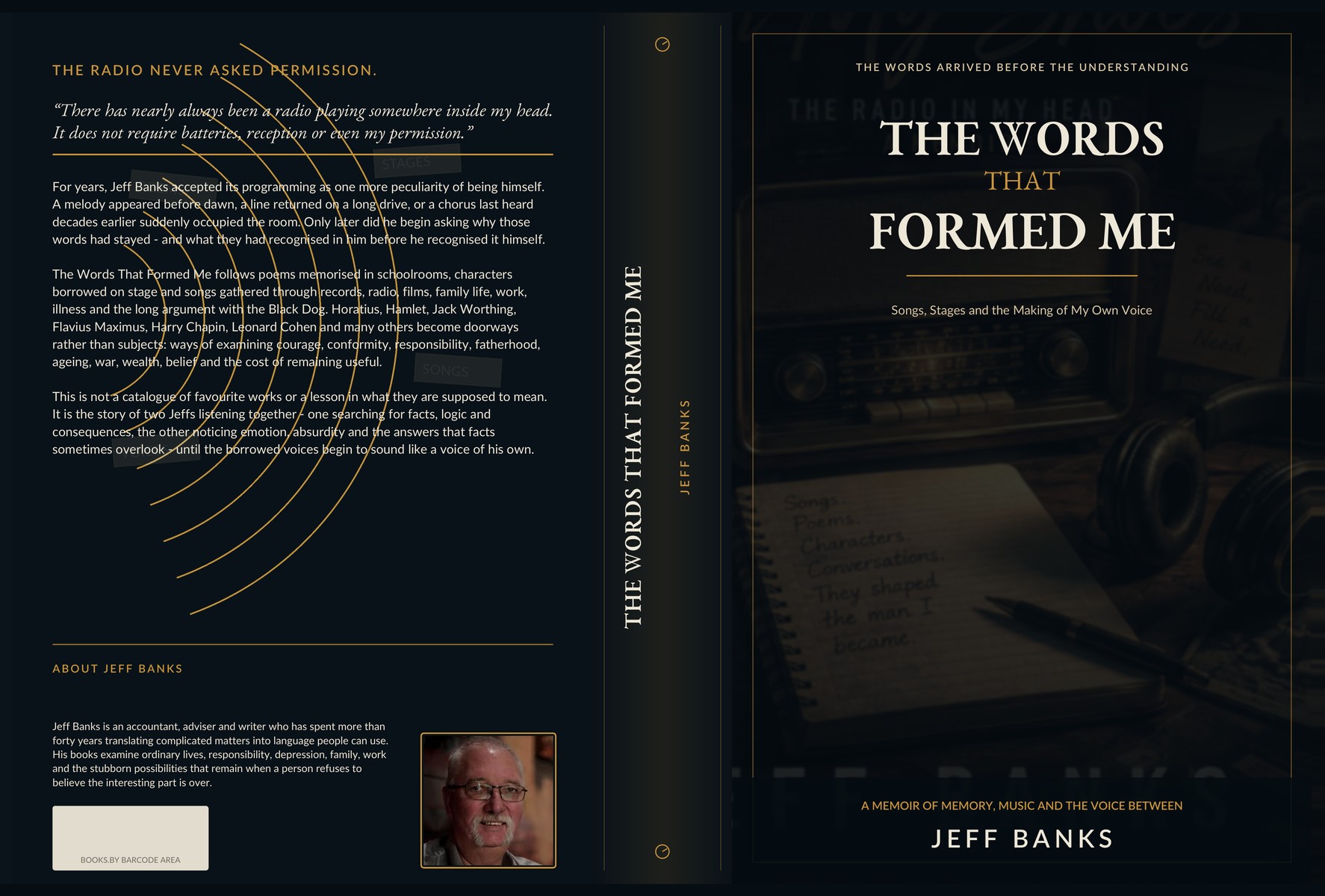
THE WORDS THAT FORMED ME Chapter 8 - Take a Load Off, Jeff

THE WORDS THAT FORMED ME Chapter 8 - Take a Load Off, Jeff | Travelling Around Australia with Jeff Banks

Writing may be the place where the two impulses can coexist more honestly. It is useful in the sense that it may reach somebody, explain something or give meaning to an ordinary life that might otherwise pass without being properly noticed. It is also something I do because the words require a place to go, whether or not another person is waiting with a visible need. Writing does not remove the burden, but it allows me to examine why I picked it up and whether I have mistaken its weight for proof of my worth.

THE WORDS THAT FORMED ME

CHAPTER 8

Take a Load Off, Jeff

Whenever The Weight comes into my head, it does not arrive as a song standing alone. It brings The Big Chill¹ with it, one of those films I can watch again even though I already know the people, the conversations and the emotional furniture waiting in each room. Perhaps that is part of the attraction, because the film is filled with people who once expected life to become something clearer than it did and who have gathered to discover what remains after certainty has quietly packed its bags. Somewhere within that gathering sits The Weight², moving at a pace that seems almost indecently relaxed considering the apparent urgency of what I hear happening inside it.

I have always heard something approaching the Nativity in the song, although I am prepared to concede that Robbie Robertson may not have been writing a Christmas pageant. Nazareth appears, along with a collection of names and images that seem to have wandered in from different pages of the Bible without waiting to check whether they belonged in the same chapter. My mind took those fragments, found a stable, inserted an exhausted mother, a worried father and a child whose arrival had created an administrative emergency for most of the Western world, and decided that must be what was going on. The Band, meanwhile, appeared completely untroubled by the possibility that civilisation might have to reset its calendar.

That relaxed tone is important to me because the birth of a child is rarely presented by the people involved as a casual event. There are preparations, worries, decisions, sleeplessness and the sudden awareness that another human life has been placed within your circle of responsibility. The song seems to stroll through all of this with its hands in its pockets, as though somebody will eventually locate a room, arrange the necessary paperwork and make sure the donkey is parked legally. It does not deny the weight, but neither does it panic beneath it.

Perhaps that is why I hear the song differently from what its writer intended. The words provide the raw materials, but the music decides how they are assembled inside me. A song is not delivered like a tax ruling, complete with definitions, explanatory notes and penalties for adopting an unauthorised interpretation. It enters through the ears, encounters whatever memories and anxieties happen to be waiting there, and becomes something neither the writer nor the listener could have created alone.

This is also why people get the words of songs wrong. Sometimes the singer is indistinct, sometimes the sound system is poor and sometimes the listener’s mind simply decides it has heard something more suitable. We laugh when the mistaken version is discovered, as though the ear has failed an examination, but the mistake may reveal where the song was already taking us. The mind was not necessarily being careless; it may have been completing the journey in the only language available to it.

Guitar Man³ by Bread works that way for me, not because I misunderstand every word but because the song becomes larger than the person carrying the instrument. Music is the journey maker. It takes somebody standing in one place and sends them towards rooms, roads, faces and versions of themselves that may no longer exist outside the song. The guitar man travels, but so does everybody who hears him, and there is no guarantee that all of us arrive at the same destination.

My internal radio has never been greatly concerned with the songwriter’s itinerary. It may select a song because one line suits the morning, because the rhythm interrupts a darker line of thought or because some association established forty years earlier has decided to report for duty. Sometimes the connection is obvious, although obvious connections are not necessarily accurate ones. At other times the station seems to be playing a private game in which I am expected to identify the relationship between a song, a memory and whatever emotional condition has been developing before I was awake enough to notice it.

The Weight is one of the more helpful selections because it introduces a possibility I have not always found easy to accept. The burden might be put down. It might be shared, transferred or left beside the road long enough for the person carrying it to straighten his back and remember that he has one. The song does not offer a detailed implementation plan, which may be why the accountant in me has occasionally regarded it with suspicion, but it keeps returning to the suggestion that carrying everything alone is not compulsory.

This has not been my natural operating position. My instinct has generally been that when a need becomes visible, it acquires my name somewhere in the process. A client reveals a problem and I begin looking for the solution before deciding whether the problem belongs within the work I was engaged to perform. A community organisation needs somebody who understands the numbers, the legal structure or the paperwork, and I can almost hear the invisible chair being pulled away from the table for me.

The client relationship made this instinct appear professional, which was useful because professionalism can give a respectable name to several unhealthy habits. Advisers are meant to help, accountants are meant to protect and somebody who understands the approaching danger can hardly pretend not to have seen it. The difficulty begins when advice becomes rescue, rescue becomes continuing supervision and supervision becomes personal responsibility for decisions made by somebody else. Before long, the client’s burden has not been placed beside mine; it has been placed on top of it.

There were times when I could see what would happen if advice was ignored, and the frustration was not merely theoretical. Numbers may appear emotionally neutral, but they have an annoying habit of leading towards consequences whether people believe in them or not. I could explain the position, simplify it, draw it, forecast it and perhaps wave my arms more than dignity required, yet the final decision still belonged to the person sitting opposite me. Knowing that did not always prevent me from carrying the consequences home.

Part of that was responsibility, but part of it may also have been fear. A useful person has an obvious place in the room. He is invited because he knows something, retained because he solves something and remembered because the difficulty became smaller after he arrived. The arrangement feels like belonging, although it comes with the possibility that the invitation may disappear once the problem has been solved.

That is an uncomfortable question for somebody who has built much of his life around being useful. Did I help because I belonged, or did I believe I belonged because I helped? The two possibilities are not mutually exclusive, and that prevents the analytical Jeff from settling the matter with a neat reconciliation. Genuine service and personal need can occupy the same action without cancelling each other, but the mixture deserves examination.

Family adds another layer because usefulness there is rarely described as a service. It is simply what a husband, father or grandfather does, particularly if he has inherited the idea that love is best expressed through provision, protection and quietly attending to whatever needs attention. The family may never have asked him to convert every uncertainty into his personal obligation, but he may still regard their safety as an account for which he remains permanently responsible. There is no year-end process capable of closing that ledger.

The arrival of a child makes the responsibility immediate. A baby comes without practical knowledge, financial capacity or the slightest concern for the established sleeping arrangements of the household. The adults are expected to handle this new life with care while learning through a combination of instinct, advice, exhaustion and mistakes they hope will not be remembered at the child’s eighteenth birthday. It is an extraordinary burden and an extraordinary privilege, although those two descriptions are more closely related than we sometimes admit.

That is where Handle with Care⁴ enters my version of the story. The words themselves belong to an adult who has already been knocked about by life, but the title takes me back towards the fragility of early child-rearing. A baby might reasonably arrive with those words stamped across the blanket, although no parent would find the instructions adequate. Handle with care is excellent advice, but it does not explain what to do at three in the morning when the small parcel is making a noise inconsistent with all previous assurances that it has been fed, changed and settled.

The song also carries a gentleness that The Weight approaches from another direction. One song appears to ask whether the load can be taken from the carrier, while the other asks whether the carrier might be treated as something more than the machinery required to move it. The distinction matters because people who become known for their capacity are often handled according to the assumption that capacity is unlimited. Strength becomes not a quality they possess but the service others expect them to provide.

I may have encouraged that assumption. There is reassurance in being the person who can cope, because competence provides a public identity that does not require much discussion of what is happening underneath it. The capable Jeff can advise the client, support the family, fix the system and prepare the necessary document while the other Jeff waits somewhere behind him. If the work continues to arrive quickly enough, nobody has to ask whether the machinery is overheating.

Depression complicates this because the burden is not always the visible work. Sometimes the real weight is the effort required to begin carrying anything at all. A task that would once have been completed almost automatically can sit nearby while the mind constructs a case for postponement, withdrawal or surrender. The outside observer sees the task and may reasonably wonder why it has not been done, while the person underneath the weight is trying to remember how movement used to begin.

Songs can create a diversion from those thoughts without pretending to cure them. A tune enters, occupies space and gives the mind something other than itself to circle. It may be no more than four minutes of borrowed movement, but four minutes can matter when the internal conversation has become too dark or repetitive. The radio does not defeat the Black Dog, although it sometimes persuades him to stop talking long enough for another voice to be heard.

The Weight does this partly through its lack of panic. The song carries requests, obligations, peculiar characters and the continuing suggestion that somebody must accept something from somebody else, yet the music refuses to behave as though disaster is inevitable. That calm can be misleading, because burdens do not become light merely because they are sung slowly. It can also be reassuring, because urgency has often increased the weight of responsibilities that were already heavy enough.

I have lived much of my professional life among urgencies. Tax deadlines arrive with dates attached, business problems arrive after months of neglect and clients frequently discover the importance of advice shortly after the opportunity to use it comfortably has passed. There is a temptation to respond to every urgent voice with equivalent urgency, even when some of the emergency has been manufactured by delay. The adviser begins running because the client has finally noticed the bridge is on fire, although the adviser had been pointing at the smoke for several meetings.

That is where restrained anger can enter the load. It is not only the effort of solving the problem but the knowledge that much of it was avoidable. I have sometimes carried resentment alongside responsibility, helping because I could not comfortably stand aside while resenting the circumstances that made the help necessary. The resentment did not make the advice less valuable, but it did make the burden heavier than the task itself required.

The same pattern can occur in community work, although the motives are often kinder and the consequences less financially dramatic. At Sandbar, I did not merely see a golf course and a group of people enjoying a game. I saw structures, responsibilities, records, risks and the practical work required to keep the good intention standing upright. Once seen, those things were difficult to unsee, and joining the community gradually included becoming one of the people responsible for helping it continue.

There is nothing false about that service. Sandbar gave me friendship, purpose and a place within a community at a time when those things mattered greatly, and it deserved something in return. Yet the old question remains beneath the generosity: would I have felt as securely part of it if I had simply turned up, played golf and gone home? I do not know, because simply turning up has rarely been the role I assigned myself.

Business Blueprint created another kind of belonging. Robyn and I kept returning for more than fifteen years because it was not merely a sequence of conferences, speakers or business techniques. It became a family of willing business owners brought towards people who could help them, surrounded by others who understood that running a business could be lonely even when the diary was full. Within that environment, contribution became part of the relationship, but it was not always clear where generosity ended and my need to justify my place began.

The Expert’s Table appealed to the adviser in me because somebody brought a question and I could bring experience, logic and the occasional warning delivered in language more likely to survive the journey home. I was useful there, and usefulness felt natural because it had been rehearsed across decades. Yet Business Blueprint also offered something I did not have to create through expertise: recognition, continuity and the comfort of familiar people who knew more than my professional description. Perhaps I returned partly because the room allowed me to contribute, but also because it did not require me to carry the entire room.

That may be the hidden wisdom of the Traveling Wilburys. Handle with Care is not performed by one heroic voice attempting to demonstrate that it can manage the whole song unaided. George Harrison, Roy Orbison, Bob Dylan, Tom Petty and Jeff Lynne pass the song among themselves, each voice bringing its own history, weariness and character. The burden is not removed, but it is distributed, and the music becomes stronger because nobody is required to pretend that one voice is sufficient.

I have not always been skilled at that distribution. Delegation is straightforward when written into a business manual and more complicated when the person delegating believes he will ultimately be responsible if the task fails. It can seem easier to carry the item personally than to explain it, supervise it and live with a result that may not resemble the one already completed inside your head. The cost of that control is that other people never receive the opportunity to carry their part, while the controller accumulates evidence that nobody else is willing or able to help.

Family responsibility can fall into the same trap. Protecting people may gradually deny them the chance to discover their own strength, while constantly anticipating their needs may turn love into a form of surveillance. I do not believe that was my intention, but intention is not the only measure of an action. Sometimes taking the load from another person is kindness, and sometimes it quietly tells them that I do not trust them to carry it.

The analytical Jeff would like a rule capable of distinguishing the two. He would prefer a formula based on risk, capacity, urgency and likely consequences, perhaps with an adjustment for family members who regard all formulas as evidence that the accountant should go outside for a while. The human Jeff knows the decision is rarely that clean. Care requires judgement, and judgement sometimes means remaining close enough to help without rushing in merely because helping is the role through which I most easily recognise myself.

The title Handle with Care also turns back towards the person doing the handling. The parent is fragile, the adviser is fragile and the community worker who keeps saying yes may be far more fragile than his reliability suggests. People can become so accustomed to someone carrying the load that they stop seeing the person underneath it. More troublingly, the carrier may stop seeing himself.

Retirement has forced that question into a room where I can no longer avoid it by increasing the workload. When paid work begins to recede, usefulness cannot remain tied entirely to invoices, deadlines, clients and the ability to solve problems faster than other people notice them. The old identity does not vanish, but it loses some of the structures that once confirmed it each day. A man who earned belonging through responsibility may then wonder whether he still belongs when fewer people require him to be responsible for them.

That fear can make retirement another project to be managed. Committees can be joined, books can be written, family concerns can be monitored and every gap in the day can be converted into evidence that the machinery is still operating. None of those activities is necessarily an avoidance, because purpose matters and contribution remains part of who I am. The question is whether I can contribute without turning every contribution into a test of my right to occupy the space.

Writing may be the place where the two impulses can coexist more honestly. It is useful in the sense that it may reach somebody, explain something or give meaning to an ordinary life that might otherwise pass without being properly noticed. It is also something I do because the words require a place to go, whether or not another person is waiting with a visible need. Writing does not remove the burden, but it allows me to examine why I picked it up and whether I have mistaken its weight for proof of my worth.

That may be what these two songs have been doing together on the internal playlist. The Weight asks whether I can put something down, while Handle with Care reminds me that the person beneath it is not a forklift. Neither song provides a permanent answer, and the radio station has shown no intention of adopting a consistent therapeutic program. It offers a suggestion, changes the subject and may follow the entire discussion with something involving a Muppet and no discernible philosophy.

Even so, the songs create a small interruption in the darker thoughts. They remind me that a load can be real without being mine alone, and that strength does not cancel the need for gentleness. They also challenge the comfortable story in which every act of service is entirely selfless, because sometimes I carried the burden to help another person and sometimes I carried it to preserve the person I believed myself to be. Most often, I suspect, I did both.

I still hear a stable inside The Weight, even if no stable was ever placed there by its writer. I hear a child arriving, responsibility beginning and a group of people responding with far less agitation than I would consider administratively responsible. Then Handle with Care follows, carrying that child into the years beyond the manger and reminding me that parents, children and all the other battered adults we become remain breakable. That may not be what either songwriter intended, but it is the journey the music made after it reached me.

The load has not disappeared, and I would not wish to put all of it down. Some burdens are the shape love takes when it enters the practical world, and some responsibilities are worth carrying because they connect us to people and places that matter. The change may be in learning that I do not have to lift every visible object merely to prove I am still useful. I can stand beside the load, ask whose it is and perhaps allow another pair of hands to reach it before mine.

The radio continues to play the songs without promising that I will follow their advice. It knows I may still answer the telephone, see a problem and begin carrying it before the other person has finished explaining how it came to be there. Yet the refrain has entered the argument now, and once an idea has been admitted into my head it can be difficult to evict. Take a load off, Jeff, it says, and for perhaps the first time I am beginning to understand that the instruction is not asking me to become useless; it may be asking me to discover whether I can belong without first earning the right through exhaustion.

Notes

  1. The Big Chill was directed by Lawrence Kasdan and released in 1983. The Band’s recording of The Weight was among the songs used in the film, whose soundtrack became central to Jeff’s memory of it.
  2. The Weight was written by Robbie Robertson and recorded by The Band for its 1968 debut album, Music from Big Pink. Levon Helm provides the principal lead vocal, with Rick Danko and Richard Manuel contributing to the recording’s shared vocal character.
  3. Guitar Man was written by David Gates and recorded by Bread. It was released as a single and as the title track of the group’s 1972 album Guitar Man, with Larry Knechtel playing the distinctive lead-guitar part.
  4. Handle with Care was written and recorded by George Harrison, Jeff Lynne, Roy Orbison, Tom Petty and Bob Dylan as the Traveling Wilburys. It was released in 1988 as the opening track and first single from Traveling Wilburys Vol. 1.

Author

Menu