

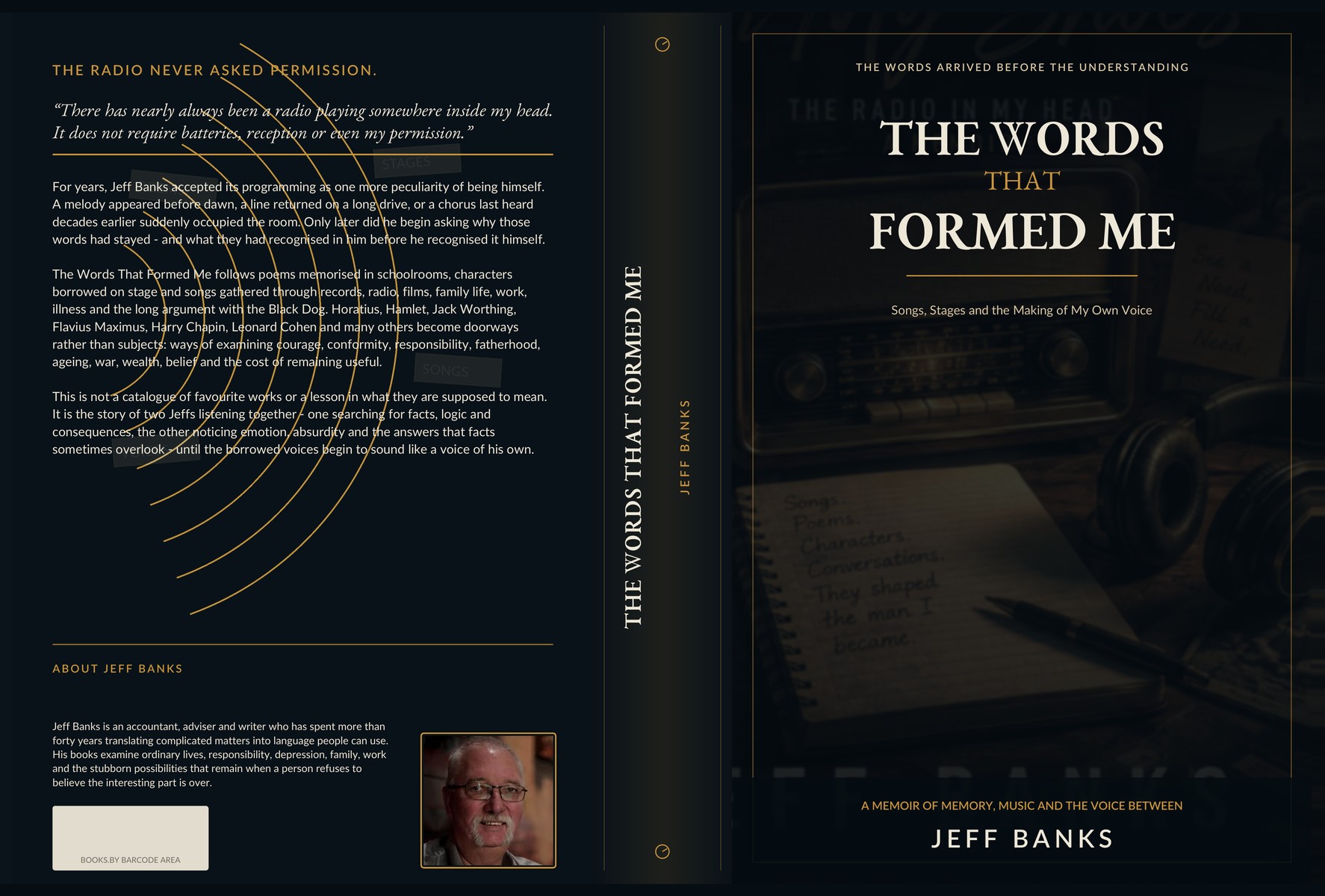
THE WORDS THAT FORMED ME Chapter 5 - The Gondolier Who Might Have Been King

THE WORDS THAT FORMED ME Chapter 5 - The Gondolier Who Might Have Been King | Travelling Around Australia with Jeff Banks

That may be the real beginning hidden inside the memory. I did not yet possess the voice with which I would later advise, challenge, write and occasionally irritate people who preferred their assumptions undisturbed. I had a musical part and a teacher’s permission, which was enough for that moment. The authority came from outside, but the act of using it began to teach me that a voice could survive being heard.

THE WORDS THAT FORMED ME

CHAPTER 5

The Gondolier Who Might Have Been King

Many years after I had stopped being Giuseppe Palmieri, I found him waiting for me at my brother-in-law’s house in the form of a vinyl record. I cannot remember what else I had gone there to do, but I remember seeing The Gondoliers¹ and feeling that the record could not simply be left sitting in its sleeve like an ornament from somebody else’s past. It had to be played, and once it was played I had to sing with it, because apparently several decades are not enough to persuade a former gondolier to exercise restraint. Whether anybody else in the house regarded this as a welcome performance or an unexpected hostage situation has not survived in my memory.

The music returned with an ease that was almost insulting. There were lines I had not consciously called upon for years, yet they emerged as though they had been waiting behind a curtain for somebody to give them a cue. “Good Morrow, Pretty Maids”² came back, along with the splendid arrival of the Duke of Plaza-Toro in “From the Sunny Spanish Shore”³, although neither belonged particularly to Giuseppe. Most persistent of all was “Rising Early in the Morning”⁴, the number in which Giuseppe describes the daily burdens and privileges of royalty with the sort of cheerful efficiency later expected of accountants, public servants and anybody foolish enough to volunteer for a committee.

Mrs Berry, our music teacher, had arranged that number differently for our school production. The first verse was sung by the full ensemble, while the second was left to me as a solo, which meant I had nowhere to hide once everybody else stopped. I do not remember thinking of that as courage at the time, because school productions had a way of turning the improbable into something listed on a rehearsal schedule. You learned the words, stood where you were told, watched the conductor and hoped your voice emerged in roughly the same key as everybody else.

Our production of The Gondoliers occurred in the year before I played Jack Worthing in The Importance of Being Earnest, yet the earlier performance is the one that remains brighter in my memory. Jack seems to have survived mainly through a cigarette case falling through a hole in my jacket, whereas Giuseppe brought an entire score with him and left parts of it behind in my head. The difference may simply be that The Gondoliers was fun. We were not merely standing in drawing rooms exchanging elegant insults; we were moving, singing, joining and separating, and allowing Sullivan’s music to carry us through places where spoken confidence alone might have failed.

That fun matters because it changes the way I now understand the boy who agreed to do it. In the school environment I inhabited, boys did not readily stand up and sing, or at least not without risking a social audit more severe than anything the Tax Office might later devise. There were approved ways for a boy to be visible, usually involving sport, toughness, noise or the convincing appearance that nothing mattered very much. Singing in a comic opera did not sit comfortably within that approved list, and my willingness to do it made me more noticeable in a way that did not necessarily make me more accepted.

I was already sufficiently outside the normal school group without providing extra evidence for the prosecution. Being willing to sing added another difference to the collection, and boys can be remarkably efficient at detecting difference even when they have no idea what to do with it. I was not dragged into the quadrangle and formally exiled, because ostracism rarely requires minutes, motions or a show of hands. It works through looks, jokes, exclusions and the gradual knowledge that there are rooms in which your presence will be tolerated more readily than your full self.

On the stage, however, the rules changed. I had a part, a place in the movement and a reason for my voice to be heard above the voices around me. Nobody could reasonably complain that I was drawing attention to myself, because drawing attention was part of the job and Mrs Berry had placed me there for that purpose. For a few hours during rehearsal and performance, I was not the boy trying to work out how much of himself the room would permit; I was Giuseppe Palmieri, and Giuseppe was expected to sing.

There is an important distinction between being heard because people want to hear you and being heard because the script says it is your turn. At school I may not have understood the difference, but I certainly experienced it. The role gave me temporary authority, not because I had changed, but because the people around me had agreed to recognise the costume, the music and the name attached to the part. When the performance ended, Giuseppe’s permission to speak did not necessarily transfer back to Jeff.

The plot now seems almost indecently well designed for the identity questions that would follow me into adult life. Giuseppe and Marco are ordinary Venetian gondoliers who are told that one of them may be the long-lost King of Barataria, although nobody can say which one. Until the matter is settled, they rule together, carrying the obligations of authority without certainty that either is the person to whom the authority properly belongs. It is impostor syndrome with an orchestra, a chorus and better costumes than most professional conferences provide.

At the time, I doubt I gave much thought to the psychological burden of possibly being a king. I had words to remember, notes to reach and marks on the stage that mattered more immediately than the constitutional arrangements of Barataria. Yet the idea entered somewhere, because here was an ordinary man treated differently the moment a title might belong to him. Nothing inside Giuseppe had necessarily altered, but the world around him reorganised itself in response to the possibility that he was somebody.

That is one of the more durable absurdities of human life. The same observation can be ignored when offered by an ordinary person and admired when repeated by somebody with the correct title, office, qualification or bank balance. The words have not improved during the transfer, but their social clothing has changed. We claim to listen to ideas while often listening first to the introduction.

I would encounter that repeatedly in business, although I did not always recognise it while it was happening. A person could know a great deal and still struggle to be heard, while another could possess a larger office, a more expensive suit or a more impressive title and be granted authority in advance. Money acquired a voice of its own, even when it had nothing useful to say. Success, or the appearance of it, was often accepted as proof of wisdom, which may explain why so many people sought advice from those who had become wealthy selling advice.

The professional world did not cure the schoolboy’s uncertainty; it merely dressed it more respectably. There were rooms in which I was expected to speak because I was the accountant, adviser, director or person presumed to understand the numbers. The title opened the door and sometimes quietened the room, yet part of me still wondered whether the permission belonged to Jeff or to the role printed beneath his name. Giuseppe had become an adviser, but the Grand Inquisitor had still not arrived with final confirmation.

Impostor syndrome is often described as though it is simply a failure to recognise one’s own competence. That may be part of it, but my version has always seemed more complicated because I could usually identify what I knew and what I did not. The uncertainty lay less in the work than in the authority attached to it. I could prepare the analysis, follow the evidence and explain the consequences, yet still wonder why anybody had decided that my voice should carry more weight than it once did in a schoolyard where singing had been treated as further proof that I did not properly belong.

Perhaps that is why I became so concerned with speaking in the language of the person in front of me. Authority imposed from above had never felt entirely trustworthy, even when I was the person temporarily holding it. I did not want clients to accept advice merely because I had letters after my name or knowledge they did not possess. I wanted them to understand enough to recognise the logic themselves, because borrowed authority can disappear as quickly as a school costume when the curtain closes.

The Gondoliers also gave me an ensemble, and that may have mattered as much as the possibility of kingship. An ensemble does not require everybody to be the same; it requires each person to know when to enter, when to listen and when to support somebody else’s line. My voice could be distinct without needing to defeat the voices around it. For a boy who often felt outside the group, that was a temporary form of belonging built not on sameness but on contribution.

It would be tempting to turn this into a neat claim that theatre saved me or revealed the person I was always destined to become. Memory is rarely that cooperative, and I did not leave school determined to pursue the stage. I did some theatre restaurant work later in life, but performing was more often something I did than something I announced as a calling. The Gondoliers remains important not because it set my career direction, but because it allowed a version of me to exist publicly before I had language to describe him.

That version was willing to risk ridicule for the pleasure of doing something properly. He could learn a difficult part, trust the people around him and step forward when the ensemble fell silent. He did not become fearless simply because a spotlight reached him, but fear had been given a task and therefore became manageable. There is a difference between confidence and having something specific to do, and much of what later looked like confidence in me may have begun as the second.

The Duke of Plaza-Toro has also remained in my head, arriving with magnificent formality and somewhat less magnificent practical substance. Even as a schoolboy I enjoyed the pomp of his entrance, although the older accountant in me now notices that the title was stronger than the balance sheet. Gilbert’s joke depends partly upon the distance between rank and reality, and I have met that distance in many forms since. Some people carry authority because they have earned trust, while others carry it because the nameplate arrived before the evidence.

Giuseppe offered the opposite problem. He had the work of kingship before the title could be verified, which meant he had to act with authority while remaining unsure whether the authority was genuinely his. That is closer to leadership than many official descriptions admit. Leaders are often required to make decisions before certainty arrives, and the good ones remain aware that the chair does not make them infallible.

The difficulty is that awareness can become either humility or paralysis. Too little doubt produces the loud fool who mistakes confidence for competence, while too much doubt leaves the capable person waiting for permission that may never come. I have spent much of my life moving between those dangers, wanting to lead because I could see what needed to be done, yet resisting the suggestion that I had some natural right to command. The gondolier and the possible king kept exchanging places without either fully leaving the stage.

There was anger in that movement, although it took years before I admitted it. I became angry when people ignored a considered warning and later expected rescue, angry when status defeated evidence, and angry when loud certainty was rewarded while careful thought was treated as hesitation. Yet the anger was not entirely directed outward, because I had also participated in the arrangement. I sometimes hid behind usefulness, waited for a title to legitimise what I already understood, or reduced my voice to avoid making the room uncomfortable.

The school production may have planted the identity crisis because it showed me two apparently incompatible truths. I could stand before an audience and sing, yet still feel socially misplaced among the boys beside whom I spent ordinary days. I could be trusted with a solo and remain uncertain whether I was entitled to be conspicuous. The stage did not solve the contradiction; it illuminated it brightly enough that I could spend the next several decades pretending not to see it.

Mrs Berry’s decision to give the first verse to the ensemble and the second to me now seems almost too neat as a metaphor, although I doubt she intended to design my future psychology between rehearsals. First I was carried by the group, surrounded by other voices and protected by the common line. Then the arrangement opened and left me exposed with words that belonged to Giuseppe but had to travel through my own breath. It was borrowed language, but the sound could only come from me.

That may be the real beginning hidden inside the memory. I did not yet possess the voice with which I would later advise, challenge, write and occasionally irritate people who preferred their assumptions undisturbed. I had a musical part and a teacher’s permission, which was enough for that moment. The authority came from outside, but the act of using it began to teach me that a voice could survive being heard.

When I played the vinyl at my brother-in-law’s house, I was not merely indulging nostalgia for a school production. I was testing whether the old words still knew me, and they did, perhaps better than I expected. They carried the fun of the performance, the awkwardness of being a boy who did something boys supposedly did not do, and the first faint suspicion that identity could change according to the part the room allowed me to play. They also carried the sound of an ensemble falling away so that I had to continue alone.

I know now that Giuseppe was not the King of Barataria, which ought to settle the matter. It does not, because the importance of the role was never dependent upon the final answer to the plot. He was the man required to carry authority while uncertainty remained, and that has often felt more familiar to me than the certainty of a crown. Perhaps the boy did not learn that he might secretly be a king; perhaps he learned that he could sing before anybody had decided what title, if any, belonged to the voice.

The record eventually finished, as records do, and I presumably returned it to its sleeve. The music did not return with it, because parts of The Gondoliers have continued to perform inside my head without requiring a turntable, an audience or Mrs Berry’s direction. Giuseppe still rises early, the Duke still arrives with more ceremony than solvency, and the pretty maids remain permanently prepared to greet somebody. Somewhere among them stands a schoolboy who had not yet found his own words, singing borrowed ones loudly enough to discover that he possessed a voice.

Notes

  1. The Gondoliers; or, The King of Barataria is a comic opera with libretto by W. S. Gilbert and music by Arthur Sullivan. It was first performed at the Savoy Theatre, London, on 7 December 1889. Giuseppe Palmieri is one of two Venetian gondoliers temporarily required to rule Barataria jointly while the identity of its rightful king remains uncertain.
  2. “Good Morrow, Pretty Maids” is the remembered opening exchange within the extended Act I opening number, commonly identified by its first words, “List and Learn,” in The Gondoliers.
  3. “From the Sunny Spanish Shore” is the Act I entrance number for the Duke and Duchess of Plaza-Toro, their daughter Casilda and their attendant Luiz, with words by W. S. Gilbert and music by Arthur Sullivan.
  4. “Rising Early in the Morning” is Giuseppe’s Act II song with chorus in The Gondoliers, with words by W. S. Gilbert and music by Arthur Sullivan. In Mrs Berry’s school production remembered here, the first verse was assigned to the ensemble and the second to Jeff as a solo.

Author

Menu