

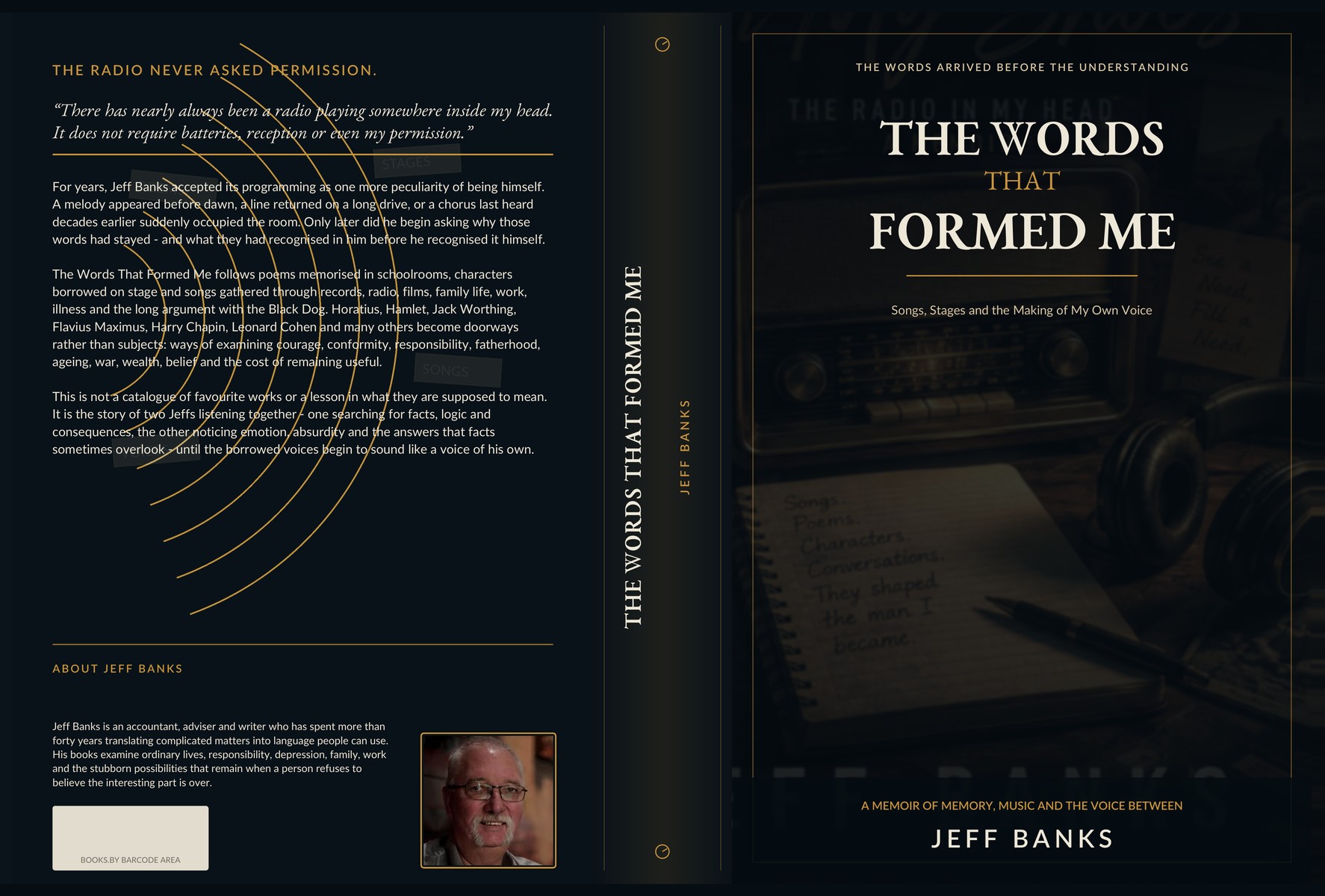
THE WORDS THAT FORMED ME Chapter 14 - Poems, Prayers & Promises

THE WORDS THAT FORMED ME Chapter 14 - Poems, Prayers & Promises | Travelling Around Australia with Jeff Banks

Yet unfinished does not necessarily mean failed. A life may remain incomplete because life itself is not designed to provide the tidy conclusion we demand from a story. There will always be conversations not held, places not visited, friendships not deepened and ideas not given enough time to become books. The existence of what remains does not erase what has been done. It simply prevents gratitude from becoming complacency.

THE WORDS THAT FORMED ME

CHAPTER 14

Poems, Prayers & Promises

Some songs wait patiently for us to become old enough to hear them properly. They may have been playing for decades, familiar enough for us to sing along without noticing that our understanding has remained several verses behind. Poems, Prayers and Promises¹ has become one of those songs for me, although I am not sure whether I have finally caught up with it or whether age has merely made me more vulnerable to what was always there. The internal radio station now plays it differently from the way it once did, with less attention to the pleasant melody and considerably more interest in the questions hiding beneath it. Its program director may still have no discernible qualifications, but even an unreliable broadcaster occasionally selects something that deserves to remain on air.

John Denver was still a young man when he wrote about the passing of time, the prospect of growing old and the strange mixture of contentment and unfinished longing that can exist inside the same life. That matters to me now because youth can imagine ageing with a confidence that ageing itself rarely possesses. When we are young, old age appears to be another destination waiting along the road, complete with wisdom, acceptance and enough accumulated experience to make sense of everything that previously seemed confused. Nobody mentions that the directions may be incomplete, that the vehicle will develop several worrying noises or that the traveller may reach the outskirts without ever finding the welcoming sign. Ageing is not necessarily an arrival, and wisdom does not automatically appear merely because the candles have become a fire hazard.

The song offers an image of people gathered comfortably together, talking about the things they believe in while the evening settles around them. There is warmth, friendship, memory and the sense that nobody in the room needs to perform, explain himself or justify why he has been invited. Denver includes a pipe being passed around, which would have left me as the one person in the circle wondering whether there was a non-smoking section near the fire. I have never smoked, so I would have been far better suited to passing a pie around, preferably one large enough to make a second circuit. The attraction was never the pipe anyway; it was the circle.

That circle represented a life I imagined other people knew how to create. They had friends who came because they wanted to be there, not because they needed advice, money, intervention, administration or somebody to rescue a situation they had ignored until it became urgent. They could sit together without the evening becoming a meeting and without anyone producing a problem that required a whiteboard. Conversation did not have to result in a decision, a strategy or a list of actions to be completed before the next gathering. People could apparently be present for the extravagant purpose of enjoying one another, and I have never been entirely convinced that I learned how to do that.

I have known many people, worked beside many more and entered enough rooms to give the impression of being socially well supplied. There have been clients, business owners, community groups, sporting clubs, professional associates and people encountered through the assorted obligations that accumulate around anyone who finds it difficult to say no. Some of those relationships have been warm, genuine and important, and I do not want to diminish them merely because they did not resemble a John Denver song. Yet the painful truth remains that I do not feel I have friends like the ones who seem to be sitting around his fire. Perhaps nobody does, but the song convinced me that somebody must.

A song, of course, is not a set of audited accounts. Denver was not required to supply supporting schedules identifying every person in the room, the frequency of their visits or whether they continued to speak after somebody argued about politics. The scene may have been memory, aspiration, invention or a mixture of all three, which is how most of us construct the stories we tell about our lives. I know better than to treat an artistic image as sworn evidence, yet the human part of me remains unimpressed by that technical objection. The picture entered my mind, and once there, it became another standard against which my life could be found wanting.

We do this to ourselves with astonishing efficiency. We compare the unedited confusion of our own lives with the three-minute version somebody else has placed inside a song, photograph or carefully remembered story. Their friendships appear effortless, their families affectionate, their homes welcoming and their old age approached with cheerful curiosity. Our own experience contains awkward silences, unanswered messages, interrupted conversations, people who drift away and gatherings where somebody leaves early because the next morning has already begun making demands. We then conclude that everyone else received the complete package while ours arrived with several parts missing and no useful instructions.

The expectation is not confined to friendship. We are supposed to build a career, provide for a family, maintain a marriage, remain healthy, contribute to the community, develop interests, nurture relationships, prepare responsibly for retirement and somehow preserve enough unallocated time to sit beside a fire discussing poems. We are expected to achieve without becoming obsessed by achievement, to care without becoming burdened, and to be available to everyone without resenting that nobody noticed how tired we had become. If we admit that any part of this is difficult, we risk sounding ungrateful for the parts that went well. The result is a life that may be remarkably full while still feeling as though we have failed to attend the main event.

My life has been full. I can say that without false modesty and without producing a professional résumé as evidence. I have built things, lost things, rebuilt some of them and discovered that others were better left where they fell. I have advised people, raised children, loved a woman, written books, helped communities and tried to make complicated matters less frightening for those who trusted me with them. Yet fullness and completion are not the same thing, and achievement has never quite delivered the feeling of arrival I assumed it was designed to produce.

There was always another task beyond the one being completed. The business could be improved, the client could be helped, the family could be made more secure, the problem could be understood more thoroughly and the next book could say what the previous one had only approached. Even retirement arrived carrying work in its luggage, as though it had misunderstood the arrangement and assumed it was merely being transferred to a different department. I have frequently lived as though satisfaction would be issued once every outstanding matter had been resolved. Unfortunately, life appears to operate on an accrual basis, and new obligations are recognised long before the old ones are paid.

That may be why Denver’s imagined evening affects me so strongly. Nobody in that circle appears to be working towards anything, and nobody seems concerned that the time could be used more productively. They are not networking, planning a venture or discussing how to improve the fire’s return on investment. They are simply there, speaking about what matters and allowing the hours to pass without demanding that they prove their value. For someone who learned to make himself useful in order to earn his place, that kind of belonging can look less like ordinary friendship than an exotic holiday destination.

Usefulness has served me well, but it has also shaped the terms upon which people approach me. When you repeatedly become the person who knows what to do, others may stop asking whether you would like them to stay once the doing is finished. They are not necessarily selfish, and I am not necessarily their victim, because I helped write the arrangement. I made competence the easiest entrance into my life and then wondered why so few people arrived carrying nothing more urgent than themselves. Perhaps I taught others that my needs were either minor or already under control, because I had spent years making certain that this was what they saw.

There is anger in that recognition, although it is not a clean anger that can be placed entirely at somebody else’s feet. Part of me wants to ask why I was remembered when accounts needed repairing, families needed helping, organisations needed organising or somebody required a difficult truth translated into language they could tolerate. Another part asks when I gave anyone permission to see beyond the competent exterior, or whether I would have known how to respond if they had. It is easy to accuse the world of overlooking needs we have worked diligently to conceal. It is much harder to admit that being needed sometimes felt safer than being known.

Being needed comes with instructions. There is a problem, a role and usually some means of measuring whether the intervention worked. Being known is less orderly because it requires us to remain in the room after the useful material has been exhausted. There is no balance sheet for companionship and no reliable performance indicator for whether one person has truly seen another. The analytical Jeff finds this lack of structure irritating, while the human Jeff suspects it may be the entire point. Neither has yet persuaded the other, which is probably why the discussion continues.

The friendship I heard in the song was not really about the number of people gathered around the fire. It was about the absence of performance. I wanted the freedom to be present without being the adviser, accountant, rescuer, provider, organiser or man expected to understand what everyone else had failed to notice. I wanted people who would remain when I had no answer and no particular entertainment to offer. That desire was not unreasonable, but the expectation that such friendship would appear fully formed without vulnerability, time or inconvenience may have been.

Real friendship is rarely arranged as beautifully as it is in a song. It competes with work, distance, families, illness, habits, pride and the reluctance of adults to admit they are lonely. Men of my generation were not especially well trained in the maintenance of emotional relationships, particularly once sport, employment or some shared organisation stopped providing the excuse to meet. We could discuss results, weather, business, politics and the stupidity of people who were not present, but asking another man whether he was frightened by ageing might have caused both of us to inspect the nearest exit. We were taught companionship through activity, not confession, and then wondered why the friendships faded when the activity ended.

The loneliness in that is not always obvious. A person may be surrounded by family, acquaintances and people who genuinely care while still feeling the absence of someone who knows the internal geography. Loneliness is not simply the number of empty chairs in a room; it can be the distance between the person everyone recognises and the person who sits behind him. I have spent much of my life being visible through what I could do, while the quieter parts remained difficult to translate. The irony is that I eventually turned to writing because borrowed words had helped me recognise feelings that ordinary conversation rarely reached.

That is where the first word in the title begins to matter. Poems are not merely lines arranged on a page by people whose work later becomes an examination question. They are attempts to place boundaries around experiences that refuse to remain still long enough to be measured. I carried fragments of poetry before I understood them, just as I carried songs whose meanings changed as my life caught up. When my own voice failed, somebody else’s words provided a temporary language, and sometimes temporary arrangements last for most of a lifetime.

My poems may not always look like poems. They appear in stories, recollections, jokes, business advice and the long detours my mind takes before returning to the matter it was supposed to address. They are present whenever I try to describe something that facts alone cannot hold, whether that is depression, fatherhood, disappointment, love or the peculiar uncertainty of retirement. The analytical mind can identify the components, but it cannot always explain why they hurt. Poetry does not necessarily solve that problem, although it gives the hurt somewhere to sit.

Prayers are more complicated because the word carries expectations of certainty I have not always possessed. I have prayed in formal ways and in the private language of hope, fear and bargaining that emerges when control has reached its limit. Some prayers have been requests directed towards something beyond me, while others have been thoughts repeated because I could not bear the alternative. Let the children be safe, let the family hold together, let the problem have an answer, let tomorrow be kinder than today. Whether every one of those thoughts qualified theologically is a question for someone with more confidence in the rules.

There are prayers we do not recognise until much later. The wish to provide can become a prayer expressed through work, although excessive devotion to that prayer may remove us from the people for whom it was supposedly offered. The determination to remain useful can become a prayer against irrelevance, particularly as retirement begins removing the titles and routines through which identity was previously confirmed. Even the desire to be remembered may be a prayer, not necessarily for fame but for evidence that our presence altered something beyond our own brief occupancy. Writing contains a great deal of that hope, however modestly we try to disguise it.

Promises are harder still because they invite examination. A poem may be misunderstood and a prayer may go unanswered, but a promise creates an obligation that eventually asks what we did. I promised to provide, to protect, to endure and to become a different kind of father from the one whose methods remained in my body long after the visible evidence disappeared. I promised myself that the people I loved would not have to wonder whether they mattered, although work, pressure and the habits of silence sometimes made my performance less convincing than my intention. The uncomfortable thing about promises is that sincerity at the beginning does not guarantee success at the end.

Some promises were kept at a cost I did not properly calculate. Others were partly kept, postponed or altered until the original wording became difficult to recognise. There were promises I made without speaking and therefore denied others the opportunity to tell me that they had never asked for them. I believed provision was love, responsibility was love and solving the problem was love, and often they were. Yet love expressed only through duty can leave everyone well provided for and still waiting to hear the words.

Ageing is the stage at which the promises begin presenting themselves for review. There is less room for the comforting assumption that everything important can be addressed later, once the urgent work has been completed. Later has started arriving, and it is not the spacious country estate of unlimited opportunity I once imagined. It comes in smaller parcels, some containing freedom and others carrying reminders that time is not an account into which further deposits can be made. The years do not announce that they are leaving; they simply stop appearing in front of us and begin accumulating behind.

Denver’s song appears able to look at growing old with excitement. I hear that confidence and wish I could borrow it as easily as I borrowed the melody. Growing old does not excite me in any uncomplicated way because it carries mortality openly rather than hiding it behind the distant horizon. The body begins issuing reports the mind did not request, and each report contains language about limitation, recovery and the wisdom of not doing things that once required no thought at all. I can smile at ageing, but I cannot dismiss what it is approaching.

That part of the song has always become more difficult when I remember John Denver’s own ending. He wrote as a young man imagining a future filled with age, family, adventure and discoveries still waiting beyond what his mind already knew. He did not receive the long old age his song was prepared to welcome, dying in a plane crash in 1997 while still only fifty-three. The knowledge places a shadow across the optimism without invalidating it. It reminds me that mortality does not negotiate according to the confidence with which we discuss it.

There is a temptation to make something poetic from the fact that a man who sang so often of mountains, sky and flight died while piloting an aircraft. I resist it because death does not become meaningful merely because its circumstances fit the public imagery attached to a life. The crash was not a final verse written for our interpretation, and a human being is not obliged to die in a manner that improves his biography. Denver’s death frightens me precisely because it was abrupt, practical and indifferent to the unfinished dreams he had once placed in song. It leaves the ageing he imagined suspended, a promise the future did not keep.

My own fear of mortality should not be confused with a desire to escape life. I have never, in my own mind, been suicidal, even during those periods when the Black Dog has made the days darker than I believed they had any right to be. Depression has altered the light, drained purpose from ordinary tasks and persuaded me that movement required more effort than I possessed, but it has not removed my desire to see what comes next. I have always wanted to know what my children might surprise me with tomorrow. They continue to surprise me, which is either a wonderful expression of life’s possibility or evidence that none of them has accepted the behavioural standards I may once have tried to establish.

That desire for tomorrow matters because it is not based upon the promise that tomorrow will be easy. The Black Dog does not disappear merely because the family produces good news, laughter or another unexpected achievement. Darkness and anticipation can occupy the same mind, just as gratitude and regret can live within the same life. I may struggle to rise into the day and still want to remain for all the days I have not yet seen. The contradiction is not a failure of logic; it is the truth of being human.

My children have become part of the answer to a question the song keeps asking. What about tomorrow, the dreams that remain and the memories still to be made? Tomorrow is not an abstract spiritual reward for me; it is the possibility that one of them will do, say or become something I could not have predicted. Their lives continue beyond my plans for them, as they should, and each surprise reminds me that the future is not merely a diminishing supply of my own time. It is also the unfolding of lives I helped begin but do not own.

There is comfort in that, but there is fear as well. Wanting to see tomorrow means accepting that there will eventually be a tomorrow I do not see. Every parent understands this intellectually, although the emotional acceptance is another matter entirely. We spend years trying to prepare children for a world in which we hope to remain available, then age begins asking us to trust that they will navigate it without us. That may be one of the final promises of parenthood: not that we will always be there, but that what we gave will remain useful after we are not.

The song’s mountains and moon once represented the life I believed I was supposed to achieve. There would be adventure, freedom, friendship, love, family, meaningful work and enough time left over to contemplate the beauty of it all. I do not remember deciding that every element had to be included, but expectations are often most powerful when nobody has written them down. We absorb them from songs, films, advertising, families and the confident stories other people tell after removing the unhelpful parts. We then judge ourselves for failing to live several incompatible lives simultaneously.

I wanted security and freedom, achievement and leisure, recognition and privacy, usefulness and peace. I wanted to provide for the family without losing time with them, to build something substantial without becoming consumed by it, and to help everyone who needed me without eventually resenting the demand. I wanted the mountain and the moon, apparently without troubling myself over the distance between them. That ambition created much of what was good in my life, but it also ensured that satisfaction remained slightly beyond reach. There was always another summit visible from the one I had just climbed.

Perhaps the life I craved was never achievable because it was assembled from moments rather than years. A song can place the fire, the friends, the love, the memories and the dreams together without including the arguments, bills, disappointments or long stretches during which nothing appears especially meaningful. It gives us the concentrated essence and leaves us to imagine that somebody else lives there permanently. Real life arrives diluted by administration. Even the happiest family eventually has to decide who is washing up.

This does not mean the image was false or that I should dismiss the ache it created. Fantasy can reveal a genuine need even when its proposed solution is unrealistic. I did not require Denver’s exact room, his particular friends or the pipe I would have politely declined. I needed companionship without a job description, time that was not being stolen from another obligation and conversation that could wander without being converted into advice. The fantasy was extravagant, but the longing beneath it was ordinary.

The question is whether I have overlooked smaller versions of that life because they failed to match the picture. Friendship may have appeared in a conversation after a golf game, a phone call without a formal purpose, a shared joke or the person who remained nearby when nothing could be fixed. Belonging may have existed in imperfect rooms containing people who did not speak in poetry and were unlikely to gather around a picturesque fire. I may have been so busy searching for the complete scene that I undervalued the fragments. Expectations do not merely make us strive; they can make us blind.

Robyn and I have not lived inside a folk song, which is probably fortunate because neither of us would enjoy having our domestic life reduced to a rhyming scheme. What we have built has contained work, worry, endurance, disagreement, laughter and the steady accumulation of shared knowledge that does not need to announce itself every time it enters the room. Love at this age is not always a dramatic declaration or a group of friends admiring it from beside the fire. Sometimes it is the person who understands which silence requires company and which one should be left alone. Sometimes it is simply knowing that the same person will still be there when the internal radio station has selected something particularly foolish.

Gratitude becomes more honest when it is not required to eliminate regret. I can be grateful for my marriage, my children, my work, my writing and the opportunities that exceeded anything the boy I once was could reasonably have expected. I can also grieve the friendships I did not form, the time I surrendered to urgency and the version of myself who believed belonging had to be purchased through competence. One emotion does not cancel the other. A full life can contain empty rooms.

That is perhaps what achievement failed to explain. I treated arrival as though it would be confirmed by evidence: a successful practice, financial security, recognition, a family raised, responsibilities met and enough stories gathered to fill several shelves. Each achievement mattered, but none possessed the authority to declare the journey complete. Arrival was always a feeling I expected the evidence to produce, whereas feelings are notoriously unwilling to follow accounting instructions. The numbers could confirm that I had travelled a long way while the mind continued asking whether I had reached anywhere.

Retirement has made that question louder because work once provided both direction and concealment. There was always something to do, somebody to help and a reason why reflection could be postponed until a quieter period. The quieter period has not behaved as promised. It has allowed old songs to become more audible and old questions to discover that I am no longer protected by a full diary. The radio in my head has apparently interpreted retirement as an invitation to extend its broadcasting hours.

Yet unfinished does not necessarily mean failed. A life may remain incomplete because life itself is not designed to provide the tidy conclusion we demand from a story. There will always be conversations not held, places not visited, friendships not deepened and ideas not given enough time to become books. The existence of what remains does not erase what has been done. It simply prevents gratitude from becoming complacency.

I am still frightened by ageing. I do not possess Denver’s apparent enthusiasm for it, and I cannot sing mortality into becoming an interesting adventure. I know there are limits ahead that optimism will not remove and losses for which no clever interpretation will provide adequate compensation. However, fear is not the only thing ageing brings. It also removes some of the excuses for postponing what matters and exposes the absurdity of spending our remaining time trying to satisfy expectations that were impossible from the beginning.

I may never have the circle of friends I heard beside Denver’s fire. That admission hurts, and I do not intend to soften it by pretending every acquaintance was secretly the friendship I wanted. Some absences remain absences, and time does not automatically fill them merely because we have developed a mature explanation. Yet I can ask whether the door is still open, whether companionship must look exactly as I once imagined and whether I am prepared to enter a room without bringing usefulness as my admission ticket. Age may reduce opportunity, but it does not remove responsibility for the opportunities that remain.

The title of the song says most of what I want to say because a life is held together by all three words. The poems are the language through which I try to understand what happened, particularly when ordinary explanation becomes too small. The prayers are the hopes I direct towards everything I cannot control, including the future lives of the people I love. The promises are the obligations that keep me moving towards tomorrow, even when the Dog has darkened the path and achievement no longer supplies a convincing destination.

None of them is complete. The poems keep changing as memory alters its emphasis, the prayers are not always answered in the form requested, and the promises include failures beside the ones I managed to keep. That incompleteness may be the most truthful thing about them. A finished life would leave nothing to question, repair, anticipate or write. I am not ready for that kind of completion.

When I hear Poems, Prayers and Promises now, I no longer hear only the life I failed to achieve. I hear a young man imagining old age, an older man listening with greater caution, and the distance between them filled with work, family, loneliness, laughter, darkness and unexpected grace. I still envy the friends beside the fire, although I am beginning to understand that the song may have been reaching for them just as much as I was. The decades have moved with frightening speed, and much remains unfinished, but tomorrow continues to hold the possibility of another surprise from my children and another word arriving from somewhere inside the radio. For the moment, that is enough reason to remain tuned in.

Notes

  1. “Poems, Prayers and Promises” was written and recorded by John Denver and released in 1971 as the title track of his RCA Victor album Poems, Prayers & Promises. Denver was still in his twenties when he wrote the song; he died in a plane crash on 12 October 1997, aged fifty-three.

Author

Menu