

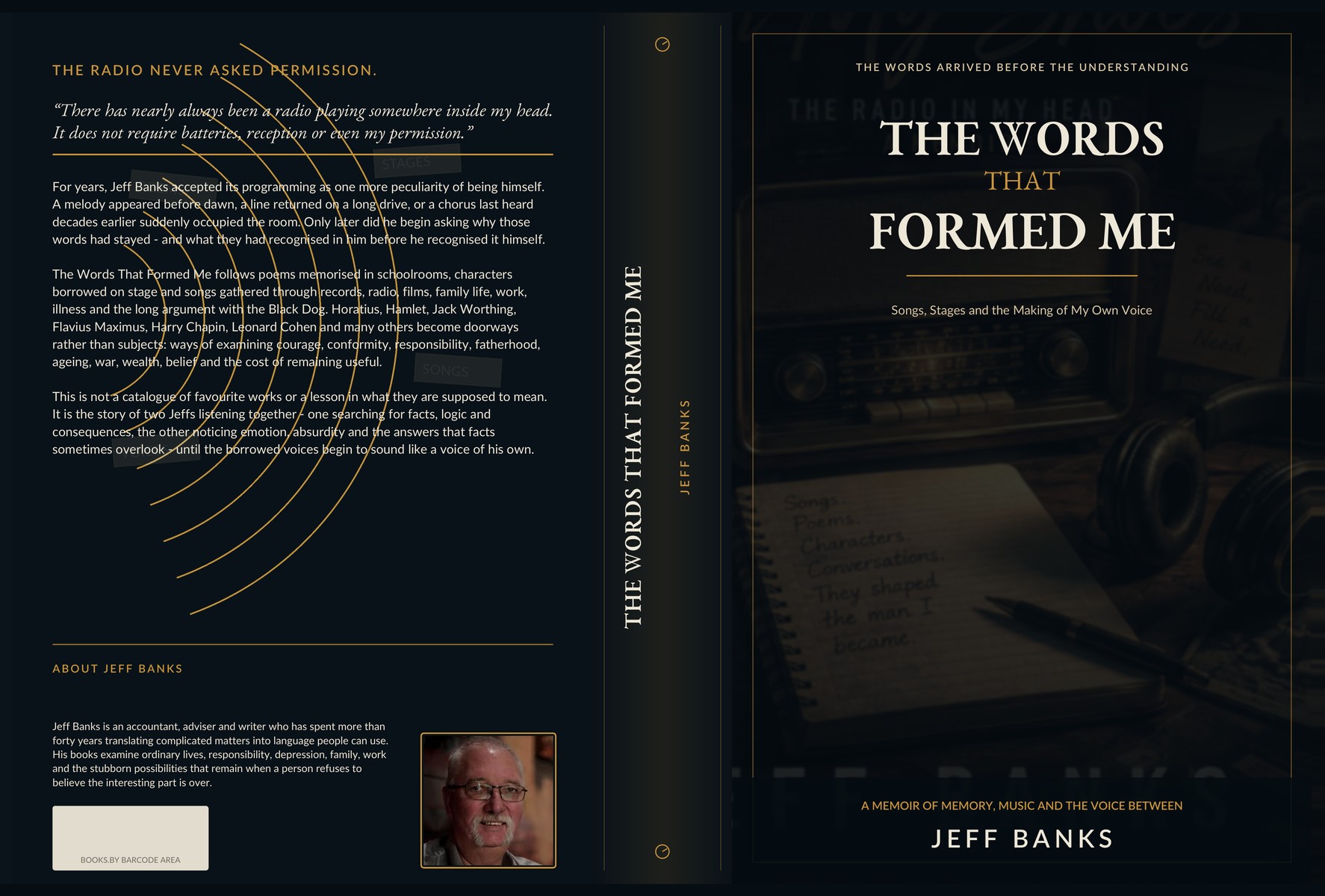
THE WORDS THAT FORMED ME Chapter 13 - What Could not be Said

THE WORDS THAT FORMED ME Chapter 13 - What Could not be Said | Travelling Around Australia with Jeff Banks

Writing has become the place where some of those unsaid words can exist without requiring a reply from people who are no longer capable of giving one. It does not recreate the conversation, and it does not place my parents in the chair opposite so that I can manufacture the apology memory failed to provide. It allows the child’s evidence to enter the record after years in which only the adult version was admissible. That is not reconciliation, but neither is it silence.

THE WORDS THAT FORMED ME

CHAPTER 13

What Could not be Said

The song arrived again before I had properly joined the morning, as songs in my head often do. There was no announcer, no explanation and certainly no consultation with the person expected to listen; the internal station simply selected The Living Years¹ and began broadcasting into the half-light. I knew where it was going before the voice had travelled very far, and I also knew that I did not want to follow it obediently. Some songs open a door into memory, but this one has always seemed to stand in the doorway asking why I did not walk back into a room I had spent much of my life escaping.

It belongs near Cat’s in the Cradle² because both songs concern fathers, sons and the damage done by time, but they do not wound me in the same place. Harry Chapin’s song hurts because it turns my attention towards my own children and the hours I surrendered to work, provision, divorce, responsibility and the belief that the important things could wait until the urgent things were finished. The Living Years turns me in the opposite direction, towards my own father and the conversations that did not happen before he died. One song makes me wish I had found more time; the other asks whether I ever truly wanted the conversation that time supposedly denied me.

That is the uncomfortable distinction, because the song carries an assumption that sounds reasonable until it reaches a family such as mine. It assumes that beneath the disagreement there was a relationship waiting to be repaired, that the words were available but postponed, and that death merely arrived before courage did. Perhaps that is true for many fathers and sons, and perhaps it was true for the men who wrote it. In my case, the silence was not simply an unfinished conversation; it was one of the structures upon which the family had been built.

“Children should be seen and not heard” was not merely an old saying that adults repeated with a smile. It was an operating instruction, a definition of the child’s place and a warning about the consequences of forgetting it. Being seen did not mean being understood, and being heard certainly did not mean being considered. A child could be visible as evidence of the family, useful when required and silent whenever adult certainty entered the room.

The rule worked because it was backed by discipline that did not invite discussion. Both my parents used methods that created obedience in the immediate moment, but obedience should not be confused with trust, respect or love. Physical punishment may stop a child from speaking, yet it cannot determine what continues inside his head once the room has gone quiet. What it taught me most effectively was not that I had been wrong, but that there were parts of me it was safer not to place within reach.

I can still use the word discipline because that was the accepted language of the time, but the older I become the less willing I am to let the word hide what happened. There were punishments that left welts, and there was fear that remained after the marks had disappeared. There was also the humiliation of having no recognised version of events, because the adult possessed both the authority to judge and the power to impose the sentence. In that system, the child did not merely lose the argument; the child was denied the standing required to have one.

A wall was not erected between my parents and me in a single dramatic afternoon. It was built through repetition, one occasion teaching caution and the next confirming that caution had been sensible. Each time speaking led to punishment, dismissal or ridicule, another brick found its place, and eventually I no longer needed them to silence me because I had learned to do the work myself. By the time I was old enough to possess the words that might have described what was happening, the wall had become part of the architecture of who I was.

My father stood on the other side of that wall, but I cannot honestly say that I spent my life searching for a gate. There were questions I could have asked him about his childhood, his disappointments, his fears and the things that made him the man he became. There were probably explanations for some of his behaviour, because every adult carries a history that a child cannot see. Explanation, however, is not the same as absolution, and curiosity does not automatically survive what has been done to it.

The respectable version of this chapter would say that I regret not knowing him better. It would speak gently about generational differences, men who could not express emotion and sons who discovered too late that their fathers had loved them in the only way they knew how. Some of that may even be true, but it is not the whole truth, and a memoir that removes the difficult half of a truth becomes another form of inherited silence. I do not know that I wanted to know him better, and I do not believe death created an obligation to pretend that I did.

That admission sits awkwardly because we are trained to become generous towards the dead. Once a person can no longer answer, contradiction is easily mistaken for cruelty, and the survivor is encouraged to search for redeeming evidence among the ruins. I can recognise that my parents were products of their own time without turning that recognition into a pardon I do not feel. The standards of an era may explain why behaviour was common, but common behaviour can still injure the child required to endure it.

Their retirement did not provide the breach that earlier years had denied us. Work ended, the daily pressures changed and there should theoretically have been more room for conversation, yet the absence of urgency does not automatically produce intimacy. The habits of a lifetime came into retirement with them, packed more securely than any furniture, and the roles remained much as they had always been. They were still the parents who possessed the authority of their version, and I was still the son who had learned that bringing his own version into the room came at a cost.

Perhaps I also protected the wall because by then it protected me. It is easy to imagine that reconciliation requires only one brave conversation, but walls built in childhood become load-bearing structures, and pulling them down can threaten the person who learned to survive behind them. I had created a life in which I could function, achieve, advise, perform and appear entirely capable without reopening those rooms. The question was no longer merely whether they would listen; it was whether I was willing to risk becoming the unheard child again.

The alternative world had begun much earlier. When the real household offered little safe space for a voice, fantasy offered rooms in which nobody struck a child for thinking beyond the approved boundary. Radio, stories, imagined journeys and eventually the stage provided words that could be borrowed until I was ready to form my own. I could disappear into a world that had rules, danger and even tragedy, but it also allowed the mind to move without first seeking parental permission.

I sometimes describe that retreat as escape, although escape suggests a temporary departure followed by a return. I am not certain I ever returned in the way that word implies. The child who found safety inside imagination became the adult who could live in thought, build arguments, create characters and follow rabbit holes long after other people had decided the subject was closed. Fantasy did not merely remove me from the family room; it became a country in which I eventually applied for permanent residency.

That country gave me many things, including humour, language and the ability to make connections that were not immediately visible to everybody else. It also allowed me to conduct conversations in my head where my questions received more than punishment or dismissal. The imaginary response may not have been the response another person would have offered, but at least the conversation was permitted to continue. In time, the inner world became so articulate that the outer silence could be mistaken for peace.

This is where The Living Years troubles me most, because it treats speech as though speech itself is the missing cure. Say what needs to be said while the other person is alive, the song urges, because death removes the possibility. Yet a conversation requires more than two living bodies and a supply of words; it requires the possibility that each person has standing in the room. We were alive together for many years, but that did not mean the conditions for genuine speech ever existed.

There are questions sons formulate only after fathers have gone, but not every question is an invitation to reconciliation. Some questions are forensic, assembled from fragments in an effort to understand how a household came to work as it did. Some are questions a child once asked silently because asking them aloud was dangerous, and age does not necessarily make them affectionate. Others have no useful answer because the answer would explain the parent while leaving the injury untouched.

I could ask my father whether he understood what fear was doing to the relationship. I could ask whether obedience satisfied him even when it arrived without closeness, and whether he ever noticed that silence had replaced trust. I could ask my mother similar questions about the methods she used and the part she played in maintaining the system. Their answers might have surprised me, but I cannot pretend that surprise would necessarily have healed anything.

The body complicates every theory about time. Intellectually, I know the welts have long gone, the rooms have changed and the adults who possessed that power are no longer here. My body is less interested in chronology, and there are moments when memory seems to sit beneath the skin rather than inside the head. The sensation does not require a visible mark to announce where it came from; it carries the old knowledge that pain once arrived from the people who were supposed to make the world safe.

People say that time heals all wounds because it is a hopeful sentence and because calendars are easier to understand than memory. Time has certainly placed distance between the child and the events, but distance is not always healing. It can reduce the frequency of pain, change its language and make it possible to live around what happened, yet the wound may remain recognisable whenever the body remembers before the mind has prepared itself. In this case, time did not erase the injury; it taught me how to carry it without allowing everybody else to see the weight.

That is another inheritance of “seen and not heard.” I became highly skilled at being seen in acceptable forms while keeping the less acceptable truths out of hearing range. The capable adviser, the performer, the provider and the person who could solve somebody else’s problem were all permitted to enter the room because they caused no discomfort to the established order. The frightened child, the angry son and the man who did not wish to forgive on command remained behind the wall. Competence became both achievement and camouflage.

Then my own children arrived, and the song’s image of a baby’s cry carrying something forward became far more confronting than its invitation to speak to the dead. I did not want to hear my parents echoed in those cries, nor did I want my children to inherit the essence of a household where authority mattered more than safety. Their voices were not interruptions to adult life; they were evidence that another life had entered and would eventually need to disagree with mine. I wanted their arrival to mark a beginning, not the next verse of an old arrangement.

Wanting is not the same as succeeding, and I cannot award myself a certificate for breaking the cycle simply because I disliked what had been done to me. Parents carry methods they have consciously rejected as well as those they have consciously adopted, and under pressure an old tone can emerge before thought catches it. I have had to ask whether my impatience, work, certainty or desire to provide ever created a different version of the same wall. The punishment may not have been the punishment I knew, but absence, preoccupation and emotional distance can also teach a child which subjects are unlikely to be welcomed.

That is where Cat’s in the Cradle returns, not to merge with this song but to argue beside it. I feared carrying forward the cruelty and silence of my parents, yet I also carried the belief that provision was one of the principal languages of fatherhood. Work became evidence of care, even when care expressed through work removed me from the people for whom the work was supposedly being done. I did not repeat my childhood in the same form, but the older I become the less confident I am that inheritance travels only in obvious disguises.

Perhaps the most important change was not that I always knew what to say, but that I wanted my children to possess the right to say it. I wanted disagreement to remain part of relationship rather than evidence of disloyalty, although I cannot claim I welcomed every disagreement with the serenity of a man writing after the event. There were still pressures, failures of patience and moments when the analytical Jeff was certain that the available evidence had already settled the matter. A child, inconveniently, does not always experience a technically correct answer as proof of being heard.

Listening became the task I had not seen modelled well enough to inherit. It requires a parent to remain in the room after authority has stopped being comfortable, and to accept that the child’s memory of an event may not match the parent’s intention. My parents may have intended discipline, order or protection, but I remember fear, pain and the construction of distance. Both statements can exist, yet the first does not possess the right to cancel the second.

What could not be said in my childhood was not one grand accusation waiting for the correct dramatic moment. It was the accumulation of smaller truths: that I was frightened, that something hurt, that I did not understand, that I disagreed, that the punishment felt unjust, and that being their child did not make my inner life their property. Those sentences remained unspoken because the cost of speaking had been demonstrated often enough. By adulthood, the words were more sophisticated, but the warning attached to them was just as old.

What could not be said later was different. I might have told them that the wall was still there, that retirement had not dissolved it and that their version of the past did not own mine. I might have said that I did not need them to agree with every detail, but I did need them to recognise that the child had experienced their parenting as abuse. Whether they could have heard that without defence, denial or reversal is a question I no longer have to test.

There is a temptation to call that lost opportunity, because lost opportunity sounds more tragic and therefore more acceptable than refusal. I am not sure it was an opportunity in any practical sense. A door is not open merely because both people remain alive, and a conversation is not possible merely because one person has finally prepared the words. Sometimes silence continues because it is imposed, sometimes because it is inherited, and sometimes because breaking it would expose the speaker to an old injury without creating anything new.

The song asks us to speak while there is still time, and I cannot dismiss that request merely because my history complicates it. There are people in my living years to whom words still matter, including my children, Robyn and those who have known the capable version of me without always seeing what the capability concealed. The lesson, if I am permitted to use that dangerous word, is not that every dead parent should be forgiven through a conversation that never occurred. It is that silence should not be allowed to claim another generation simply because it once kept me safe.

Even that conclusion requires caution. Speaking can become another form of control if I use my words to insist that others accept my interpretation, and writing a memoir does not appoint me the sole historian of every family room. This is how the past remains in me, and it is the truth from the side of the wall on which I learned to live. Others may remember different walls, different doors or no wall at all, but their memories cannot remove the welts from mine merely because the skin no longer displays them.

Writing has become the place where some of those unsaid words can exist without requiring a reply from people who are no longer capable of giving one. It does not recreate the conversation, and it does not place my parents in the chair opposite so that I can manufacture the apology memory failed to provide. It allows the child’s evidence to enter the record after years in which only the adult version was admissible. That is not reconciliation, but neither is it silence.

I do not know whether my father would recognise himself in these pages. I do not know whether my mother would say I had misunderstood the times, exaggerated the punishments or failed to appreciate what they carried from their own childhoods. They may both have believed that the child before them needed correction rather than understanding. The fact that they might have believed it sincerely is part of the tragedy, but sincerity does not make the welts less real.

The internal station eventually moves to another song because even it cannot hold one frequency forever. The Living Years remains behind, not as a command to romanticise the conversation I never wanted, but as a warning about what silence can become when authority passes it from parent to child. I cannot speak to my parents now, and I am not convinced I would have known how to speak to them when they were alive. What remains possible is to hear my children while we are all still in our living years, and to keep asking whether the wall behind me has cast a shadow longer than I intended.

There may never be a morning when the song arrives and finds the wound healed. Time has changed me, given me language and allowed me to stand far enough away to see the architecture, but it has not returned the childhood that disappeared behind that wall. I can refuse to carry every brick forward without pretending the wall was never there. Perhaps that is the most honest response I can offer the song: not reconciliation, not revenge and not a tidy forgiveness, but the determination that what could not be said then will not remain unsayable forever.

Notes

  1. The Living Years was written by Mike Rutherford and B. A. Robertson. The version remembered in this chapter was recorded by Mike + The Mechanics, with lead vocals by Paul Carrack, and released in 1988 on the album Living Years.
  2. Cat’s in the Cradle was written by Harry Chapin and Sandy Chapin. Harry Chapin recorded the song for the 1974 album Verities & Balderdash.

Author

Menu