

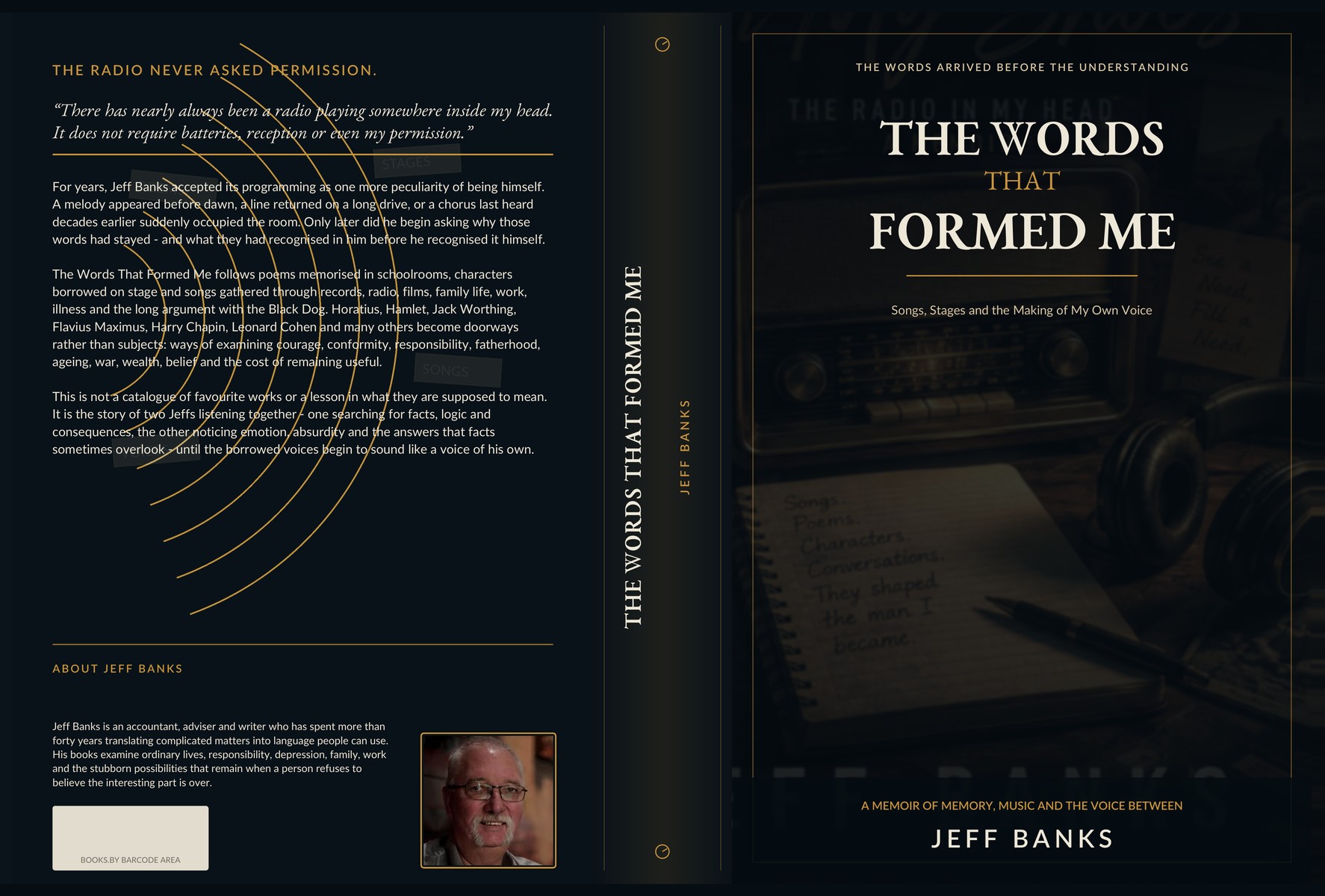
THE WORDS THAT FORMED ME Chapter 11 - The Station Never Goes Silent

THE WORDS THAT FORMED ME Chapter 11 - The Station Never Goes Silent | Travelling Around Australia with Jeff Banks

The silly songs assist because they arrive beneath that standard. They do not demand courage, insight or transformation; they ask for almost nothing beyond recognition. A few notes can confirm that the station remains connected to its library, that memory is still moving and that some inner part of me has not surrendered its capacity for association. The broadcast may be ridiculous, but it is still a broadcast.

THE WORDS THAT FORMED ME

CHAPTER 11

The Station Never Goes Silent

Some mornings I wake to discover that the program director has abandoned even the pretence of good taste. Before I have properly opened my eyes, before I have taken stock of the body or decided whether the day is likely to cooperate, Mah Nà Mah N๠is already bouncing around inside my head. It has no useful advice to offer, no emotional subtlety and, unless I have missed a previously unpublished translation, no words of consequence. It simply arrives, occupies the studio and behaves as though nonsense was exactly what the listening public had requested.

There was a time when I might have regarded that as evidence that the station had finally deteriorated beyond repair. Here was a mind capable of worrying through taxation law, business structures, family problems, mortality and the meaning of existence, yet its opening broadcast had been entrusted to a collection of cheerful syllables. The analytical Jeff could reasonably object that valuable processing capacity was being wasted, while the human Jeff might be grateful that the first voice of the morning was not asking him to solve anything. Between them sat the song, unconcerned by either argument and apparently willing to continue until somebody found the off switch.

The original plan for this chapter was to concentrate upon the times when the station went silent. That silence mattered because the absence of music could feel less like peace than evidence that the machinery had stopped producing any signal at all. Yet the diaries also showed something more persistent and, in its own peculiar way, more hopeful: the station rarely surrendered the airwaves for long. When it returned, it did not always come back with wisdom, comfort or a song chosen by a thoughtful therapist; sometimes it returned with a tune that would struggle to justify its inclusion on a supermarket loudspeaker.

That may be the more accurate story of the station. It was not merely an emotional weather forecaster identifying depression, confidence, anxiety or contentment with the precision of a musical barometer. It was also a restless scavenger, pulling fragments from decades of radio, records, films, television and public gatherings, then offering them up without any explanation of the selection criteria. Some songs appeared to reflect the mood already present, while others seemed to alter it by arriving with sufficient energy, silliness or insistence to disrupt the path along which the mind had been travelling. The difference may have been no more scientific than sleep, pain, memory, habit and whatever biorhythm was operating that morning, but the effect was real enough to notice.

I do not want to turn these songs into a self-help program. That would be unfair to self-help programs and place a responsibility upon Mah Nà Mah Nà that even the Muppets would have declined. A silly song did not cure depression, resolve a business problem or remove the underlying cause of a difficult morning. What it sometimes did was create an interruption, and an interruption can be more useful than it first appears when the mind has entered a rabbit hole and begun furnishing it as a permanent residence.

The rabbit hole is rarely announced as such when I enter it. It begins with a thought that appears legitimate, perhaps something unfinished, something I should have done differently or something that may yet go wrong. The analytical mind takes charge, gathers evidence, prepares scenarios and then quietly changes the terms of reference so that every path leads further underground. By the time I realise what has happened, I am no longer examining a problem; I am living inside a conclusion, and that conclusion is usually that the day, the decision or the person at the centre of it cannot be repaired.

Then the station may insert nonsense. It does not argue with the conclusion because nonsense has no evidence, no counter-submission and no intention of winning the debate. It merely causes the mental proceedings to lose their dignity for a moment, which may be enough for another thought to enter. I can resent the intrusion, smile at it or wonder why the mind retained such material in the first place, but any of those responses requires me to move slightly away from the certainty of the rabbit hole.

Mah Nà Mah Nà has that property because it cannot be made responsible for anything. There is no hidden instruction I am required to obey and no great emotional truth I have failed to recognise. It is sound playing with sound, a musical elbow in the ribs from a station that has decided I am taking myself too seriously. The song may not lift me very far, but it proves that some part of the mind is still capable of mischief, and mischief is difficult to reconcile with complete surrender.

Spanish Flea² performs a different shift. It does not so much interrupt the rabbit hole as send a tiny, overdressed creature scurrying through it with a trumpet section following close behind. The music has the brisk confidence of something that has never encountered an unsolvable problem because it has never stopped moving long enough to recognise one. Where Mah Nà Mah Nà pokes fun at seriousness, Spanish Flea introduces activity, the sound of a mind suddenly rearranging the furniture whether the furniture required rearranging or not.

There are mornings when that is precisely what the internal system seems to need. The body may still be reluctant, the mood may remain uncertain and the day may not yet have offered a convincing reason to begin, but the music has already begun doing laps. It suggests movement before motivation, which is sometimes the reverse of the order I would prefer. I have often waited to feel ready before acting, although experience keeps demonstrating that readiness has a habit of arriving after the first movement rather than before it.

That is one of the less glamorous discoveries hidden inside many self-help strategies. The breakthrough is frequently not a breakthrough at all but a minor change in direction, a decision to sit up, move rooms, open a document, walk outside or complete one task whose size does not permit grand failure. Spanish Flea does not tell me any of this, and I would distrust it if it tried. It simply supplies a rhythm in which remaining completely motionless begins to feel like an administrative oversight.

The song also reminds me that energy is not the same as happiness. A busy mind can still be an unhappy one, just as a crowded office can contain very little useful work. The flea may be running because it is excited, frightened or merely incapable of staying still, and the station does not provide a diagnostic report. Yet there is value in recognising that the internal weather has changed from stillness to movement, even when I cannot immediately decide whether the change is improvement or agitation.

Mamma Mia³ usually enters with more history attached to it. The title alone carries the weary recognition of something happening again, which makes it a natural station selection for a mind that revisits old arguments, old disappointments and old doubts as though they were annual compliance obligations. There are days when the arrival of the song feels almost sarcastic, the program director observing that we have apparently returned to the same emotional address and should perhaps have kept the previous directions. I can hear the exasperation without needing the station to supply any further explanation.

The danger in “here we go again” thinking is that repetition begins to look like destiny. A difficult morning resembles an earlier difficult morning, which resembles a longer period of difficulty, and the mind decides the pattern has already written the ending. The Black Dog benefits from that form of accounting because it treats every relapse as proof that no progress was ever made. All improvements are written off as temporary, while every recurrence is capitalised and carried forward indefinitely.

Yet Mamma Mia is too buoyant to remain an anthem of resignation. Its energy refuses to match the heaviness of the conclusion I may be trying to draw from it. The song recognises repetition but does not collapse beneath it, which creates an awkward question for the part of me insisting that returning to a familiar struggle means I have failed. Perhaps going around again is not evidence that nothing changed; perhaps it is evidence that life repeats its examinations and does not always issue the same paper.

I am suspicious of neat cycles because they can become another way of forcing experience into a theory. Biorhythms, moods, seasons, sleep and pain all affect the station, but I cannot pretend to know the precise mix on any given day. What I can recognise is the difference between a recurrence and a permanent condition. Mamma Mia may announce that I have been here before, but being here before also means I have left here before, and that is a piece of evidence the darker accountant is inclined to omit.

Kokomo⁴ offers escape with considerably less paperwork. It creates a place assembled from warmth, water, distance and the promise that the ordinary rules have been temporarily suspended. I do not require the geography to be accurate because the destination exists most effectively as an idea, somewhere beyond the immediate room where nothing is demanding an answer. The station is capable of constructing such places in seconds, which is fortunate because its travel budget appears to be largely imaginary.

Escape has always had an ambiguous reputation in my mind. The analytical Jeff regards it as avoidance, a failure to address the issue in front of me, while the human Jeff knows that a person cannot stare continuously at the same wall and expect the wall to become more informative. Music provided escape long before I understood depression, allowing a bedroom, a car or an ordinary stretch of road to open into somewhere else. The destination did not need to exist in a travel brochure; it only needed to be far enough from the current thought to permit breathing room.

There is, however, a difference between taking a mental holiday and emigrating permanently into fantasy. Kokomo can lighten the day by suggesting warmth and possibility, but it cannot be allowed to become a substitute for returning to the life waiting outside the song. The useful part of escape is the return, carrying back enough space to see that the problem was not the whole landscape. A song can create that distance without pretending the difficult thing has disappeared.

This is where the station occasionally shows more wisdom than its programming would suggest. It does not always answer darkness with a solemn song about endurance, because solemnity can sometimes deepen the weight by confirming that the situation is indeed as serious as it feels. Instead, it may send in palm trees, harmonies and a destination whose chief qualification is that it is not here. The choice is not profound, but the change in mental scenery can be.

*Y.M.C.A.*⁵ takes the process one stage further by recruiting the body. It is difficult for the song to remain entirely inside the head because generations of public performance have attached movements to it, and the movements arrive almost as quickly as the music. Even if I do not physically perform them before breakfast, some part of the body remembers the ridiculous geometry. The mind may be discussing existential fatigue while the arms are apparently considering membership of a community organisation.

There is something useful in that disagreement. Depression often persuades the body to imitate the mood, reducing movement, narrowing posture and making the smallest action feel like an unreasonable request. A song with an established physical response can briefly reverse the instruction, not through determination but through familiarity. The body knows what comes next before the mind has completed its objection.

I am not suggesting that arm movements are a clinical treatment, although they may be cheaper than some alternatives. What matters is the reminder that mood is not conducted entirely in words. Rhythm, breath, posture and movement can alter the internal conversation even when the argument itself remains unresolved. Y.M.C.A. does not defeat the Black Dog, but it may cause the dog to look up in confusion, and confusion is at least a change in the balance of power.

The song also carries the memory of crowds, weddings, clubs, sporting events and rooms in which people who may have little else in common suddenly agree upon the next four movements. That collective familiarity gives the internal station access to company even when I am physically alone. It recalls the peculiar comfort of joining in without needing to explain myself, a temporary membership granted by recognition rather than achievement. For someone who has spent much of life wondering whether he properly belonged in the room, that is not an insignificant gift from a very large disco song.

Sweet Caroline⁶ brings a different crowd into the studio. The song has accumulated public responses so thoroughly that silence around it now feels almost incorrect, as though an audience has failed to attend its cue. When it plays internally, I do not hear only the recorded performance; I hear the imagined participation of people who have adopted the gaps and made them their own. A solitary broadcast becomes communal, even when the community exists only in remembered sound.

That matters because the station can be intensely private. Nobody else hears the tune unless I mention it, and even then they receive only the title rather than the full emotional setting in which it arrived. Yet songs such as Sweet Caroline carry evidence that private response can become shared ritual. Thousands of people can enter the same song through different memories and still recognise the moment when they are expected to contribute.

Perhaps that is one of the reasons music has stayed so close to my writing. I send words outward without knowing precisely where they will land or what another person will make of them. The hope is not that every reader will hear exactly what I heard, because that would reduce them to an audience following instructions. The hope is that I leave enough room for them to enter, add their own response and turn the private broadcast into something that briefly belongs to both of us.

There is also uncomplicated uplift in Sweet Caroline, and I should not distrust it merely because it is uncomplicated. I have a tendency to examine a good feeling until it produces supporting documentation, which can result in the feeling expiring before approval is granted. The song does not ask permission to become communal joy. It simply reaches the point at which everybody knows what to do, and for a few seconds nobody appears worried about whether the response is intellectually defensible.

Afternoon Delight⁷ is evidence that the program director should not be granted complete authority merely because some selections prove useful. A song can arrive at an hour, in a mood or during a line of thought that makes its presence difficult to explain without damaging my reputation. The internal station has never accepted conventional scheduling rules, and the fact that a song contains the word “afternoon” does not prevent it appearing before dawn. Apparently titles are treated as suggestions rather than regulatory requirements.

This is where attempts to interpret every selection become particularly dangerous. I could search for a hidden emotional message, examine the day before, consider suppressed desires and produce a theory impressive enough to make the song regret arriving. The more honest explanation may be that the tune was stored in the library, a loose association activated it and the disc jockey pressed the wrong button. Not every song is a message from the subconscious; some are the subconscious knocking over a shelf.

That admission is important because the book would become unbearable if every tune were forced to carry a revelation. Songs accompanied ordinary life as well as its crises, and some remained because they were catchy, silly, repetitive or attached to an era rather than a wound. Afternoon Delight can be allowed to arrive, create mild embarrassment and leave without being required to explain my childhood. The station is more believable when it is permitted to have poor judgment.

Poor judgment can itself be uplifting. It breaks the idea that the inner world must be treated as a courtroom in which every thought becomes evidence and every song a witness. Sometimes the appropriate response is simply to notice what is playing, shake my head and continue with the day. The capacity to be amused by the mind is different from being ruled by it, and that distinction may be one of the quietest forms of recovery.

Do Wah Diddy Diddy⁸ returns to the value of forward movement. The title is scarcely more informative than Mah Nà Mah Nà, but the song has the rhythm of people going somewhere with confidence, even if the destination is none of my business. It moves along rather than circling, which can matter on a morning when thought has become repetitive. The internal station occasionally understands that momentum requires less explanation than I am inclined to demand.

Walking has often changed the shape of a thought without solving the issue that created it. The scenery moves, the body establishes a rhythm and the mind is required to process something beyond its own argument. A song such as Do Wah Diddy Diddy can create a miniature version of that effect before any actual walk has begun. It introduces a beat that points forward, and forward is a useful direction when every internal road has been returning to the same place.

The nonsense syllables also remove the obligation to think in complete propositions. My mind spends much of its time forming arguments, qualifications, consequences and responses to objections nobody has yet raised. A phrase without analytical content gives that machinery nothing to grip, which can feel irritating at first and relieving a moment later. The mind is still active, but it has been temporarily prevented from cross-examining itself.

None of this means the silence has ceased to matter. There are mornings when the station is quiet, and I still need to decide whether the quiet is peace or emptiness. Peace has room in it; emptiness feels as though the room itself has been removed. Peace allows thought to arrive without urgency, while emptiness makes even the search for thought feel pointless.

The distinction is not always obvious from inside the moment. A quiet mind may be resting, recovering or simply waiting, but the Black Dog can imitate rest while draining the day of movement and interest. I have learned to look for other signals rather than judging the silence alone. Can I become curious about anything, respond to another person, notice the world outside the room or take one action without converting it into a referendum on my entire life?

Sometimes the rabbit hole itself uncovers a strategy. I may follow a thought too far, recognise the familiar walls and remember something that helped on an earlier visit. The strategy might be movement, writing, changing the immediate environment, completing one small task or allowing the day to be smaller than originally planned. None of these actions is heroic, but heroism is often an unnecessary standard imposed by a mind looking for another reason not to begin.

The silly songs assist because they arrive beneath that standard. They do not demand courage, insight or transformation; they ask for almost nothing beyond recognition. A few notes can confirm that the station remains connected to its library, that memory is still moving and that some inner part of me has not surrendered its capacity for association. The broadcast may be ridiculous, but it is still a broadcast.

I should be careful not to romanticise this process. There were silences that frightened me, songs that irritated rather than helped and mornings when no tune, sensible or otherwise, shifted the weight. Depression is not defeated by a playlist, and it would be insulting to pretend that people could sing themselves out of every darkness if only they selected something cheerful. The songs were companions and interruptions, not cures, and their value lay partly in refusing to claim more authority than they possessed.

Yet companionship matters when the alternative is a mind speaking only in its own darkest voice. A silly song introduces another tone, even when that tone is a trumpet, a disco chorus or a collection of syllables that would not survive editorial review. It reminds me that the library contains more than the current mood and that memory has not agreed to surrender all its shelves to the Black Dog. The station can still reach backwards, sideways and occasionally somewhere tropical.

Perhaps that is the real uplifting property shared by these otherwise mismatched selections. They restore variety. Depression narrows the available story until one interpretation, one feeling and one expected outcome appear to occupy the whole frequency. Mah Nà Mah Nà, Spanish Flea, Mamma Mia, Kokomo, Y.M.C.A., Sweet Caroline, Afternoon Delight and Do Wah Diddy Diddy do not present a united philosophy, which may be exactly why they help.

One offers nonsense, another movement, another recognition, another escape, another physical memory, another community, another embarrassment and another push forward. Together they demonstrate that the station has more than one response available, even when I do not consciously select any of them. The program director may have poor judgment, but poor judgment is preferable to a locked studio in which the same dark announcement is repeated without interruption. A mind capable of changing the record has not become completely trapped by the one already playing.

The station does go silent, despite the title of this chapter, but perhaps it never goes silent in the final sense I once feared. Somewhere in the accumulated library another tune waits behind a half-remembered image, a phrase, a rhythm or an association too small to be noticed until it presses the button. It may not be the song I would choose, and it may arrive with all the dignity of a Muppet bursting into a serious meeting. Even so, when the first ridiculous notes appear, I know the studio lights have come back on, and for that moment the station is broadcasting life rather than merely reporting its absence.

Notes

  1. Mah Nà Mah Nà was written by Italian composer Piero Umiliani and first appeared in connection with the 1968 film Svezia, inferno e paradiso (Sweden: Heaven and Hell). The version most strongly remembered here is the Muppet performance, particularly its appearance in the first episode of The Muppet Show in 1976.
  2. Spanish Flea was written by Julius Wechter and recorded by Herb Alpert and the Tijuana Brass for the 1965 album Going Places. It was subsequently issued on the B-side of “What Now My Love” in 1966.
  3. Mamma Mia was written by Benny Andersson, Björn Ulvaeus and Stig Anderson. It was recorded by ABBA and released in 1975 on the album ABBA.
  4. Kokomo was written by John Phillips, Scott McKenzie, Mike Love and Terry Melcher. The Beach Boys released the recording in 1988 in connection with the film Cocktail, and it later appeared on the album Still Cruisin’.
  5. Y.M.C.A. was credited on its original release to Jacques Morali, Victor Willis and Henri Belolo. Village People released the song in 1978 on the album Cruisin’.
  6. Sweet Caroline was written and recorded by Neil Diamond and released in 1969. It was later included on a reissued version of the album Brother Love’s Travelling Salvation Show.
  7. Afternoon Delight was written by Bill Danoff and recorded by Starland Vocal Band. It was released in 1976 on the group’s self-titled debut album.
  8. Do Wah Diddy Diddy was written by Jeff Barry and Ellie Greenwich. The Exciters first recorded it as “Do-Wah-Diddy” in 1963, while the version remembered here is Manfred Mann’s 1964 recording.

Author

Menu