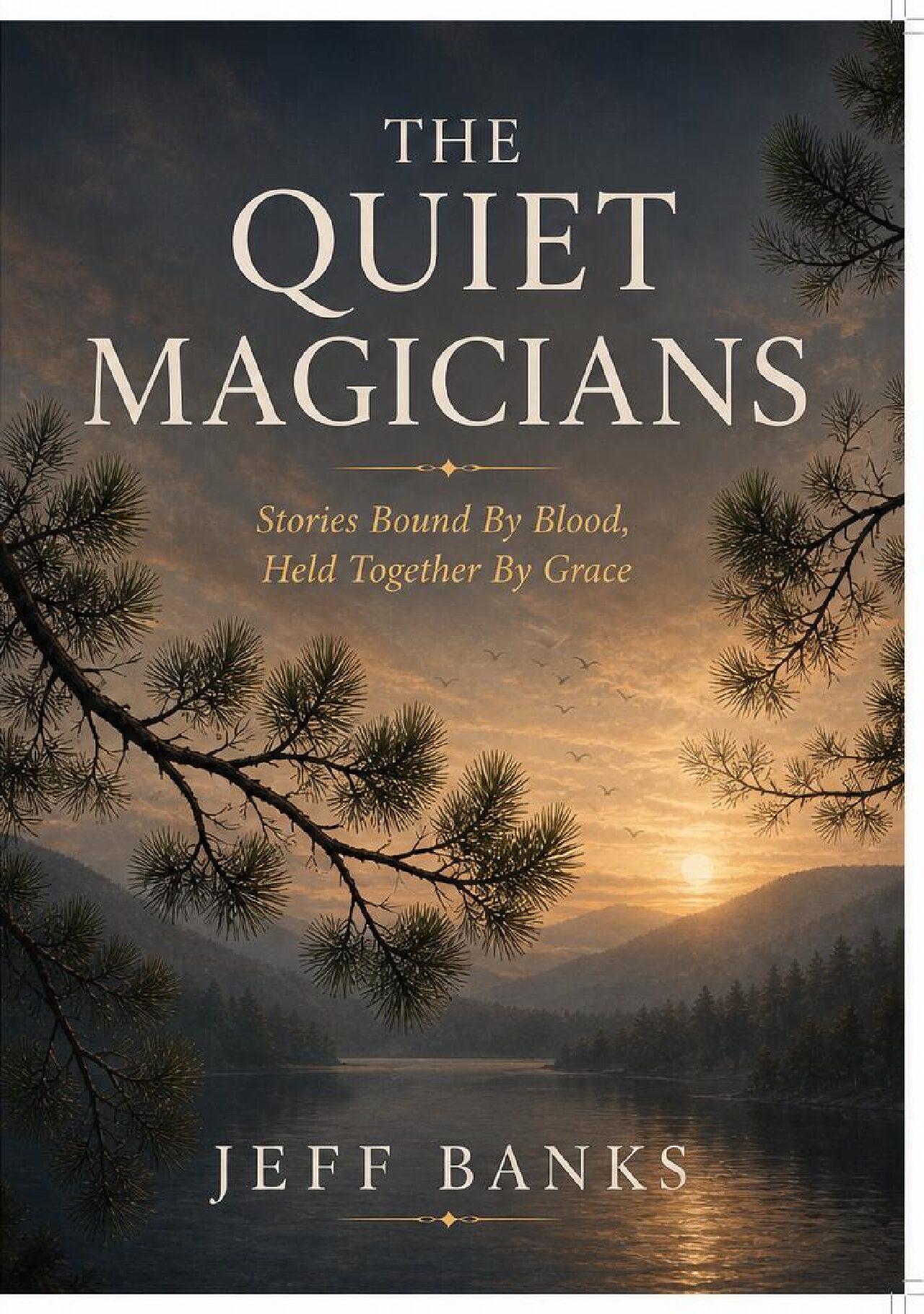
THE QUIET MAGICIANS - Chapter 8 - Just More Pain

THE QUIET MAGICIANS - Chapter 8 - Just More Pain | Travelling Around Australia with Jeff Banks

When people ask what kind of stock we came from, I sometimes think of him. Not because he is the best of us, nor the worst, but because he is the clearest evidence. He should have slowed down and did not. He should have chosen ease and refused it. He should know better and often doesn’t. Yet he keeps fronting up. In a world obsessed with polish, planning, and personal branding, there is something almost ancient about a man who simply keeps turning up, broken in places, wrong in others, but still prepared to help carry the piano.

THE QUIET MAGICIANS

Chapter 8 – Just More Pain

Stories Bound by Blood, Held Together by Grace

He was the only one who arrived by appointment, which in our family made him something close to royalty before he had even drawn breath. The rest of us seemed to have entered the world through the usual country method of timing, chance, bad planning, and optimism. He came with intention, discussion, medical advice, and the desperate hope that a new baby might steady a troubled household. There is a strange burden in being born as someone else’s remedy. You do not know it as a child, of course. You simply grow up believing the room should tilt slightly toward you, because perhaps it always did.

I have often thought that his first cradle was not a cot but expectation. Our mother was battling storms of the mind that in those days were spoken about in lowered voices or not at all. The wisdom of the era, and wisdom is too generous a word, suggested that something to care for might heal the person doing the caring. So he entered the family carrying a task no infant should be handed. I was away at camp when he was born, learning discipline, homesickness, and the peculiar cruelty of institutional vegetables, while back home a new brother was being welcomed into a family already tired in ways children do not yet understand.

By the time memory properly caught him, the farm was already fading into story. He had only the briefest taste of that life before it was sold, packed up, and filed away with the machinery, dogs, and dreams. He did not know our parents as farmers measuring rain and worry against each other. He knew them later, with dirt still under the nails but the horizon gone. He saw them as workers for other people, mowing other people’s lawns, fixing other people’s fences, pruning other people’s roses and delivering other people’s mail. There is a difference between growing up around ownership and growing up around labour. One teaches entitlement, the other teaches endurance. He inherited a confusing mix of both.

To say he was spoilt would be both true and unfair. Families often spoil the youngest not because they love them more, but because by then they are tired, guilty, wiser, lazier, or all four. Rules that were once iron become rubber. Standards soften. Battles no longer seem worth fighting. The youngest child benefits from lessons paid for by everyone else. He received more softness than some of us did, but softness does not always create softness. Sometimes it creates a person forever trying to repay a debt nobody formally charged.

He became one of those men every town recognises instantly. If someone needed help moving a fridge, he was there. If a mate needed a lift, a favour, a hand with roofing, fencing, shifting, digging, painting, lifting, towing, or regretting, he was already halfway down the road. He would give away his last hour, his last dollar, his last functioning vertebra, then wonder why his own life remained held together by string and weather. Some people are selfish in obvious ways. Others are selfish through martyrdom, because they make helping everyone else the excuse for never helping themselves.

On the football field he became a kind of local legend of the unnoticed variety. He would play lower grade, then pull on another jersey when reserves were short, then warm up for first grade if someone’s hamstring surrendered. He was useful everywhere and central nowhere. Not quite selected, never quite rejected. There is a sadness in being the man every team needs but no team claims. Yet there was also pride in it. He wore usefulness like a medal. If there was grass to be run on and a guernsey to be borrowed, he was happy enough.

That pattern followed him through life. He was forever the stand-in. Reliable but not settled. Present but not anchored. He had relationships in series rather than in harmony, collecting affection, disappointment, misunderstandings, and children along the way. He loved in the same style he helped people: generously, impulsively, and without much regard for long-term engineering. Some men build cathedrals; others erect tents in storms and act surprised when the canvas leaks.

Then came the accident that should have finished him. It was one of those ordinary-purpose journeys that turn savage without warning. He had been looking for the local council offices, which is as mundane a mission as any man can undertake, yet fate has never cared for irony. What happened next was measured later in injuries, surgeries, and probabilities. Had a co-worker not intervened when they did, we would have been planning a funeral instead of a recovery.

Recovery, however, can be crueller than death notices imagine. Death is final; recovery is repetitive. It asks again and again for patience, pain tolerance, humility, and acceptance, all qualities our family can imitate briefly but struggles to maintain for long. We gathered around him in the way families do, awkwardly, loyally, inconsistently. Comfort was offered. Advice was oversupplied. Hope was rationed and then replenished. We tried to steer him toward a life that might not be the life he once pictured, but could still be decent, workable, meaningful.

He responded by doing what he always does when handed wisdom: nodding politely and ignoring most of it.

Before he should have, he was helping mates again. Before he was fit, he was driving trucks because a mate “needed him”. Before the body had signed off, he was asking it to carry debts it could no longer afford. More knocks came. More setbacks. Fresh incapacitations layered themselves over old ones. To watch him was to witness a man in permanent argument with his own limitations. Some admired it as courage. Others saw stupidity. In truth it was both, which is often the case with behaviour we judge too quickly.

There came a payout, the kind outsiders imagine solves everything. People who have never lived inside damaged bodies think compensation is a finish line. They picture fishing rods, caravans, recliners, and long afternoons of grievance-funded comfort. They do not understand that some people cannot sit still inside themselves. Money can replace wages, but it cannot replace identity. Rest sounds lovely to those who are exhausted. To those wired for motion, rest can feel like burial.

So he asked for more. More work. More purpose. More strain. More chaos. More chances to prove he was not done. It offended logic, and logic has a strong case. But families are not built on logic alone. Ours certainly was not. Ours was built on getting up when down, working when hurt, carrying on when wiser people might have stopped. That inheritance can make saints of some and fools of others. Occasionally it makes both in the one person.

He remained in the old parental house long after prudence had moved out. The place, by all reports, was surrendering room by room to age, gravity, and neglect. Roofs sag, pipes sulk, walls remember every season. Yet to him it was not just a structure. It was duty, memory, territory, perhaps penance. He stayed where common sense would have sold. He held ground no one was attacking. In his mind it was the right thing. In mine it was the wrong answer to a right instinct.

That is the difficulty in explaining him to outsiders. They see poor choices, and many are there to be seen. They see waste, stubbornness, needless struggle, and self-inflicted complications. They are not entirely wrong. But they do not see the machinery underneath. They do not see a man born into expectation, raised in softened rules, desperate to be useful, terrified perhaps of being unnecessary. They do not see how often generosity and self-sabotage wear the same coat.

I have laughed at him more than once, and he has earned most of it. He can make baffling decisions with the confidence of a man unveiling engineering genius. He can defend nonsense with such sincerity that you begin doubting mathematics. Yet if your world tipped sideways at midnight and you needed someone in boots at the front door, he would likely be there before your second phone call.

Families rarely produce clean examples. They produce mixtures. My youngest brother is one of ours in concentrated form: hardworking, misguided, loyal, exhausting, generous, stubborn, damaged, funny, and somehow still hopeful. He is the sort of man who can waste opportunities and still remain admirable, who can ignore advice yet inspire affection, who can limp through life while carrying other people’s loads.

When people ask what kind of stock we came from, I sometimes think of him. Not because he is the best of us, nor the worst, but because he is the clearest evidence. He should have slowed down and did not. He should have chosen ease and refused it. He should know better and often doesn’t. Yet he keeps fronting up. In a world obsessed with polish, planning, and personal branding, there is something almost ancient about a man who simply keeps turning up, broken in places, wrong in others, but still prepared to help carry the piano.

Author

Menu