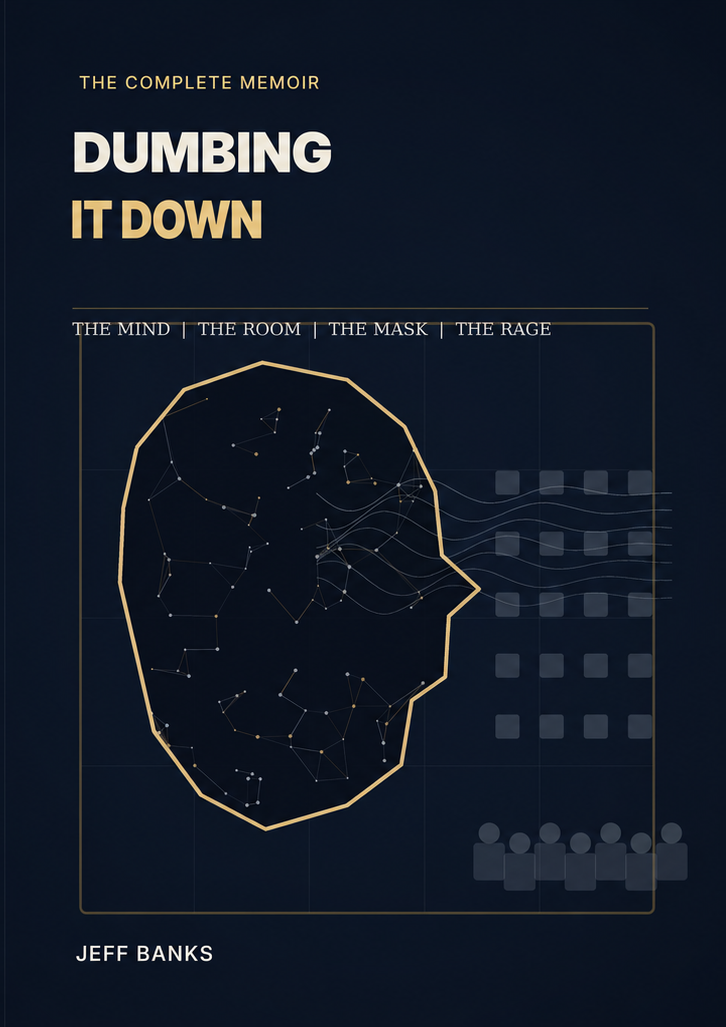
DUMBING IT DOWN - Chapter 33 - The Rage, Finally Named

DUMBING IT DOWN - Chapter 33 - The Rage, Finally Named | Travelling Around Australia with Jeff Banks

For three hours I stayed at the desk and wrote the first book in which emotion was not merely supporting material. I was not writing primarily about a road, a profession, a business program, a childhood weapon or somebody else’s struggle, even though all of them remained present in what emerged. I was writing about what those experiences had accumulated inside me and about the cost of repeatedly turning that accumulation into something useful for other people. The speed surprised me, but perhaps it should not have, because the material had been assembling itself across years and several books. Once the plan arrived in the early hours, there was very little left to do except follow it.

DUMBING IT DOWN

Chapter 33

The Rage, Finally Named

I woke with the sort of start that usually means the body has heard a noise the mind has missed. There was no noise outside me, at least none I could identify, and the bedroom was still carrying that heavy darkness before dawn has properly decided whether to arrive. I had spent much of the night turning from one side to the other, rearranging pillows, negotiating with the CPAP hose and pretending the next position would be the one in which sleep finally returned. It had not returned for long, because beneath the ordinary restlessness there had been a thought moving around, gathering pieces, rejecting some and coming back for others. By the time I opened my eyes properly, the thought had stopped being something I might consider and had become something I needed to write.

I walked the few paces from the bedroom to the office before the idea had time to become sensible. The computer came to life with its usual confidence, as though it had spent the night sleeping beautifully and could not understand why I looked as if I had been dragged behind a ute. On the screen were folders from other projects, photographs waiting to be sorted, half-finished notes and titles that had once arrived with urgency and then learned patience, and I sat looking at them while the house remained quiet, not yet knowing whether I was beginning another book or simply trying to get a troublesome thought out of my head. Contemplating the next book makes the process sound calmer than it was, because I was really staring at the evidence of several books already written and wondering why none of them had quite said the thing pressing hardest against the inside of me.

Until then, much of what I had written could be described as documentary, even when I appeared in it. I had written about roads, towns, people, businesses, childhood weapons, systems, decisions and the strange human habit of ignoring advice until it returned disguised as consequence. There was emotion in all of it, because no memory remains neutral once enough years have been added, but I had generally given the emotion a useful job. It could explain why a place mattered, sharpen a warning, soften a judgement or provide a little humour when the truth was edging too close to the skin. What I had not done was allow the emotion to become the subject, because that would have required me to stop observing the room and admit what being in the room had done to me.

The first sign of what writing might become had sat on my computer for a long time under the title From the Centre to the Dish. The idea had begun during a drive from Condobolin to Parkes with Aunty Kerre in the passenger seat, a journey that had an entirely practical reason behind it. Cousins were travelling from Orange to meet me for lunch because, at the time, I was the property investment adviser and they wanted to talk through what they were considering. Parkes was close enough to halfway to make the arrangement seem efficient, and efficiency has always appealed to me even when the day later proves it had other plans. I had also decided to use the drive to jog my memory and collect photographs for a possible book about the road between the geographical centre of New South Wales and the Dish, although at that stage “book” was probably giving the collection more status than it had earned.

With Kerre beside me, the secondary purpose quickly became the more interesting one. I stopped for signs, mailboxes, road art, memorials, towns, paddocks and the ordinary pieces of inland Australia that most people pass without noticing because the destination has been given more importance than the journey. Each stop gave Kerre another opening, and before long we were talking about family, the land, the people who had lived on it, those who still did and the things country people learned without ever thinking of them as lessons. A broken gate could lead to a story about somebody who had worked a property decades earlier, while an old building could bring back a name, a marriage, a hardship or a piece of family history that had never found its way into a formal record. The road was doing what roads sometimes do when the right person is sitting beside you; it was turning distance into memory.

We talked for almost the entire drive, except when one of us was looking closely at something beside the road or trying to remember the name attached to it. Places I had travelled through many times began to carry more people than I had previously seen there, and what might have been a quick photograph became part of a longer story about work, survival, humour or the way a family had adapted when the land made its own decisions. By the time we reached Parkes, the drive had become much more than a way of getting to lunch, although the cousins had still made the trip from Orange and the property conversation still had to be had. I cannot now pretend the lunch was merely an interruption to the creative process, because that would be unfair to both the cousins and the work I was doing, but the road had clearly taken hold of the day. I returned with photographs, notes and remembered fragments. What I did not return with was enough structure to know how they belonged together.

The folder sat on the computer for months, perhaps longer than I would care to calculate, waiting for me to decide what it wanted to be. I did not regard it as abandoned, because writers have more respectable words for neglect when the neglected item contains their own ideas. It was resting, maturing or awaiting the right moment, all of which sounded better than admitting I had opened it several times, looked at the photographs and closed it again. The material interested me, but interest is not structure, and I could not yet see how to move from one image to the next without producing something that looked like a slide show with paragraphs attached. I knew there was a story in the road, but knowing a story exists is not the same as knowing how to tell it.

From the Centre to the Dish was also an extension of an earlier piece I had written called The Plight of the Shopping Trolley. That had been a deliberately tongue-in-cheek look at litter and abandonment, posted on the website as an opinion piece outside the normal travel diary blogs. I had taken the humble shopping trolley, an object that seems to lose all dignity the moment it leaves a supermarket car park, and treated it as though it were a displaced citizen wandering the edges of society. The piece was light, perhaps even silly in places, but the humour gave me permission to write about rubbish, neglect and the things people leave behind once they decide somebody else will eventually deal with them. It was not an issue likely to bring governments to a halt, although a trolley lying upside down in a creek can look surprisingly committed to its protest.

Beneath the joke sat the same habit of noticing what other people had learned to pass without a second thought. A trolley in a creek, a mattress beside a road, bottles pushed into long grass or a sign gradually losing its argument with dust and weather all said something about the people who had been there. The travel diary blogs usually recorded where I had gone, what I had seen and whatever incident had made the day worth remembering, but The Plight of the Shopping Trolley let me step outside that pattern. I could give the discarded object a voice and, through it, ask what our carelessness said about us without delivering a lecture on civic responsibility. The piece showed me that observation could be more than a record of distance travelled, and that humour could encourage a reader to look at something they might otherwise avoid.

That same approach followed me onto the road between Condobolin and Parkes. I was not only photographing recognised landmarks or the things likely to appear in a tourism brochure, because the smaller objects often carried the better stories. An improvised letterbox, a rusting machine, a roadside memorial or a gate repaired with whatever had been available could say more about a place than a carefully worded sign designed in an office. Kerre understood that instinct immediately, which was why the conversation moved so easily from an object to a person and then from the person to the family, the district and the period in which they had lived. The laughter opened the door, but what came through it was memory, and some of that memory carried more weight than either of us had expected when we left Condobolin.

Once I finally sat down and thought seriously about structure, the book came together with astonishing speed. The photographs already knew where they belonged, even if I had not known it while taking them, because the road itself provided the order I had been trying to invent. One place led naturally to the next, and the conversation with Kerre had given many of the images a human connection that a caption alone could never have provided. The journey became more than a line on a map between the geographical centre of New South Wales and the great listening dish at Parkes, and I had spent all that time thinking I needed to construct the book when, in reality, I needed to recognise that I had already travelled through its structure.

There was a lesson in that, although at the time I treated it mainly as proof that procrastination can occasionally be rebranded as preparation. The book came together, photographs and all, not because I had suddenly become more disciplined, but because the order had been waiting in the road. Once I stopped trying to impose something clever on it, the material settled into place with very little resistance. That experience mattered later, because it showed me that some books are written long before the words are placed on the page. The writer’s job is sometimes not to invent the route, but to notice the route already travelled and admit where it led.

From the Centre to the Dish remained safe territory because the land carried much of the emotional weight. I could write about endurance, distance, loss, belonging and the things the country remembers without saying too directly what I remembered. The road gave me somewhere to look other than inward, and the photographs provided evidence that did not argue back or ask whether I was being entirely honest. Even when the writing turned reflective, I remained the traveller, the observer and the person pointing towards something other people might have missed. It was honest writing, but it was an honesty with the windows open and an escape route clearly marked.

Diary of a Child Sniper closed some of that distance. It began as a recollection of the weapons I had owned as a youngster on the land, before life diverted me towards the city and replaced the direct consequences of rural work with the more complicated consequences of people. The slug gun, the rifles and the nights with a spotlight all belonged there. So did the strange competence expected of a boy, although none of it was included to romanticise firearms or turn childhood into an adventure serial. They belonged to the environment in which I grew up, where responsibility arrived early, silence was normal and usefulness mattered more than explanation. I thought I was writing about the weapons, but I was also trying to recover the child who had learned control before he had any reason to ask what control might later cost him.

The memories were not neat when I brought them back. There was pride in being trusted, discomfort about consequence, affection for the land and frustration at the ease with which people who had never lived that life could later reduce it to a policy position or a moral slogan. None of that meant the old way was beyond criticism, and hindsight had given me questions the boy could not have formed at the time. It did mean that judgement without context felt thin, particularly when delivered with the confidence of somebody who had never needed the skill they were condemning. The rage was present in that book, although I still called it background, history or context because those words sounded more manageable.

The move towards the city had done more than change where I lived. It took a set of abilities that made complete sense in one environment and made them difficult to explain in another, rather like arriving at a bowls club carrying a chainsaw and insisting it had been essential where I came from. The boy who understood trajectory, patience, consequence and the difference between noise and intent became a student, then an accountant and eventually an adviser expected to operate through language rather than action. I learned the new rules and became good at them, but the older instinct remained underneath the qualifications and professional manners. See the risk, steady the hand and act before the damage becomes irreversible was still the method, even when the weapon had become a spreadsheet.

That instinct followed me into What the Accountant Saw, although by then it wore a suit and had learned to use qualifying language. The book drew on decades of watching people make decisions, justify them, seek advice after the emotional commitment had already been made and then become surprised when the numbers recorded what their behaviour had been saying all along. Accounting was never simply about figures on a page, because the figures were usually the last witnesses called. Before them came confidence, denial, urgency, vanity, fear, hope, family pressure, borrowed money and the occasional belief that a tax deduction made the purchase free. By the time the ledger spoke, the interesting part of the story had generally happened elsewhere.

I wrote those stories with humour because humour had always been one of the safer ways to tell the truth. A client could recognise the absurdity in another person’s decision long before recognising the same machinery operating inside their own, and I was not exempt from that process. The identities were softened or blurred, the circumstances adjusted where necessary and the judgement turned back towards me often enough to prevent the book becoming a parade of fools led by an unusually perceptive accountant. That would have been dishonest, as well as unpleasant to read, because I had made enough decisions of my own to know that intelligence does not prevent a person believing what they need to believe. Still, beneath the generosity and amusement there was pressure I had not yet allowed myself to name.

The pressure came from being underestimated and depended upon at the same time. People could dismiss the warning, resist the explanation, question the interpretation and still expect me to be available when the outcome arrived. They did not always want the full thought when it might alter the decision, but they wanted the full capacity when the decision needed rescuing. That contradiction appeared in client meetings, professional partnerships, business ventures and conversations where I could feel the room asking me to be less difficult until difficulty became useful. Over time I became accustomed to being treated as excessive before the crisis and essential after it, which is not as flattering as it might sound.

There is a particular kind of anger in seeing the wall before the person walking towards it. You point it out, explain the distance, estimate the speed and suggest a turn that might avoid the collision without causing too much inconvenience. The person assures you the wall is not as close as it looks, or that somebody else walked in that direction last year and seemed perfectly fine, or that your outlook is unnecessarily negative. When the impact comes, the conversation often begins again with the observation that nobody could possibly have seen it coming. I have spent a large part of my life with a sore forehead from trying to head off walls on behalf of people who preferred to meet them personally.

It would be easy to tell those stories as proof that I was right and everyone else was wrong, but that would only replace one form of dumbing down with another. I was often impatient, and impatience can make sound advice feel like an accusation. I could arrive at a conclusion so quickly that I failed to show the steps, then become frustrated when other people did not accept a destination they had never travelled towards. At times I mistook clarity in my own mind for communication in the room. At other times I allowed the strength of the pattern to flatten the individuality of the person standing in front of me. Seeing the wall did not always make me pleasant company on the walk, particularly when I believed the time for gentle discussion had already passed.

Some of the rage therefore came from me, not merely from other people refusing to listen. Advising is not controlling, no matter how strong the evidence or how obvious the likely outcome appears, and people retain the right to make decisions I consider foolish. That principle becomes harder to live with when the decision affects me, costs me money or leaves me to repair what follows, but the principle does not disappear merely because I am inconvenienced by it. Professionally, I understood that the client owned the decision. Emotionally, I often carried the consequence as though my inability to prevent it had been a failure of my own.

Death by a Thousand Cuts gave the rage another body to inhabit. The book followed Mandy as she tried to create something built on care, only to meet landlords, contractors, suppliers and officials whose most consistent contribution seemed to be the confident lowering of expectations. She wanted the space, the service and the experience to mean something, while the people around the project repeatedly translated that care into fussiness, inconvenience or an invitation to assert control. None of the individual incidents necessarily appeared large enough to justify fury when looked at separately. That was part of the cruelty, because a thousand cuts depend on each blade being small enough for somebody else to dismiss.

Writing Mandy’s experience allowed me to describe what happens when caring is treated as a defect. Each delay, dismissal, unanswered question and piece of condescension carried the familiar message that the person who sees more should learn to ask for less. It was her story, and I did not need to steal it in order to recognise the exhaustion beneath it. I had also known what it was to have standards presented as unreasonable simply because those standards required another person to do the job they had agreed to do. The rage in that book accumulated in detail rather than announcement, which was how it had accumulated in me for years.

The Little Blue School Book moved the same argument into rooms full of business owners, particularly those within the Business Blueprint arena, surrounded by ideas, energy and the promise of change. I had watched people attend the program, fill notebooks, underline revelations, return home inspired and then allow the practical work to dissolve beneath the next urgent matter. The experts were available, the frameworks were explained and the path was often visible, yet many people still preferred the excitement of possibility to the discipline of execution. They did not necessarily lack intelligence or ambition, and it would have been too simple to dismiss them as lazy; often they lacked the willingness, confidence or emotional steadiness to stay with the boring part long enough for it to work.

Sitting at an experts table as the accountant made the pattern particularly clear. People would ask questions about cash flow, structure, tax or risk, but the question beneath the question was often whether I could give them permission to do what they had already decided. Some wanted reassurance that the chosen course was sound, while others wanted a sufficiently complex answer to protect them from a simple obligation. I could lead the horse to water, point out the trough, test the water, calculate the likely rate of dehydration and prepare a tasteful spreadsheet showing the consequences of continued refusal. I could not make the horse drink, although I was frequently expected to revive it later and explain why the water had not worked.

The book was intended as a conversation rather than an attack, and I meant that. I had watched enough people struggle to know that failure is rarely explained by laziness alone, and that the person changing direction for the fifth time may be frightened, overwhelmed or trying to recover from the fourth attempt rather than simply being foolish. Even so, there was rage beneath the patience because the same avoidable confusion kept returning. Capable people surrendered progress to noise, then blamed the framework, the staff, the market or the adviser who had tried to slow them down long enough to make the decision visible. I could understand the human reasons and still feel the frustration, which was one of the contradictions I had spent years trying to reduce into professional language.

By then the pattern across the books should have been obvious to me, although it is easier to see a pattern after several versions of it have been placed together. A road book asked people to notice what they passed and to understand that ordinary objects could carry family, land and memory, while a childhood memoir asked them to understand the world before judging the tools that world had required. An accounting book asked them to examine the behaviour before admiring or condemning the numbers, while the later business books showed how care and discipline could be worn down by indifference, resistance and repetition. In each case I was pointing towards something visible to me and trying to make it visible without causing the reader to feel accused before they had properly looked.

That was dumbing it down in its most respectable form. I slowed the thought, softened the warning, removed the branches and offered the conclusion in language the room might tolerate. I learned to say, “Perhaps we should consider,” when the fuller sentence in my head was closer to, “This will end badly, and we both know who will be asked to fix it.” I turned certainty into suggestion, frustration into humour and exhaustion into another careful explanation, sometimes because that was good communication and sometimes because I had learned what happened when the full thought entered the room. The method worked often enough to become habit, but usefulness does not make a habit harmless.

There is a private humiliation in editing a thought before it is allowed to exist. It is not the humiliation of being unable to express yourself, but of being able to express yourself too fully and knowing the room is likely to punish the attempt. You reduce the warning until it sounds optional. You trim the reasoning until it appears simple and remove the emotional cost because emotion from a competent man tends to make people uneasy. When the reduced version fails to carry the urgency, you may later be told that you should have been clearer, as though clarity had not been the first thing removed to make the conversation survivable. I became good at presenting the small cup while carrying the flood behind my back.

The flood did not disappear because I kept it out of sight. It became part of the dull roar beneath work, usefulness, humour and the appearance of coping, joining the depression that had already learned to live quietly behind competence. There were days when the frustration felt sharp enough to identify, but more often it became background pressure, a sense that every conversation required translation and every translation removed another small piece of the original thought. I did not walk around raging at people, because unrestrained rage would have destroyed the relationships and responsibilities I was trying to preserve. Instead, I contained it, and containment can look remarkably like maturity from the outside while feeling very different from within.

The night before I sat at the desk, the word had become harder to avoid. I had used anger, irritation, impatience, frustration, disappointment and weariness. All of them were true, and all of them were smaller. Rage sounded dangerous, self-important and faintly theatrical, as though I should have been pacing a moor in bad weather rather than lying in bed at Smiths Lake fighting with a CPAP hose. I resisted the word because I did not want to become a bitter man assembling a case against the world, nor did I want to turn every disagreement into proof that I had been misunderstood. Refusing the word, however, had done nothing to reduce the pressure it described.

Sitting at the desk, I began to understand that naming rage was not the same as surrendering to it. Surrender would have allowed the feeling to decide who was guilty, simplify every memory and convert every disappointment into proof that I had been surrounded by lesser minds. Naming it meant placing it on the page where it could be examined, questioned, qualified and compared with what had actually happened. The written word gave the rage edges, and edges made it possible to see where it belonged and where it had trespassed. Once it was written, it became evidence rather than weather moving through the background of everything else.

Evidence can still be misleading, particularly when the witness has a personal interest in the verdict. Rage remembers the warnings that were ignored and is less reliable about the warnings delivered badly. It remembers being depended upon while overlooking the satisfaction that sometimes came from being useful, and it can reduce years of cooperation to the moments when somebody resisted. There were people who listened, people who challenged me honestly and people who saved me from my own certainty, even if those memories did not arrive first when I was lying awake. Writing the rage down did not make it correct, but it made it accountable to a record larger than itself.

I began to see the books behind me not as separate projects but as stages in the same release. From the Centre to the Dish had shown how observation could hold memory without requiring me to stand directly inside it. Diary of a Child Sniper brought the child and his early competence closer, while What the Accountant Saw recorded the human decisions behind professional evidence. Death by a Thousand Cuts and The Little Blue School Book showed what happened when care, standards and discipline were repeatedly worn down by resistance, noise and avoidance. The rage had been speaking for some time, but I had kept giving it the title of whichever case happened to be before me.

Once I accepted that, the black and white became more visible, although not necessarily simpler. A lifetime in taxation had cured me of the belief that written words remain obedient once definitions, interpretation, facts and human intention are allowed near them. Grey can be necessary. It can be intelligent and honest because life often refuses to fit within the first answer. It can also become a comfortable fog used by people who do not want to admit that a line existed, a promise had been made, a responsibility was avoided or a foreseeable consequence had arrived. My rage was rarely at genuine uncertainty; it was more often at certainty being disguised as uncertainty until accountability had safely moved elsewhere.

The professional part of me had spent decades living inside that distinction. A law could appear black on one page and become white when another provision, exception or fact was admitted, which was why competent advice required interpretation rather than rigid recitation. I also knew the difference between interpretation and evasion, even when the person seeking advice preferred not to. Nuance should deepen responsibility by helping us understand what actually applies, not dissolve responsibility until nobody can remember who was meant to act. Too often I had watched grey used not to understand the truth but to make the truth less inconvenient.

The wider world seemed increasingly comfortable with that use of grey. People could postpone a decision by requesting more information, avoid a conclusion by widening the discussion or soften a failure by changing the description after the event. I had done versions of those things myself, particularly when the honest answer threatened a relationship or required me to admit I had stayed too long with something already failing. The rage therefore could not be directed entirely outward, because some of the fog had been mine. Naming it required me to acknowledge not only the walls other people ignored, but the occasions when I had continued walking because turning away would have meant accepting that my usefulness was no longer enough.

When the plug finally came out, the writing did not arrive as a sequence of dramatic revelations. It came clearly. It also came constantly, one thought opening another and each book behind me appearing in a slightly different light. I did not need to manufacture emotion because it had been held under pressure for years by work, manners, caution and the reasonable desire not to sound like an old man complaining that nobody listened. Many of the sentences had already been rehearsed in meetings, sleepless nights and later conversations held in my own head, where my timing was naturally much better. That morning I was not creating the rage so much as allowing it to speak without first reducing it to what another room might tolerate.

ChatGPT helped me organise the flow, test the structure and turn the rush into something a reader could follow. That assistance did not make the emotion artificial any more than a word processor made the memories digital, because the machine had not sat in the rooms, carried the responsibility or felt the impact when the wall arrived. It could suggest a bridge and identify repetition. It could also occasionally remove a sentence that had become too impressed with itself. The experience was useful because I was still deciding how much of the unfiltered thought belonged on the page and how much was only heat from the moment. The rage remained mine, as did the responsibility for the shape I gave it and the people who might recognise themselves within it.

For three hours I stayed at the desk and wrote the first book in which emotion was not merely supporting material. I was not writing primarily about a road, a profession, a business program, a childhood weapon or somebody else’s struggle, even though all of them remained present in what emerged. I was writing about what those experiences had accumulated inside me and about the cost of repeatedly turning that accumulation into something useful for other people. The speed surprised me, but perhaps it should not have, because the material had been assembling itself across years and several books. Once the plan arrived in the early hours, there was very little left to do except follow it.

The three hours did not pass in a haze of artistic inspiration, because even emotional exposure has practical requirements. I moved between the manuscript, the cover, the description, the formatting and the Books.by website, checking files and persuading the machinery that this private eruption was also a book with dimensions. Titles had to be entered, pages placed in the right order and the upload process watched with the same suspicion I usually reserved for a tax return that balanced too easily. Those ordinary tasks prevented the morning becoming grander than it needed to be. They also reminded me that even rage eventually has to deal with file formats, cover images and an upload button that does not care what the book has cost emotionally.

When I finally closed the Books.by website, the office looked almost exactly as it had when I entered it. The desk was still crowded, the computer still hummed and daylight had taken possession of the room without consulting me. Nothing outside had been resolved, no apology had arrived from the past and no wall had moved because I had finally written about seeing it. Yet the part of the rage I had carried into the office before dawn was no longer entirely background noise, because it now existed on the page where I and anyone else prepared to read it could see its shape. From the moment I woke with the plan until I closed the website three hours later, the first book driven openly by those emotions had been written and released, with that part of the rage bared for all to see and, for once, not softened by an apology before it entered the room.

Author

Menu