

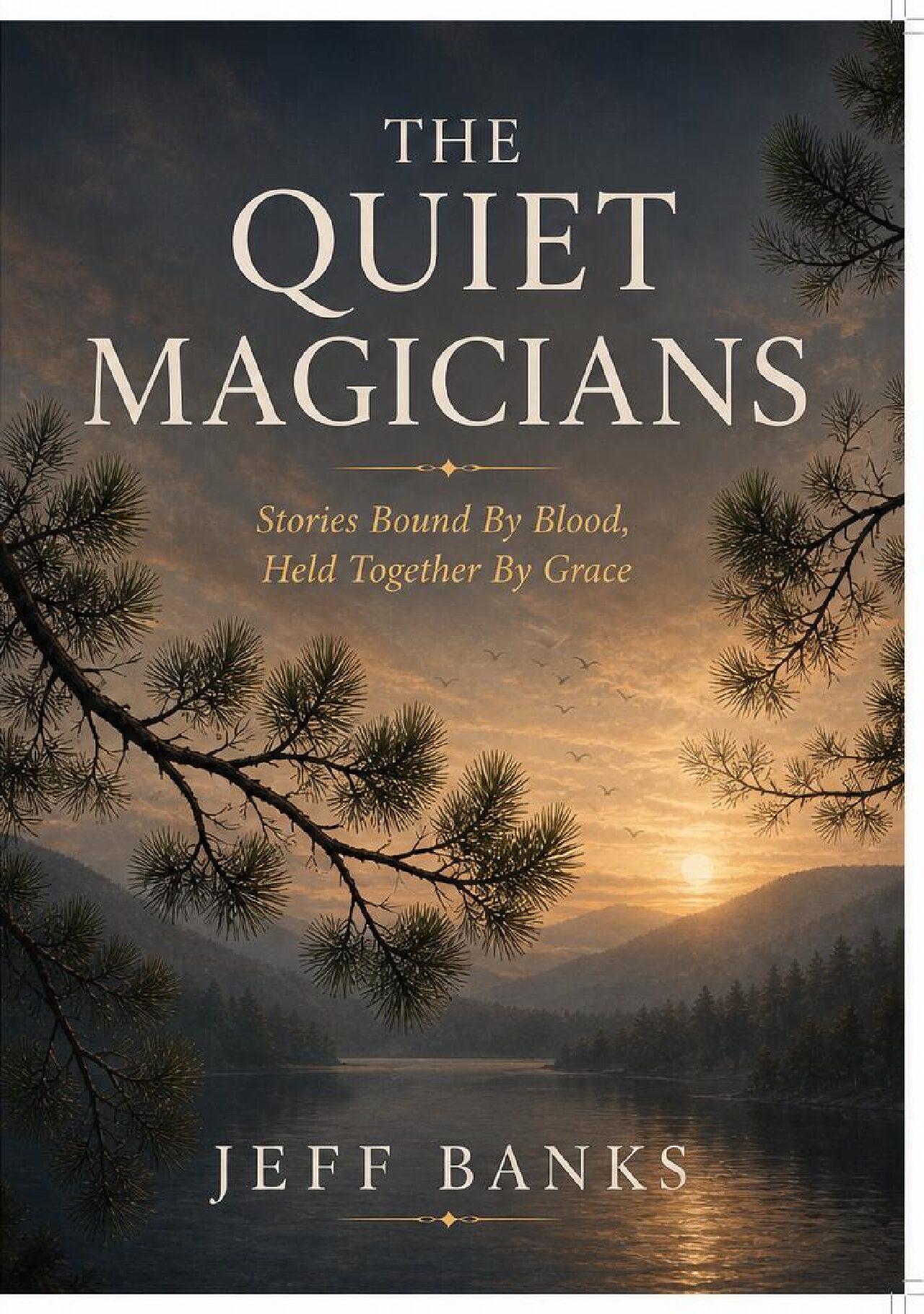
THE QUIET MAGICIANS - Chapter 28 - The Gentle Giant

THE QUIET MAGICIANS - Chapter 28 - The Gentle Giant | Travelling Around Australia with Jeff Banks

When I think of The Gentle Giant, I do not think first of limitations. I think of a large frame containing an old-fashioned conscience. I think of someone forever half a step from becoming more, yet already possessing qualities many “successful” people spend fortunes trying to imitate. He may never fully leave the safety of the yard gate. He may always need reasons to stay close to home. But if character counts for anything, then he has been carrying more of it than most people noticed.

THE QUIET MAGICIANS

Chapter 28 – The Gentle Giant

Stories Bound by Blood, Held Together by Grace

The first thing most people notice about The Gentle Giant is his size. He enters a room before he speaks, occupies a doorway before he decides whether to walk through it, and carries the sort of physical presence that makes strangers assume certainty lives inside him. Then he opens his mouth, smiles with complete sincerity, and the illusion rearranges itself. What stands before you is not a conqueror, not a strategist, not one of life’s natural tacticians. What stands before you is a man built like a front-row enforcer and furnished internally with the soft wiring of loyalty, fairness, and an almost painful desire to do the right thing.

The world can be unkind to people like that. It forgives sharp elbows, celebrates cunning, and often mistakes hesitation for weakness. It has endless patience for rogues if they are entertaining, but very little for innocence if it arrives in adult form. The Gentle Giant has spent much of his life living inside that mismatch. He was given the body of someone people expect to dominate and the heart of someone more likely to help stack the chairs after everyone else has gone home.

As a boy he was never going to win races of the mind. Some children sprint through school as if the place was built for them. Others wander its hallways like tourists in a foreign country, trying to read signs written in a language everybody else seems to understand. He belonged to the second group. Instructions that landed neatly on other desks often arrived scrambled on his. Sarcasm passed him by. Complexity annoyed him less than it exhausted him. Yet while others were learning shortcuts, he was learning something rarer. He knew when something was unfair. He knew when someone was being mocked. He knew when rules were being bent for the benefit of the already powerful. Those instincts cannot be measured on any test paper, but they matter enormously in the long run.

He grew into a big man carrying small-boy sensitivities. That combination can be confusing to observe. People expect size to come with swagger. They expect volume, appetite, certainty, maybe even menace. Instead they found a fellow who wanted to be useful, wanted to belong, wanted to be thought well of, and wanted above all else to know where he stood. There are many dangerous men in the world. There are also many harmless men who look dangerous and therefore spend half their lives apologising for shadows they never cast intentionally. He was one of those.

Like many in our family tree, he inherited more than eye colour and bone structure. He inherited patterns. His father had long belonged to one of those communities that convinces a person they are indispensable while functioning perfectly well without them. Every town has one. Sometimes it is a club, sometimes a committee, sometimes a volunteer circle, sometimes a cause dressed up as destiny. These places are not without value, but they can become theatres where lonely people audition daily for significance. His father found identity there. The son, naturally enough, followed.

It is hard to criticise belonging when you know how scarce it can be. If a man is welcomed somewhere, handed a task, called by name, and made to feel necessary, he will often overlook whether the necessity is real. The Gentle Giant was no different. He liked to be needed. He liked the rhythm of routine, the expectation that he would turn up, the small nods of approval that said he mattered. To outsiders it may have looked like spinning wheels in mud. To him it was traction.

Then came his father’s accident, and with it the perfect excuse for a deeper retreat into the familiar. He stayed close to home “just in case.” Those three words can hide a universe. They can mean duty, fear, love, avoidance, tenderness, paralysis, or some blend of all six. Families become fluent in these coded phrases. We all nodded at the explanation because it contained enough truth to pass inspection. There was care in it, certainly. There was concern. But there was also shelter.

Home can become a sanctuary, and sanctuaries can quietly become cages. If the outside world demands skills you do not trust yourself to possess, then remaining nearby seems noble rather than anxious. If new paths require confidence, risk, paperwork, unfamiliar people, or the possibility of failing publicly, then staying put can be rebranded as loyalty. Many lives have narrowed beneath banners that looked honourable from a distance.

That is the ache of The Gentle Giant’s story. He is not lazy in the traditional sense. He can move, lift, carry, turn up, endure weather, and commit to effort when the task is concrete. Give him something physical and immediate and he can surprise you. Give him a cause that feels righteous and he will stand taller. Give him someone vulnerable to defend and he may show a courage absent in matters concerning himself. But ask him to reinvent his life, challenge long-set patterns, step into unknown rooms where he is not instantly comfortable, and the engine begins to splutter.

There are people who mistake this for stupidity. That is too easy and too crude. Intelligence wears many costumes, and lack of one kind does not equal absence of all. He possesses social radar in flashes that cleverer people miss entirely. He can sense who is genuine. He knows when someone is using fancy words to hide poor character. He understands gratitude instinctively. He can smell snobbery from across a paddock. None of that earns certificates, but it often leads to sound judgments about human beings.

I have watched supposedly bright people make catastrophic decisions while he, in his slower and simpler way, remained loyal, decent, and free of malice. There are boardrooms full of high-IQ disasters and kitchen tables graced by humble wisdom. If civilisation were measured only by kindness, many geniuses would need remedial tutoring from men like him.

He also carries the family trait of wanting to be seen as capable. That hunger can produce comedy. There is something both admirable and faintly chaotic about a person determined to help in areas where help may not be strictly required. He can involve himself in matters already under control, offering labour, opinions, presence, or concern with the seriousness of a wartime logistics officer. You learn not to dismiss it too harshly. Beneath the fussing is a plea as old as humanity: let me matter here.

Families are often least charitable toward the wounds they understand best. We can be impatient with his reluctance to grow because we see the roads not taken. We can become exasperated by comfort zones because many of us have our own, disguised in better tailoring. We say he should push himself, challenge himself, become more. Perhaps he should. But advice is cheap when offered from temperaments built for movement. Some people are natural migrants of the soul. Others need maps, escorts, reassurance, and three false starts before leaving the driveway.

He has probably been underestimated all his life, sometimes fairly, often lazily. Yet if there were trouble at midnight, if an elderly neighbour needed lifting, if a relative needed company in a waiting room, if some petty injustice needed someone to stand there and say “that’s not right,” he would likely be among the first to arrive. Society tends to overvalue dazzling people and undervalue dependable ones. One group fills biographies. The other keeps families functioning.

There is tragedy in unused potential, but there is also danger in defining potential too narrowly. Not every worthy life becomes expansive. Some lives stay local, repetitive, bounded by habit and radius. Some men never conquer cities or industries or themselves in the dramatic sense. They simply remain kind in a world that offers incentives not to be. That is not nothing. In some eras it may be close to heroic.

When I think of The Gentle Giant, I do not think first of limitations. I think of a large frame containing an old-fashioned conscience. I think of someone forever half a step from becoming more, yet already possessing qualities many “successful” people spend fortunes trying to imitate. He may never fully leave the safety of the yard gate. He may always need reasons to stay close to home. But if character counts for anything, then he has been carrying more of it than most people noticed.

Author

Menu