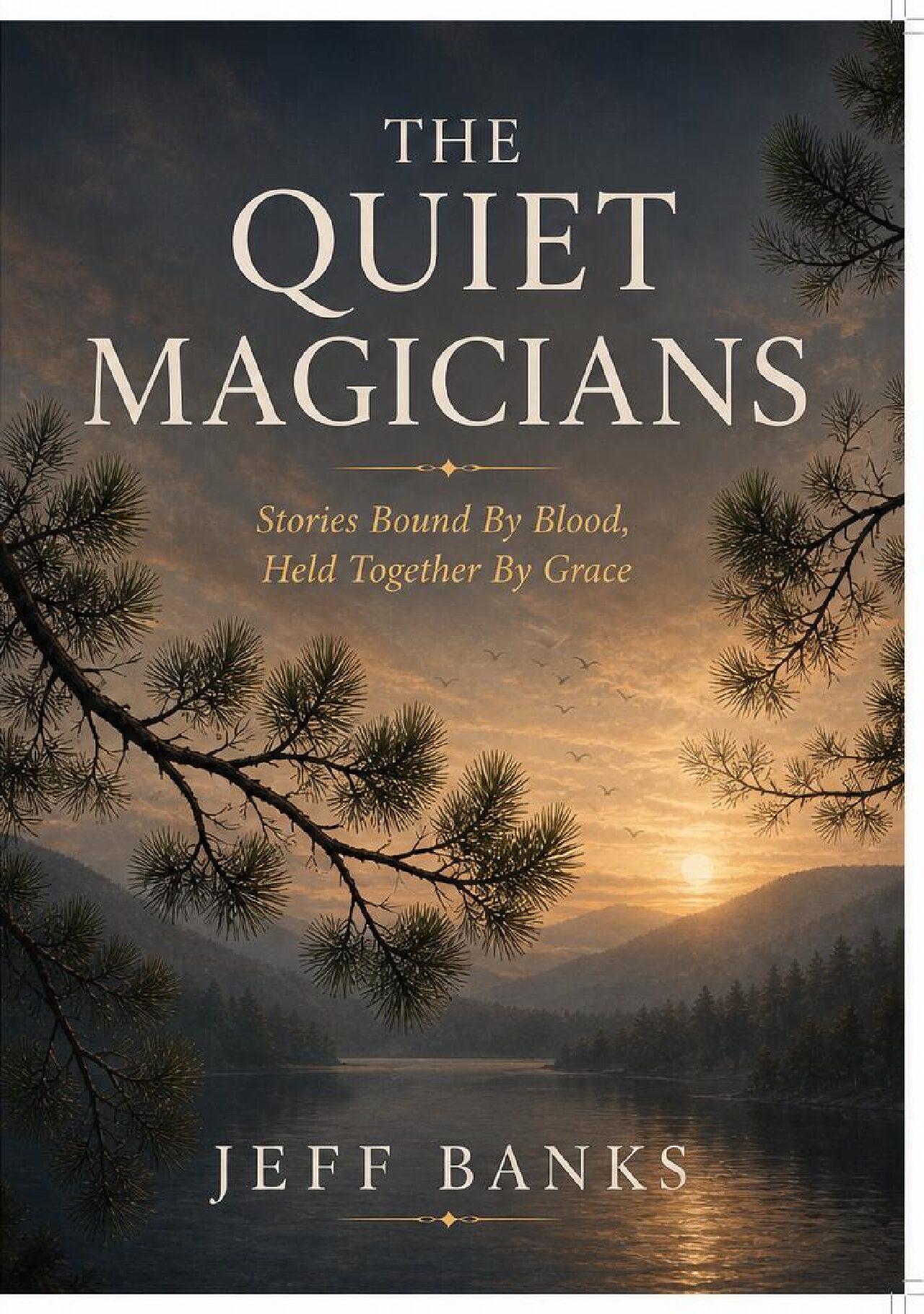
THE QUIET MAGICIANS - Chapter 19 - Unions Bring Stars

THE QUIET MAGICIANS - Chapter 19 - Unions Bring Stars | Travelling Around Australia with Jeff Banks

Unions bring stars, not because they guarantee greatness, but because they create the conditions for it to emerge. And in watching that unfold, in seeing the next generation step forward with their own ideas, their own strengths, their own version of the story, there is a quiet satisfaction that doesn’t need to be declared. It simply exists, steady and unassuming, like a light that has been passed on and now shines in more places than it ever could have before.

THE QUIET MAGICIANS

Chapter 19 – Unions Bring Stars

Stories Bound by Blood, Held Together by Grace

There’s a moment that sneaks up on you without invitation, and for most of your life you don’t even know it exists. It’s not marked by a birthday or an anniversary, and it doesn’t arrive with the fanfare of weddings or the quiet solemnity of funerals. It slips in somewhere between watching your children stand on their own feet and realising that those feet are now carrying someone else’s future. It’s the moment you understand that the story has shifted, that the narrative you thought you were writing has quietly handed the pen to another generation, and that somehow, without ceremony, you’ve moved from being the centre of the story to becoming part of its foundation.

I remember sitting at a gathering, one of those family occasions where the conversation moves in unpredictable currents and the food arrives in waves rather than courses. The older voices were still there, seasoned and comfortable, speaking in the shorthand of shared history. But it was the younger ones who held the room in a different way, not through authority, but through energy, through possibility. Their conversations weren’t anchored in what had been, but in what might be. Careers, travel, ideas, ambitions that hadn’t yet collided with reality. There was a lightness to it, not from naivety, but from momentum. And sitting there, somewhere between listener and participant, it became clear that this was not simply continuation. This was expansion.

We often talk about family in linear terms, as if one generation follows another in a neat and orderly procession, like carriages on a train. Parents raise children, children become adults, adults create their own families, and so the line continues. It sounds simple when you say it that way, almost mechanical. But the truth is far less orderly and far more interesting. Each generation doesn’t just follow the last; it reshapes it, questions it, builds on it, and occasionally rejects parts of it altogether. And somewhere in that messy, unpredictable process, something remarkable happens. The combination of two people, with all their histories, flaws, strengths, and unspoken hopes, creates something entirely new. Not a replica, not a continuation, but an evolution.

That’s the quiet miracle of unions. Not the ceremony, not the vows, not the photographs that capture a single polished day, but what comes after. The slow merging of habits, the negotiation of differences, the blending of two ways of seeing the world into something that didn’t exist before. It’s in those moments, often invisible to anyone outside the relationship, that the foundations are laid for what comes next. And when children arrive into that space, they don’t just inherit two family lines; they inherit the tension, the compromise, the humour, the resilience, and the unspoken agreements that have already shaped the environment they step into.

Watching the second generation become parents is a curious experience, particularly when you remember them as children themselves. There’s a quiet recalibration that has to take place, an adjustment in how you see them. The child who once needed guidance now gives it. The one who tested boundaries now sets them. And while there is pride in that transition, there is also a certain disbelief, as though part of you is still waiting for someone more qualified to step in and take over. But they don’t. They grow into it, often awkwardly at first, learning the same lessons we all did, usually a few minutes after they needed to know them.

And then come the children of that generation, the third layer in what is no longer a line but something closer to a constellation. They arrive without the weight of history but are shaped by it nonetheless. They carry fragments of personalities, echoes of behaviours, glimpses of expressions that feel strangely familiar even when they appear in entirely new contexts. A laugh that reminds you of someone long gone. A stubborn streak that surfaces at inconvenient moments. A kindness that seems to have bypassed the usual filters and arrived fully formed.

It’s tempting to look for patterns, to trace traits back through the generations as though we’re solving a puzzle, but that only tells part of the story. What’s more interesting is how those traits combine, how they are expressed differently depending on the environment they grow in. A quality that may have been a weakness in one generation becomes a strength in another. What was once a source of conflict becomes the very thing that allows someone to thrive. It’s not just inheritance; it’s transformation.

There’s a particular kind of pride that emerges at this stage, and it’s different from anything that comes before it. It’s not the protective pride of raising a child, where every achievement feels like a shared victory and every setback carries a personal sting. This is something quieter, more reflective. It’s the recognition that what has been built, often imperfectly and sometimes unintentionally, has created the conditions for something good to grow. And that growth is no longer yours to direct. It belongs to them.

You see it in the way parents of this generation speak about their children. There’s the expected admiration, of course, but beneath it is something deeper. A sense of purpose that isn’t tied to career or status or the markers we once used to define success. It’s in the small observations, the stories that get repeated not because they are remarkable to anyone else, but because they capture something essential. A moment of courage. An act of kindness. A decision that shows character rather than convenience. These are the things that seem to matter most, even if they don’t make for impressive headlines.

It raises a question that lingers longer than it used to. Why? Why do we do what we do? Why the effort, the sacrifice, the persistence in the face of setbacks that don’t always make sense at the time? For a long time, the answers tend to be practical. Provide, protect, build something stable, create opportunities. All valid, all necessary. But as the generations unfold, those answers start to feel incomplete. They explain the actions, but not the meaning behind them.

Perhaps the answer sits somewhere in these transitions, in the moments where one generation quietly hands over to the next without ever formally acknowledging that it has done so. Perhaps the “why” isn’t something we articulate in the middle of the struggle, but something that becomes clearer when we step back and see what has emerged as a result. Not perfection, certainly not that, but continuity. Growth. The emergence of individuals who carry forward parts of us while becoming entirely themselves.

There’s humour in it too, because for all the reflection and perceived wisdom, the same patterns repeat in ways that are both predictable and surprising. The things we swore we would never say suddenly find their way into our conversations. The habits we once rolled our eyes at become oddly comforting. And the advice we offer, often with the best of intentions, is received with the same polite scepticism we once displayed. It’s a cycle that doesn’t so much repeat as it echoes, each time with slight variations that make it uniquely its own.

What stands out most, though, is the sense that these unions, these pairings of individuals who decide to build something together, are the real turning points in the story. They are where new directions are set, where the trajectory shifts in ways that can’t always be predicted. Some unions are steady and predictable, providing a stable platform for the next generation. Others are more turbulent, shaping resilience and adaptability in ways that only become apparent later. Each one contributes something, whether it’s immediately obvious or not.

And from those unions come the stars. Not in the sense of fame or recognition, although that may come for some, but in the quieter sense of potential realised, of individuals finding their place in the world in ways that reflect both where they have come from and where they are going. They shine in different ways, at different times, often in moments that don’t attract attention beyond the immediate circle. But the light is there nonetheless, a reflection of something that has been built over time, through effort, through connection, through the simple act of people choosing to come together and create something beyond themselves.

As I sit with that thought, it becomes clear that this transition is not an ending or even a passing of the baton in the traditional sense. It’s an expansion of the story, a widening of the lens that allows for more voices, more perspectives, more possibilities. The earlier chapters don’t disappear; they provide the context that gives meaning to what follows. But the focus shifts, as it should, because the story was never meant to stay in one place.

In the end, what remains is not a neat conclusion or a tidy summary, but a sense of continuity that feels both humbling and reassuring. The understanding that whatever role we have played, however imperfectly, has contributed to something that continues to grow and evolve beyond our direct influence. And perhaps that is enough. Not in the sense of completion, but in the recognition that the value of what we have done is not measured solely by what we achieved, but by what it has allowed others to become.

Unions bring stars, not because they guarantee greatness, but because they create the conditions for it to emerge. And in watching that unfold, in seeing the next generation step forward with their own ideas, their own strengths, their own version of the story, there is a quiet satisfaction that doesn’t need to be declared. It simply exists, steady and unassuming, like a light that has been passed on and now shines in more places than it ever could have before.

Author

Menu