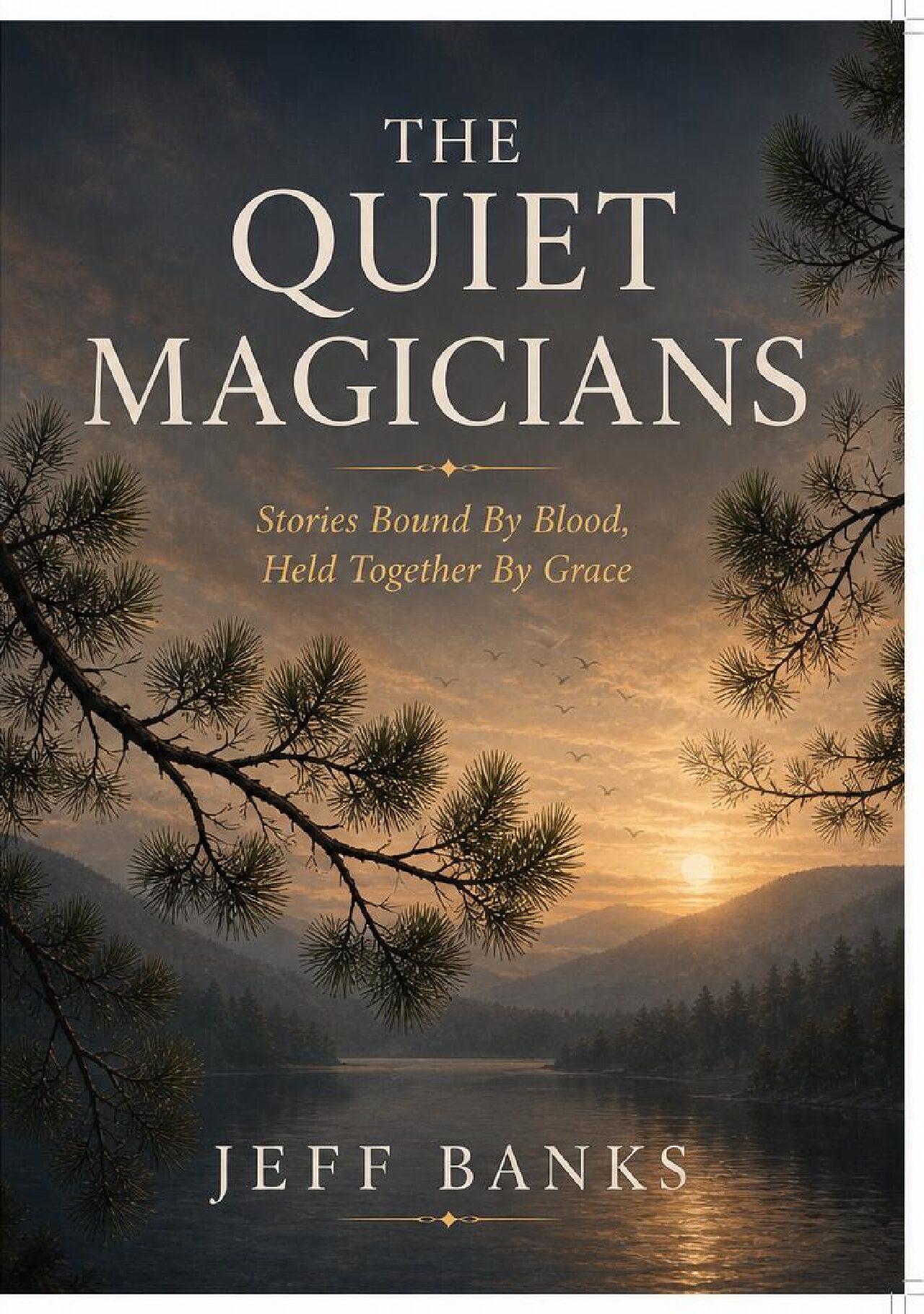
THE QUIET MAGICIANS - Chapter 13 - Fighting in a Mans World

THE QUIET MAGICIANS - Chapter 13 - Fighting in a Mans World | Travelling Around Australia with Jeff Banks

When I think of her now, I do not think first of titles, committees, job descriptions, or even achievements, substantial though they were. I think of the constant thread running underneath them all: a person who refused to be made smaller by circumstance. A girl expected to fit one mould built her own. A sister wounded by loss carried on. A worker undervalued became indispensable. A late mother poured fuel into the next generation. A retiree found fresh usefulness where others might have settled for idleness

THE QUIET MAGICIANS

Chapter 13 – Fighting in a Mans World

Stories Bound by Blood, Held Together by Grace

There are people who walk into a room and announce themselves with noise, height, title, or sheer confidence. Then there are those who arrive armed with something far more dangerous: competence. My wife has never needed much help from the first group because she spent a lifetime becoming part of the second. If she sometimes raised her voice along the way, it was only because the world had an odd habit of speaking over her first.

She came into life as the second of five, which in many families is a position of relative comfort. You are close enough to the front to know what is happening and far enough from the rear to avoid some of the blame. But families are living things, and tragedy rearranges furniture no one intended to move. When her older sister was murdered, the mathematics of birth order ceased to matter. She was thrust forward into a role she had not applied for, made oldest not by time but by loss. Some people inherit jewellery or recipes. She inherited gravity.

That sort of inheritance does something to a person. It can harden them, soften them, or make them permanently alert. In her case, it sharpened the instinct to be heard before the next silence arrived. She had what I have occasionally, and with affection, called little person syndrome. Not in any physical sense, but in the emotional architecture of someone who learns early that if they do not project themselves, larger bodies and louder personalities will simply step around them as though they were furniture.

So she fought. She fought first in the small domestic parliament of siblings, where her younger brother developed the art of provocation long before any of them understood diplomacy. She fought for room at the table, for the right to finish a sentence, for the principle that volume should not be mistaken for correctness. Those early battles, fought over bathrooms, last sausages, family pecking order, and who touched what, were better training than half the management courses sold to executives later in life.

Then she met a broader opponent: the era itself. She came of age in a time when many institutions still regarded girls’ education as decorative. Learn enough to be presentable, enough to converse, enough to raise children respectably, but not so much that you became inconvenient. The assumption sat in the walls more than the textbooks. It was there in lowered expectations, in careers gently steered elsewhere, in praise given for neatness rather than intellect.

She was not built for neat little boxes. If anything, being underestimated acted on her like oxygen on flame. The more someone implied a ceiling, the more interested she became in climbing through it. She had that particular kind of intelligence often ignored by formal systems: practical, retentive, detail-oriented, stubbornly curious, and entirely unimpressed by bluster. She could smell nonsense before it finished introducing itself.

That talent took her into the world of large organisations, where many people survive by appearing to know things and a smaller number actually do. She entered the specialised field of food regulatory affairs, which sounds dull until one realises it sits at the crossroads of science, law, commerce, public health, politics, and human laziness. It is where labels matter, ingredients matter, wording matters, and one misplaced decimal can become tomorrow’s headline.

In such environments, there are always those who mistake glamour for importance. They drift toward marketing, media, or boardroom theatre while someone else quietly keeps the machinery legal. My wife became one of the someone elses. She made a name for herself in an area where reputations are not built by applause but by accuracy. When peers need answers, they do not seek the charismatic fool. They seek the person who has been right before.

Her appointment to a national authority as an industry representative said more than plaques ever could. Bodies like that do not invite passengers. They need people who know the terrain, understand consequence, and can distinguish between what sounds good and what will actually work. She sat at tables many assumed people like her were never meant to reach, then proved more useful there than some who had always expected the seat.

For twenty-one years she held a position of authority that, like many such positions, paid less than the value extracted from it. This is another quiet comedy of modern life. Organisations will underpay the person carrying institutional memory, then spend fortunes replacing them badly when they leave. Yet she stayed, not from passivity, but from commitment, pride, and the old-fashioned belief that doing the job properly still mattered.

Even now, long after formal retirement from that world, people seek her advice. That tells you everything. Titles expire. Email signatures vanish. Corporate passes stop opening doors. But genuine expertise remains in circulation because others remember where the real answers used to come from.

She was never only her work. Somewhere amidst regulations, meetings, standards, and people who confused urgency with importance, she became a Scout Leader. That role suited her more than some executives’ titles ever did. Scouting rewards those who can organise chaos, tolerate damp children, tie knots under pressure, and maintain standards while appearing cheerful. In short, it was perfect preparation for marriage.

Leadership in those settings is rarely glamorous. It is clipboards, patience, forgotten forms, burnt sausages, weather forecasts, and children discovering independence one scraped knee at a time. She had a gift for it because she understood structure without becoming rigid. Rules were there to help growth, not suffocate it. Many adults never learn that distinction.

Then, at forty, she became a mother herself. There are people who speak of parenthood as though it is a natural sequence, one item after another on life’s conveyor belt. For others it arrives later, harder won, more consciously treasured. She brought to motherhood everything she brought elsewhere: determination, vigilance, standards, humour, and the occasional capacity to stare someone into improved behaviour.

Our daughter inherited plenty from her. Not merely drive, though there is that. Not merely the desire to learn, though that too runs strongly. She inherited the instinct to lead people toward water and somehow make them think drinking was their own idea. Some call it influence. Some call it guidance. Some, when on the receiving end, call it being managed. Families know all three terms can mean the same thing.

When the time came for shifts in our own working lives, she retired from one sphere only to walk into another, joining the accounting practice. That transition amused me. Some people retire into gardening, bowls, or caravans. She retired into debtors, workflow, clients who could not find the attachment clearly clipped to the email, and the timeless miracle of people wanting urgent help with matters they ignored for eleven months.

Yet she understood small business because she had lived within large systems and knew what smaller operators were up against. She also knew that regulation does not disappear because turnover is modest. In many industries, the smallest players are expected to navigate the same maze as the largest, just with fewer staff, less money, and no legal department.

So she did something very much in character. She stepped forward by stepping backward. Rather than chase status, she opened a business to help small operators with labelling requirements. It was classic her: practical, niche, necessary, underappreciated by those who most needed it. In a world where packaging can determine legality, trust, shelf access, and customer safety, she chose to help the people least equipped to manage it.

Labelling is one of those subjects the public barely notices until it goes wrong. A missing allergen warning, an incorrect claim, misleading wording, wrong nutritional panel, poor compliance wording, suddenly everyone cares. Until then, it is treated like administrative wallpaper. She understood that hidden things often carry the biggest consequences.

What she also understood was the peculiar morality of the micro-business world, where “near enough” is often mistaken for strategy. Some believed if the font looked tidy and no one complained, all must be well. Others assumed rules only applied to corporations. She knew better. Near enough may be good enough in backyard cricket. It is less persuasive when regulators come calling.

Living with someone like this can be educational. You learn that shopping is slower when labels are read properly. You learn that vague claims on packets provoke muttering. You learn that “natural” can be one of the most elastic words in commerce. You also learn that intelligence paired with persistence creates a force field around nonsense.

She is not without contradictions, which is fortunate because perfection is exhausting company. She can be deeply generous and magnificently impatient, nurturing and formidable, intensely loyal and entirely capable of cutting through foolishness with one sentence. She will help people beyond reason, then wonder aloud why people are unreasonable. She likes standards, but often spends herself compensating for those who have none.

There were times outsiders likely saw only the sharper edges. Strong women are often described by the world using language never applied to stubborn men. Direct becomes difficult. Certain becomes bossy. Capable becomes intimidating. Much of that says more about the observer than the observed. If she pushed hard, it was usually because slackness had already been given every chance.

What sits beneath it all, and what many miss, is care. Care for family. Care for getting things right. Care for fairness. Care for not wasting potential. Care for children, for work done properly, for words used accurately, for people not being cheated by ignorance or laziness. Some people express care through softness. Others express it through standards. She has always belonged more to the second category.

When I think of her now, I do not think first of titles, committees, job descriptions, or even achievements, substantial though they were. I think of the constant thread running underneath them all: a person who refused to be made smaller by circumstance. A girl expected to fit one mould built her own. A sister wounded by loss carried on. A worker undervalued became indispensable. A late mother poured fuel into the next generation. A retiree found fresh usefulness where others might have settled for idleness.

Some lives make noise. Others make structure. If you remove the second kind, the first soon collapses under its own echo. My wife has always been one of the builders, even when the world only noticed the walls long after she had laid the foundations.

Author

Menu