
THE BUSINESS WE MEANT TO BUILD - Chapter 9 - Stewardship Before Extraction

THE BUSINESS WE MEANT TO BUILD - Chapter 9 - Stewardship Before Extraction | Travelling Around Australia with Jeff Banks

Stewardship before extraction does not reject profit, ambition or personal reward. It asks that reward follow the creation of value without consuming the capacity required to create it again. It asks whether the business is being left stronger in reputation, people, systems, knowledge, cash and trust. Those are the things that allow a brand to last beyond a single year’s result or the amount sitting in the owner’s bank account at a particular moment.

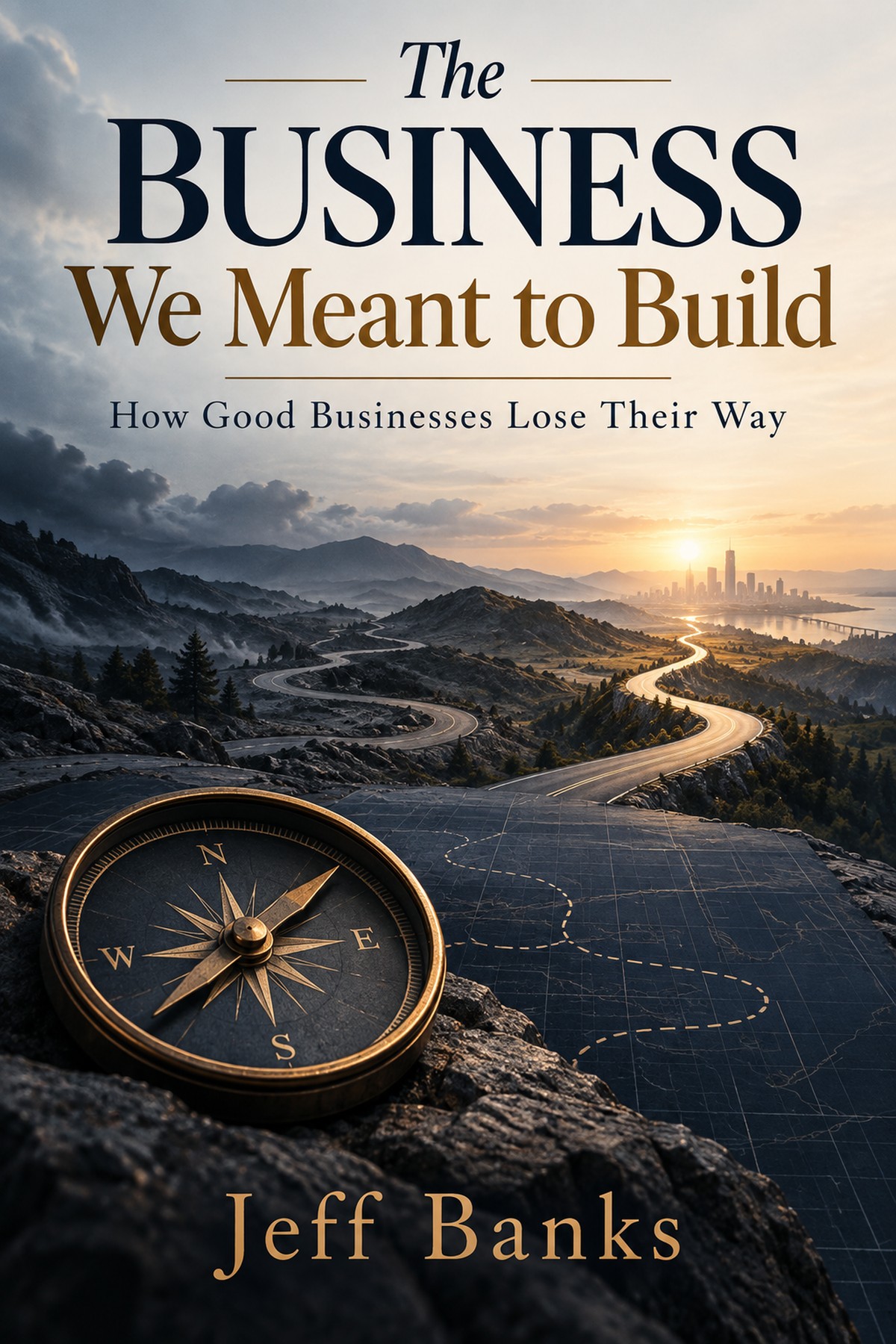
THE BUSINESS WE MEANT TO BUILD

How good businesses lose their way

Chapter 9 – Stewardship Before Extraction

In What the Accountant Saw, I wrote about what I came to call rose-coloured glasses syndrome. It appeared most often when people looked at an established business from the outside and concluded that its success must have been easier to create than it really was. They could see the customers, the turnover and perhaps the lifestyle of the owner, but they could not see the years of retained profits, careful decisions, damaged weekends, repaired mistakes and ordinary disciplines holding the whole thing together.

The glasses did not blind them completely, because complete blindness would have been easier to recognise. Instead, they softened the edges of everything uncomfortable. A recurring loss became an investment in the future, weakening cash flow became the price of growth, and an inadequate margin became evidence that the business was still establishing itself. The future was expected to repair the present, despite the future having contributed neither cash nor evidence that it had agreed to the arrangement.

I have seen the same thinking among owners who have already built something worthwhile. Their business has begun to produce a reasonable income, customers know the name and the owner feels that some reward is finally deserved. There is nothing improper about that reward, yet a subtle change can occur when the amount taken from the business becomes the primary measure of what the business is worth. Success becomes less about value created and more about value extracted.

That is part of the noise surrounding modern business. We are shown founders who sell, shareholders who distribute, executives who receive bonuses and owners whose lifestyles are presented as proof of commercial achievement. The amount removed from a business is often celebrated more loudly than the strength left behind. An owner may therefore begin to believe that a successful business is one capable of funding every expectation placed upon it, regardless of whether those expectations are weakening its ability to continue.

Capitalism does not require an apology. At its best, it rewards people who identify a need, take a risk, create value and provide something for which another person is prepared to pay. Profit allows a business to employ people, invest, improve, meet its obligations and survive the difficult periods that eventually visit most enterprises. The problem is not the creation or enjoyment of profit, but the assumption that every available dollar is now the owner’s reward rather than part of the business’s continuing capacity.

Perhaps the better question is not how much the owner can take from the business today. It may be how much the business can provide without weakening what it must still do tomorrow. That question moves us away from entitlement and towards stewardship, which is the acceptance that ownership carries responsibility for the condition in which the business is maintained. A business may belong legally to its owner, but it also supports employees, customers, suppliers, families and communities that have come to rely upon its continued competence.

Stewardship does not mean preserving the business at the expense of the human being who owns it. I have spent enough of my life allowing work to occupy places it had no right to occupy, and there is nothing noble about maintaining a healthy balance sheet while gradually exhausting the person responsible for it. The business should serve a life rather than consume it. Even so, serving a life is different from being stripped to finance a lifestyle it can no longer afford.

Extraction can be obvious, but it is more often gradual. It may involve drawings that increase each time turnover improves but never reduce when margins tighten. It may be a vehicle, holiday or property commitment justified on the basis that the business is now successful enough to pay for it. It may also be less visible, appearing through the failure to replace equipment, maintain systems, train employees, fund tax obligations or retain sufficient working capital.

Each decision may appear reasonable when viewed alone. The owner has worked hard, the tax deduction is available, the purchase may be useful and the cash is sitting in the account. The danger appears when the decisions are considered together and the business is expected to fund the owner’s present while also repairing every weakness postponed into its future. What looks like reward may gradually become consumption of the very capacity required to continue producing it.

This is where the Discipline of Boring becomes more important than the glamour surrounding entrepreneurship. Stewardship is demonstrated through ordinary acts: retaining enough cash, paying suppliers properly, reviewing margins, training people, documenting knowledge, maintaining equipment and protecting the standard promised to customers. None of those actions is likely to produce a dramatic photograph for social media. They are nevertheless the work through which a business remains capable of honouring its promises.

The numbers remain important, but business has never been only about numbers. Reputation, trust, knowledge, patience and reliability rarely appear as separately valued assets in a set of accounts, although their absence eventually appears in the figures. Customers leave, employees disengage, suppliers become less accommodating and the margin begins to carry the cost of relationships that were treated as expendable. By the time the financial statements confirm the damage, much of the real loss may already have occurred.

Reputation is particularly unforgiving. It takes years of consistency to establish and can be weakened by a handful of decisions made in pursuit of short-term gain. An owner may improve one month’s result by reducing quality, delaying payment, cutting service or placing unsustainable pressure on employees. The bank balance may rise, but the business has borrowed from trust, and trust does not send a monthly statement showing the interest accumulating.

This is where narrow thinking can appear intelligent because it produces an immediate answer. The owner asks whether a decision will increase profit, reduce tax or release cash, and the answer may be yes. A wider question might ask what the decision does to the business’s capacity, reputation and relationships over the next three years. Both questions involve numbers, but only one considers whether the vehicle is being strengthened for the remainder of the journey.

I sometimes wonder how we arrived at a position where extraction became such a persuasive symbol of success. We admire the amount distributed, withdrawn or sold, yet rarely ask what remained in the business after the celebration. We speak about returns to owners more readily than returns to customers, employees or the community that allowed the business to exist. Perhaps the result is that value removal is praised as though it were indistinguishable from value creation.

A genuine “silent” partner should be prepared to examine that distinction. The word “silent” was always placed in quotation marks at Banks Consultancy because we were never promising to watch quietly while a client weakened the thing they had spent years building. The intention was to think like a partner without taking ownership of the dream. It meant understanding the business well enough to ask the uncomfortable question while leaving the final decision, and the consequences, with the owner.

Such an adviser might ask whether the owner’s lifestyle has moved ahead of the business’s ability to support it. They might ask which investments are being delayed, which obligations are being pushed forward and what part of the business is quietly being consumed to preserve the appearance of success. They may also ask whether the original purpose of the business remains visible. Those are not accusations, but they may reveal that the owner has begun funding a life built around the best year the business ever had.

Living beyond one’s means is not confined to households. A business can also become trapped by expectations formed during a particularly successful period. The owner may increase personal commitments, staffing, premises and fixed costs on the assumption that one strong year represents a permanent new normal. When conditions soften, the business is asked to work harder, draw deeper upon reserves and postpone more of the boring work necessary to rebuild its strength.

Rose-coloured glasses become useful at that point because they allow the owner to preserve the story they prefer. Reduced cash is explained as timing, unpaid tax becomes a temporary inconvenience and declining margins are blamed entirely upon the economy. Another sale, another customer or another busy month is expected to restore everything, even when additional activity is producing less actual return. The business may look busy enough to reassure everyone while becoming steadily less capable of supporting the life built upon it.

This does not make the owner foolish. Business decisions are rarely separated neatly from pride, identity, fear, family and the need to believe that previous sacrifices were worthwhile. I have held onto projects, relationships and expectations longer than the evidence justified because stopping would have required me to reconsider what had already been invested. Experience has taught me that recognising a mistake is difficult, but continuing to finance it can be considerably more expensive.

Self-accountability need not involve shame. It may simply mean asking whether today’s apparent win contributes to the final outcome or removes something the business will later need. Is the decision strengthening the vehicle, or is another part being removed while the destination remains unchanged? Is the owner enjoying a reasonable reward, or asking the future business to finance a present it has not yet earned?

There is also a deeper reason for considering stewardship. Most worthwhile businesses were created because someone saw a need and believed they could provide a solution. The customer was not merely a source of revenue standing between the owner and their dream; the customer was the reason the opportunity existed. When extraction weakens service, removes knowledge or eventually closes the business, the loss includes the disappearance of that solution.

This is where business for business’s sake becomes hollow. Growth, profit and reward may all be worthwhile, but they need some relationship to the purpose that gave the business life. We can become so occupied with building the vehicle that we forget where it was meant to take us, or so eager to enjoy the destination that we begin dismantling the vehicle before we arrive. A dream is not protected by the amount we say it matters, but by the standards we maintain while pursuing it.

CANEI belongs naturally within that stewardship. Constant and Never-Ending Improvement does not require continual expansion, constant reinvention or the pursuit of every new idea placed before us. It may mean becoming better at protecting the brand, developing people, serving customers, managing cash and making decisions that preserve future capacity. As the owner grows in judgement, the business should become a stronger reflection of that growth rather than merely a larger source of drawings.

What the Accountant Saw was never simply a book about figures. It was about what sat behind the figures, what people hoped they meant and what the evidence was sometimes trying to say despite the preferred explanation. Accounts may show how much was earned, distributed, retained or owed. They cannot decide whether the outcome remains worthy of the dream, although they can make the question increasingly difficult to avoid.

Stewardship before extraction does not reject profit, ambition or personal reward. It asks that reward follow the creation of value without consuming the capacity required to create it again. It asks whether the business is being left stronger in reputation, people, systems, knowledge, cash and trust. Those are the things that allow a brand to last beyond a single year’s result or the amount sitting in the owner’s bank account at a particular moment.

The final decision remains with the owner, as it should. They may choose what to draw, what to reinvest, which standards to protect and what legacy the business is intended to leave. Perhaps the question beneath the noise is whether today’s decision strengthens what will remain tomorrow or simply takes more from it now. A brand can survive many ordinary years, but it is far more easily tarnished when the dream is abandoned in favour of the short-term glare.

Author

Menu