
THE BUSINESS WE MEANT TO BUILD - Chapter 21 - The Courage to Stop

THE BUSINESS WE MEANT TO BUILD - Chapter 21 - The Courage to Stop | Travelling Around Australia with Jeff Banks

There is no shame in discovering that an idea was wrong, nor does closing something automatically make the original decision foolish. Business decisions are made using the information available at the time, and hindsight has the unfair advantage of knowing what happened next. The weakness does not necessarily lie in getting the first decision wrong; it may lie in refusing to revisit that decision after the evidence has changed.

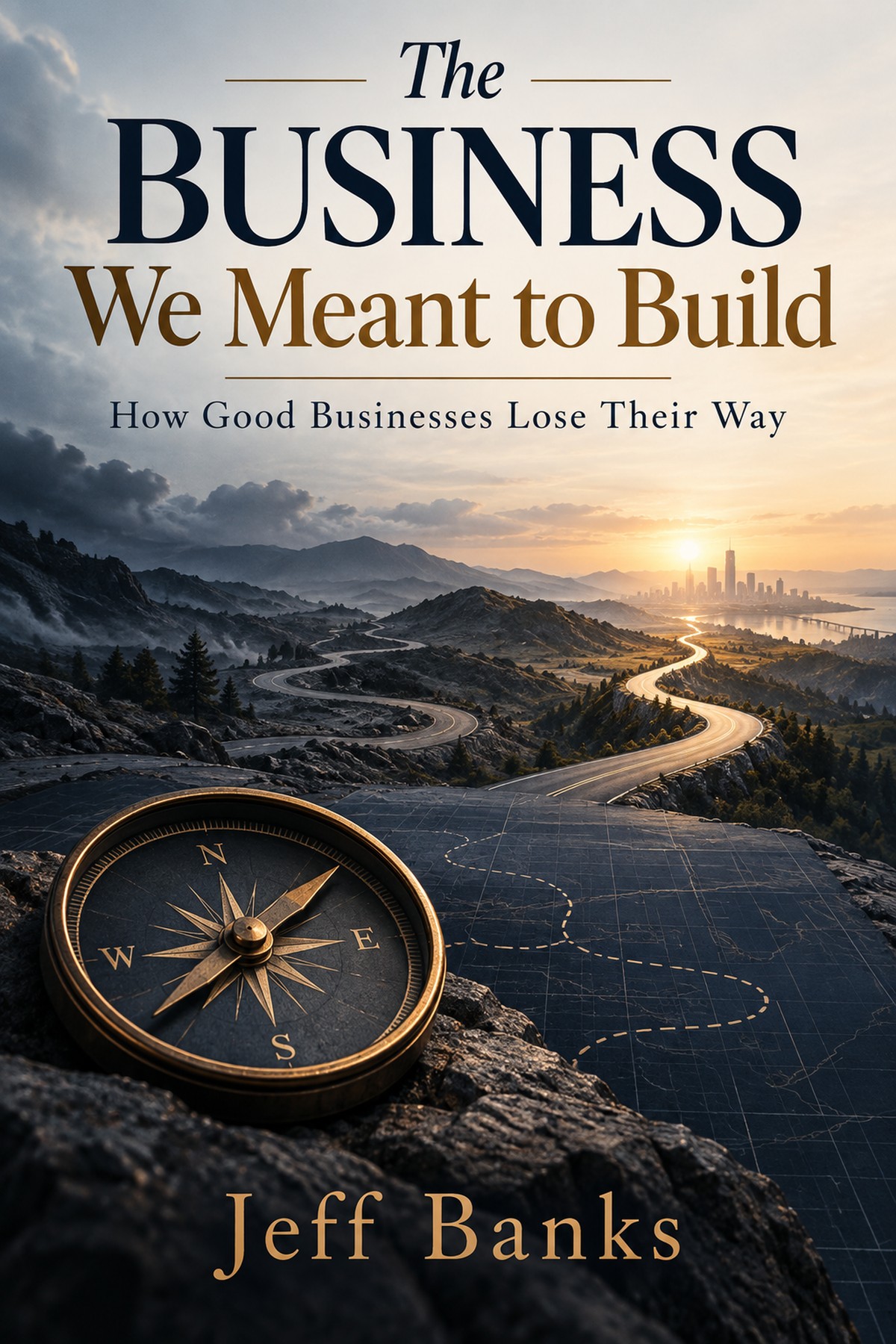
THE BUSINESS WE MEANT TO BUILD

How good businesses lose their way

Chapter 21 – The Courage to Stop

I have sat across the desk from business owners who have known, long before they were prepared to say it aloud, that something was no longer working. The project had consumed more money than expected, taken twice as long as planned and begun stealing attention from the part of the business that actually paid the bills. Yet almost inevitably there would come a point in the conversation where somebody would say, “We can’t stop now. Look how much we’ve already put into it.”

That sentence has probably kept more bad ideas alive than many genuinely bad business decisions ever could. It sounds responsible because it carries words such as commitment, persistence and determination somewhere in its background, but sometimes it is simply fear dressed in respectable clothing. What has already been spent may explain how we arrived at today, but it does not automatically justify spending another dollar tomorrow.

Business loves stories about persistence. We celebrate the entrepreneur who was rejected fifty times before somebody finally said yes, the inventor who failed repeatedly before finding the answer and the business owner who mortgaged everything because they believed so strongly in what they were building. Those stories deserve their place because resilience matters, but the problem begins when we convert somebody else’s eventual success into a universal instruction that stopping is somehow evidence of weakness.

Perhaps the more uncomfortable truth is that persistence and stubbornness can look remarkably similar from the inside. Both involve continuing when things are difficult, both can require courage and both can attract admiration from people standing outside the business. The difference may only become obvious when we ask whether we are still pursuing a sound objective or merely defending the decisions that brought us this far.

Accountants have a particularly unromantic expression for part of this problem: sunk cost. In ordinary language, it simply means that the money already spent is gone whether we continue or stop, and therefore yesterday’s expenditure should not be allowed to decide tomorrow’s investment. That sounds perfectly logical when written in a textbook, yet it becomes considerably more difficult when the sunk cost contains two years of your life, hundreds of thousands of dollars, a staff member you hired specifically for the project and a promise you confidently made to everybody around you.

Money is rarely the only thing that keeps us there. Ego becomes invested, reputation becomes invested and sometimes identity becomes invested because we have told the story so many times that abandoning the project begins to feel like abandoning part of ourselves. We remember telling the bank manager, our spouse, our employees and perhaps a room full of customers how important this project would become, and suddenly stopping seems to require an explanation we would rather not give.

That is where persistence can quietly stop serving the dream and begin serving the past. We tell ourselves we are showing character when what we may really be doing is avoiding embarrassment, postponing an admission or hoping that one more injection of money will somehow validate everything that came before it. The project ceases to be judged by what it can become and begins to be protected because of what it has already cost.

I have often thought this is one of the more difficult conversations a genuine adviser can have with a business owner. The job is not to walk into the room, thump the table and announce that the project should be killed, because the adviser does not own the dream and will not carry every consequence of the decision. The role of the “silent” partner is different: understand enough of the business to ask the question the owner may have been avoiding, then leave the ownership of the answer exactly where it belongs.

One of those questions might be surprisingly simple: if this opportunity appeared today, with everything we now know, would we invest in it? Not whether we can recover what has already been spent, not whether stopping would look embarrassing and not whether the original idea was foolish, because none of those questions help much with the decision in front of us. The useful question is whether the next dollar, the next month and the next piece of management attention still deserve to be committed.

The numbers can help because they are usually less sentimental than we are. They may show that the expected margin never arrived, that the sales assumptions were too optimistic, that the project is consuming working capital or that every improvement requires another layer of expenditure simply to keep the original promise alive. Numbers do not make the decision for us, but they can make it increasingly difficult to pretend that nothing has changed.

This is where What the Accountant Saw sits quietly beneath the discussion. Numbers are rarely interesting merely because they are numbers; their importance comes from what they reveal about behaviour, assumptions and consequences. Sometimes the most useful thing an accountant can do is not calculate another forecast but ask why the previous three forecasts were wrong and whether the latest one contains anything materially different beyond a renewed dose of optimism.

There is also a strange moral judgement we sometimes attach to stopping. We describe people who continue as committed, determined and courageous, while those who withdraw risk being described as having given up. Yet there are circumstances where continuing requires very little courage because it simply avoids the more difficult conversation, while stopping requires the owner to admit that circumstances have changed, the assumptions were wrong or the original idea simply did not survive contact with reality.

That is not the same as suggesting businesses should abandon projects whenever they become difficult. Almost anything worthwhile encounters resistance, and a business that changes direction at every setback will achieve little more than permanent motion. The challenge is not deciding whether difficulty exists; it is determining whether the difficulty is part of building something worthwhile or evidence that we are attempting to force life into something that no longer deserves it.

Perhaps that distinction deserves more attention when a project begins. We are usually very good at setting targets for what success should look like, but far less enthusiastic about defining what would cause us to stop. We prepare sales forecasts, budgets, launch dates and growth expectations, yet rarely write down the conditions under which we would admit that the assumptions had failed.

There is considerable strength in deciding some of those things before emotion gets involved. A project might be reviewed if expenditure exceeds an agreed amount, if customer uptake remains below a certain level, if the margin cannot reach an acceptable point or if continuing begins damaging the core business that was meant to fund the opportunity. These are not automatic execution orders; they are warning lights designed to force a conversation while choices still exist.

That last part matters more than it may first appear, because warning lights have a habit of becoming background decoration when we do not particularly like what they are warning us about. One missed target can be explained, one disappointing month can be seasonal and one unexpected expense can genuinely be unusual. The difficulty begins when every warning sign acquires an explanation but none of those explanations results in the underlying problem changing.

That is where 20 Days Too Late becomes relevant to this discussion, because much of that book was built around the observation that business problems rarely begin as emergencies. A slow-paying customer becomes a timing issue, a shrinking margin becomes the cost of doing business, a staff problem becomes something we will deal with later and a cash squeeze is expected to fix itself next month. None of those things necessarily demands panic, but each may deserve attention before habit, hope and delay begin narrowing the choices available.

The title 20 Days Too Late was never really about twenty days. It was about the habit of waiting until a problem changes shape before deciding it deserves our attention, because there is an enormous difference between choosing to stop something and eventually discovering that circumstances have stopped it for us. The first can still leave room for planning, negotiation and the orderly redeployment of money and people; the second often leaves us discussing creditors, refinancing, redundancies and damage control.

That difference may be one of the most important parts of the courage to stop. If we wait until the bank refuses further funding, until the supplier removes terms, until the tax debt becomes unmanageable or until the core business can no longer support the experiment, we may no longer be making a decision at all. We may simply be witnessing the consequences of decisions we postponed.

Perhaps another warning sign therefore sits not within the numbers but within the conversations surrounding them. Are we still discussing how to improve the project, or have most of our conversations become explanations for why the warning signs do not matter? When every falling margin has a reason, every missed target was caused by something unusual and every request for more money arrives with an assurance that this really will be the last one, it may be worth asking whether we are still examining the project or merely defending it.

The same applies when advice is sought. There is a point at which an accountant, adviser or mentor can help reshape a decision, and another point where they are largely being asked to explain the consequences of what has already happened. Advice received early may preserve alternatives, while advice sought after the alternatives disappear becomes something closer to an autopsy.

That is one of the threads running through 20 Days Too Late. Business owners often know more about an emerging problem than they initially admit to themselves, because the warning signs are usually present long before the crisis receives its name. The issue is not necessarily whether we could have predicted everything that happened, but whether we were paying attention to what was already happening.

This also sits comfortably with CANEI, although at first glance stopping something may appear to contradict the idea of Constant and Never-Ending Improvement. Improvement does not mean endlessly repairing every idea we have ever had, nor does it require us to preserve every initiative simply because we once believed in it. Sometimes improvement involves changing the process, sometimes it involves changing direction and sometimes the best improvement available is freeing people, money and attention from something that no longer deserves them.

There is a temptation to assume that cancelling a project represents going backwards, particularly when progress has been measured by how much has already been built. Yet CANEI is about getting better, not simply getting further along whatever road we happen to have chosen. If experience shows that the road is taking us somewhere we no longer wish to go, continuing merely because we have travelled a long way does not suddenly make the destination more attractive.

The Discipline of Boring has a role here as well. It is far easier to become excited about launching the next stage than to sit with the monthly figures and ask whether the last stage achieved what we said it would, but that ordinary review is where much of the truth tends to hide. Cash flow, margins, debtor levels, customer behaviour and management time are not nearly as romantic as vision, but dreams funded without regard to those things eventually discover that romance does not pay wages.

There is another cost that rarely appears neatly on the profit and loss statement, and that is opportunity cost. Every hour spent rescuing a failing project is an hour that cannot be spent strengthening something else, and every dollar committed to protecting yesterday is unavailable for tomorrow. Sometimes the real question is not how much we will lose by stopping, but what we continue to lose because we refuse to stop.

That can become particularly uncomfortable in owner-operated businesses because business decisions rarely remain confined to business. More borrowings may affect the family home, another six months may mean another six months of working nights, and another attempt to fix the problem may involve staff who have already lost confidence in what they are being asked to do. A project can therefore survive financially long after it has stopped making sense personally, which is why the owner’s definition of success still matters.

There may even be times when closing a project protects the original dream rather than abandons it. If the business was created to provide independence, security, satisfaction or a particular way of living, it is worth asking whether preserving one unsuccessful venture has begun threatening everything the owner wanted the business to provide. The question from The Little Blue School Book then becomes relevant again: whose definition of success are we trying to satisfy, and has proving that we were right become more important than building the life we originally intended?

This is not an argument in favour of quitting. It is an argument in favour of making continuation earn its place just as the original investment had to earn its place, because the fact that we started something does not grant it a permanent claim upon our resources. Persistence remains one of the great business strengths, but persistence without review can become nothing more than inertia with a motivational poster attached.

Before putting another dollar into a struggling project, I would want to understand what has actually changed since the last decision to continue. I would want to know what evidence suggests the next six months will produce something different, what the project is costing beyond the obvious expenditure and whether the owner is defending an opportunity or defending themselves. Most importantly, I would want to know what success now looks like, because projects sometimes remain alive long after nobody can clearly explain what winning would actually mean.

I would also want to know which warning signs have already been normalised. Has the project required repeated extensions of the budget, are deadlines continually moving, has the business begun borrowing simply to protect money already spent, or has management attention been dragged away from profitable work to rescue something that is perpetually almost there? None of those signs alone necessarily condemns a project, but collectively they may be asking for more than another optimistic forecast.

There is no shame in discovering that an idea was wrong, nor does closing something automatically make the original decision foolish. Business decisions are made using the information available at the time, and hindsight has the unfair advantage of knowing what happened next. The weakness does not necessarily lie in getting the first decision wrong; it may lie in refusing to revisit that decision after the evidence has changed.

That may ultimately be where What the Accountant Saw and 20 Days Too Late meet. One asks us to look behind the figures and understand what they are trying to tell us, while the other reminds us that listening eventually becomes less useful if we keep postponing the response. Recognising a warning sign is valuable, but recognising it while something can still be done about it is considerably more valuable.

Perhaps that is the real courage involved in stopping. It is the willingness to separate ourselves from yesterday’s decision long enough to judge tomorrow on its own merits, while accepting that persistence is valuable only when the destination still deserves the journey. A dream deserves commitment, patience and the willingness to push through difficulty, but it also deserves enough honesty to stop feeding something that has begun taking us further away from it.

The final decision will always belong to the owner because only they know what they are trying to build and what they are prepared to risk in building it. My role, whether as accountant, adviser or “silent” partner, has never been to choose that destination on their behalf, but I have often found that one question clears away a surprising amount of noise: if none of what we have already spent could be recovered, would we still choose to spend what comes next? The answer may still be yes, and if it is, perhaps we continue with renewed clarity; but if the answer is no, the courage may no longer lie in hanging on, and the greatest value may be recognising that while stopping is still a decision we are free to make.

Author

Menu