
THE BUSINESS WE MEANT TO BUILD - Chapter 3 - Old Rules in a New Economy

THE BUSINESS WE MEANT TO BUILD - Chapter 3 - Old Rules in a New Economy | Travelling Around Australia with Jeff Banks

There is nothing inadequate about slowing down long enough to ask whether an apparent improvement supports the journey. The owner may discover that the new tool saves time, strengthens service and deserves immediate adoption. They may instead discover that it introduces cost and distraction into a business that has not yet mastered invoicing, margins, debtor collection or the responsibilities already attached to operating. Both answers are possible, and neither should be predetermined by an adviser, commentator or article. The useful decision is the one reached after the noise has been turned down and the owner has listened again to the purpose of the business.

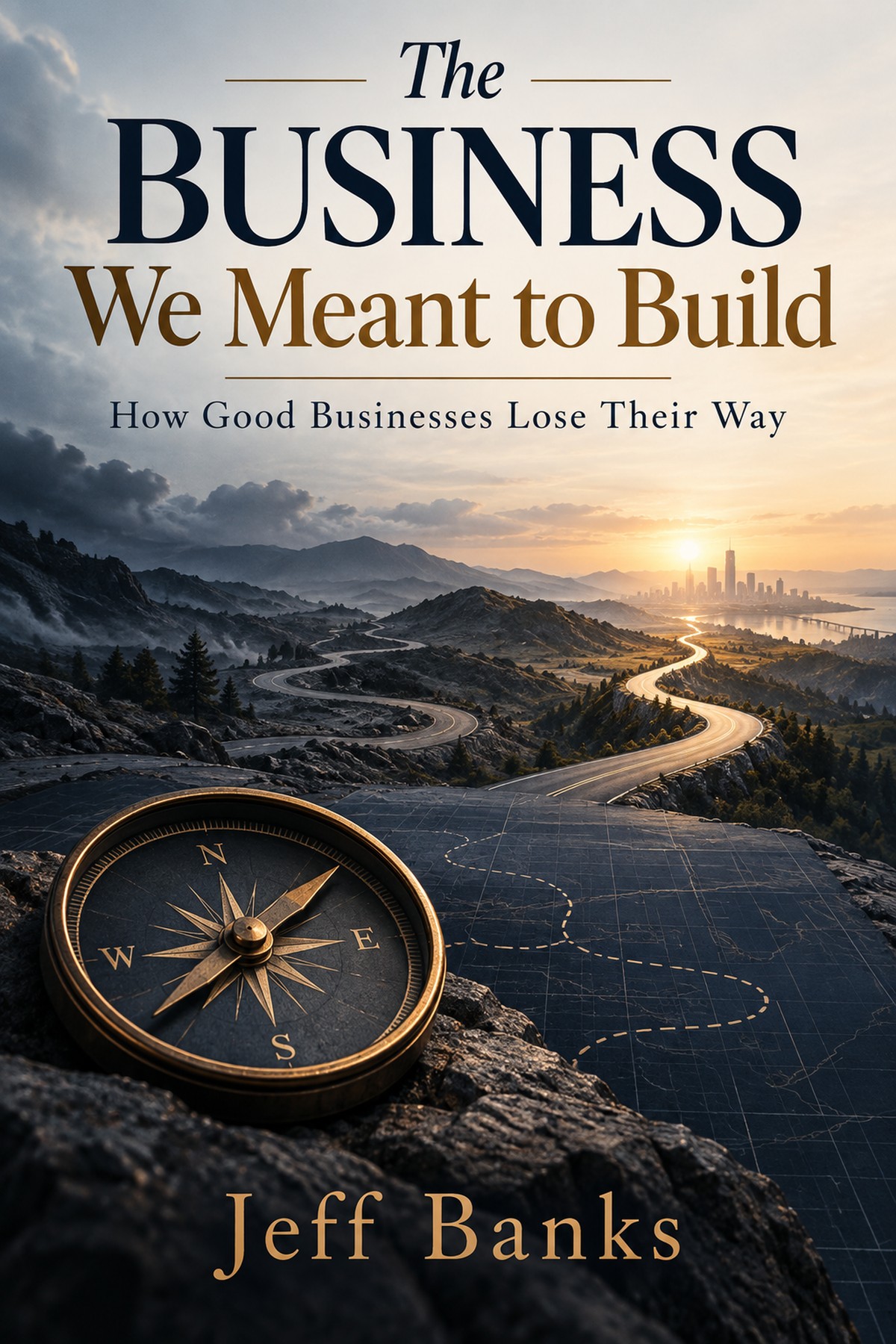
THE BUSINESS WE MEANT TO BUILD

How good businesses lose their way

Chapter 3 – Old Rules in a New Economy

I have often wondered how long it will take for the telephone to ring after the latest business sensation has been announced. Sometimes the call arrives within hours of a Federal Budget, a government press release or an economist explaining that everything we once understood is about to change. At other times it follows a breathless media report about artificial intelligence, interest rates, consumer confidence, a new tax measure or some other development apparently capable of transforming every business in Australia by lunchtime. The voice on the other end is usually concerned, occasionally excited and almost always asking the same underlying question: what do we need to do now?

It is a reasonable question because change is real. Technology changes the way businesses communicate, sell, produce, employ people and maintain records, while tax law and regulation continue to place new responsibilities upon owners. Customers behave differently, competitors arrive from places we could not once have imagined, and language that did not exist a decade ago now dominates business conversations. It would be foolish to pretend that none of this matters. What concerns me is not that business owners notice change, but that the noise surrounding change can become so loud that they lose sight of what has not changed at all.

A business must still create something of value for somebody willing and able to pay for it. Over time, it must collect more cash than it spends, price its work properly, understand its margins, manage its working capital and meet the promises it makes. It must maintain records capable of explaining what happened, provide for obligations before they fall due and make important decisions while useful choices remain available. Reputation still takes time to build and remarkably little time to damage. For all the new language surrounding business, these old principles remain remarkably stubborn.

Perhaps that is why they receive so little attention. There is not much excitement in suggesting that invoices should be issued promptly, debtors followed up, records reconciled, margins reviewed and tax liabilities provided for. Nobody is likely to fill a conference room by promising an afternoon devoted to reading agreements, checking prices and keeping commitments already made to customers. The shiny new thing offers something far more attractive: the possibility that improvement can be purchased without first confronting the weaknesses already sitting inside the business. The Discipline of Boring offers no such escape, which may be precisely why it remains useful.

The modern business owner is repeatedly encouraged to fear being left behind. Somebody else is adopting the latest technology, entering a new market, restructuring their workforce, appearing on another platform or following a strategy that supposedly produces extraordinary growth with surprisingly little effort. Before long, observation becomes comparison and comparison becomes anxiety. The owner begins moving not because the movement serves the dream, but because standing still for long enough to think feels dangerous. Fear of missing out becomes a business strategy, although nobody seems particularly interested in asking what the business may be missing while it rushes after everything else.

Keeping up with the Joneses has always carried a degree of risk, but in business the danger is greater because we rarely know what the Joneses are actually trying to achieve. Their appetite for growth may be different, their financial position may be stronger, their tolerance for debt may be higher and their private circumstances may bear no resemblance to ours. They may even be making a dreadful mistake while presenting it beautifully on social media. Following them without understanding their destination is not progress. It is simply allowing somebody else’s movement to determine the direction of our own journey.

The better question may not be whether the latest development is useful, but whether it is useful here. What problem will it solve, what result is it meant to produce and how will we know whether it has worked? What will it cost in money, training, disruption, attention and responsibility, and which existing commitments will receive less attention while it is introduced? A tool may be genuinely valuable while still being wrong for a particular business at a particular time. Newness tells us when something arrived, but it tells us very little about whether we need it.

This is where the first reaction to sensationalised business news should perhaps be a little slower than the media would prefer. Are we dealing with enacted law, proposed legislation, a policy announcement, a press release, an economic forecast or merely somebody’s interpretation of what may happen next? Those categories are not interchangeable, although they often become tangled together by the time the urgent telephone call arrives. Advice sought after a law has changed may require immediate attention, while a prediction about what might happen deserves a different response. Before wandering down the rabbit hole, I would want to know whether it leads towards the long-term goal or simply gives us somewhere energetic to disappear.

The old Banks Consultancy promise that we would drag clients kicking and screaming to compliance was never based upon a love of forms, deadlines or government departments. It arose from watching what happened when manageable obligations were ignored until they became crises. Poor records narrowed choices, late decisions increased costs and liabilities that had not been provided for eventually demanded cash the business no longer possessed. The modern expression of that pillar should not require anybody to be dragged anywhere. It should help owners understand that compliance is one of the disciplines protecting their freedom to continue pursuing the dream.

There is an important distinction between sticking to the rules and refusing to change. Proper records, timely lodgements, adequate provisions and a willingness to understand obligations do not prevent innovation; they provide the foundation from which innovation can be judged. A business that understands its cash flow and margins is better equipped to evaluate new technology than one relying upon instinct and enthusiasm. An owner who knows what is due, when it is due and how it will be funded can take calculated risks without pretending risk has disappeared. Compliance may look backward because it records what has happened, but strong compliance improves the quality of decisions about what happens next.

This is also where stewardship should come before extraction. A business is not merely something from which the owner takes income, status or opportunity; it is something entrusted to them for as long as they choose to operate it. Stewardship asks whether the business is being maintained properly, whether its people and customers are being treated with respect and whether today’s decisions strengthen or weaken tomorrow’s choices. It does not reject profit, because profit is essential to survival and renewal. It simply recognises that extracting everything available today may leave very little capable of supporting the dream tomorrow.

The underlying principle of business remains simple, although simple should never be confused with easy. Create value, charge properly, collect the money, control costs, protect cash flow, keep promises and improve what genuinely needs improvement. Complexity may be unavoidable around those activities, particularly as businesses grow and regulation expands, but complexity should serve the core rather than conceal it. When the explanation becomes so elaborate that nobody can identify how the proposal improves value, cash, margin, service or risk, it may be worth asking whether we have mistaken movement for progress. Sometimes the smartest business decision is not another initiative, but a return to the work already known to matter.

CANEI, Constant and Never-Ending Improvement, belongs naturally within this discussion because improvement does not require continual reinvention. A business may not need to become larger, louder or more complicated, but it can still improve the way it serves customers, trains people, monitors cash, reviews prices and follows through on commitments. The latest technology may assist that improvement, and where it does, it deserves proper consideration. It should not, however, become a convenient substitute for improving the process it was purchased to support. Automating confusion generally produces confusion more quickly, which is not quite the breakthrough promised in the brochure.

A genuine “silent” partner would therefore resist the temptation to answer the urgent telephone call with an equally urgent instruction. They might first ask what has actually changed, whether it applies to this business and what decision is required today. They would want to understand whether the owner is responding to evidence or anxiety, and whether the proposed action strengthens the destination already chosen. Most importantly, they would not replace the owner’s dream with their own enthusiasm for the latest idea. The adviser’s role is to improve the quality of the owner’s thinking, not to enjoy the temporary authority of taking control.

These questions run quietly through my three business books. The Little Blue School Book asks whose definition of success is driving the journey and whether the owner is still pursuing something that genuinely belongs to them. What the Accountant Saw looks beyond the explanation towards the evidence, asking what the numbers, behaviours and warning signs may be trying to reveal. 20 Days Too Late reminds us that timing matters because a choice available today may become an explanation required tomorrow. Together, they suggest that business strength rarely arrives through a single dramatic discovery; it is more often built through direction, observation and decisions made before neglect removes the options.

How Did We Get Here grew from my frustration at watching common sense disappear beneath noise, complication and accepted explanations that nobody seemed willing to question. Dumbing It Down emerged from the related concern that people were being encouraged to repeat conclusions rather than examine them. I still feel that frustration when a headline, seminar or new business fashion sends otherwise thoughtful owners rushing towards a solution before they have defined the problem. The frustration is not directed at the owner because the pressure to react is real and relentless. It is directed towards a business culture that repeatedly sells borrowed certainty while making careful thought appear slow, old-fashioned or somehow inadequate.

There is nothing inadequate about slowing down long enough to ask whether an apparent improvement supports the journey. The owner may discover that the new tool saves time, strengthens service and deserves immediate adoption. They may instead discover that it introduces cost and distraction into a business that has not yet mastered invoicing, margins, debtor collection or the responsibilities already attached to operating. Both answers are possible, and neither should be predetermined by an adviser, commentator or article. The useful decision is the one reached after the noise has been turned down and the owner has listened again to the purpose of the business.

Perhaps the practical reflection is therefore quite small. Are we looking at a genuine improvement, or are we trying to keep pace with people whose dreams may have nothing to do with ours? Are we responding to actual law and reliable evidence, or reacting to a press release, prediction or carefully manufactured urgency? Which part of the business has truly changed, and which old principle is merely wearing new clothes? The answers may lead us towards innovation, but they may also lead us back to the invoices, customers, records, prices, promises and responsibilities waiting patiently on the desk.

The economy will continue changing, and business owners will need to change with it. New tools will become useful, old practices will become inadequate and some accepted principles will deserve to be questioned. Yet the dream will still require focus, responsibility, sound judgement and the willingness to do ordinary things properly for longer than excitement usually lasts. The final step remains with the owner because nobody else can decide which habits and standards are worthy of the journey they claim to be pursuing. The language may change, the tools may change and the noise will certainly change, but the old rules still run true.

Author

Menu