

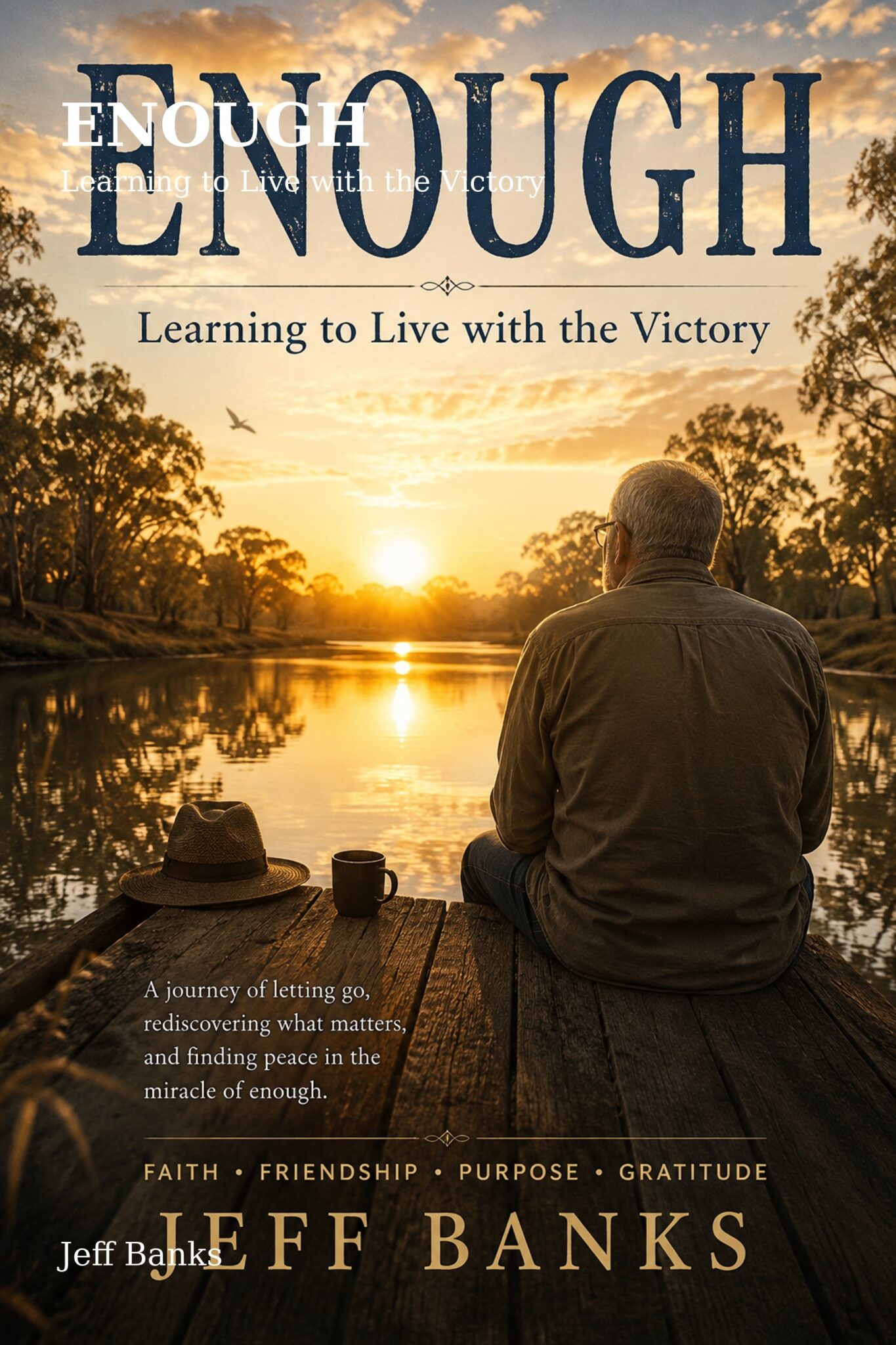
ENOUGH Chapter 5 - The Featherweight and the Ogre

ENOUGH Chapter 5 - The Featherweight and the Ogre | Travelling Around Australia with Jeff Banks

Neither building is there anymore, just grassy areas assumed by the golf course, and fading in the memory of those who wandered the streets of our youth.

Enough

Learning to Live with the Victory

Chapter 5 – The Featherweight and the Ogre

“In restless dreams I walk alone”. The halo of a street lamp in this case is the daylight poking through the gap in the curtains. Sleep has brought with it dreams of turmoil, reflections of conflict, past and present, some resolved, some not, but all fresh in the mind as I wake.

The subject matter very much the reasoning behind my walkabout as the struggle to hold all the balls of life in the air, when you have to mediate in a boxing ring seemingly of a featherweight versus an ogre, where the smaller version simply won’t see eye to eye with the larger or see both are integral to the referee. They are both an annoyance on the other, but both, meaningful in their individual journey of need, become the source of the very conflict they are trying to resolve.

It’s supposed to be raining today, but weather in this part of the world can be fickle. But it seems that sitting on the river bank being frustrated only with biting patterns of a quarry might be replaced with an unwillingness to consider the answer to life’s questions and fall back to the all knowing computer and just take 42 and move on. But to do that would be the coward’s way out, hiding under work, vain conversations and the silence of shut out.

I have taken the big step, now I need to continue that journey and not lose the perceived potential healing power of this place.

By the time restless movement starts we are quickly talking about dementia and settling precedents to allow one to simply go when the time comes. We recount watching family members, Aunty Robyn, Aunty Carolyn and recently Aunty Christine waste away as the disease went its inevitable path and with a presentation to be attended today by Aunty Kerre and Uncle Brolga, questions will be asked and plans put in place to ensure those left behind do not lose time caring for mindless bodies, lost in the realms of forgetfulness.

It’s not something I want to contemplate, at least not at this point of life. Yes, we watched and waited for my mother to pass all those years ago. But she was sound of mind right to the end, holding onto life as hard as she could before she finally succumbed with us all around. It was a tough time. Taking the children to say goodbye, again and again as the word that this was about to be the end was taxing, although the trip itself was at times quite amusing, especially with my oldest son Justin reprising his Russell Diperdomenico impressions.

The Business Blueprint A Team meeting comes and goes, allowing me to neatly sidestep one of those conversations that everyone knows matters but nobody seems in a rush to begin, particularly when the opening question comes from my aunt in the deceptively simple form of, Why am I really here? It is one of those questions that sounds conversational enough on the surface, almost casual in delivery, yet carries the sort of precision capable of cutting straight through every practical excuse already assembled. It ignores the fishing rods, steps over the timber in the trailer, and politely dismisses all the carefully prepared camouflage about “just getting away for a few days.”

And quite remarkably, I manage to avoid it, which says far more about human nature than perhaps I would care to admit. That, I suspect, is one of procrastination’s more impressive talents, because it rarely introduces itself honestly. It does not walk into the room wearing a badge announcing, I am now deliberately avoiding emotional discomfort. Instead, it arrives dressed in entirely respectable clothing, wearing the face of practicality, timing, responsibility, or unavoidable circumstance. In this case, it turns up disguised as a perfectly legitimate Business Blueprint A Team meeting, which makes the avoidance not merely easy, but morally defendable.

That is what makes procrastination in difficult conversations so wonderfully dangerous, because it is rarely about laziness. If anything, some of the most industrious people are absolute world champions at procrastination when emotional honesty is required. We will answer emails, reorganise sheds, sort tools, tidy files, research irrelevant subjects, fix machinery, prepare fishing tackle, or attend meetings with astonishing energy if doing so buys us temporary relief from saying the thing that most needs saying. The harder the conversation, the more attractive distraction becomes, particularly when the distraction itself appears productive.

That is the genius of emotional procrastination, because distraction feels useful. If one simply sat in a chair openly refusing to engage, the avoidance would be obvious, even to oneself. But if one remains busy, productive, and surrounded by entirely legitimate activity, avoidance becomes far harder to identify because it arrives disguised as responsible behaviour. I’m not avoiding this conversation, I’m just dealing with something important first. The problem, of course, is that “something important” has an extraordinary capacity to reproduce itself the moment emotional discomfort enters the equation.

There is always another interruption. Another meeting. Another task requiring attention. Another fishing session. Another practical job that suddenly feels urgent. Another conversation easier to have than the one hovering uncomfortably in the background. Because once the mind realises it can escape discomfort through activity, it becomes remarkably creative in manufacturing reasons to remain occupied. Procrastination, in that sense, is not passive at all. It is often highly energetic avoidance wearing the mask of admirable engagement.

It fascinates me how easily procrastination implants itself when the stakes are emotional rather than practical. Ask someone to assemble flat-pack furniture and procrastination might present itself through coffee breaks, mild swearing, or strategic bathroom visits. Ask someone to discuss grief, depression, purpose, ageing, regret, retirement, or why they are really here, and procrastination suddenly evolves into an Olympic-level performance. The stakes are simply different, because difficult conversations do not merely threaten awkwardness. They threaten self-image, emotional equilibrium, and sometimes the carefully maintained narratives we have built around ourselves.

That, perhaps, is the true issue with my aunt’s question, because answering Why am I really here? honestly is rather less straightforward than the socially acceptable versions suggest. If I say I am here to fish, everyone nods and the conversation remains easy. If I say I came to help collect timber, the story still works neatly enough. If I admit I am here because retirement has become unexpectedly repetitive, because the batteries are flatter than I would like, because the Black Dog occasionally circles closer than is comfortable, because I am struggling to reconnect with whatever freshness once animated ordinary life, then the tone changes rather dramatically.

And perhaps that is precisely why the Business Blueprint meeting becomes such an effective escape hatch, because legitimacy offers emotional cover. The meeting matters. It is not invented. It is not frivolous. It represents something genuinely requiring attention. That is what makes it such a beautifully effective tool of avoidance. Emotional procrastination rarely asks us to do obviously foolish things. It simply encourages us to prioritise slightly easier, equally respectable things first, until the moment for honesty quietly passes.

That may well be the cruellest part of the entire exercise, because the conversations we most need to have are often the ones most vulnerable to postponement precisely because they matter. Nobody procrastinates the emotionally irrelevant. We delay what threatens discomfort. We postpone what risks exposure. We defer what might require honesty not merely with others, but with ourselves. The mind, for all its intelligence, can be astonishingly gifted at protecting us from truths we claim to want.

So yes, the Business Blueprint A Team meeting comes and goes, and on paper nothing improper has occurred. The commitment was honoured. The time was used productively. The world continued spinning exactly as expected. Yet the real question remains sitting exactly where my aunt left it, patient, undiminished, and waiting for the moment when I finally run out of respectable places to hide.

With the meeting behind me, I wander outside to see what my aunt is up to. She is setting the animals out of their oversight containment. The chooks and turkeys start to peck the ground. The dogs race around, being nuisance value to both the recently released birds and those gathered now watching, as I enquire as to what is next, not wanting to restart the difficult conversation but simply seeking direction.

The one job that will need to be done today is to tend to the footsore horse. Thankfully they have gathered by the hay shed and are easily contained ready for my aunt’s return from the dementia talk. Trevor and I will be tasked with “wrangling” the miniature pony to allow inspection of the problem hoof. Hopefully it will be something like a stone bruise which will recover in time as opposed to something more sinister.

Although this is a working farm, the loss of an individual animal brings with it pain. If you ask after a certain animal, she will know. Being able to take one to an abattoir is never considered. They can be taken to the saleyards but not directly to the meat factory. The relationship is far too close for something as brutal as that.

Before any thought of the remedial actions for the horse there is a dementia clinic in town for Aunty Kerre who is not wanting to be a burden on her family should the affliction which has taken too many of her siblings attack her, she has put in place options for them. She is keen to see what the options are and is taking my Uncle Brolga, about to turn 80, with her, not in any sense of anything macabre, just to check out things, given the horrible incidences of recent times.

I have no reason to think I should accompany her. Mortality, or the end of it as I see it, I trust will see me broadside into a grave, in Maverick terms, “with your hair on fire”.

We have more mundane things to work on. The engraver sits on the table, reconstructed from its “original”, now apparently according to Trevor, in ready to work condition. It has to be said the interpretation of the instructions was something of a consideration that the viewer, as most of it was pictures, knew something about electronics, able to understand why tab A goes into slot B and more importantly knows the nuances of the difference between slot B and slot C. The attempts by the purchasers of the machine to replicate the pictures has resulted in something in reverse of the intention of the instructions.

Trevor is very keen to suggest they have done a job similar to how I may have attacked it or how he might have attacked preparing his own tax return.

I am a bit loathed to download the software required to my laptop for two reasons. The first being of course space on my hard drive, but realistically, most of my stuff is saved in the cloud away from my laptop, and secondly as the eventual end user, my cousin Tammy wont have access to anything I do to “make it right”, should the need arise.

I do it anyway and soon we have the laser cutting a South Sydney Rabbitohs logo into one of the pieces of timber sawn by Mitch. It’s a piece that won’t pass muster anyway, so losing it to attempts to make the laser work is no big loss.

The first attempt works apparently perfectly, although there is a mad dash for a fan as the smoke from wood being burnt quickly rises and suggests it might trigger the adjacent fire alarm. It’s a simple logo so I look for something more intricate and settle on the Australian Coat of Arms, and set the machine in motion again,

Again another perfect outcome. The last practice most certainly has to be a picture, and although I find a black and white photograph from my archives to print, I am yet to master the sizing of the output, something that I suspect will take lots of trial and error utilising time I do not have for now. What I get is a small black looking rectangle, which if you get close enough you can make out the images. Enough to suggest we are on the right track and now in a position to head back to its original owner.

That done, I head back to considering what is next when the phone rings. Its Kerre with a luncheon request for Trevor and I. She has met up with her very good friend Ann, the editor of the local newspaper, the Argus, who, having heard me speak at the recent funeral of Aunty Christine, and knowing through Aunty Kerre that I was writing books, wants to meet me.

We toddle off into town for the rendezvous. We meet up at Happy Daze, a play on words named cafe, and sit with our next new friends and talk over a hamburger and shake. Nothing is off the table, and nothing is opinionated, just discussed. One of those periods of conversations that can while away an afternoon without leaving anyone with a feeling of a need to escape.

Ann is confined to a wheelchair. Multiple Sclerosis eating away at her. The body may be failing but the mind runs at a million miles an hour. Aunty Kerre later confides in me, this lady, the Editor of the local newspaper, the Argus, does so much for the town of Condobollin, her town, and does it without the recognition she deserves. She does it because she sees a need and fills it. Where have I heard that before?

As well as the Argus she is presently seeking to plan a major golf tournament as a fundraiser for one of the many causes she patronises. Finding out my passion for Sandbar Golf, she is happy to allow me to impart the aspects of putting on such an event. Listening intently after her pitch.

She is very easy to talk to. Passionate without being in your face about it. Probably why she fails to get any of the recognition she truly deserves.

She also talks about programs, not unlike how my Rotary Club worked with Peak Hill Central School, but with far better thinking and outcomes, building confidence in local, not just Aboriginal children and young adults, as they embark on employment. There, she is very quick to add she is not alone in these pursuits, efforts have seen many locals employed locally, and that brings a warm feeling to any heat, but especially those in rural Australia, where we both agree governments are more about urban areas than the bush.

They close the restaurant around us, and we bid a mutual good byes as the rain continues to fall in the street. I take Trevor to see the house of my grandmother and Ann heads off not unlike Don Quixote, but with far more success, on her next quest.

The house in Aldis Street is still there, albeit a starkly different colour to that of its earlier history. It happens to presently be for sale which is interesting as it was Housing Commission back in the day. A two bedroom with an enclosed verandah or “sleep out” as it was called that over the years housed many a Ferguson. Not all of the 13 siblings and 2 adults, but many.

Without going into the history of the Ferguson clan, I take Trevor on a trip down memory lane as we drive towards the boundary of the golf course at the end of the street, three houses from my grandmother’s home, turn left as we did back when we walked when we were kids, heading to the dairy for milk in a bottle, to placate the tea drinkers in the family and, on very special days to Oppy’s “factory”, a palace that manufactured soft drinks.

Neither building is there anymore, just grassy areas assumed by the golf course, and fading in the memory of those who wandered the streets of our youth.

There is another house I want Trevor to see, but not of nostalgic significance. A house not far from the entrance to the golf course has multiple pitched areas of roof, every one with a solar panel. Trevor giggles, “must be a relative of Hunter’s” in a veiled sledge at a mutual friend who seems to have the need to have something bigger and better (often gawdier) than anyone else.

The giggling aside, it’s back to the Prairie and the horse with the sore foot. Rocket might be a miniature version of the equine species, but wrangling him won’t be easy. The foot is sore and he is not as “quiet” as the other horses on the farm, simply not having been interacting with people as much.

Four people around the animal and its anxiety raises. The first attempt to lift the hoof is met with the horse striking out at us, even though I am at its side, allowing it to lean on me. Unfortunately there is really only one way to attack this without laying the horse on its side like a sheep being taken to the shearing stand and that is to have Trevor at the front, just off centre to avoid any strike should the horse overpower us, have him in company with myself hold the horses head down, making it impossible for him to strike. This will also allow, hopefully, for full inspection of the hoof.

The horse is no taller than half way between my knee and hip, yet the power it can exert is almost too much for us to handle. But the job is done, even a pedicure is performed with an angle grinder, and the horse, placated with a handful of carrot pieces, gently walks on the hoof, that now cleaned out may have been simply stone bruised. That is the hope anyway.

On a roll we pedicure the other horses in the same manner, and even though the angle grinder is abhorrently noisy, they both “take their medicine”, especially as carrot pieces are the reward. Hopefully the injured horse may recover even more overnight as we let them back into the paddock where it limps away, perceptibly walking better than before, but now and again playing up to the crowd, or so it seems, by jumping forward in an apparent favouring of its offside front leg.

We lunched clearly, so dinner is not high on the agenda and the roast leg of lamb that was planned for tonight is put on hold in favour of pies and chips purchased by Trevor in an early morning foray into town. As well as the pies, he brought home some custard tarts onto which Aunty Kerre threatens to lash some ice cream for desert.

We didn’t fish today as the rain came. All 3mm of it, but it was enough for us to consider other options and the throwing in of lunch certainly was a “nice interlude”. What 3mm will do is not turn the red dirt to brown mud, allowing us to venture well into the wilderness seeking our pescatorial prey tomorrow. Thursday may be far different as rain is predicted again and we might bear the brunt of a good amount given today many towns around us did.

Author

Menu