

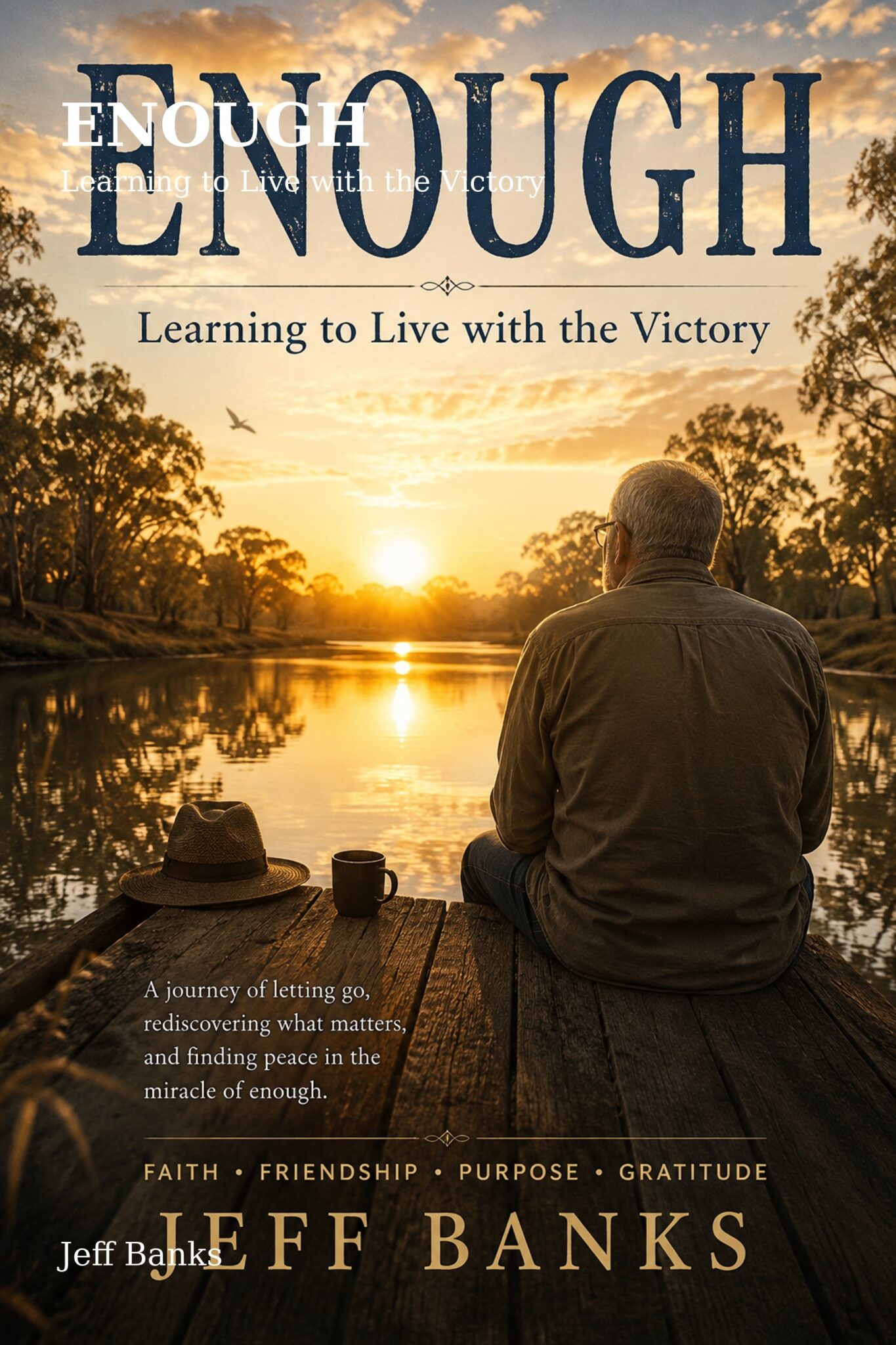
ENOUGH Chapter 1 - The Measure of a Friend

ENOUGH Chapter 1 - The Measure of a Friend | Travelling Around Australia with Jeff Banks

Yet perhaps some of the most important developments in life occur while pursuing something entirely different. Perhaps purpose emerges while being useful. Perhaps contentment emerges while contributing. Perhaps understanding emerges while living. Perhaps answers emerge while asking better questions rather than demanding immediate solutions.
Enough

Learning to Live with the Victory


This book is dedicated to my long suffering wife Robyn who hangs in there regardless and my sister Tracey a voracious reader of that which pours from my fingers. I love you both

Chapter 1 – The Measure of a Friend

My travelling companion would suggest he is a close friend, and when you look at the history, you would easily agree. He has been there in the dark days, offering a room when my first wife decided potential was not something easily lived with any more, especially when the pushing of the edge of the envelope seemed so close to failure that bankruptcy, coupled with the changes occurring in her own world, forced her away, taking the boys with her. In those days, when pride was in short supply and certainty even scarcer, he offered shelter without condition. There was no application process, no judgment, and no lecture. There was simply a room and the quiet understanding that sometimes a mate needs somewhere to land before he can figure out where he is going next.

By almost any reasonable measure, that qualifies as friendship. Yet friendship is one of those curious concepts that seems to mean entirely different things depending on who is defining it. Ask ten people what constitutes a friend and you will likely receive ten different answers. Some define friendship through frequency of contact. Others through shared experiences. Some through loyalty. Others through vulnerability. For some, a friend is someone they see every week. For others, it is someone they may not speak to for years but can immediately reconnect with as though no time has passed at all.

Perhaps that is why I have always struggled with the concept because I am not entirely sure my definition resembles that of most other people. It is not that I do not know many people. In fact, over a lifetime in business, community organisations, Rotary, golf clubs, networking groups, schools, Scouts, and countless other pursuits, I have met thousands. I know their stories. I know their families. I know their successes, failures, and struggles. Many would undoubtedly consider me a friend. Yet if I am brutally honest with myself, I have always held friendship to a standard so high that very few people have ever managed to qualify.

That may say more about me than it does about them.

I have often wondered whether I unconsciously confuse friendship with something deeper, something rarer, and perhaps something impossible to replicate. Acquaintances are easy. Colleagues are common. Mates are plentiful. People willing to share a beer, a laugh, a round of golf, or a conversation about life seem to appear throughout every stage of a person’s journey. Yet friendship, at least as I have always measured it, seems to require something else entirely. It requires trust of a different order. The sort of trust where explanations become unnecessary. The sort of trust where silence remains comfortable. The sort of trust where failure can be exposed without fear of judgment. The sort of trust where neither party is keeping score.

When viewed through that lens, the list becomes remarkably short.

As I sit here reflecting upon it, I realise my travelling companion and I may simply be operating from different definitions. He would likely see friendship in the history we share, the crises survived, the miles travelled, the countless conversations, the practical support exchanged, and the decades of mutual assistance. Looking objectively, he would be entirely justified in reaching that conclusion. Most people observing from the outside would probably reach the same conclusion. Yet somewhere inside me sits a different measuring stick, one I never consciously selected but have nevertheless carried for most of my life.

And if I am completely honest, there was only ever one person who fully satisfied that measure, and he had the unfortunate habit of dying on me before I was ready to let him go.

Even writing those words feels strangely uncomfortable because they carry a truth I rarely examine directly. Throughout life there was one person with whom the barriers simply did not exist. There was no need for performance. No need for explanation. No need to maintain an image. Conversations could wander anywhere. Failures could be exposed. Doubts could be voiced. Successes could be celebrated without envy or comparison. Silences could exist without awkwardness. The friendship was not maintained through effort or obligation. It simply existed in the same way breathing exists, requiring no conscious thought to sustain it.

When he died, something disappeared that was never truly replaced.

That absence was not created because others failed. It was not created because opportunities never arose. Nor was it created because people were unwilling to invest in a meaningful relationship. Rather, it reflected the uncomfortable reality that some relationships occupy spaces that cannot simply be filled by substitution. Modern thinking often suggests every void can eventually be replaced through new relationships, new opportunities, and new chapters. Yet life does not always operate according to such tidy formulas. Some people are not replaced. Their absence simply becomes incorporated into the landscape of who we are, becoming part of the emotional geography we navigate for the remainder of our lives.

Perhaps that is why I continue to view friendship differently from many others. Others appear to count companionship while I seem to count trust. Others see shared activities while I see shared vulnerabilities. Others recognise history while I measure exposure. None of those approaches are necessarily right or wrong. They are simply different maps describing the same territory. Yet maps influence how we travel, and perhaps my map has always led me down a narrower road than most.

The irony, of course, is that by holding friendship to such an elevated standard, I may inadvertently diminish the value of relationships that have enriched my life enormously. The travelling companion sitting beside me on this walkabout has stood beside me through chapters many people would have quietly avoided. He has offered practical support when practical support was needed. He has shared victories, disappointments, frustrations, laughter, and countless hours of companionship. He has tolerated my moods, my obsessions, my entrepreneurial adventures, and more than a few questionable ideas. If friendship is measured by loyalty, consistency, and willingness to remain present when life becomes difficult, then he unquestionably qualifies.

Yet perhaps that is one of the questions this walkabout is quietly encouraging me to reconsider. Not whether I have friends, but whether I have spent too long measuring friendship through the lens of loss. Because when the benchmark becomes someone no longer here, everyone else is competing against a memory rather than a person. Memories are impossible opponents because they become polished over time. The rough edges disappear. The disappointments fade. The frustrations soften. What remains is an idealised standard no living person can realistically match, regardless of how much they contribute to your life.

Perhaps that is unfair, both to those around me and to myself.

Perhaps friendship, like so many things in life, does not need to fit a perfect definition in order to possess immense value. Perhaps a friend is not necessarily the person who occupies every corner of your life or understands every corner of your soul. Perhaps a friend is simply the person who appears when a corner collapses. Perhaps friendship is less about perfection and more about presence. Less about complete understanding and more about steadfastness. Less about matching some idealised memory and more about showing up when showing up matters.

By that measure, my travelling companion has earned the title many times over. Whether I have been willing to fully acknowledge that fact may say far more about me than it does about him, and perhaps recognising that distinction is one of the answers this walkabout has quietly been placing in front of me all along.

It’s almost an endless drive from home to the Little Prairie, the sanctuary in the middle of New South Wales, literally the geographic centre of the state. It’s been raining on the coast for a free day now. Welcome rain for the land starting to harden for the lack of water of late. My garden, presently sewn with peas and beans, has produced a crop which needed shaving for the first time, and I have in the Cruiser a large bag of produce.

Getting the Cruiser packed is an act of Tetris like movement as we pack in bags for a week of staying, recreational accompaniments, including a golf bag, less the buggy and multiple fishing rods and peripheral equipment including a shopping bag of worms and accompanying soil.

I haven’t been sleeping well of late, whether it’s the light from the garage/walkway from next door going on regularly just after 4.30am when one of the younger crew heads off to work, filtering past the heavy blinds and shutters of the bedroom, the commencing movement of traffic early on a work day, or simply the snoring of my wife, even though I go to bed early for some and often get, according tot the Cpap machine between 8 and 10, sometimes 12 hours sleep, I feel I am woken, not wake of my own accord and as such still feel tired, ergo the comment “I am not sleeping well”

On this day, it has its purpose, if not perfection, but it has me up. It’s just after 4.00am and my wife, on her way to Melbourne for some time with our daughter on her birthday, should be about to alight from her train at Albury.

So much to contemplate if you allow it. I can get up, pack and leave. I can roll over and try to go back to sleep, there is no real need to get up. I could message my wife, wake her up, assuming unlike the John English song Turn the Page where the girl “could never sleep on the train”, having taken a first class seat on what in older days would have been the Southern Aurora, she may have been able to recline the seat to a comfortable spot and while away the long hours in the land of nod rather than peering at the land passing by in the darkness.

I decide to make the move, message my wife and my sister who has risen early in the cold hard early morning, almost frost bitten world of Albury/Wodonga in late Autumn, both of who are mindful of the brittleness of the bodies now moving in the early morning darkness. My sister jokes she is freezing except for her hands wrapped around a large mug of latte. Robyn will be well insulated, knowing the temperature difference between the comfort of the train and the onslaught of Mother Nature will be significant.

That transition has occurred and I settle in to do the morning post on social media and deal with the final packing, particularly the computer equipment, and my rattling around wakes my driving partner. It’s cold but nothing like what the girls will be experiencing on the Murray.

It’s 5.30am and we are on the road. Along the Lakes Way in the dark, the driving lights carving swathes through the darkness, the rain and reflecting in the fog of the hills, in an eerie scene much like one from a horror film, but still we forge on. The world beyond the edge of the headlights does not really exist. Trees emerge from the darkness only long enough to disappear again. Water glistens across the bitumen. The fog hangs low on the hillsides as though reluctant to surrender the night. It is one of those drives where visibility becomes a negotiation rather than a certainty, yet somehow the road keeps unfolding ahead of us, metre by metre, kilometre by kilometre.

There is something uniquely relentless about beginning a journey before dawn because the body knows full well it should still be asleep. The mind has not fully committed to the day. Even conversation seems different at that hour, softer and more economical, as though words themselves remain wrapped in blankets waiting for the sun to arrive. The kilometres pass in a strange suspended state where yesterday has not quite ended and today has not properly begun. The darkness creates its own cocoon, isolating travellers from the wider world and reducing life to the simple mathematics of steering wheel, headlights, road markings and forward momentum.

The rain only amplifies that feeling because rain transforms driving from a task into a commitment. Every corner demands attention. Every approaching set of headlights creates a temporary blindness. Every patch of standing water carries uncertainty. Yet there is also something strangely comforting about it. The rhythm of the wipers. The hum of tyres. The steady sweep of the lights. It creates a hypnotic quality that allows the mind to wander while the body remains firmly anchored to the practical business of reaching the destination.

We meet other idiots like us, morons on the road at this ungainly hour, heading we know not where, but clearly travelling with purpose. There is a strange camaraderie amongst those who choose, or are forced, to travel before dawn. You pass them in silence. A set of headlights approaches. A vehicle flashes by. Another traveller disappears into the darkness behind you. Yet for a brief moment there is an unspoken acknowledgement that both parties have surrendered comfort for necessity. Somewhere beyond the darkness lies a reason compelling enough to drag each of us from warm beds into cold vehicles while most of civilisation remains asleep.

As the kilometres accumulate, the darkness begins slowly surrendering territory. First the horizon softens. Then the blackness becomes charcoal grey. The outlines of trees emerge. Hills take shape. The world slowly rebuilds itself from silhouettes into substance. Dawn never arrives all at once. It negotiates. It bargains. It advances gradually until suddenly you realise the night has lost. The rain remains, the fog still lingers in pockets, but now there is colour in the landscape. Greens emerge. Browns reappear. The countryside slowly reveals itself.

Then comes the motorway with its seemingly endless lines of trucks transporting goods from one place to another so we, the people, can live our lives in comfort, interspersed with some of the masses, all heading somewhere. It is easy to complain about trucks when trapped behind them, but watching them at that hour creates a different appreciation. Every trailer carries part of somebody else’s life. Food for supermarkets. Timber for building sites. Machinery for farms. Components for factories. The invisible arteries of commerce are suddenly visible, flowing endlessly through the darkness while most of the population sleeps comfortably unaware of the effort required to keep shelves stocked and businesses operating.

The motorway itself feels almost industrial in its purpose. Unlike country roads which twist and weave around geography, the motorway possesses a singular obsession with efficiency. It wants movement. It wants flow. It wants distance consumed. Vehicles surge north and south like blood through veins, each carrying people with destinations, obligations, ambitions, worries, hopes and responsibilities. Looking around at the traffic, it becomes impossible not to wonder where everyone is going. The young bloke in the ute. The family wagon, loaded with luggage. The sales representative, chasing appointments. The truck driver beginning the second half of an overnight haul. Every vehicle contains its own story, yet for a few brief moments all those stories share the same ribbon of bitumen.

Eventually the mountains begin to appear ahead, standing between the coast and the interior like an ancient barrier separating two entirely different Australians. The climb westward has always fascinated me because it feels like travelling not merely across geography but between cultures. The coast, crowded and increasingly urbanised, slowly falls behind. The road rises. The air cools. The landscape changes. The traffic thins. Towns become smaller and further apart. The density of people gives way to the density of land.

As we climb through the ranges the rain follows us, clouds wrapping themselves around the peaks and spilling across the road. Visibility comes and goes. One moment there are spectacular glimpses across valleys. The next everything vanishes behind a curtain of mist. The mountains demand patience because they care little for schedules. They have stood here for millions of years and remain entirely indifferent to our desire to arrive somewhere on time.

Then, almost without warning, the western side reveals itself.

The descent opens into the vastness of the western plains of New South Wales. The country stretches away toward horizons that seem impossibly distant. The roads straighten. The sky grows larger. The landscape changes from confinement to openness. There is something liberating about that transition, as though the mountains behind have been holding the world together and suddenly decide to let it unfold.

The drive remains long, of course. Long drives in Australia possess a relentlessness difficult to explain to those raised in smaller countries. Distances are measured not in kilometres but in hours. Destinations are judged by how many podcasts, conversations, fuel stops and meals stand between here and there. Yet there is also something deeply reflective about those journeys. Once the novelty wears off and conversation settles into comfortable silence, the mind begins to wander. Problems are examined. Memories surface. Plans form. Questions emerge.

Perhaps that is why I have always enjoyed the road despite its fatigue.

There is something about travelling through darkness, watching dawn emerge from rain and fog, crossing mountains and rolling out onto the plains that mirrors life itself. Progress often feels slow. Visibility is rarely perfect. Sometimes the destination seems impossibly distant. Yet the road keeps unfolding ahead regardless. One kilometre becomes another. Darkness gives way to light. Mountains eventually become plains. And before you realise it, you have travelled much further than you ever thought possible when you first pulled out into the darkness at 5.30 in the morning.

Roadworks are the bane of the long distance drive. Today we will see many sets, get up to speed, seemingly bowl along in the relentlessness of the drive, only to be slowed, and potentially stopped by the interruption. It’s not that the small towns and villages are not enough, but the continual need to upgrade or repair a section of the highway, sees the monotony broken, before returning to speed.

Me, I like to drive, and get there. My partner Trevor is not able to comply, much as I would contemplate as ideal. He is having a go at medical intervention assisted weight loss and the medication he is taking creates a need for regular stops. This adds to the time on the road, but not much.

Denman, Merriwa, through the Hunter Valley passed the spelling farms of some of the biggest names in horse racing. Packer’s Eldersley and the great Godolfin estates pass us by, changed somewhat since my last trip here. The fences have been painted black, a stark contrast to the white they previously were. Someone, a present day expert I suspect, has gotten into the ear of someone and convinced them the change was in order, and everyone followed suit. The pack mentality.

Onward, Dunnedoo and past a tree which looks as though it has spent a lifetime splitting two massive pieces of granite apart. It stands there beside the road almost unnoticed by those travelling too quickly to pay attention, yet there is something about it that demands a second look. The granite appears ancient, immovable, permanent. The tree by comparison appears fragile, temporary, vulnerable to drought, fire, insects, storms, and time itself. Yet somehow it is the tree that has forced the separation. Root by root. Season by season. Year by year. Not through violence, but through persistence.

As we pass it, I find myself thinking about the questions that have brought me onto this walkabout in the first place. Perhaps that is the thing about answers. We tend to imagine them arriving dramatically. A lightning strike of understanding. A moment of revelation. Some grand event where confusion gives way to certainty. Yet the tree suggests something entirely different. The granite did not split in an afternoon. There was no single decisive moment. There were thousands upon thousands of tiny moments. Roots probing for moisture. Fibres expanding. Water entering cracks. Heat and cold widening imperfections. Progress so small as to be invisible on any given day, yet unstoppable when viewed across decades.

Maybe that is what is happening inside me as well.

I have spent much of the planning of this trip searching for answers to questions I cannot properly articulate. Why does retirement feel less liberating than advertised? Why does achievement increasingly seem disconnected from satisfaction? Why does the Black Dog continue prowling despite all the evidence suggesting life should be good? Why do I feel trapped by walls that may not even exist outside my own mind? These questions have followed me across kilometres of road, through conversations, dreams, meals, and moments of silence. Yet perhaps I have been looking for the equivalent of dynamite when the reality is much closer to roots.

Perhaps understanding arrives not through a single revelation but through countless observations accumulating over time. The later conversation with Ann. The stories from Aunty Kerre. The laughter with Trevor. The dreams. The fox barking in the darkness. The chainsaw that only starts for me. The long drives. The timber. The meals. The silences. Individually they seem insignificant. Collectively they may be slowly widening cracks in assumptions I have carried for years without ever properly examining them.

The tree and the granite also speak to something else, something I am increasingly reluctant to ignore. The granite appears solid, permanent, and immovable, much like many of the beliefs we develop about ourselves. We convince ourselves we know who we are. We know what success means. We know what friendship means. We know what retirement should feel like. We know what achievement should bring. Over time those beliefs become so familiar that we stop questioning them. They cease being opinions and become facts, at least in our own minds. Yet many of those beliefs eventually become prisons disguised as certainty.

The tree, meanwhile, simply grows. It does not debate. It does not analyse. It does not sit beside the road constructing elaborate theories about granite. It simply continues being what it is, seeking water, sunlight, and space. In doing so, it eventually changes the very landscape around it. Perhaps there is a lesson in that because as an accountant, entrepreneur, and professional problem-solver, my instinct has always been to think my way through difficulties. Analyse them. Break them down. Construct solutions. Measure outcomes. Yet many of the questions surrounding this walkabout refuse to submit to that process because they are emotional questions rather than practical ones. They do not arrive with spreadsheets attached.

Maybe the tree never set out to split the rock at all. Maybe it simply sought water, sunlight, and growth. The splitting became a consequence rather than an objective. That thought sits uncomfortably with me because I suspect much of my life has been spent pursuing outcomes. Build the business. Raise the family. Grow the practice. Pay off the debt. Buy the property. Achieve the goal. Reach the destination. Yet perhaps some of the most important developments in life occur while pursuing something entirely different. Perhaps purpose emerges while being useful. Perhaps contentment emerges while contributing. Perhaps understanding emerges while living. Perhaps answers emerge while asking better questions rather than demanding immediate solutions.

The road continues westward and we pass a road-blocking vehicle transporting some enormous silo-like structure, five metres wide and consuming almost every inch of available bitumen. Traffic slows. Vehicles shuffle and negotiate around the oversized load. Nobody gets where they intended at the speed they intended. Progress becomes slower than planned. Watching the procession unfold, I cannot help thinking how often life behaves in exactly the same fashion. We set off with a timetable. We create expectations. We convince ourselves we know the pace at which things should occur. Then some oversized burden appears in the middle of the road and everything changes. Sometimes those burdens belong to us. Sometimes they belong to others and simply occupy the route we happen to be travelling. Either way, impatience changes nothing. The only meaningful response is adaptation.

Around Dubbo and onwards toward Narromine and Tullamore the landscape begins opening itself once more. The horizons stretch. The roads lengthen. The sky becomes larger. There is a sense of space impossible to find along the coast, a feeling that the land itself is encouraging bigger thoughts. The further west one travels, the more room there seems to be between things, not merely physically but mentally. Perhaps that is why people come out here searching for perspective. Space has a curious habit of exposing thoughts that become hidden in crowded places.

And perhaps that is exactly what this walkabout has become. Not a search for answers, at least not in the way I originally imagined. Instead it feels more like a search for cracks. Cracks in assumptions. Cracks in expectations. Cracks in the walls slowly pressing inward. Cracks in the belief that fulfilment must arrive through achievement. Cracks in the notion that retirement represents an ending rather than another beginning. Cracks in the idea that every question must be answered before life can move forward.

Like the tree forcing apart the granite, perhaps the purpose of this journey is not to solve anything immediately. Perhaps it is simply to keep growing. To keep probing. To keep searching for sunlight and water wherever they may be found. If enough roots find enough cracks, perhaps one day the seemingly immovable obstacles inside me will begin to separate as well. And if that happens, the answer will not have arrived in a single dramatic moment. It will have been growing quietly all along, hidden beneath the surface, patiently reshaping the landscape while I was busy looking elsewhere.

Just outside Tullamore we come across something from the past. A trip down memory lane. Cattle on the road, but where Clancy may have been sleepily riding a horse at one end, this herd is being kept in check by technology it appears. I slow to a crawl, savouring the experience.

Trevor pulls out his phone and videos the passing. At one point a yearling looks at me as if to say “I am contemplating crossing the road and there is naught you can do about it except stop and let me pass”. I retort sharply, as one might dealing with an about to be errant child, that I have a very large esky in the Cruiser and I am prepared to use it, all captured on the video to the mirth of my passenger.

But there are still more kilometres to be travelled, and as the sign posts reduce the numbers to our destination, adrenaline starts to course, taking away any tiredness being experienced from behind the wheel. It’s a nearly 8 hour drive when you take in the breaks here and there, something the experts suggest should not be done as it has been done today, but we are here, and this time, at least, in one piece. The drive home may not be so focussed, hence the need for a partner in the Cruiser, who is more than happy to have a break from his form of the monotony of life.

There is no one home when we arrive at the Prairie or so it seems. The front door is open and the TV is on but no bodies can be found. It seems a little odd to simply walk in, but it will have been left open knowing we were to arrive and life, with its quirks and necessities can often allay the best laid plans of mice and men. But leaving the TV on is a bit of a stretch.

I text my aunt who has ducked into town for some last minute dinner shopping. She only laughs and suggests my uncle may have got a call to attend the doctor’s surgery to have some stitches removed from a wound deleting some skin cancers on his forehead. Once the Cruiser is unpacked a noise from the back area towards the dam, shows why my uncle was not enjoying the TV. He is down the back “helping” a mate as only Uncle Lionel can do, offering “advice” as to the best way to do something, here, loading scrap metal onto a truck for dispatch to a dealer, and complain about how much money the transaction won’t make, the vagaries of a family that makes decisions that baffle some but are rudimentary on the microcosm of it.

He is pleased to see we have made it in one piece, and we retire to the house for lunch. Although his teeth are few, having lost some recently to planned surgery, he still managed to make himself a toasted ham cheese and tomato sandwich, devouring it with purpose, while I heat some pizza slices left over from my dinner last night.

Aunty Kerre arrives home and the pleasantries and conversations about why I am really here start to form. She is the matriarch of this side of the family. Not the oldest by any means, even of the remaining few of the family of 12 siblings, but she is the centre of the universe for us.

The words, stay as long as you like, do the things you need to do are quickly spoken with a passion so deeply ingrained any thought of saying them for saying them’s sake is instantly lost in a moment of truth. I don’t know why I am here, yes I am seeking wood, if you believe the rhetoric, but I need to be here in this moment, in this time, having gone walkabout from my life, coming home to place not that I have never been before, and certainly not one of “comfort” as you might contemplate, but a place where one just might hear “the casual reply” to questions unknowingly being asked.

It’s not as if we are here for a weekend, in fact we have 10 days to fill, but it seems imperative we use the sunshine afforded us today. I know Trevor wants to catch a Murray Cod, even though a keen fisherman and having been on specific jaunts in the pursuit of the elusive monster, has never actually caught one. Me on the other hand have been able to catch several, especially in the Lachlan River or Galari in the words of my Wiradjuri heritage, so Trevor, not one to be one upped, wants his chance.

It’s only early afternoon so we can contemplate the right spot and after a quick shop for cheese to act as an adjunct for the worms we will use as bait we head into the “wilderness”. We are heading to a spot, yes, where I have caught cod before but a place of meaning, not because of the experiences but because of something else.

Along the road from Forbes to Condobolin there are a group of statues made in part to break the monotony of a long country road but also as a tribute to the lives entangled in the area, the river and a turbulent history. One of the presentations – Between the Silence and the Heartbeat – has tormented me. It talks in its endlessly laying position in the travelling stock reserve (TSR), 12km from Condobolin.

Between the Silence and the Heartbeat represents the indifference to Indigenous deaths within ‘white’ Australia; whether it is in police custody, by suicide, the gap in health care or being deliberately targeted.

“Indigenous Australians have been here for over 60,000 years. The heartbeat of the People is the heartbeat of Country. It is time for the silence about these deaths to end; it is time for us all to take a stand” – Clancy Warner.​

Based on a wood series made for the 2018 Biennale of Australian Art exhibition, the installation comprises 15 bronze figures featuring a wooden heart inlay.​

The sculpture took almost a year and a half to create. Clancy created silicone moulds from the original series, and then created wax versions from those moulds. This process enabled the texture of the wood grain to be transferred to the bronze. The figures are patinated black. The wooden heart spaces were carved from recycled Oregon, varnished and then inlayed.

For someone who came to understanding “heritage” later in life, our Aboriginal heritage kept from us until the unveiling of a statute of my great grandfather William Ferguson in the Dubbo City Centre, jogging of memories of times long past of events never personally encountered, bleed profusely on the id, asking questions that can’t simply be answered

We catch nothing other than pictures to be mused over later, and as the sun is setting we head to the pub to catch up with the son of our host. Another of the reasons to be here. The proprietor of business ventures that are a testament to hard work and an ethic boosted by leadership not of push but that of simply “helping along”. Their successes, him and his partner are a testament to what can be done. There is no academic prowess, but there is a “see a need fill a need” mentality and the belief in self to make it happen and then an application strong enough to see it through.

For me I have been doing my bit handling their tax affairs, and not charging them as they are family, but seeing my contribution come back in respect and even more success.

I am very tired by the time we have dinner, an extravagant repast of sausages, eggs and chips with onion gravy, simple, tasty and flush with family undertones. I head to bed looking to catch up on some of the sleep I have apparently been missing.


Author

Menu