DUMBING IT DOWN - Foreword

DUMBING IT DOWN - Foreword | Travelling Around Australia with Jeff Banks

There is no grand victory waiting at the end of these pages. Retirement has not transformed me into a serene man gazing contentedly across the water, and writing has not emptied every cupboard where the old feelings were stored. What has changed is that I can now recognise the bargain I kept making. I would reduce myself in exchange for belonging, usefulness or peace, even when the peace was temporary and the belonging depended on never presenting the whole person.

DUMBING IT DOWN

Foreword

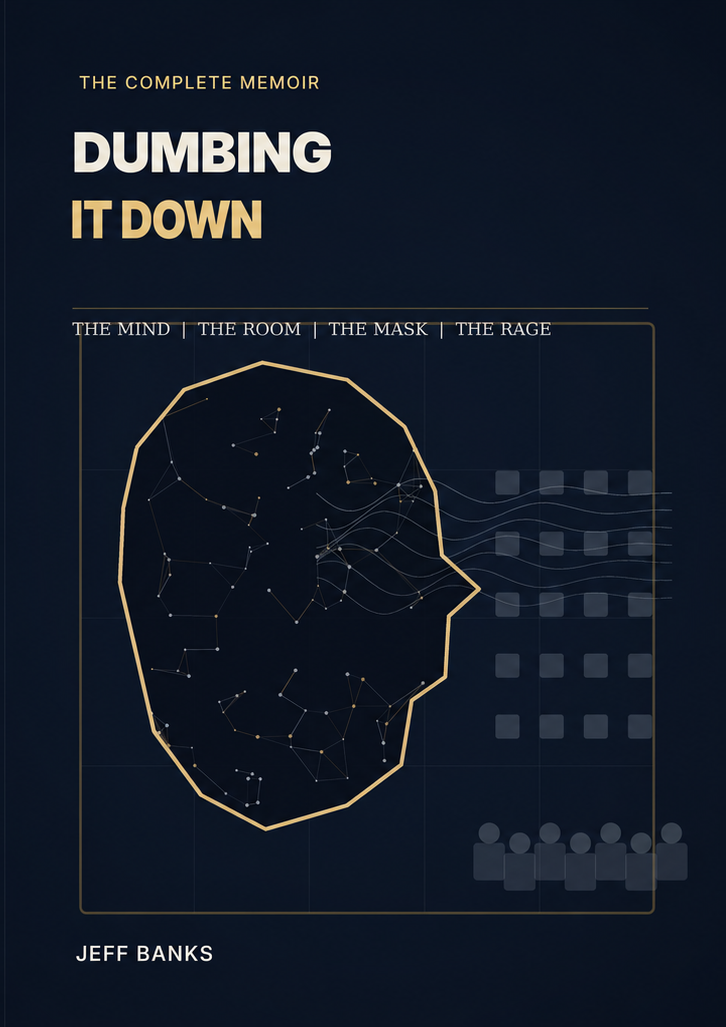
I used to think that dumbing myself down was something I did occasionally, usually when an explanation had gone on too long and I could see the eyes across the table beginning to glaze. I imagined it as a communication technique, no different from replacing a complicated word with a simpler one or drawing a diagram on the back of whatever piece of paper happened to be available. It took me most of a lifetime to understand that it had become something much larger than that. I had not merely learned to simplify an explanation. I had learned to reduce myself.

That distinction sits at the heart of this book. Dumbing It Down is not an argument that I was the clever person in every room and everyone else was struggling to keep up, because life has provided more than enough evidence to prevent me reaching that comforting conclusion. I have been wrong, stubborn, impatient, blunt and occasionally so convinced of my own reasoning that I failed to notice the damage being done by its delivery. Being able to see something quickly did not automatically make me wise, kind or easy to live with. Sometimes it simply meant I reached the brick wall before everyone else and then became angry when they refused to believe it was there.

The habit began early, although I did not recognise it at the time. Growing up in the country taught me that usefulness mattered and that praise was often accompanied by a reminder of what had been missed. School reports containing almost perfect marks did not necessarily produce celebration, because the missing marks had a way of becoming louder than all the ones that were there. At Rye Park Public School, rote learning suited a mind that could remember, repeat and move quickly through the expected answers. It was a comfortable arrangement until I began to discover that knowing the approved answer was not the same as being encouraged to think beyond it.

School was where I first learned that ability had different levels of social acceptability. Sporting ability could be cheered because it was visible, physical and belonged to the team, while academic ability could make a room uneasy because it seemed to belong only to the person displaying it. On a football field, at an athletics carnival or on the back of a horse, achievement could be explained as talent, effort or a good day. In a classroom, the same certainty could be interpreted as showing off, challenging authority or failing to know my place. I learned to hesitate before answering, soften what I knew and allow someone else enough time to reach the destination without having to admit I had been standing there waiting.

High school added distance to the equation. The town children seemed to understand the place before the rest of us had worked out which room we were supposed to be in, and being placed among the country children quietly reinforced the feeling that we were a secondary arrangement. A bout of mumps removed me during those first weeks, allowing friendships and pecking orders to form in my absence. By the time I returned, the room already had its shape and I was trying to find the gap left for me. It was one of the early lessons that would follow me through life: a room does not need to openly reject you for you to understand that you do not quite belong.

Sport offered a different entrance. I could run, jump, ride and play, and those abilities gave me a version of belonging that did not require much explanation. The paddock became a one-person football field, training ground, escape route and stage for victories witnessed by nobody but me. Horses provided another place where competence was accepted because the result could be seen, measured and awarded without anyone needing to debate what it meant. Yet even there I began to understand that standing out was safest when it was useful to someone else.

By the later years of school, I had already started translating myself for the benefit of the room. When several footballers asked me to write their economics essays, the arrangement said more about the school’s hierarchy than any of us understood at the time. They possessed the approved kind of status, while I possessed something they needed, and usefulness once again created temporary acceptance. The arrangement ended badly when one of the essays appeared in my handwriting and authority suddenly became interested in how easily I understood economics. Even then, I was more focused on becoming an Air Force pilot than recognising the direction my mind was trying to point me.

The pilot I nearly became remained one of the deeper cuts. I travelled to Sydney with my father, progressed through the selection process and reached the final group before a psychological assessment concerning sleep-talking and sleepwalking removed me from consideration. A future that had seemed clear disappeared through a decision I could neither argue with nor repair. I did not possess the language then to describe the numbness that followed, so I did what I would continue doing for years. I found another task, made myself useful and kept moving.

Shearing, study and eventually accounting gave movement a more permanent structure. I worked during the day, studied at night and found that tax and business problems suited the part of my mind that looked for patterns, consequences and the point where one decision would eventually collide with another. Being the youngest man in the room was not always an advantage, even when the answer was right. Older men could read certainty from a younger person as arrogance, particularly when the younger person had not yet learned to wrap the answer in sufficient apology. Becoming the joker helped, because humour allowed a sharp answer to arrive with softer edges.

Accounting became both a career and a refuge. It rewarded interpretation, memory, persistence and the ability to see the relationship between decisions that other people preferred to treat as separate. It also placed me in rooms where people asked for advice and then rejected it because the advice interfered with the life they had already decided to live. I learned to slow the explanation, remove the uncomfortable parts and present the warning in a form that would not cause the client to turn against the messenger. Then, when the predicted problem arrived, I was expected to repair it without mentioning that we had already discussed the approaching wall.

That pattern created a particular kind of frustration. It was not simply the irritation of being ignored, although there was plenty of that. It was the deeper exhaustion of being responsible for consequences I had been prevented from preventing, and of having to remain calm while someone asked why the result had not somehow been different. The accountant was expected to translate tax, cash flow, GST, wages, drawings and debt into an explanation that would remove the discomfort without altering the facts. When the facts refused to cooperate, the explanation was often treated as the problem.

Usefulness became the currency by which I measured my place in the world. Clients rang when they needed something fixed, businesses called when the numbers no longer made sense, and people who had disregarded advice returned when the consequences became too heavy to carry alone. I helped because helping was what I knew how to do, but also because being needed offered a form of belonging that being understood rarely provided. The distinction took years to see. A person can be trusted, relied upon and repeatedly called upon without anyone ever asking what it costs them to keep functioning.

The cost was not merely professional. Unpaid accounts accumulated while wages, rent, software, tax and superannuation continued to demand actual money rather than promises about next week. More than $250,000 in fees disappeared over the years into businesses and people who accepted the work but found reasons not to pay for it. Chasing money already earned required a politeness that bordered on apology, as though asking to be paid was a minor breach of professional etiquette. The resentment went inward because outward anger risked losing the client, the relationship and the identity built around being dependable.

Family life did not exist outside these patterns. Work came home in my head even when the files remained at the office, and responsibility had no reliable closing time. A call could interrupt a journey, a holiday, a conversation or a rare attempt to stop thinking about other people’s problems. Even a call from Mensa, which might once have represented recognition or curiosity, became another interruption while I was travelling along Warringah Road dealing with a property and a client matter. Obligation had become so natural that I barely noticed the door closing.

Depression fitted easily into that life because it learned to wear respectable clothes. It did not always stop me working, speaking or helping, which allowed both me and those around me to underestimate it. I could interpret a set of accounts, answer a difficult question and appear entirely functional while privately feeling the walls move closer and the energy drain from everything. Competence became the façade behind which the struggle could remain unnamed. Each morning I could pull on the business suit, real or imagined, and face a world largely oblivious to the conflict taking place beneath it.

Rage lived nearby. Some of it came from frustration, some from disappointment and some from patterns learned long before I understood they had been inherited. It could emerge safely while watching football, arguing with a television or protesting an injustice that did not require me to explain the older grievance underneath. At other times it remained silent, circling inside while I softened another warning or accepted another dismissal. The danger was not that I spent my life shouting at everyone, but that I became increasingly skilled at appearing calm while the internal noise grew louder.

Retirement was supposed to end much of this, although retirement and I have maintained a slightly uncertain relationship. I imagined leaving the office would remove the weight, only to discover that usefulness had become part of my identity and did not disappear merely because a date had been selected. Clients continued to call, problems continued to arrive, and the travelling office followed the caravan more easily than I expected. Even in Exmouth, with Robyn on the phone and emus wandering past, the old machinery remained willing to start.

The empty room of retirement raised questions work had allowed me to postpone. Without deadlines, clients and emergencies, I had to consider who remained when usefulness was no longer required every hour of the day. The answer was not immediately comforting, because work had provided structure, distraction, validation and a socially acceptable explanation for never being entirely still. Lower stress did not automatically produce peace. Sometimes it merely created enough quiet for the old thoughts to become audible.

Writing entered that quiet almost accidentally. It began with travel diaries and the desire to preserve places, family stories and moments that might otherwise disappear. Gradually it became a way of recovering the parts of my mind that had spent years being softened, edited and withheld. Accounting required me to translate my thinking into the version other people could tolerate, while writing allowed the thought to remain long enough to discover what it was trying to say. Whether that amounts to therapy is still an open question, but it has at least stopped some of the noise from having to remain entirely inside.

This book has grown from that process. It moves through childhood, school, sport, ambition, rejection, work, family, depression, rage and the uneasy approach to retirement, not because any one of those subjects provides a complete explanation, but because the pattern runs through all of them. Again and again, the mind meets the room, judges what the room will accept and adjusts itself accordingly. Sometimes the adjustment is sensible communication. Sometimes it is survival, and sometimes it becomes a quiet form of self-erasure.

I have not written these pages to prove that I was right all along. There were times when I was right and handled it badly, times when I mistook speed for depth, and times when the room understood something about people that I had missed while concentrating on the answer. Nor have I written them to assign blame to every teacher, client, colleague, friend or family member who failed to recognise what was happening. Most of them were navigating their own rooms and making their own reductions. The more honest question is why I became so willing to assist in my own disappearance.

The title Dumbing It Down may sound like an accusation, but it is closer to a confession. I became very good at presenting the acceptable version, the useful version and the version that could be invited back without causing too much discomfort. That ability helped me survive, build businesses, support people and create a life of genuine value. It also allowed depression to hide, rage to accumulate and loneliness to exist in rooms where I appeared completely at home.

There is no grand victory waiting at the end of these pages. Retirement has not transformed me into a serene man gazing contentedly across the water, and writing has not emptied every cupboard where the old feelings were stored. What has changed is that I can now recognise the bargain I kept making. I would reduce myself in exchange for belonging, usefulness or peace, even when the peace was temporary and the belonging depended on never presenting the whole person.

Writing this book is the first deliberate refusal of that bargain. It is an attempt to place the fuller thought on the page without immediately softening it for the comfort of the room. The result will not always be flattering, either to me or to the world I moved through, but it is as honest as I can make it. After a lifetime of dumbing it down, honesty seems a reasonable place to begin.

About the Author

Jeff Banks has spent much of his life being useful. He became the person people rang when the numbers no longer made sense, when a business was in trouble, when a tax problem had been ignored for too long or when a decision needed to be made but nobody wanted to take responsibility for making it. For decades, he worked as a tax accountant, business adviser, consultant and problem-solver, building a professional life around the ability to see patterns, anticipate consequences and explain complicated matters in terms other people could understand. What was less visible was the cost of continually carrying problems that often belonged to someone else.

Jeff grew up on a grazing property in country New South Wales, several miles from the nearest settlement and beyond easy voice reach of the neighbouring farms. Isolation was not presented as hardship at the time; it was simply the shape of childhood, filled with horses, paddocks, long bus rides, physical work and a great deal of time spent inside his own head. School revealed that learning came easily, although fitting in did not. Academic ability could attract suspicion, while sporting achievement offered a more acceptable path to belonging, and Jeff gradually learned that standing out was safest when the thing that made him different was useful to the group.

That early lesson followed him through secondary school, representative sport and the first serious decisions of adulthood. He was selected as one of the final candidates for pilot training with the Royal Australian Air Force, only to be rejected after a psychological assessment raised concerns about sleepwalking and sleep-talking. The decision ended a future he had imagined clearly, without offering him any meaningful way to argue, appeal or understand it. Like many disappointments in his life, it was absorbed rather than discussed, and the next practical task was allowed to cover what had been lost.

Shearing, work and part-time study eventually led him into accounting, a profession that rewarded the same qualities that had sometimes made childhood and school uncomfortable. Numbers behaved according to rules, even when people did not, and business problems often revealed themselves through patterns long before their owners were ready to acknowledge them. Jeff developed a reputation for seeing where decisions were leading and for telling clients what they needed to hear, although not always what they wanted to hear. Over time, he also became skilled at softening those warnings, simplifying explanations and reducing the force of his own thinking so that the person receiving the advice would remain comfortable enough to listen.

This process became one of the central struggles explored in Dumbing It Down. Jeff does not use the phrase to claim that he was always the most intelligent person in the room, nor does he present himself as a misunderstood genius surrounded by people incapable of recognising his brilliance. He has been wrong often enough to understand the danger of that story, and stubborn enough to know that having the correct answer does not excuse delivering it without care. The deeper question is what happens when a person repeatedly edits himself to secure acceptance, preserve relationships or avoid being treated as difficult.

Throughout his career, usefulness became both an identity and a trap. Clients sought his advice, ignored it, encountered the consequences and then returned expecting him to repair what might have been prevented. Businesses relied on his judgement while resisting the uncomfortable decisions that judgement required, and unpaid professional fees accumulated even as wages, software, rent, tax and family obligations continued to demand real money. Jeff often found himself apologetically asking to be paid for work already completed, while the people owing the money behaved as though his request had created the inconvenience.

The frustration did not always appear openly. Jeff learned to wear competence as a form of protection, maintaining the professional voice, solving the immediate problem and appearing calm even when the internal pressure was building. Depression could therefore exist alongside productivity, responsibility and humour, largely hidden from those who assumed that continued functioning meant continued wellbeing. He could sit across from a client, interpret a complicated set of accounts and provide a clear course of action while privately struggling to find the energy or meaning required to continue carrying his own life.

Rage existed beside the depression, although it was not always named or understood. Sometimes it appeared as impatience with incompetence, dishonesty, wilful ignorance or authority exercised without responsibility. At other times, it remained below the surface, accumulating through years of advice dismissed, accounts unpaid, sacrifices unnoticed and expectations accepted without question. The anger was not merely about individual events; it was connected to a lifetime of making himself smaller, quieter or more agreeable in order to remain useful and included.

Family provided love, purpose and continuity, but it did not exist separately from the demands of work. Jeff’s wife, Robyn, and their family lived alongside a professional life that often followed him home through phone calls, unfinished thoughts and responsibilities that did not respect evenings, weekends or holidays. Even after formal retirement approached, the office proved difficult to leave because it had never existed only in a building. It travelled in his mind, in the expectations of clients and in the deeply ingrained belief that his value depended upon being available when somebody needed an answer.

Retirement therefore became more than the end of paid work. It opened an uncomfortable space in which Jeff had to consider who he was when there was no crisis requiring him, no client waiting for a solution and no deadline providing a reason to avoid stillness. The reduction in external pressure did not automatically produce peace, because quiet allowed older disappointments and unexamined emotions to become more audible. The empty room of retirement could feel less like freedom and more like the removal of the structure that had concealed everything beneath it.

Writing emerged as a way of entering that room without being overwhelmed by it. Jeff began recording travel, family stories, working experiences and the strange mixture of humour and sadness found in ordinary days. What started as documentation gradually became investigation, allowing him to revisit the moments in which identity had been shaped by rejection, achievement, usefulness, silence and the repeated need to belong. Writing gave him permission to hold a thought long enough to understand it rather than immediately translating it into the least confronting version for someone else.

His books are grounded in lived experience and written in a reflective, conversational Australian voice. They move between humour and grief, achievement and disappointment, family and isolation, often finding that the apparently minor anecdote contains the larger truth. Jeff is less interested in presenting a polished life than in examining the contradictions within it, including the pride that can sit beside insecurity, the generosity that can conceal resentment and the competence that can hide depression. He writes about people as complicated beings rather than heroes or villains, himself included.

Dumbing It Down is one of his most personal works because it traces the pattern beneath many of those contradictions. It examines how a boy from a remote grazing property became a capable student, sportsman, accountant, adviser, business owner, husband, father and reluctant retiree, while continuing to carry a sense of standing slightly outside the room. It asks whether the desire to be understood was gradually replaced by the safer desire to be needed, and whether usefulness became a substitute for belonging. Most importantly, it asks what remained after a lifetime of adapting himself to the expectations, limitations and comfort of others.

Jeff does not claim to have resolved every struggle explored in the book. Depression does not disappear because it has been described accurately, rage does not become harmless merely because its origins have been identified, and retirement does not provide an automatic conclusion to questions that have taken a lifetime to form. Writing has, however, made those struggles harder to hide behind professional competence and humour. It has allowed him to recognise the difference between communicating clearly and erasing himself for the convenience of the room.

He now lives at Smiths Lake on the New South Wales Mid North Coast with Robyn, where retirement continues to be more a negotiation than a settled state. His days include writing, family, golf, travel, community involvement and the occasional professional problem that still finds its way to him despite every declaration that he has finished working. He remains curious about why people make the decisions they make, why institutions resist obvious truths and why belonging can remain elusive even within a full and productive life. That curiosity, combined with a refusal to pretend the difficult parts did not happen, continues to shape his work.

Jeff Banks writes because stories disappear when nobody takes responsibility for recording them. He writes because memory changes with time, because families rarely agree on what happened and because apparently successful lives can contain private struggles that deserve more than a polite summary. He also writes because the page is one of the few places where he no longer needs to reduce the thought before presenting it. After years of dumbing himself down, writing has become his way of returning to full size.

Author

Menu