

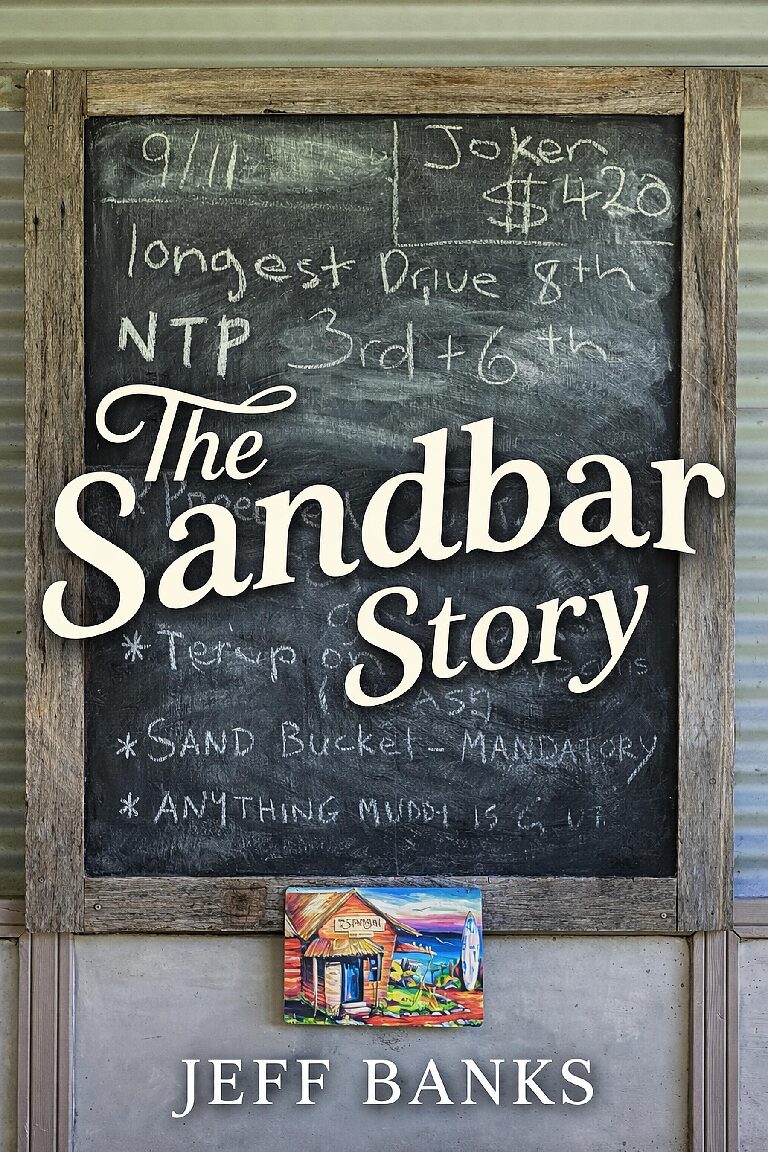
The Sandbar Story - Chapter 8 - Where to from Here

The Sandbar Story - Chapter 8 - Where to from Here | Travelling Around Australia with Jeff Banks

The laughter that followed a wayward tee shot. The quiet satisfaction of someone finally winning the Joker draw after weeks of near misses. The familiar rhythm of local businesses dropping off prizes for Wednesday competitions because they knew the club brought people together.

THE SANDBAR STORY


Chapter 8 – Where to From Here?


There comes a point in the life of most volunteer organisations when the optimism that created them collides rather abruptly with the practical realities of keeping them running. Sandbar Golf Club reached that point as well, although not in the quiet, gradual way one might hope for. The increase in green fees, necessary as it was as far as park management was concerned, triggered a backlash that was both immediate and, in some cases, surprisingly emotional. Numbers began to soften immediately, and whether the two were entirely connected or merely coincidental hardly mattered, the effect was the same. The committee suddenly finds itself confronting the uncomfortable truth that running a community club involves more than enthusiasm and goodwill. It requires decisions that not everyone will agree with, even when those decisions are grounded in simple arithmetic rather than ambition.


In the earlier years the club had grown almost organically. Golfers turned up, competitions took shape, local businesses began donating prizes and before long Wednesday afternoons had developed their own rhythm. On a good day twenty players might gather around the first tee, and occasionally the number crept closer to forty. Those were the days when the place felt vibrant. Golf bags rattled on the gravel, scorecards were passed around, and someone inevitably told a story about the putt they had missed the previous week that would have won them the competition.


It felt like a proper golf club. Which was remarkable when you considered that only a short time earlier it had barely existed at all.


Momentum has a way of creating that illusion. When something is growing, it feels as though it will always keep growing. The laughter becomes normal, the numbers become expected and nobody spends much time thinking about the mechanics beneath it all.


But momentum is not permanent. At some point the numbers begin to change.


It rarely happens suddenly. A couple of regular players miss a week. Someone develops a sore back. Another golfer begins travelling more frequently for work. Life moves on in the quiet ways that it always does, and slowly the group around the first tee begins to thin.


Twenty players become fifteen. Fifteen becomes twelve. Eventually there are ten golfers standing around the first tee looking at each other with the shared understanding that the atmosphere has changed. Ten players can still produce a perfectly enjoyable game of golf, but it no longer carries the same energy as the days when twice that number wandered across the fairways.


That was the moment when the committee began to ask the sort of questions that are easy to ignore when the place is full.


What happens if the numbers keep drifting downward? What do we change? What do we leave alone? And perhaps most importantly, what does the community actually want this place to be?


To understand those questions properly it was necessary to look honestly at the structure the club had built. Sandbar Golf Club had always tried to keep things straightforward. There was no appetite for complicated fee structures or elaborate membership tiers. Golfers who wanted an official handicap through Golf Australia paid an annual fee of one hundred dollars, which covered the AGU number and the administration involved in maintaining a handicap. Those members also received a free round of golf and the ability to participate in competitions.


For those who simply wanted to support the club or play occasionally without worrying about handicaps, there was social membership at fifty-five dollars. It included a free round as well, and for many locals that arrangement felt perfectly adequate. They could remain part of the club without committing themselves to the competitive side of the game.


Green fees had once been fifteen dollars for members, a figure that had survived for many years largely because nobody particularly wanted to be responsible for increasing it. Eventually reality intervened and the fee rose to twenty-five dollars, a price that still compared favourably with almost any golf course in the country. Non-members paid thirty-five dollars, although a loyalty program softened the edge of that figure. Play three rounds and one of them could be redeemed for free.


The system was simple enough that nobody needed a manual to understand it. Someone kept track of the loyalty rounds and the players accepted that arrangement without fuss. In small community organisations simplicity is often the most reliable form of administration.


Wednesday competitions had always been built around the same uncomplicated philosophy. Each player contributed their green fee and the winner received two dollars for every player entered. With twenty players the prize was forty dollars. With ten players it was twenty. The winner also received a free round in the following competition, a small but effective incentive to come back the next week and defend their honour.


All of the other prizes, the nearest-the-pin balls, the long drive and the sausages hole, the occasional novelty award, the small vouchers,were donated by local businesses, The Bowlo, the Smiths Lake Butchery and the Caravan Park itself. That detail was more important than it might appear at first glance. The club itself did not spend money on prizes. Those locals who simply liked the idea of supporting community sport provided those items because they believed the club added something valuable to the local area.


The actual weekly expenses of the club are modest by almost any standard. Ice for the drinks cost about eighteen dollars. A twenty-dollar contribution went into what everyone called the Joker Draw, a small game of chance that accumulated until someone picked the right card. The drinks themselves are sold at roughly one dollar above the purchase price, a margin that had historically caused far more debate than the mathematics probably justified, but the profit all went to the annual Christmas shindig


The economics of a beer have an uncanny ability to provoke philosophical discussion in community organisations.


Still, that small margin helped that club function. Every dollar mattered when an organisation relied largely on volunteer effort and modest participation fees.


For quite a while the structure worked perfectly well.


But as the competition numbers slipped toward ten players, the arithmetic began to look slightly different. A system designed for twenty or thirty participants behaves very differently when only half that number arrives each week. The free round for the competition winner, which had once felt like a harmless reward, suddenly represented a meaningful reduction in the club’s already limited income. The Joker Draw contribution also began to look like a luxury rather than a necessity.


So the committee did what committees in volunteer organisations often have to do. It made a practical decision that nobody particularly enjoyed explaining. The free rounds for competition winners were suspended temporarily, and the weekly contribution to the Joker Draw was paused.


Those decisions were not made lightly. They were simply an acknowledgment that enthusiasm alone cannot override arithmetic forever. And that was when the broader conversation really began.


Sandbar Golf Course existed inside two very different narratives. From a commercial perspective it was part of a privately owned caravan park complex. The land had owners, the infrastructure required maintenance and the economics of operating the broader property inevitably influenced how the golf course functioned.


But for many locals the course had always felt like something else entirely.


Some of the older members remembered the early days when the course was first carved out of the flood-prone land between the caravan parks. There were stories of fathers and sons clearing sections of fairway, of machinery borrowed from neighbouring properties and of children wandering around the site while the adults did the heavy work. There are even photographs of those days, youngsters with Tonka trucks apparently supervising the construction while their fathers wrestled with the real equipment.


Memories like that create a powerful sense of ownership.


Over time that emotional connection sometimes evolves into expectation. When people believe they helped build something, they often feel that it belongs to them in a deeper sense than the legal title might suggest.


The committee understood that sentiment perfectly well. Most of us were locals too. We had grown up hearing the same stories and playing the same fairways. But the club also has to live within the real world. And the real world occasionally demands uncomfortable conversations about costs, sustainability and the difference between what people would like something to be and what it can realistically become.


At the centre of those conversations sat a deceptively simple question.


What does the community actually want? Do people want a fully structured golf club with handicaps, competitions and formal memberships? Or do they simply want somewhere pleasant to wander down and have a hit with their mates every now and then?


The answer, as it turned out, was probably a mixture of both.


Some players genuinely enjoyed the competitive side of the game. They liked watching their handicaps shift, arguing about scorecards and chasing the modest prize money each Wednesday. Others had little interest in any of that. They simply wanted the chance to enjoy a round of golf without fuss or formality.


Balancing those two expectations required a certain degree of flexibility. The club began looking at ways to present membership less as a cost and more as an invitation to belong. Affiliated membership offered a recognised Golf Australia handicap, discounted green fees, eligibility to play in competitions and the opportunity to remain connected to a club that had become part of the local landscape. Social membership offered a simpler pathway for those who preferred a more relaxed involvement.


Meanwhile the loyalty program continues quietly in the background. If someone turned up regularly enough to play three rounds, they deserved a free one. The principle behind that arrangement was simple: loyalty should be acknowledged.


The competitions themselves were also worth reconsidering. Golf clubs sometimes fall into the habit of treating the game with an almost reverential seriousness, forgetting that most people picked up a golf club in the first place because it was enjoyable. Introducing the occasional team event or Ambrose format might encourage players who found traditional stroke competitions a little intimidating.


After all, not every golfer is chasing a handicap reduction. Many are simply chasing an enjoyable afternoon.


Through all of these discussions one theme keeps emerging with increasing clarity. Change is inevitable. Sandbar Golf Club has already changed several times since its formation. It had grown from a loose gathering of golfers into a structured club with memberships, competitions and administrative responsibilities. Ownership structures have shifted, management approaches have evolved and the expectations of players have gradually adapted to those realities.


This stage was simply another chapter in that ongoing story.


Some locals resist these changes, clinging to the idea that the course should operate exactly as they remembered it. Others recognised that adaptation was the only way the club could survive in the long term. The difference between those two attitudes was not really about golf at all. It was about how people respond when circumstances shift around them.


Because the real test of any organisation is not how comfortably it operates when everything is stable.


The real test is how it responds when things begin to move.


Sandbar Golf Course had never been a static place. From the moment the first fairway was carved out of that flood-affected ground, the course had been evolving in response to new pressures and new opportunities. The people involved had always found a way to adjust, sometimes reluctantly, but always with the understanding that standing still was rarely an option.


Many within the community still believed strongly in the vision that had brought the club into existence. They could see its value not just as a golf course but as a gathering place where friendships formed, stories were exchanged and the occasional argument about a missed putt dissolved into laughter over a cold drink.


In the end that belief mattered more than any particular membership structure or competition format.


Because a golf club, especially one built largely through volunteer effort, ultimately survives for only one reason.


The community decides it is worth keeping alive. And if that decision remains strong enough, then the rest, the prices, the incentives, the competitions and the occasional disagreement about the cost of a beer, can usually be worked out along the way.


As the discussions around membership renewals began to take shape, the committee found itself returning to a question that had quietly hovered over the club since its earliest days. It was a simple question, but like many simple questions it carried more weight the longer you thought about it.


What exactly were we asking people to renew?


On the surface the answer seemed obvious. Membership. Fifty-five dollars for social members, one hundred for affiliated players who wanted a Golf Australia handicap. A free round included. Discounted competition fees on Wednesdays. Access to the loyalty program at other times. When the numbers were laid out on paper, the arithmetic still made sense.


If someone played just four rounds across the year, the membership had effectively paid for itself. One free round and three games at the member rate of twenty-five dollars meant a total outlay of seventy-five dollars. A non-member paying standard rates would have spent somewhere closer to one hundred and twenty. Over a handful of games the saving was already there.


But the longer we talked about it, the clearer it became that the numbers were not really the point. The club had learned that lesson the hard way when the green fee increase triggered the sort of backlash that only community organisations truly understand. Some of the criticism had been perfectly reasonable. Some of it had been driven more by emotion than arithmetic. But the experience reminded everyone on the committee that pricing alone rarely determines how people feel about a place.


People don’t join community clubs because they are cheap. They join them because they feel they belong.


Once that realisation settled in, the tone of the conversation began to change. Instead of asking how we could make membership cheaper or more attractive in purely financial terms, the committee began talking about what Sandbar Golf Club had always really been.


It wasn’t just a golf course. It was the collection of small moments that happened around it.


The laughter that followed a wayward tee shot. The quiet satisfaction of someone finally winning the Joker draw after weeks of near misses. The familiar rhythm of local businesses dropping off prizes for Wednesday competitions because they knew the club brought people together.


Those things don’t appear on balance sheets. But they are the reason places like Sandbar exist.


When the time came to discuss how membership renewals should be presented, the committee began leaning toward a different approach. The numbers would still be there, they had to be, but they would no longer sit at the centre of the story.


Instead, the message would be simpler.


Membership wasn’t just about the cost of a round of golf. It was about keeping something alive that had gradually become part of the local landscape.


Those who wanted an official handicap could still obtain one through affiliated membership. Those who simply enjoyed the occasional hit could remain social members and continue to benefit from the loyalty program. The structure itself did not need to change dramatically.


What mattered was reminding people why the club existed in the first place.


Because the truth was that Sandbar Golf Club had never been sustained purely by economics. If it had relied only on financial logic, it might never have existed at all. It survived because enough people believed it added something worthwhile to the community.


They believed the course was worth maintaining. They believed Wednesday competitions were worth organising. They believed that standing around the first tee with a group of locals on a sunny afternoon still mattered.


Once you recognised that, the task of encouraging membership renewals looked a little different. The goal was not simply to convince people that fifty-five dollars represented good value.


The goal is to remind them that the club itself represented something bigger than the price of a round. And that was a message the committee feels comfortable delivering.


After all, Sandbar Golf Club had already survived more than its fair share of adjustments. Management changes. Financial realities. Differences of opinion about how things should operate. Through each stage the club had done what most successful community organisations eventually learn to do.


It had rolled with the punches. Sometimes reluctantly. Sometimes with spirited debate. But always with the underlying understanding that standing still was rarely an option.


Change, as it turned out, was not the enemy. Ignoring change is.


The future of Sandbar Golf Club would almost certainly look a little different from its past. Membership numbers might rise and fall from time to time. Competition formats might evolve. New players will arrive while older ones gradually step aside.


That is simply the nature of community life. But as long as the people who walked those fairways continued to recognise the place for what it really is, a gathering point for like-minded locals supported by like-minded local businesses, the club would continue to find its way forward.


Because in the end, the story of Sandbar Golf Club was never really about golf.


Golf just happened to be the excuse.


The real story was about a group of people who decided that a patch of flood-prone ground between two caravan parks could become something more than just another piece of land on a balance sheet. They chose to turn it into a place where neighbours met, friendships grew and the occasional argument about handicaps dissolved into laughter over a cold drink. And if that spirit remained strong enough, then the club would continue doing what it had always done.


Adapting when necessary. Adjusting when circumstances demanded it. And welcoming the next group of golfers who wandered down the path toward the first tee, wondering what sort of afternoon they might find waiting for them.


Because the game, like the club itself, was never meant to stand still.


It was always meant to keep moving forward.

Author

Menu