

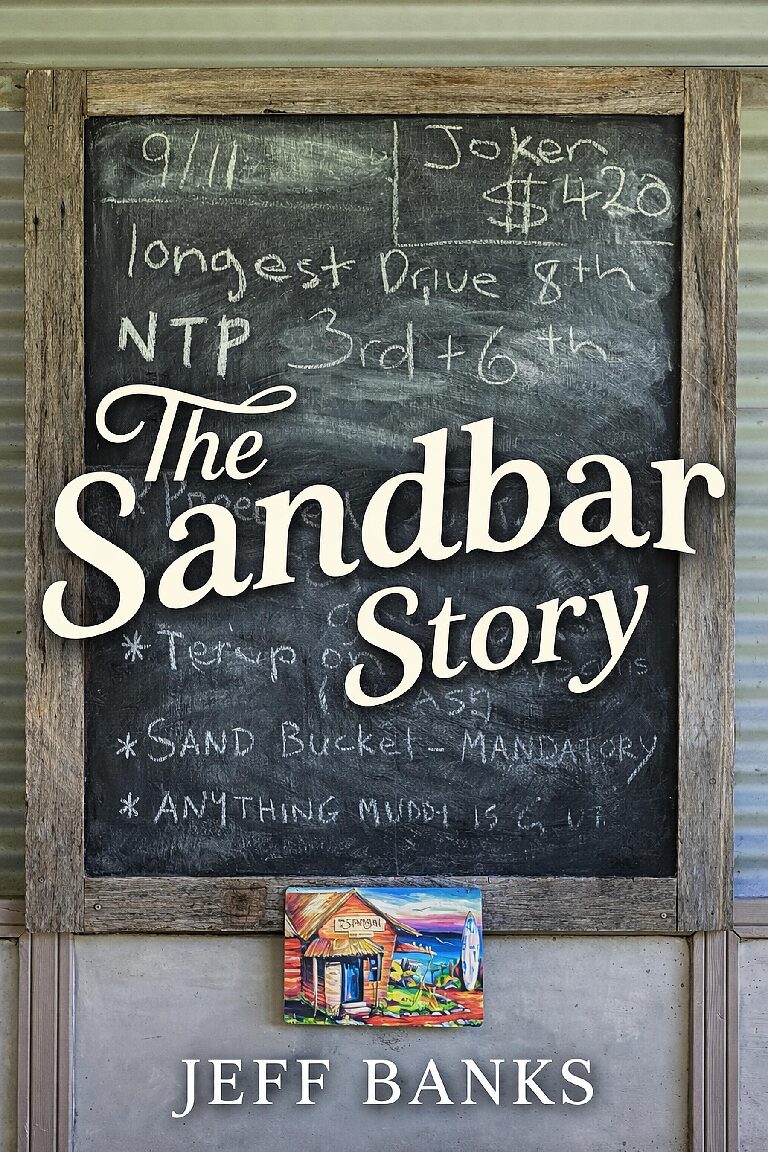
The Sandbar Story - Chapter 3 - The First Committee Meeting

The Sandbar Story - Chapter 3 - The First Committee Meeting | Travelling Around Australia with Jeff Banks

Looking back, my involvement in the Sandbar Golf Club began almost accidentally. A friend asked for help. A meeting revealed chaos. Professional instinct triggered alarm bells. And suddenly I found myself responsible for turning a tin full of coins into a functioning sporting organisation.

THE SANDBAR STORY


Chapter 3 – The First Committee Meeting


Every story has a moment when observation quietly becomes participation.


For the first two chapters of this story, I had been nothing more than a distant spectator. A golfer who occasionally wandered around the fairways of the Sandbar course. A local who understood the strange tension between community ownership and private land. Someone aware that something informal was taking place on Wednesday afternoons, but not someone particularly invested in how that informality functioned.


That changed the day Craig Wilson called.


Craig is one of those golfers who does not merely play golf. He inhabits it. Golf is not a pastime for him. It is a rhythm of life. He knows who won the club championship in 1984. He remembers every hole-in-one scored by members over the last decade. If there is a Wednesday competition somewhere within driving distance, Craig will find it. In short, Craig is exactly the sort of person who becomes emotionally invested in a local golf club.


I am not. I enjoy golf. I play reasonably competently when I have the time. I understand the etiquette and the pleasure of walking a course with good company. But golf has never been the centrepiece of my life.


Accounting has. And unfortunately for Craig and his friends, accounting tends to ruin the romance of informality very quickly.


Craig’s request was simple. “Mate, we’re having a meeting about the club. Would you mind coming along?”


There was a slight pause before the explanation arrived. “We probably need someone there who understands… you know… the legal side of things.”


That was the moment I should have been suspicious. When someone says they “probably need someone who understands the legal side of things,” what they are really saying is: Things are already much worse than you think.


The meeting itself was held at the local Bowlo, the sort of place where half the town’s committees, arguments and ideas about “doing something for the community” have probably begun over the years. It was exactly the environment you would expect for the birth of something like this: a back room with mismatched chairs, a table that had seen better decades, and a group of men who all believed they were acting in the best interests of something they cared about.


The Bowlo, like so many regional clubs across Australia, had long been one of the quiet anchors of the local community. It was the place where sporting teams celebrated wins, where raffles were drawn, where local charities held fundraisers, and where committees for everything from junior sport to fishing clubs gathered to solve the problems of the world, or at least the problems of the district.


At the time it was simply a convenient venue for a meeting.


What none of us fully appreciated that evening was how closely the Bowlo would eventually become tied to the story of the Sandbar Golf Club itself. In the years that followed, the club would become one of Sandbar’s most important supporters and sponsors, not out of obligation, but out of the same instinct that drives so many local organisations to back one another.


That is the nature of community institutions. They survive because they invest in each other.


But on that particular evening, none of that future support was yet visible. It was simply a borrowed room, a few cold drinks within reach of the bar, and a group of golfers beginning to realise that what they had created on Wednesday afternoons might need a little more structure than a tin on a table.


None of them, however, had any real idea what they were actually creating.


Craig greeted me with the enthusiasm of a man who had successfully recruited reinforcements. “Glad you could make it.”


Around the room were a handful of the regular Wednesday players. Good blokes. Most of them tradesmen, small business owners, retirees, and enthusiastic golfers. The sort of people who keep local communities alive.


And sitting comfortably among them was Evan. Evan had been the catalyst for much of what was happening on the course. He was the one who had quietly stepped away from running the Wednesday competition, encouraging the players to organise themselves. The one who had encouraged the tin to appear on the table. The one who had fostered the sense that something resembling a club already existed. And to be fair to Evan, from a golfer’s perspective, he had achieved something impressive.


The players had taken ownership. The Wednesday competition ran. People turned up. Money went into and out of the tin.


Prizes were handed out. From the outside, it looked like a club. From the inside, however, it was something else entirely.


The first sign of trouble was, quite literally, sitting on the table.


The tin. Every Wednesday, players would arrive and throw a few dollars into it. That money funded the prize pool. Over time it had also started covering small expenses. Someone would buy scorecards. Someone else would organise small trophies. Occasionally money was set aside for other costs.


No real records. No reconciliations. No accountability. Just a tin full of cash and receipts.


For the average person this arrangement probably seemed charmingly simple. Community-driven. Trust-based. Informal.


For a professional accountant, however, it was something closer to a mild cardiac event. Cash collection without records immediately raises questions. Who is responsible for it? Where is it stored? How much is there? Who decides how it is spent? What happens if it goes missing?


More importantly… What happens if someone gets hurt? Because once money begins changing hands regularly, something subtle but important occurs.


What looked like a casual gathering of friends starts to resemble an organisation. And organisations carry responsibilities.


It did not take long for the next concern to surface. Insurance.


Golf, despite its leisurely reputation, is not a risk-free activity. Golf balls travel at considerable speed. Golf carts overturn. People slip on wet grass. Accidents happen.


In most established clubs those risks are managed through structured insurance policies arranged through governing bodies. Membership fees contribute to those protections. Players are covered when they step onto the course during official competitions.


But Sandbar did not yet have a club. It had a tin. And a Wednesday competition. Which meant that if something went wrong, the legal consequences could be messy.


Very messy.


At some point during the meeting someone mentioned that the group was “affiliated” with Golf NSW. That word, affiliated, hung in the air like a promise.


My professional instincts immediately started asking questions. Affiliated how? Through what structure? Under whose authority? With what documentation? Because affiliation with a governing sporting body is not something that simply occurs because someone believes it should exist.


It requires formal recognition. It requires membership records. It requires governance. It requires compliance.


None of which appeared to exist.


Then Evan produced what they proudly described as the club’s constitution.


It was a document of sorts. Several pages long. Typed, photocopied, and stapled together.


I began reading it while the conversation around the table continued. Within about thirty seconds I realised something important. This document had not been written by anyone who had ever seen a functioning constitution before.


It contained grand statements about the purpose of the club. It contained aspirations about membership and competitions. It contained language that sounded vaguely official tying decision making to the management of the Caravan Park. But it lacked the things that actually make a constitution useful.


There were no clear rules around governance. No defined roles or responsibilities. No mechanisms for financial control. No clarity around decision-making other than the veto provisions of Park Management.


In essence, it was less a legal document and more a collection of hopeful sentences.


That is not unusual in the early days of community organisations. People start with enthusiasm, not legal frameworks. But enthusiasm alone does not satisfy regulators. Or insurers. Or the Australian Taxation Office.


As the meeting continued, I began to understand the mindset that had created this situation.


It was what I would later think of as the cowboy mentality. Not in the reckless sense. More in the pioneering sense.


Someone has an idea. Someone believes it can work. And therefore, in their mind, it already exists.


Evan embodied that mindset perfectly. He was not careless. He simply believed that if people wanted a club badly enough, the details would eventually fall into place.


In his world, vision came first. Structure would follow.


For someone like me, raised professionally in the world of compliance, legislation, and statutory obligations, that order of operations is terrifying. Because when vision runs too far ahead of structure, the consequences tend to arrive suddenly. Usually in the form of letters from government agencies. Or worse. Realisation


As the meeting progressed, a slow realisation began forming in my mind. This group of enthusiastic golfers was standing on the edge of something they did not yet understand.


What they had created was no longer just a friendly Wednesday gathering. It was evolving into an organisation.


That meant responsibility. Financial responsibility. Legal responsibility. Administrative responsibility.


Without those foundations, the entire venture could collapse the moment it encountered real scrutiny. And the people who would suffer most would be the very people sitting around the table.


Craig. His friends. The men who simply wanted a place to play golf on Wednesday afternoons.


At some point someone asked the inevitable question. “Do we need a committee?”


The answer, from a governance perspective, was obvious. Yes. If the group wanted legitimacy, they needed structure. Officers. Defined roles. Accountability.


What followed was the slightly awkward process common to early committees everywhere. People were nominated. Some accepted. Many resisted.


Eventually positions began to fill. And then someone looked in my direction. “You understand this stuff,” someone said. It was not really a question. It was more a statement of fact. Which is how I found myself joining the committee.


Not out of ambition. Not out of a deep love for golf administration. But out of a mixture of professional alarm and personal loyalty.


I could see where this was heading. And if someone did not intervene soon, the consequences could be expensive. Very expensive.


In the end, I “accepted” two roles.


Honorary Secretary and Honorary Treasurer. It was a combination that made sense given my background, although it also meant inheriting responsibility for the two areas that were currently the most chaotic.


Governance. Finance. 


I made a quiet promise to myself that night. If I was going to be involved, things would change.


The tin would not disappear overnight, habits rarely do, but it would eventually be replaced by proper financial systems.


Membership records would be created. The constitution would be rewritten. Registrations would be obtained. The club would become something legally recognisable.


An incorporated association if necessary. With an ABN. A TFN. Bank accounts. Financial statements.


All the dull, unglamorous machinery that makes organisations sustainable. It would not be exciting work. But it would protect the people who had unknowingly built something fragile.


The weeks that followed were a lesson in translating enthusiasm into structure.


The first task was the constitution. The original document was carefully dismantled and rebuilt into something that actually resembled a legal framework.


Roles were defined. Voting processes established. Membership classes clarified. Financial controls inserted.


Next came registrations. Applying for an ABN. Establishing tax file number arrangements. Opening proper bank accounts. Separating club money from personal cash handling.


Creating membership rosters that actually recorded who belonged to the club.


Each step felt like replacing loose planks on a bridge that people were already crossing.


Throughout all of this, Evan remained an interesting figure.


His vision for the club had never been about paperwork. It had been about community. Golfers turning up. Competition thriving. People feeling like they belonged to something.


But as the conversations around that early committee table unfolded, it became increasingly clear that Evan’s ambitions extended well beyond simply running a Wednesday competition under a loosely organised banner.


In Evan’s mind the club was not just a way of formalising what had already begun. It was the beginning of something bigger, something that, while never completely articulated in formal language, was clearly taking shape in his imagination.


He spoke often about participation numbers. About how many players were already turning up. About how that number could grow if the club looked more legitimate.


Monthly medals. Club championships. Perhaps even inter-club competitions with neighbouring courses.


All of which sounded perfectly reasonable on the surface. But beneath those discussions there was another idea slowly revealing itself.


The clubhouse. Not the modest shelter that existed at the time, but a proper clubhouse. Something that could serve drinks, host presentations, run raffles, perhaps even cater small functions. A place where golfers would linger after their rounds rather than simply heading home.


In Evan’s mind the clubhouse was not just about comfort. It was about revenue. Bar takings. Competition fees. Membership subscriptions. Sponsorship opportunities. Corporate days.


All the small streams of income that, when combined, can transform a struggling sporting venue into something financially viable. And behind that idea sat an even larger possibility.


If the club grew strong enough, if the membership numbers increased and the organisation became structured, then perhaps the club itself could take on a role in managing the course.


At the time the course existed as part of a broader caravan park business. From the owners’ perspective it was simply another asset within a portfolio, a recreational facility that needed to justify the land it occupied.


But golf courses are not always easy assets to run profitably. Maintenance costs are constant. Machinery breaks. Greens require constant care. And if the number of paying players fluctuates, the numbers can quickly move from manageable to uncomfortable.


Evan could see that. And his thinking seemed to follow a very simple line of reasoning.


If the golfers were already turning up… If they were already organising competitions… If they were already generating small pools of money… Then why couldn’t a properly formed club step in and manage the golf operations themselves?


The club could run competitions. The club could operate the clubhouse. The club could generate its own income streams. And in doing so, it might even help reduce the financial burden the course represented to its owners.


From Evan’s perspective it was a win for everyone.


The golfers would gain a true home. The course might move closer to financial sustainability. And the club would become something more than just a weekly competition. It would become the centre of the entire operation.


It was an ambitious vision. Perhaps even a romantic one. But as I sat there listening, another set of thoughts was forming in my mind. Because every one of those ideas, clubhouse operations, revenue streams, management responsibilities, carried legal and financial implications that no one in the room had yet considered.


Running a competition with a tin on the table was one thing. Running a sporting organisation that handled money, memberships, alcohol service, sponsorship agreements and potentially course management was something entirely different.


It meant governance. Licensing. Insurance. Financial controls. Regulatory compliance.


In short, it meant structure. And while Evan’s mind was racing ahead into what the club might become, mine was busy calculating what it would take simply to ensure that what already existed didn’t collapse under its own weight.


Because vision can inspire people to gather. But without the foundations to support it, even the most enthusiastic vision can lead a group of well-meaning volunteers straight into trouble.


The relationship between those two forces, vision and structure, would shape much of the club’s future.


At that first committee meeting, however, none of us fully understood how complicated that balance would become.


Looking back, my involvement in the Sandbar Golf Club began almost accidentally. A friend asked for help. A meeting revealed chaos. Professional instinct triggered alarm bells. And suddenly I found myself responsible for turning a tin full of coins into a functioning sporting organisation.


It was not what I had planned for my spare time. But sometimes community organisations begin exactly this way.


Not through grand strategy. But through a moment when someone realises that if they do not step forward, the whole thing may fall apart. And that night, sitting in that small room with Craig and the others, it became clear to me that the Sandbar Golf Club needed more than enthusiasm.


It needed structure.


Unfortunately for me, I was the person in the room who knew how to build it.

Author

Menu