

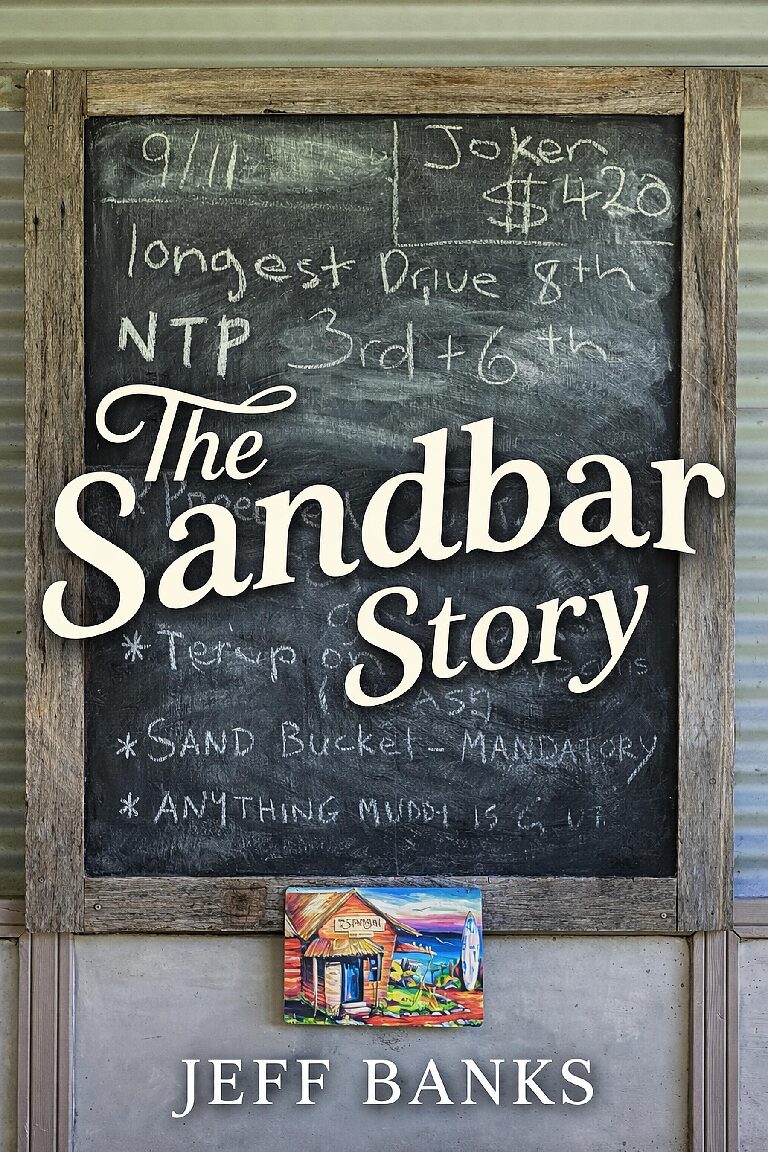
The Sandbar Story - Chapter 10 - A Round at Sandbar

The Sandbar Story - Chapter 10 - A Round at Sandbar | Travelling Around Australia with Jeff Banks

That is the rhythm of golf at Sandbar. A walk through bushland and water hazards. A handful of clever holes that reward patience and punish impatience. And the easy laughter that comes from sharing the course with friends who understand why this quiet stretch of land between two caravan parks has become something special.

THE SANDBAR STORY


Chapter 10 – A Round at Sandbar


Every golf course has a personality. Some announce themselves with grand clubhouses and manicured driveways that make it immediately clear you are arriving somewhere important. Others reveal themselves more slowly, almost reluctantly, as though they are waiting to see whether you are the sort of person who will appreciate them.


Sandbar Golf Course belongs firmly in the second category.


To find it, you leave the steady flow of traffic along The Lakes Way and turn toward Cellito Beach. The road narrows almost immediately. The traffic disappears. The houses thin out and are replaced by bushland, patches of coastal scrub and the occasional glimpse of the ocean through the trees. It is the sort of drive that feels as though you are leaving the busy world behind, kilometre by kilometre.


About two and a half kilometres down that road, almost at the point where it feels like you have reached the end of civilisation, the course reveals itself.


There are no grand gates announcing its presence. No imposing clubhouse dominating the skyline. Instead, Sandbar sits quietly between two caravan parks, tucked into a strip of flood-prone coastal land that generations of locals decided would make a golf course long before anyone thought about business models or balance sheets.


It is the sort of place you stumble upon and wonder how it managed to remain hidden for so long. That is why those who know it often refer to Sandbar Golf Course as the hidden gem of the Mid North Coast.


From the Northern Beaches of Sydney it is barely three hours away. From Forster it is a short drive south. Close enough to be convenient, far enough away to feel like an escape. For some, it becomes the destination for a day trip. For others, particularly those staying in the adjacent Sandbar Caravan Park, it becomes part of a relaxed weekend ritual, morning golf followed by the sort of long afternoons that only seem to exist near the coast.


But Sandbar’s charm is not just its location. It is the experience of the course itself.


At first glance the layout appears modest: nine holes winding through native vegetation and low coastal ground. Yet anyone who has played there knows that the number alone tells you very little about the challenge that awaits.


The course is a par 31 for nine holes, though few first-time visitors play it like that. Because the layout has been designed to be played twice from different tees, turning those nine holes into a full eighteen-hole experience. It is a simple solution, but an elegant one. The altered angles change the feel of the holes just enough that the second lap rarely feels like a repetition of the first.


It is a course that asks questions rather than demanding brute force answers.


The longer hitters quickly discover that distance alone will not conquer Sandbar. The tighter fairways, the positioning of hazards and the subtle shaping of the holes encourage thought as much as power. The hacker finds plenty of opportunities for recovery. The more proficient golfer discovers there are enough traps, both literal and strategic, to ensure complacency is rarely rewarded.


The beauty of Sandbar lies in that balance. It is welcoming without being easy.


From the first tee the golfer is immediately aware of the environment surrounding the course. The air carries that familiar coastal scent, salt, bush and sand. Native plants line much of the course, not as ornamental landscaping but as a reflection of the land itself. Lomandra, coastal rosemary and other hardy species dominate the terrain, chosen not for aesthetics alone but for their ability to survive the harsh coastal winds and occasional flooding that define this part of the coast.


The course does not attempt to overpower the landscape. It works with it.


That philosophy has shaped Sandbar from the beginning. Rather than forcing imported greenery into an environment that would struggle to support it, the course embraces the natural bushland aesthetic. The result is a layout that feels almost organic, as though it grew out of the land rather than being imposed upon it.


Birdlife is constant company during a round. The occasional wallaby might wander across the fairway. And if the breeze is coming from the right direction, the distant sound of the ocean reminds players just how close Cellito Beach really is.


It is golf played at a different rhythm. Here, a round rarely feels rushed.


Part of that is practical. With a nine-hole layout that can be comfortably played in well under two hours, Sandbar fits neatly into the relaxed pace of coastal life. But part of it is cultural as well. The players who frequent the course are rarely chasing professional ambitions. They are chasing the simple pleasure of hitting a ball across open ground, sharing a laugh with friends and perhaps settling a small wager over the final putt.


That spirit is woven into the identity of Sandbar Golf Club itself.


The Wednesday competitions that helped give the club its original momentum still echo through the course today. Groups of players gathering in the car park, sorting themselves into groups, comparing handicaps that may or may not be entirely accurate, and setting off across the course with the quiet understanding that the real reward is the afternoon itself.


It is golf stripped back to its essentials. And perhaps that is why so many visitors find themselves returning. Because once you have played Sandbar, it becomes difficult to explain to others exactly why it stays with you.


It is not the longest course. It is not the most manicured. It certainly does not pretend to be the most prestigious. But somewhere between the bushland fairways, the ocean air and the laughter drifting across the greens, Sandbar manages to capture something many larger courses lose.


A sense that golf, at its heart, was always meant to feel like this. Relaxed. Challenging. And quietly beautiful.


For those who discover it, Sandbar Golf Course becomes more than a place to play. It becomes a place to return to. Which, for a small course at the end of a quiet coastal road, might be the highest compliment of all.


So let me take you on a virtual tour of our course


Hole 1 (and 10)


Every round at Sandbar begins with a quiet moment on the first tee.


There are no grandstands, no starter calling groups forward, no polite applause for the opening drive, unless of course we are mocking a PGA Tournament like when we run the Sandbar Masters. Just a small patch of teeing ground, the rustle of coastal trees in the breeze and the realisation that the round ahead will ask a few questions of your golf before you have properly loosened your shoulders.


Hole One is a 300-metre dogleg right, and like many of the holes at Sandbar it rewards thought just as much as strength.


At first glance it appears welcoming enough. From the tee the fairway stretches out invitingly, the widest on the course, at least as far as the eye can see from that opening stance. For the power fading right-handed golfer it looks almost purpose built. The shape of the hole encourages that gentle fade that starts down the left side and drifts comfortably back toward the middle of the fairway.


But Sandbar has a habit of disguising its intentions.


The real shape of the hole begins to reveal itself around the 200-metre mark where the dogleg begins its gradual bend to the right. From the tee the temptation is obvious: cut the corner and give yourself a short approach into the green.


It is certainly possible. But like most temptations in golf, success requires both confidence and precision.


Push the ball too far right and the trouble arrives quickly. Tea trees line that entire side of the hole, thick enough to swallow a wayward drive and stubborn enough to make recovery a matter of hope rather than strategy. Just beyond them sit bunkers near the second green, positioned in exactly the sort of place that punishes ambition more than caution.


Some golfers, chasing the perfect line, will fade the ball a little too enthusiastically and find themselves drifting onto the second fairway. From there the lie is often reasonable, but the approach shot becomes a different puzzle entirely. The angle into the green tightens, and the large greenside bunker guarding the right-hand side suddenly becomes a far more intimidating obstacle.


Go the other way and the story changes again.


Those who pull their drive left, or lose the power fade, may find themselves wandering toward the ninth fairway, or occasionally even the eighth, with a decent lie but a far less straightforward path to the green. A line of trees can block the direct approach, forcing the golfer to shape a recovery shot back toward the target or play conservatively around the obstruction.


Like many opening holes, it offers options. And like many opening holes, it quietly punishes those who choose the wrong one.


For the golfer who plays it sensibly, the corner at around 200 metres leaves a comfortable wedge into the green. From there the hole softens slightly, inviting a controlled approach toward a putting surface tucked beside a stand of large sheoak trees. Those trees, established long before most of the current players ever walked the course, shelter the green from the harshness of the afternoon sun and give the hole a sense of calm that belies the decisions required to reach it.


Yet even here Sandbar adds one final reminder not to become complacent.


After rain, the ground in front and to the right of the green can become soft, sometimes deceptively so. Many a well-struck wedge, floating beautifully toward the flag, has landed there only to disappear into a patch of muddy ground that seems to have a particular appetite for golf balls.


It is an opening hole that manages to be both generous and demanding. Wide enough to welcome you. Clever enough to remind you that the round ahead deserves respect.


In short, it is exactly the sort of introduction you would expect at Sandbar Golf Course.


A place where every hole looks friendly from the tee… until the course quietly reminds you that appearances can be deceptive.


Hole 2 (and 11)


If the first hole at Sandbar greets you with a sense of quiet welcome, the second quickly reminds you that friendliness does not mean forgiveness.


The walk from the first green to the second tee is only short, but the mood changes almost immediately. Where the opening hole offers width and possibility, the second presents something altogether different.


Here begins what locals affectionately refer to as Lomandra Corner.


The name is a gentle nod to the famous Amen Corner at Augusta National Golf Club, though Sandbar’s version comes with its own distinctly coastal flavour. The reference is not only to the difficulty of the holes that follow, but also to the thick clumps of lomandra that frame much of the area, hardy native plants that seem to grow precisely where a slightly nervous golfer would least like them to be.


Standing on the tee, the challenge becomes immediately clear.


Hole Two is a 131-metre par three, played uphill toward a green perched on a raised plateau that begins roughly halfway up the fairway. From the tee it does not appear especially long, but distance alone rarely tells the story at Sandbar.


What truly defines this hole is its elevation and its protection.


Below the green sit two particularly hungry bunkers. They wait patiently for any shot that comes up a little short or loses its nerve in the wind. Above them, a drain runs across the slope, bordered by a line of lomandra that seems determined to intercept anything travelling too boldly toward the back.


The result is a narrow window of opportunity between the two. And then there is the green itself.


Like many of Sandbar’s putting surfaces, it carries its own personality. The centre of the green slopes gently away on either side, and when the ground has dried out under the coastal sun the surface can take on an almost mirror-like firmness. A ball landing too aggressively will often bounce forward, skidding away toward the edges where the bunkers and slopes wait patiently.


Holding the green from the tee can be a delicate exercise.


The wind adds another layer to the puzzle. The hole runs broadly along a north–south line, which means the prevailing conditions can play dramatically different roles depending on the day. A southerly breeze pushes straight back into the golfer’s face, making the uphill distance feel far longer than the yardage suggests. When the more common north-easterly arrives, the ball suddenly travels with a little more enthusiasm.


Either way, club selection becomes a small act of judgment.


For the cautious golfer there is always the temptation to play short, aiming for the swale that lies just in front of the green. It is the safer option in theory. In practice, it often leaves a delicate recovery, one of those awkward little pitches where touch becomes more important than strength if par is still the ambition.


The adventurous player might instead consider a different approach altogether.


Along the left side of the hole the slope offers the possibility of running the ball onto the green, using the natural contours of the ground to feed the shot toward the target. In theory it is a clever option.


In reality, the line of lomandra guarding that side has other ideas. More than one carefully imagined recovery has disappeared into those thick native clumps, leaving the golfer to reflect on the difference between strategy and execution.


That is the quiet brilliance of Hole Two.


It is not long. It is not dramatic. Yet it demands attention to detail from the moment you place the ball on the tee. It asks the golfer to judge elevation, wind, firmness and nerve all within a single swing.


And as the opening act of Lomandra Corner, it sets the tone beautifully for what lies ahead.


Because at Sandbar, even the shortest holes have a way of reminding you that the course is always thinking a step ahead.


Hole 3 (and 12)


If the second hole introduces you to the testing stretch known as Lomandra Corner, the third confirms that the name was never meant as a joke.


There is no gentle transition between the two.


Leaving the second green, the path climbs up into the bushland, the sounds of the course softening as the trees begin to close around you. By the time you reach the third tee it feels as though you have stepped into a different part of the property altogether. The openness of the earlier holes gives way to something tighter, more enclosed, where the natural bush begins to dictate the shape of the golf rather than the other way around.


Then you arrive at the tee. And immediately notice something unusual. You cannot see the green.


Checking your scorecard, you notice you are standing on the precipice of the hardest-rated hole on the course. For a par three measuring just 139 metres, that absence of sightline feels almost mischievous. From the all-weather tee the green lies hidden beyond a rise and a corridor of vegetation, forcing the golfer to trust both their club selection and their alignment without the comfort of actually seeing the destination.


The ladies’ tee, positioned forward at around 85 metres, offers a slightly kinder perspective, allowing a clearer view of the putting surface. But from the back tee, the shot remains something of an act of faith.


The landscape quickly explains why. The entire right-hand side of the hole is bordered by dense native bushland that has no intention whatsoever of returning lost golf balls. It is marked as out of bounds, though most players quickly realise the rule is almost redundant. Anything struck into that direction will vanish with remarkable efficiency.


If there is a side to miss on this hole, it is unquestionably the left.


Standing on the tee, regular players often perform the quiet ritual that has become part of the hole’s folklore. Before playing, they step up onto the bench seats positioned behind the tee to confirm the group ahead has safely cleared the green. It is a small moment that also offers a clearer vantage point of the terrain ahead.


From there, the line becomes easier to visualise.


Out in the distance stands a large gum tree, rising above the tangled undergrowth like a natural aiming post. It is not part of the course design in any official sense, but over time it has become the unofficial target for countless tee shots. Aim just left of that tree, and the contours of the land tend to guide the ball gently down toward the green.


Drift right of it, and the bushland takes over the story.


For many Sandbar players, the gum tree has become a quiet ally, a simple reference point in a hole that otherwise asks for imagination as much as execution.


Beyond that line lies one of Sandbar’s more distinctive visual features.


A well-struck tee shot will sail over the Sandbar Golf Club sign, a piece of living landscaping fashioned from carefully planted coastal rosemary. It is one of those small touches that captures the character of the course: simple, local, and quietly proud of the club that has grown around it. From there the ball must still negotiate the final guardians of the green.


Clumps of lomandra sit watchfully around the approach and edges of the putting surface, waiting to punish anything that comes up short or drifts slightly off line. They are a familiar presence now that you are fully inside Lomandra Corner, and by this stage of the round most golfers have learned to treat them with respect.


When everything comes together, the correct club, the right line past the gum tree, the carry over the sign and the clearance of the lomandra, the reward is a satisfying arrival on the green.


It is a hole that asks for commitment. Not power. Not flair. Just a single, confident strike. And as the middle chapter of Lomandra Corner, it reinforces exactly what this stretch of the course was designed to do: remind golfers that at Sandbar, even the shortest holes can demand your full attention.


By the time you walk off the third green, you begin to understand that this quiet coastal course is far more cunning than it first appears.


Hole 4 (and 13)


By the time you leave the third green you have earned a small moment of relief. The two opening holes of Lomandra Corner have already tested your nerve and concentration, and as you make your way toward the fourth tee the path begins to open again. The dense bush that framed the previous holes softens slightly, the terrain flattens, and for the first time since stepping onto the second tee the course seems to offer something approaching generosity.


Then you arrive at the tee. And the view stops you for a moment.


Hole Four is widely regarded as Sandbar’s signature hole, and it takes only a glance to understand why. Compared to the strategic puzzles of the previous two holes, this one feels almost picturesque, a small pocket of golfing theatre framed by the natural landscape that surrounds the course.


From the tee the green sits just 110 metres away, close enough that the flag seems almost within reach, yet protected in a way that ensures the shot is never quite as simple as the yardage suggests.


This is not a hole built on distance. It is built on precision.


Assuming you get your ball out the chute of overhanging branches and heading towards the green unimpeded, running down the entire right-hand side is a deep drainage channel that waits patiently for anything drifting that way. The drain is not particularly wide, but it is positioned with enough menace that it captures the attention of anyone standing over the ball.


Adjacent to it and at the right front of the green, stand two large palm trees, rising beside the green like silent sentinels. They frame the right-hand side of the putting surface and add a distinctly coastal character to the hole, reminding you that this course sits only a short distance from the ocean.


On the opposite side, a line of sheoaks guards the left edge of the green. Their thin branches and whispering needles create a natural boundary that discourages any overly cautious shot drifting in that direction.


Between them sits the target. And it is not a large one.


A band of lomandra forms part of the right-hand rough, tightening the entrance to the green and narrowing the safe landing area. The surrounding bushland seems to lean inward just enough to make the golfer feel that the green is tucked away inside its own small clearing.


The effect is subtle but powerful. From the tee there is very little room to simply swing freely and hope for the best.


Every shot here requires intent.


The walk to the tee itself has become something of a small ritual for those familiar with the course. The best advice, often shared with first-time visitors, is to leave the buggy at the bottom of the walkway. From there, take a couple of clubs that feel appropriate for the distance… and perhaps a spare ball or two, just in case.


Then climb the short path to the tee. And pause. Because from that vantage point the hole reveals its full charm. The palms, the bushland, the pocket green sitting quietly in the landscape, it is a moment where the natural beauty of Sandbar becomes as memorable as the golf itself.


Once the ball is struck, of course, admiration quickly gives way to concentration again.


A shot played with the right distance will land softly on the green and offer a rare opportunity for birdie. A shot drifting slightly right or left will quickly discover that the protection surrounding the hole is more than decorative.


It is effective.


As the final hole of Lomandra Corner, the fourth delivers a fitting conclusion to one of Sandbar’s most demanding stretches. It replaces the blind challenge of the third and the uphill tension of the second with something altogether different, a test of touch, judgment and nerve wrapped inside the most beautiful setting on the course.


It is the sort of hole players remember long after the round is finished.


Not because it is the longest. But because, for a brief moment, it perfectly captures what makes Sandbar special.


A small green. A quiet clearing. And a shot that looks easy… until you try to play it.


Hole 5 (and 14)


Leaving the delicate precision of Lomandra Corner, the walk to the fifth tee feels almost like stepping out of a tight corridor and into open country again.


The path winds behind the eighth green and past the familiar landmark of the halfway shack, a place that has saved many a round with a cold drink or a moment of reflection. From there the track leads to one of the more picturesque teeing areas on the course. And immediately something catches the eye.


In front of the tee sits the lake. It is not enormous, but from the tee it fills the entire foreground of the hole, creating a moment of hesitation for anyone about to play their shot. The ladies’ tee sits on the far side of the water for those who would prefer to bypass that opening challenge, but for most players the round continues from the back tee, where the lake becomes the first decision of the hole.


On calm summer mornings the water is often still enough to reflect the surrounding trees, and occasionally the course’s unofficial resident appears. A large water dragon has made this part of the lake his home, and regular players swear he watches with quiet amusement as golf balls splash into the water.


He has witnessed more than a few ambitious tee shots ending their journey earlier than intended.


Once across the lake the hole opens up considerably. Beyond the narrow chute framed by natural bushland and sheoaks, the fairway spreads out into one of the more generous landing areas on the course. After the tightness of the previous holes, it almost feels liberating to see that much grass ahead.


But like many Sandbar holes, the apparent generosity comes with conditions.


Midway up the left-hand side a small cluster of trees interrupts the direct path to the green, subtly shaping the strategy for the hole. For the golfer hoping to attack the green from the tee, or even simply leave a straightforward second shot, the positioning of the drive becomes important.


The right side of the fairway, meanwhile, carries its own warning.


Running the length of that edge is a long drainage channel that acts as a persistent hazard. It is not always filled with water, but it is deep enough to punish any drive that fades too enthusiastically. For the right-handed power fade golfer, the natural shape of the shot can sometimes carry a little too far in that direction.


Beyond the drain lies the thicker bushland where golf balls have a habit of disappearing entirely. There is, technically, an access road in the out-of-bounds area along that side, and a number of small bridges crossing the drain further down the fairway. On the rare occasion that an errant drive remains visible, these bridges offer at least the possibility of retrieving the ball, assuming pride has not already encouraged the golfer to quietly reach for another.


At 253 metres, the green itself is not entirely out of reach for the longer hitters. The temptation to open the shoulders and try to drive it is certainly there. But Sandbar rarely offers opportunity without attaching a few conditions.


In addition to the fairway drain guarding the right side of the hole, the green is also protected by another drainage channel behind it. Unlike the one running along the fairway, this rear drain is often thick with vegetation and, after rain, can become muddy enough to swallow both ball and shoe with equal enthusiasm.


A shot struck a little too boldly can easily find itself beyond the green and into that overgrown ground.


Which is why many players choose the more measured approach, finding the wide section of fairway and setting up a comfortable second shot into the green.


Of course, that restraint is easier to recommend than it is to practice. Because standing on the fifth tee, looking across the water and out toward that open fairway, the invitation is clear.


Open your shoulders if you dare. Just remember that Sandbar has a long history of rewarding courage… and quietly punishing overconfidence. Many a time a Snadbar Wednesday competitor, the author included, has carded a score well into the teens on this hole, with several still hitting from the tee already in double figures.


Hole 6 (and 15)


One of the realities of building a golf course on a relatively small parcel of land is that creativity becomes essential.


At Sandbar, that creativity reveals itself in the number of par threes scattered throughout the course. There are five in total, each with its own character, each asking a different question of the golfer standing on the tee.


If Lomandra Corner tested players with bushland, elevation and tight sightlines, the next stretch of holes introduces a different theme entirely.


Here, the challenge becomes water. Not a huge lake like the previous hole but water all the same.


Hole Six is not a long hole by any conventional measure. At just 100 metres, it might appear almost forgiving on the scorecard. But like many holes at Sandbar, the true difficulty lies not in the distance but in the placement of hazards and the subtle decisions required before the swing is even taken.


Standing on the tee, the first thing you notice is the watercourse running across the fairway. It is not a lake or a dramatic feature, more a narrow retention drain that traverses the hole between tee and green. Yet despite its modest appearance, it has developed a reputation among regular players for one particular talent: catching the topped tee shot with relentless consistency.


Many a golfer has watched their ball roll optimistically toward the green only to disappear into that narrow strip of water halfway along its journey.


As if that were not enough, a second drainage line runs along the right-hand boundary of the hole, waiting patiently for any shot that drifts too far in that direction.


The placement of the tee markers can subtly change the nature of the challenge as well. When the tee is positioned toward the right side of the tee box, the surrounding bushland tightens the visual corridor to the green, making the shot feel even more confined.


Suddenly that simple 100-metre swing demands just a little more concentration.


The green itself offers a welcome change from the guarded approaches of earlier holes.


Unlike many of Sandbar’s putting surfaces, the sixth green slopes gently back toward the tee, encouraging a slightly more aggressive approach. A well-struck shot can land beyond the flag and feed its way back down the slope toward the centre of the green.


For once, boldness can be rewarded. But only if the distance is correct.


Long of the green the protection changes again. A line of tea trees stands guard at the back, ready to catch any shot that carries too far. To the right, the water hazard remains an ever-present companion. And to the left lies a different kind of concern altogether.


Shots pulled in that direction may wander toward the seventh tee, where the next group of golfers might be preparing to play. There is enough space between the green and that teeing area to avoid real danger in most cases, but any ball travelling that way is likely to be accompanied by the universal warning shouted across golf courses everywhere:


“Fore!” But with the prevailing nor-easter howling up the course, starting the ball on that line will often see it fade back towards, and perhaps onto the green


It is another example of the quiet balancing act that defines Sandbar. A short hole that tempts you to relax. A green that encourages an attacking shot. And just enough hazards surrounding it to remind you that even the smallest holes deserve respect.


By the time you walk off the sixth green, it becomes clear that distance alone rarely determines difficulty at Sandbar.


Sometimes 100 metres is more than enough.


Hole 7 (and 16)


By the time you arrive at the seventh tee, Sandbar has already shown you most of the tools in its box.


Bushland corridors. Blind greens. Drains that swallow balls with quiet efficiency.


Hole Seven gathers several of those ideas together and presents them in one final par three, closing out the short-hole sequence that plays such an important role in shaping the rhythm of the course.


At just 92 metres, it is the shortest of Sandbar’s par threes. But standing on the tee, it rarely feels that simple.


From the elevated teeing ground the eye is drawn immediately to the large green sitting across yet another water hazard. The putting surface appears generous in size, almost inviting compared with some of the tighter greens encountered earlier in the round.


But as always at Sandbar, the invitation comes with a few carefully placed complications, especially as now any wind present is the exact opposite of the previous hole.


The green is framed by trees on three sides, giving the hole a sheltered, almost enclosed feel. It is one of the more picturesque spots on the course, particularly when the light filters through the surrounding branches and reflects off the water below.


Between tee and green sits the hazard that gives the hole its personality.


It is not a wide lake, but it is wide enough to command attention, stretching across the entire approach. In the centre of it sits a narrow walking bridge, placed directly along the natural line of play between tee and green.


Over time this bridge has developed its own small reputation among regular players. Because every so often someone will strike a slightly duffed tee shot, one of those awkward half-strikes that never quite gets airborne. Instead of splashing into the water, the ball rolls forward along the ground and, if fortune allows, runs perfectly along the narrow boards of the bridge.


When it happens, the moment is usually greeted with laughter and the familiar phrase that echoes around the tee: “Threaded the needle!” It is one of those little quirks that make Sandbar memorable.


Of course, relying on that sort of good fortune is rarely a sound strategy.


The rough and water surrounding the green mean that missing the putting surface can quickly turn a simple hole into a delicate recovery exercise. Chipping back toward the flag from the edges is rarely straightforward, and saving par after a missed green often requires a steady hand and a little imagination.


Adding to the challenge, the green itself is protected by several bunkers, positioned carefully to catch shots that drift too far offline. Yet despite that protection, the design once again offers an opportunity for positive play.


Like the sixth hole before it, the green slopes gently back toward the tee, meaning a confident, aggressive tee shot can land beyond the hole and feed its way back toward the centre of the putting surface.


It is a design that rewards commitment. Strike it cleanly and the ball will often work its way toward the flag. Hesitate, and the surrounding hazards are ready to intervene.


As the final par three on the course, Hole Seven provides a fitting conclusion to Sandbar’s short-hole collection. It is scenic without being soft, inviting without being careless, and full of the small moments, like the occasional miracle across the bridge, that become stories repeated in the car park after the round.


A short hole. A beautiful setting. And one more reminder that at Sandbar, distance rarely tells the whole story.


Hole 8 (and 17)


Just when you think Sandbar has finished showing you its relationship with water, the eighth tee offers a gentle reminder that the course still has a few ideas left.


You step onto the tee, glance at the card and see the number 221 metres beside the hole. For many golfers the thought appears almost immediately. Yes… I can drive this.


After all, the hole is reachable. The distance is inviting. And after the sequence of par threes that precede it, the opportunity to open the shoulders again feels particularly appealing. But Sandbar has always enjoyed letting golfers reach their own conclusions… before quietly revealing the full picture. Because the lake you encountered from the fifth tee has not gone anywhere.


In fact, it now sits squarely in the landing zone.


From the eighth tee the water curves around the left-hand side of the fairway, waiting exactly where the average drive tends to finish. The more cautious player may carry safely across the corner, but for those trying to reach the green in one blow the margin for error becomes much narrower.


Drift slightly left of centre, and the lake that seemed harmless earlier in the round suddenly becomes very relevant again.


The sheoaks lining the edge of the water rise beside the raised wall of the lake, their branches reaching toward the fairway as though slowly reclaiming the ground. From the tee they appear to lean into the hole, visually tightening the space available for the drive.


The fairway ahead is there. But it feels narrower than the yardage suggests.


On the right-hand side, the story is not much kinder. A line of vegetation borders the fairway, ready to gather any shot that fades a little too enthusiastically away from the water. Beyond that line sit more sheoaks protecting the nearby ninth tee, a quiet reminder that an errant shot here might inconvenience more than just your own scorecard.


Where the drive finishes determines everything about the hole.


A ball finishing short and left near the lake creates one of the more awkward second shots on the course. From that position the approach must often travel over the trees and back across the water toward the green, a task that requires both precision and a certain amount of optimism.


The safer line tends to favour the centre or slightly right of the fairway. Even then, the hole keeps a final detail in reserve.


For the truly ambitious player who does manage to carry the hazards and approach the green from the tee, being long is acceptable, but only up to a point. There is a small area of relief behind the putting surface, but around 30 metres beyond the green another drainage channel quietly marks the limit of that generosity.


Carry too far, and the ball will find yet another reminder that Sandbar likes its water features.


All of which brings us back to that original thought standing on the tee. Yes… I can drive this.


Perhaps you can. But the eighth hole asks the question in a very particular way. Because threading the drive between the lake on the left, the vegetation on the right and the narrowing fairway ahead requires more than just distance.


It requires nerve. And a very steady swing.


Thread the needle if you dare.


Hole 9 (and 18)


Every round at Sandbar eventually arrives at the ninth tee, and by this point the golfer has usually learned two things. First, that the course is far more cunning than its modest length suggests. And second, that there is always something a little different waiting on the final hole.


On Wednesday competition days, this hole carries a nickname that has become part of Sandbar folklore.


It is known simply as “The Sausages Hole.”


The reason lies not in the shape of the hole or the difficulty of the shot, but in a prize that has motivated golfers for years. The local butcher at Smiths Lake generously provides a $25 tray of sausages for the player who finishes closest to the pin with their second shot.


It sounds simple. In practice, it becomes one of the most fiercely contested prizes on the course.


Some weeks the competition produces a clear winner. Other weeks the wind, the pressure or the strategic challenge of the hole means that nobody gets close enough and the sausages remain unclaimed, a delight to the local sport reporter Allan Hughes who tracks our antics on the local radio station 101.5 Great Lakes FM every Saturday morning at 8.00am of thereabouts, discussing the state of the sausages after a long hiatus between wins. Which only increases the determination the following week.


The hole itself is a 307-metre dogleg left, and as with many Sandbar holes the temptation arrives immediately. For the longer hitter the idea of cutting the corner can seem irresistible. A bold drive across the bend could shorten the hole dramatically and leave only the briefest of approaches to the green.


But there is one rather significant complication. Running alongside the intended line sits the first fairway, and with it a line of out-of-bounds markers that punish any drive drifting too far from its intended path. Add to that the trees that guard the edges of the hole along its entire length and the risk becomes obvious.


The heroic line is there. But it comes with consequences.


For most players, the wiser strategy is to lay up to the corner, positioning the ball safely in the fairway and leaving a more manageable 100 to 150 metre approach into the green.


Even that, of course, depends heavily on the conditions.


If a southerly wind is blowing up the hole, that second shot can feel far longer than the yardage suggests. On calmer days, or when the familiar sea breeze arrives from the north-east, shaping the ball gently around the corner can provide the perfect angle into the green.


And that second shot matters. Because this is the one that determines who might be taking home the sausages.


The green itself is protected by a bunker on the approach, positioned perfectly to collect anything that comes in a little too low or a little too cautious. It is the final defensive gesture from a course that has spent the entire round quietly asking golfers to think before they swing.


Those who land their approach close to the pin usually know it immediately. There is a brief moment of silence as the ball rolls across the green. Then someone nearby will say it. “Those sausages might be yours.”


With the final putt holed, the round comes to its natural conclusion.


From the ninth green it is only a short walk back toward the car park, where players often gather in the shade of the modest clubhouse. Scorecards are added up slowly, stories begin to circulate and the conversation inevitably returns to the moments that shaped the round.


Someone will talk about the drive they threaded down the eighth. Another will recount the near miss at Lomandra Corner. And eventually someone will ask the question that seems to matter most on a Wednesday afternoon.


“Who won the sausages?”


Because that is the thing about Sandbar. It is not just a course you play. It is a course you talk about afterwards.


Great rounds become stories retold beside the clubhouse. Near misses grow slightly more dramatic with each retelling. A birdie made on the fourth or a brave carry across the lake on the fifth becomes part of the quiet folklore of the place.


And every now and then someone walks off the ninth green having played the sort of round that makes the whole journey worthwhile.


A round where the drives found the fairways.


The putts fell when they mattered. And the sausages went home in the boot of the car.


That is the rhythm of golf at Sandbar. A walk through bushland and water hazards. A handful of clever holes that reward patience and punish impatience. And the easy laughter that comes from sharing the course with friends who understand why this quiet stretch of land between two caravan parks has become something special.


Because long after the scorecards have been added up, one thing remains clear.


Sandbar is not just somewhere you play golf. It is somewhere you come back to.

Author

Menu