

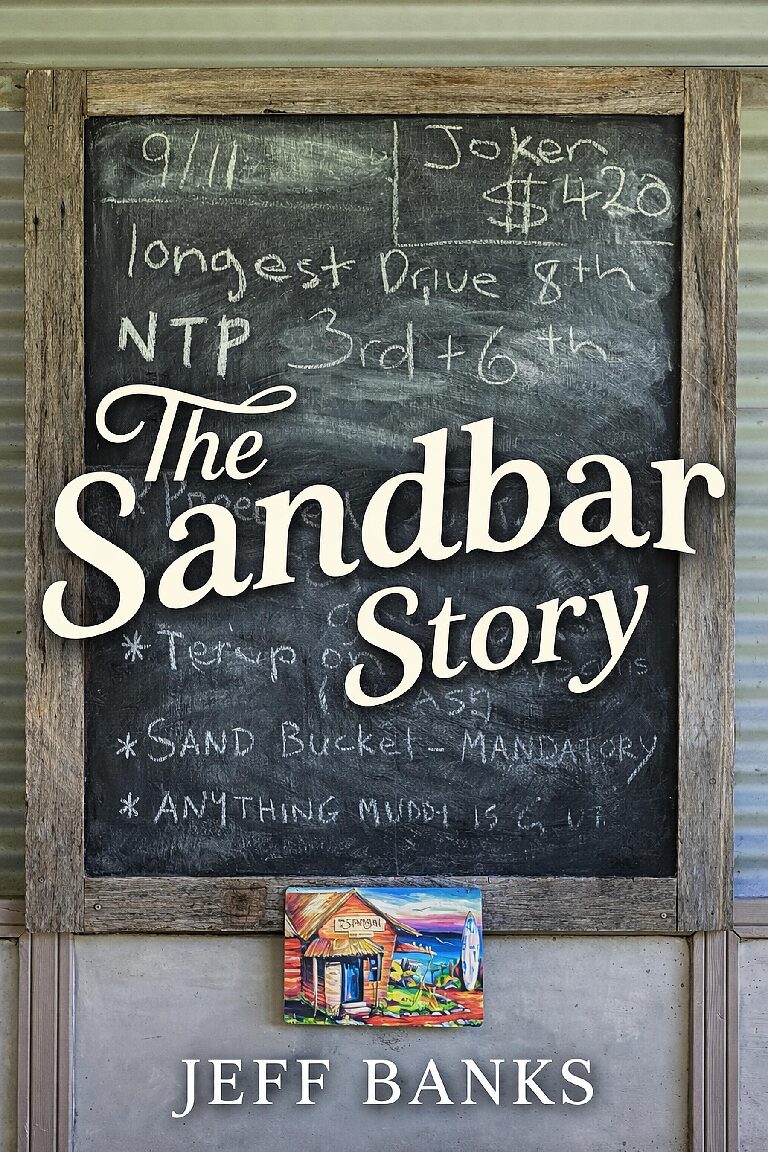
The Sandbar Story - Chapter 1 - Community Asset or Business Venture

The Sandbar Story - Chapter 1 - Community Asset or Business Venture | Travelling Around Australia with Jeff Banks

Because the Sandbar Golf Course had never been just a golf course. It was a place where business and community quietly overlapped. Where private ownership existed alongside public expectation.

THE SANDBAR STORY


Chapter 1 – Community Asset or Business Venture


There are places that clearly belong to someone.


The title deed is obvious. The business model is clear. The lines between owner, customer and visitor are defined. If you walk onto the premises, you understand the arrangement. Someone owns it, someone manages it, someone pays to use it. The transaction is visible.


And then there are places like Sandbar.


Places that sit somewhere between ownership and belonging. Between private enterprise and public expectation. Places that feel communal even though they never were.


Sandbar sits on the edge of a stretch of coastline that has always carried an almost deceptive sense of calm about it. To the casual visitor arriving for the first time, the area presents itself as one of those quietly idyllic corners of the New South Wales coast, the kind of place that feels removed from the rush of the world beyond it. The Pacific Ocean lies just beyond the dunes, its rhythm constant and indifferent to the small dramas of land ownership and local politics playing out inland. Tall coastal trees frame the horizon, their branches bending slightly with the onshore breeze that seems to arrive most afternoons as predictably as the tide.


The beach itself, Celito Beach, carries a name that most visitors assume must have some ancient coastal origin. It sounds lyrical, almost Mediterranean, as though it had been lifted from a map of some distant European shoreline. In truth, like many names along the Australian coast, its origins are far more grounded in the simple act of people deciding that something needed a name.


And once a place is named, it begins to exist in a different way.


Celito Beach became the reference point for everything around it. Holidaymakers spoke about walking down to Celito. Fishermen referred to their favourite gutter “just south of Celito.” Real estate agents used the name to evoke images of unspoiled coastline and quiet seaside living. The name attached itself not just to the beach but to the surrounding landscape. The caravan parks, the access tracks, the open spaces between them — they all became part of the same loosely defined area. And eventually the name Sandbar itself began to carry similar weight.


But geography has its own quiet irony. Because the stretch of land that leads from the caravan parks to Celito Beach is not public land in the way most people assume. The area surrounding the golf course, the caravan parks, and the access routes that weave through them sits within privately owned property. The land belongs to a corporate entity whose interests extend far beyond this quiet coastal pocket.


Yet despite that ownership, the path to the beach has always remained open.


Visitors arrive at the caravan parks with surfboards strapped to car roofs. Families wander down the sandy tracks carrying towels and picnic baskets. Local residents park their cars along the road and follow the familiar route towards the ocean. And eventually they reach the boardwalk.


At some point, recognising both the popularity of the beach and the practical challenges of accessing it across fragile dune systems, the local council installed a timber boardwalk leading out toward the sand. It is one of those pieces of infrastructure that quietly blends into the environment, functional, unobtrusive, and immediately accepted as part of the natural landscape.


The boardwalk begins just beside the golf course.


From there it winds its way gently across the dunes, lifting visitors above the sensitive vegetation that holds the coastal sand in place. The timber planks creak slightly underfoot in that familiar way all seaside boardwalks seem to share. The air carries the scent of salt and warm sand. And as you move further along, the ocean slowly reveals itself between the grasses.


For many people walking that path, the transition feels seamless. Car park. Caravan park. Golf course. Boardwalk. Beach.


The boundaries blur.


Most visitors would struggle to explain where one piece of land ownership ends and another begins. And in many ways, they never need to know. The path works. The beach is accessible. The landscape feels open and welcoming. But that sense of openness hides a more complicated reality.


Because the journey to Celito Beach, the walk that hundreds, perhaps thousands of people take each year, begins on privately owned land. It crosses property that, in strict legal terms, belongs to someone else entirely.


Yet over time, the simple act of walking that path has reinforced a powerful idea.


That this place belongs to everyone.


The golf course sits quietly beside that boardwalk. On some days, the fairways are dotted with local players moving slowly from hole to hole. On others, holidaymakers from the caravan parks wander across the grass carrying borrowed clubs for a casual round. And just beyond them, a steady stream of beachgoers passes along the timber walkway, barely noticing the subtle line that separates recreational spaces from private property.


It is easy to see how the illusion formed.


A golf course built by locals. A beach accessed by the public. A council boardwalk bridging the dunes. Two caravan parks welcoming visitors year-round.


From a distance, the entire landscape feels like a shared community space. And that feeling is reinforced by the scenery itself.


There is something disarming about Celito Beach. Unlike many heavily developed coastal areas, the horizon remains uncluttered. There are no towering apartment blocks casting shadows across the sand. No dense commercial strips pressing up against the shoreline. The beach stretches long and wide, the dunes rising gently behind it as though protecting the inland landscape from the ocean’s constant advance.


In the early mornings the light comes across the water in soft layers, turning the sea into a shifting palette of blues and silvers. Surfers move quietly through the shallows searching for the first decent set of the day. Fishermen stand waist-deep in the surf casting into the deeper gutters.


By late afternoon the colours shift again. The sun drops behind the coastal trees inland, and the light across the dunes turns warm and amber. Shadows stretch across the golf course fairways. The ocean continues its endless rhythm just beyond the vegetation line.


It is, by almost any standard, an idyllic setting. And idyllic places have a curious effect on human perception.


They encourage people to feel ownership. Not legal ownership, but emotional ownership.


People who walk the boardwalk for the first time often speak about discovering Celito Beach as though they have stumbled upon a hidden treasure. Locals talk about the area with the quiet pride of people who believe they are custodians of something special. And somewhere in that mixture of beauty, accessibility and shared experience, the line between public and private begins to fade.


The golf course, sitting quietly beside the boardwalk, becomes part of that same mental landscape.


Visitors see open green fairways framed by coastal trees. They see golfers moving slowly across the grass. They see what appears to be a community recreational space.


What they do not see, at least not immediately, is the legal framework sitting quietly beneath it all. Privately owned land. Commercial caravan park operations. Business considerations that sit far removed from the romantic image of a coastal community asset. And yet, because the place feels so open, so accessible, so intertwined with the daily rhythms of local life, the assumption slowly settles in.


This must belong to the community.


That assumption would eventually become one of the defining tensions of the Sandbar story. Because while the scenery encourages a sense of shared ownership… The title deeds have always said something very different.


And it is in that quiet gap between perception and reality, between the idyllic setting of Celito Beach and the legal structure that surrounds it, that the deeper story of Sandbar Golf Club truly begins to take shape.


The Sandbar Golf Course sits on a strip of land that, at first glance, might not seem an obvious site for a golf course at all. It lies as a part of two caravan parks, Sandbar Caravan Park and Bushland Caravan Park, tucked into a stretch of low-lying ground that has never quite escaped the reputation of being flood-affected land. When the rains settle in, the ground reminds everyone who visits that it was never meant to be anything permanent.


But permanence is a funny concept in regional communities. If something lasts long enough, if people gather around it often enough, if memories accumulate over the decades, it begins to feel permanent regardless of what the soil underneath might say.


Almost fifty years ago, locals built what would become the Sandbar Golf Course.


That fact alone is important, because it shaped everything that followed.


The course was not designed by a major golf architect. It was not part of a national resort chain. There were no glossy brochures or development proposals prepared by consultants explaining projected visitor numbers or tourism yields.


It was built by people who lived nearby. Men who worked with machinery, tractors and graders. Men who understood land in a practical sense rather than a planning sense. They cleared ground, shaped fairways, moved dirt and coaxed something resembling a golf course out of what had previously been little more than scrub and uneven grass.


And while the fathers were doing the heavy lifting, the next generation was there too.


Old photographs still circulate among members, on the website of the Sandbar Golf Club and in the hearts of those who still remember. Faded prints that have survived in shoeboxes and club archives. Images that show the early construction days, a rough landscape, machinery in the background, men standing with the quiet pride of people building something for the first time. And sometimes, in the foreground of those pictures, there is a child.


A youngster sitting in the dirt with a Tonka truck, pushing miniature piles of sand around while the real earthmoving happens behind him. A child “helping” to build the course while his father and the other men carve fairways into the ground.


Today that child might well be a member of the club. Perhaps even a committee member. Perhaps someone who still tells the story of how he was there when the course was built.


Memory is powerful like that. Over time, memories turn labour into legacy. The story becomes not simply that the land was shaped into a golf course, but that we built this place. That subtle shift in language matters more than people realise.


Because the Sandbar Golf Course was never actually owned by the people who built it.


The land itself belonged, and still belongs, to a much larger private concern. A corporate entity whose interests stretch far beyond this small stretch of recreational land.


The property forms part of holdings connected to the Paspaley empire, a name far better known in other circles for pearls, business interests and a long-established corporate presence.


From a legal standpoint, the arrangement is simple. The land is privately owned. The caravan parks operate as businesses. And the golf course sits within that commercial ecosystem.


But legality and perception rarely travel at the same speed. Because when a group of local men spend months shaping land into fairways and greens… when families gather there year after year… when weekend competitions become part of the rhythm of community life… something else quietly forms.


A sense of ownership. Not legal ownership. But something that feels just as strong.


The Sandbar Golf Course became, in the eyes of many locals, their course. A place built by locals, maintained by locals and played by locals. A community asset. And that perception would slowly grow stronger with every passing decade.


It didn’t happen overnight. It rarely does.


At first the arrangement was simple enough. The course existed within the broader caravan park complex. Holidaymakers staying at Sandbar or Bushland might wander over for a casual round. Locals would drop by for an afternoon hit. It was relaxed, informal and very much a product of its environment.


But the more people played there, the more they began to feel connected to it. Generations passed through. Parents introduced their children to the game on those fairways. Friends gathered for social rounds. Competitions emerged in small, informal ways. The place slowly developed a culture that belonged less to the owners and more to the people who spent time there. And that is where the first seeds of tension quietly began to grow.


Because while the course felt like a community asset… It was still, at its core, a component of a privately owned business operation. The caravan parks existed to generate revenue.


Visitors paid for accommodation. Facilities were provided to enhance the value of the park experience. And the golf course, in its original form, was simply one more attraction within that environment.


For the owners, the logic was straightforward.


For many locals, it was something else entirely. They saw the course as a product of their labour, their community and their history. They had photographs proving it.


They had stories about the early construction days. They had memories stretching back decades. And slowly, over time, those memories hardened into expectation.


The expectation that the course was theirs. Not legally. But culturally. And that is where the distance between owners and locals began to appear.


At first it was barely noticeable. A difference in perspective rather than an outright conflict. The owners saw land, infrastructure and operational costs. The locals saw tradition, community and identity. Both perspectives were valid.


Both perspectives would continue to shape the story. Because what no one fully realised at the time was that the Sandbar Golf Course sat in a very unusual position, one that would eventually demand some form of resolution.


A privately owned recreational facility operating inside a commercial caravan park environment… yet carrying the emotional weight of a community institution.


That tension has begun to simmer quietly for years.


Sometimes invisible. Sometimes bubbling to the surface in small disagreements about maintenance, access or expectations. But always present. Always sitting just beneath the surface of every conversation about the course. And it is from this tension, this subtle but persistent divide between community asset and business venture, that the real story of Sandbar Golf Club begins.


At first, none of these philosophical questions about ownership or structure were spoken aloud. No one sat around a table debating governance models or constitutional frameworks. The place simply evolved in the way small communities often do, quietly, practically, and with a certain amount of improvisation.


One of the earliest examples of this could be seen in what would eventually become the normal Wednesday competition.


It didn’t begin as a “competition” in the formal sense. There were no official scorecards registered with a governing body, no handicap system recognised by a national golf authority, and certainly no club committee organising the event. What existed instead was a simple idea from the local management of the caravan park: if enough golfers happened to turn up on the same day each week, perhaps something could be organised to make the round a little more interesting.


And so Wednesday gradually became that day. A sense that the Park was part of the Community


The process was almost charmingly simple. Players would arrive at the course and pay their green fee as they normally would. Word had spread that Wednesday was the day people tended to gather, so locals and visitors alike began timing their games accordingly. By mid-morning there might be half a dozen players around the first tee. By late morning the number might double.


The management, seeing the opportunity for a bit of community engagement, and no doubt a bit of additional green fee revenue, began to encourage the gathering.


A few cold beverages might appear on an esky. The casual chatter around the rustic “Club House” would include the quiet suggestion that there might be enough players to make a small competition worthwhile. Park management would collect the few dollars from each participant to create a modest prize pool.


Nothing complicated. Nothing formal. Just a handful of golfers agreeing to play against one another for the bragging rights of the day.


By the end of the round the scores would be tallied, usually on whatever scrap of paper happened to be available. The winner might receive the accumulated prize pool, or perhaps a voucher for drinks. There was laughter, a bit of storytelling about missed putts and lucky bounces, and the quiet satisfaction of having shared a morning on the course.


Then everyone would go home.


What is important about that early Wednesday gathering is not the structure of the competition, because there really wasn’t much structure at all, but the role it played in shaping how people thought about the place.


For the golfers who turned up each week, it began to feel like a club day. There were familiar faces. Regular playing partners. The sense that Wednesday had become “their” time on the course.


But behind the scenes, everything about the event remained internal to the caravan park operation. The management arranged the logistics. The green fees were collected through the business. The prize pool was organised informally by the staff.


There was no separate entity overseeing the activity, no membership base, no constitution, no formal governance. It was simply a clever piece of community engagement run by the people who managed the land.


From a business perspective, it made perfect sense. Encourage locals to return regularly. Create a social atmosphere. Sell a few extra drinks.


Maintain goodwill between the caravan park and the surrounding community. It was good business. But for the players themselves, the experience began to create a different impression entirely.


They weren’t thinking about commercial engagement strategies or customer retention models. What they experienced was something much simpler.


They had a weekly competition. And once people begin to feel they are part of something regular, something shared, the language begins to change.


“I’m playing Wednesday.” to “The Wednesday comp.” “See you at the club.”


That last phrase is perhaps the most telling of all. Because at that point, there still wasn’t a club. There was only a privately owned golf course sitting beside two caravan parks, with the management quietly facilitating a weekly gathering of players.


Yet the experience felt like club golf.


The distinction between those two realities was subtle, but important. To the owners, the Wednesday competition was simply an initiative, a way to bring people together and create a lively atmosphere around the course. To the players, it was the beginning of something more communal. Something that looked suspiciously like a golf club. And like many things at Sandbar, the arrangement worked perfectly well for quite a long time precisely because no one stopped to analyse it too closely.


Everyone benefited. The caravan park built goodwill within the local community. The golfers enjoyed regular competition. Visitors staying at the park occasionally joined in, adding new faces to the group.


It was relaxed, uncomplicated and distinctly coastal in its informality. But beneath that simplicity sat the same quiet tension that had existed since the course was first carved from the flood-affected ground.


The players experienced the course as a shared community space. The owners operated it as part of a business. The Wednesday competition existed somewhere between those two perspectives. And without anyone quite realising it, the foundations were slowly being laid for a larger question. Because once golfers begin to gather regularly… once competitions begin to form… once stories, rivalries and traditions begin to accumulate…


The idea of a club is never very far behind.


At Sandbar, that idea would take time to emerge. But the seeds were already there. They had been planted decades earlier when locals helped shape the original fairways. They had grown stronger each Wednesday morning as golfers gathered for their informal competition. And they would eventually develop into something far more structured than anyone had originally imagined.


Because the Sandbar Golf Course had never been just a golf course. It was a place where business and community quietly overlapped. Where private ownership existed alongside public expectation.


Where something created within a commercial environment slowly began to feel like it belonged to everyone.


Understanding that delicate balance, and the misunderstandings it would eventually produce, is the only way to understand the story that follows. Because from that simple Wednesday gathering, the idea of a golf club was already beginning to take shape.

Author

Menu